Science Explorer Back to mapMap
Discussion
University · São Paulo · Brazil

Faculdades Oswaldo Cruz

In research, Faculdades Oswaldo Cruz stands highest in Health Sciences (#7,000 of 9,902 worldwide) and Social Sciences (#7,407 of 9,585 worldwide), 2022-now.

World rank, 2022-now
#9,588
of 22,385 · #7,264 all time
Rank in Brazil
#379
of 684
Research works
1.3k
▼ 28% vs 2018-21
Citations
9.4k
7.1 per fractional work
Top-10% rate
7.1%
all institutions 10.0%
vs its own fields
0.91×
1.00× is exactly expected
Open access
77%
world 40%
International
17%
world 18%

What is Faculdades Oswaldo Cruz known for in research?

The fields where it stands highest, 2022-now, ranked among every institution above the floor in each field.

FieldWorld rankWhere that sitsTop-10% rateWorksAll time
Health SciencesDomain #7,000 of 9,902 5.5%76 #7635
Social SciencesDomain #7,407 of 9,585 9.5%75 #5651

Each strip is that field's whole ranked pool, with the notch where Faculdades Oswaldo Cruz sits in it, in the colour of the band that rank falls in. The track under the rate is the rate itself: it carries no average mark, because the average differs by field (from about 6% in Dentistry to 21% in Economics).

Which fields of science does Faculdades Oswaldo Cruz work in?

In 2022-now, 38% of research at Faculdades Oswaldo Cruz is in Health Sciences, 33% in Social Sciences. Its largest fields are Medicine (27%), Social Sciences (22%), Health Professions (9%). It does 1.6× the world's share of Health Sciences.

Health Sciences: 98 fractional works · 37.8% of its workMedicine: 70 fractional works · 27.0% of its workPublic Health, Environmental and Occupational Health: 19 fractional works · 7.2% of its workEpidemiology: 9 fractional works · 3.6% of its workInfectious Diseases: 8 fractional works · 3.1% of its workSurgery: 4 fractional works · 1.7% of its workPhysiology: 3 fractional works · 1.0% of its workPulmonary and Respiratory Medicine: 3 fractional works · 1.0% of its workComplementary and alternative medicine: 2 fractional works · 0.8% of its workRheumatology: 2 fractional works · 0.8% of its workCardiology and Cardiovascular Medicine: 2 fractional works · 0.7% of its workOncology: 2 fractional works · 0.7% of its workPsychiatry and Mental health: 2 fractional works · 0.6% of its workPediatrics, Perinatology and Child Health: 1 fractional works · 0.6% of its workObstetrics and Gynecology: 1 fractional works · 0.5% of its workHepatology: 1 fractional works · 0.4% of its workPharmacology: 1 fractional works · 0.4% of its workNeurology: 1 fractional works · 0.4% of its workEmergency Medicine: 1 fractional works · 0.4% of its workHematology: 1 fractional works · 0.3% of its workRadiology, Nuclear Medicine and Imaging: 1 fractional works · 0.3% of its workOrthopedics and Sports Medicine: 1 fractional works · 0.2% of its workPathology and Forensic Medicine: 1 fractional works · 0.2% of its workBiochemistry: 1 fractional works · 0.2% of its workGenetics: 1 fractional works · 0.2% of its workSmaller subfields together: 4 fractional works · 1.6% of its workHealth Professions: 24 fractional works · 9.3% of its workGeneral Health Professions: 14 fractional works · 5.5% of its workHealth Information Management: 3 fractional works · 1.2% of its workOccupational Therapy: 2 fractional works · 0.8% of its workSpeech and Hearing: 2 fractional works · 0.7% of its workEmergency Medical Services: 1 fractional works · 0.4% of its workPharmacy: 1 fractional works · 0.2% of its workSmaller subfields together: 1 fractional works · 0.3% of its workNursing: 2 fractional works · 0.8% of its workNutrition and Dietetics: 2 fractional works · 0.8% of its workDentistry: 1 fractional works · 0.5% of its workOral Surgery: 1 fractional works · 0.3% of its workSmaller subfields together: 1 fractional works · 0.3% of its workVeterinary: 1 fractional works · 0.2% of its workSmall Animals: 1 fractional works · 0.2% of its workSocial Sciences: 84 fractional works · 32.6% of its workSocial Sciences: 56 fractional works · 21.9% of its workEducation: 17 fractional works · 6.6% of its workSociology and Political Science: 15 fractional works · 5.9% of its workDemography: 5 fractional works · 1.8% of its workAnthropology: 3 fractional works · 1.3% of its workHealth: 3 fractional works · 1.1% of its workPolitical Science and International Relations: 3 fractional works · 1.0% of its workUrban Studies: 2 fractional works · 0.9% of its workLaw: 2 fractional works · 0.8% of its workDevelopment: 2 fractional works · 0.6% of its workGender Studies: 1 fractional works · 0.5% of its workCultural Studies: 1 fractional works · 0.4% of its workCommunication: 1 fractional works · 0.3% of its workSmaller subfields together: 1 fractional works · 0.5% of its workArts and Humanities: 11 fractional works · 4.1% of its workHistory: 3 fractional works · 1.1% of its workArcheology: 2 fractional works · 0.8% of its workLiterature and Literary Theory: 1 fractional works · 0.5% of its workPhilosophy: 1 fractional works · 0.5% of its workHistory and Philosophy of Science: 1 fractional works · 0.3% of its workVisual Arts and Performing Arts: 1 fractional works · 0.3% of its workSmaller subfields together: 1 fractional works · 0.5% of its workPsychology: 8 fractional works · 3.1% of its workClinical Psychology: 3 fractional works · 1.3% of its workSocial Psychology: 2 fractional works · 0.8% of its workDevelopmental and Educational Psychology: 1 fractional works · 0.6% of its workExperimental and Cognitive Psychology: 1 fractional works · 0.4% of its workBusiness, Management and Accounting: 4 fractional works · 1.4% of its workManagement of Technology and Innovation: 1 fractional works · 0.5% of its workStrategy and Management: 1 fractional works · 0.4% of its workManagement Information Systems: 1 fractional works · 0.2% of its workSmaller subfields together: 1 fractional works · 0.4% of its workDecision Sciences: 3 fractional works · 1.1% of its workInformation Systems and Management: 2 fractional works · 0.9% of its workSmaller subfields together: 0 fractional works · 0.2% of its workEconomics, Econometrics and Finance: 3 fractional works · 1.0% of its workEconomics and Econometrics: 2 fractional works · 0.7% of its workFinance: 1 fractional works · 0.3% of its workSmaller subfields together: 0 fractional works · 0.1% of its workPhysical Sciences: 39 fractional works · 15.2% of its workEnvironmental Science: 18 fractional works · 7.1% of its workManagement, Monitoring, Policy and Law: 8 fractional works · 3.0% of its workHealth, Toxicology and Mutagenesis: 4 fractional works · 1.5% of its workEcology: 2 fractional works · 0.9% of its workPollution: 1 fractional works · 0.4% of its workIndustrial and Manufacturing Engineering: 1 fractional works · 0.3% of its workWater Science and Technology: 1 fractional works · 0.3% of its workNature and Landscape Conservation: 1 fractional works · 0.2% of its workEnvironmental Chemistry: 1 fractional works · 0.2% of its workSmaller subfields together: 1 fractional works · 0.2% of its workComputer Science: 7 fractional works · 2.9% of its workInformation Systems: 5 fractional works · 2.1% of its workComputer Vision and Pattern Recognition: 1 fractional works · 0.4% of its workSmaller subfields together: 1 fractional works · 0.5% of its workEngineering: 6 fractional works · 2.3% of its workBiomedical Engineering: 3 fractional works · 1.1% of its workMedia Technology: 1 fractional works · 0.2% of its workBuilding and Construction: 1 fractional works · 0.2% of its workCivil and Structural Engineering: 1 fractional works · 0.2% of its workElectrical and Electronic Engineering: 1 fractional works · 0.2% of its workSmaller subfields together: 1 fractional works · 0.3% of its workChemistry: 3 fractional works · 1.1% of its workOrganic Chemistry: 2 fractional works · 0.8% of its workSmaller subfields together: 1 fractional works · 0.4% of its workMaterials Science: 2 fractional works · 0.6% of its workBiomaterials: 1 fractional works · 0.3% of its workSmaller subfields together: 1 fractional works · 0.3% of its workMathematics: 1 fractional works · 0.5% of its workModeling and Simulation: 1 fractional works · 0.5% of its workEarth and Planetary Sciences: 1 fractional works · 0.3% of its workEnergy: 1 fractional works · 0.3% of its workRenewable Energy, Sustainability and the Environment: 1 fractional works · 0.3% of its workPhysics and Astronomy: 0 fractional works · 0.1% of its workChemical Engineering: 0 fractional works · 0.0% of its workLife Sciences: 37 fractional works · 14.3% of its workBiochemistry, Genetics and Molecular Biology: 14 fractional works · 5.3% of its workMolecular Biology: 7 fractional works · 2.9% of its workGenetics: 2 fractional works · 1.0% of its workMolecular Medicine: 1 fractional works · 0.3% of its workEndocrinology: 1 fractional works · 0.3% of its workBiotechnology: 1 fractional works · 0.2% of its workCancer Research: 1 fractional works · 0.2% of its workSmaller subfields together: 1 fractional works · 0.4% of its workAgricultural and Biological Sciences: 13 fractional works · 5.0% of its workPlant Science: 4 fractional works · 1.5% of its workFood Science: 2 fractional works · 0.8% of its workInsect Science: 2 fractional works · 0.7% of its workEcology, Evolution, Behavior and Systematics: 2 fractional works · 0.6% of its workForestry: 1 fractional works · 0.5% of its workAnimal Science and Zoology: 1 fractional works · 0.5% of its workSmaller subfields together: 1 fractional works · 0.3% of its workImmunology and Microbiology: 8 fractional works · 2.9% of its workParasitology: 3 fractional works · 1.3% of its workImmunology: 3 fractional works · 1.1% of its workMicrobiology: 1 fractional works · 0.3% of its workVirology: 1 fractional works · 0.2% of its workPharmacology, Toxicology and Pharmaceutics: 1 fractional works · 0.6% of its workPharmacology: 1 fractional works · 0.3% of its workToxicology: 1 fractional works · 0.2% of its workSmaller subfields together: 0 fractional works · 0.1% of its workNeuroscience: 1 fractional works · 0.5% of its workALL ITS WORKFaculdadesOswaldo Cruz258fractional works, 2022-now
Life Sciences14%Physical Sciences15%Health Sciences38%Social Sciences33%

Each ring splits the one inside it: the four domains of science, their fields, their subfields. Size is fractional works in 2022-now. Every slice is a page; the interactive view zooms down to single topics and colours each by how much more of it this institution does than the world.

Its 4 domains and 26 fields, with their numbers
    1. Medicine7027.0%
    2. Health Professions249.3%
    3. Nursing20.8%
    4. Dentistry10.5%
    5. Veterinary10.2%
    1. Social Sciences5621.9%
    2. Arts and Humanities114.1%
    3. Psychology83.1%
    4. Business, Management and Accounting41.4%
    5. Decision Sciences31.1%
    6. Economics, Econometrics and Finance31.0%
    1. Environmental Science187.1%
    2. Computer Science72.9%
    3. Engineering62.3%
    4. Chemistry31.1%
    5. Materials Science20.6%
    6. Mathematics10.5%
    7. Earth and Planetary Sciences10.3%
    8. Energy10.3%
    9. Physics and Astronomy00.1%
    10. Chemical Engineering00.0%
    1. Biochemistry, Genetics and Molecular Biology145.3%
    2. Agricultural and Biological Sciences135.0%
    3. Immunology and Microbiology82.9%
    4. Pharmacology, Toxicology and Pharmaceutics10.6%
    5. Neuroscience10.5%
All of science, and how each field's share has moved since 1950: the Science domain explorer

Field profile

Location quotient across every field it publishes in: outside the ring is more than an institution of this size would be expected to publish, inside it is less.

Agricultural and Biological Sciences: 1.06× its world share, 13 worksAgricultural and Bio…Biochemistry, Genetics and Molecular Biology: 0.99× its world share, 14 worksBiochemistry, Geneti…Immunology and Microbiology: 2.93× its world share, 8 worksImmunology and Micro…Neuroscience: 0.33× its world share, 1 worksNeurosciencePharmacology, Toxicology and Pharmaceutics: 1.64× its world share, 2 worksPharmacology, Toxico…Chemical Engineering: 0.12× its world share, 0 worksChemical EngineeringChemistry: 0.72× its world share, 3 worksChemistryComputer Science: 0.37× its world share, 8 worksComputer ScienceEarth and Planetary Sciences: 0.17× its world share, 1 worksEarth and Planetary …Energy: 0.29× its world share, 1 worksEnergyEngineering: 0.16× its world share, 6 worksEngineeringEnvironmental Science: 1.42× its world share, 18 worksEnvironmental ScienceMaterials Science: 0.17× its world share, 2 worksMaterials ScienceMathematics: 0.43× its world share, 1 worksMathematicsPhysics and Astronomy: 0.04× its world share, 0 worksPhysics and AstronomyDentistry: 1.10× its world share, 1 worksDentistryHealth Professions: 3.53× its world share, 24 worksHealth ProfessionsMedicine: 1.40× its world share, 70 worksMedicineNursing: 1.65× its world share, 2 worksNursingVeterinary: 1.78× its world share, 1 worksVeterinaryArts and Humanities: 1.44× its world share, 11 worksArts and HumanitiesBusiness, Management and Accounting: 0.44× its world share, 4 worksBusiness, Management…Decision Sciences: 1.12× its world share, 3 worksDecision SciencesEconomics, Econometrics and Finance: 0.48× its world share, 3 worksEconomics, Econometr…Psychology: 1.01× its world share, 8 worksPsychologySocial Sciences: 1.73× its world share, 56 worksSocial Sciences1×world share
more than its size predictsabout as predictedless

Rings at 0.5×, 1× and 2×. Widest outward: Health Professions, 3.5×. Every wedge is a field page.

All 26 fields, with their numbers
  1. Health Professions3.53×24 works
  2. Immunology and Microbiology2.93×8 works
  3. Veterinary1.78×1 works
  4. Social Sciences1.73×56 works
  5. Nursing1.65×2 works
  6. Pharmacology, Toxicology and Pharmaceutics1.64×2 works
  7. Arts and Humanities1.44×11 works
  8. Environmental Science1.42×18 works
  9. Medicine1.40×70 works
  10. Decision Sciences1.12×3 works
  11. Dentistry1.10×1 works
  12. Agricultural and Biological Sciences1.06×13 works
  13. Psychology1.01×8 works
  14. Biochemistry, Genetics and Molecular Biology0.99×14 works
  15. Chemistry0.72×3 works
  16. Economics, Econometrics and Finance0.48×3 works
  17. Business, Management and Accounting0.44×4 works
  18. Mathematics0.43×1 works
  19. Computer Science0.37×8 works
  20. Neuroscience0.33×1 works
  21. Energy0.29×1 works
  22. Earth and Planetary Sciences0.17×1 works
  23. Materials Science0.17×2 works
  24. Engineering0.16×6 works
  25. Chemical Engineering0.12×0 works
  26. Physics and Astronomy0.04×0 works

Who are the top researchers at Faculdades Oswaldo Cruz?

Ranked on the quality score, Henrique de Beaurepaire Aragão, Sergio Goes de Paula and Glauber Túlio Fonseca Coelho lead among researchers whose main affiliation is Faculdades Oswaldo Cruz.

  1. 1 Henrique de Beaurepaire Aragão Brazil · #1,952,511 worldwide 776 citations · 82 works
  2. 2 Sergio Goes de Paula Brazil · #3,451,072 worldwide 81 citations · 34 works
  3. 3 Glauber Túlio Fonseca Coelho Brazil · #3,966,938 worldwide 6 citations · 20 works
  4. 4 Os Editores Brazil · #4,175,255 worldwide 1 citations · 20 works
  5. 5 Aurélio Hess Brazil · #4,349,661 worldwide 54 citations · 15 works
  6. 6 Osnei Francisco Alves Brazil · #4,605,155 worldwide 1 citations · 16 works
  7. 7 Francisca Elidivânia de Farias Camboim Brazil · #4,817,702 worldwide 51 citations · 29 works
  8. 8 Débora Ribeiro Vieira Brazil · #4,855,356 worldwide 14 citations · 16 works
  9. 9 Charlene de Oliveira Pereira Brazil · #4,865,378 worldwide 57 citations · 25 works
  10. 10 José Cleston Alves Camboim Brazil · #4,913,194 worldwide 43 citations · 18 works
All ranked researchers at Faculdades Oswaldo Cruz

What are the most cited papers from Faculdades Oswaldo Cruz?

The most cited paper from Faculdades Oswaldo Cruz is "Mycobacterium tuberculosis lineage 4 comprises globally distributed and geographically restricted sublineages" (David Stucki et al., 2016), with 494 citations. Next come "Social determinants of health, universal health coverage, and sustainable development: case studies from Latin American countries" (351) and "ECLAMC: The Latin-American Collaborative Study of Congenital Malformations" (328).

Most cited papers
#PaperReleasedCitations
1 Mycobacterium tuberculosis lineage 4 comprises globally distributed and geographically restricted sublineages David Stucki et al. · Nature Genetics Open access 31 Oct 2016 494
2 Social determinants of health, universal health coverage, and sustainable development: case studies from Latin American countries Luiz Odorico Monteiro de Andrade, Alberto Pellegrini Filho, Orielle Solar et al. · The Lancet 15 Oct 2014 351
3 ECLAMC: The Latin-American Collaborative Study of Congenital Malformations Eduardo Enrique Castilla, Ieda Maria Orioli · Public Health Genomics 2004 328
4 Strategies for the implementation of clinical practice guidelines in public health: an overview of systematic reviews Viviane Cássia Pereira, Sarah Nascimento Silva, Viviane Karoline da Silva Carvalho et al. · Health Research Policy and Systems ReviewOpen access 24 Jan 2022 314
5 The use of ITS1 rDNA PCR in detecting pathogenic African trypanosomes Zablon Kithinji Njiru, C.C. Constantine, Samuel Onyoyo Guya et al. · Parasitology Research 23 Dec 2004 301
All 60 most cited papers, with filters and sorting

Which keywords describe research at Faculdades Oswaldo Cruz?

By fractional works in 2022-now, weighted toward what it does more of than the world: Epidemiology, Public Health, Public Policy, Healthcare Access, Vaccine Development, Drug Resistance, Quality of Life and Health Policy.

▲ more of its work than of the world's◆ about the world's share▼ less than the world's

Size is fractional works in 2022-now in the topics tagged with each word; colour is the word's share of this institution's work against its share of the world's. The 40 words are chosen for being large and distinctive. Each links to the topic it comes from most.

All 40 words, with their numbers
  1. Epidemiology37▲ 3.6×67 topics
  2. Public Health27▲ 7.1×35 topics
  3. Quality of Life14▲ 3.9×22 topics
  4. Public Policy13▲ 10×12 topics
  5. Healthcare Access12▲ 17×5 topics
  6. Sustainability11▲ 1.81×17 topics
  7. Vaccine Development11▲ 17×8 topics
  8. Drug Resistance11▲ 14×6 topics
  9. Treatment10▲ 3.3×19 topics
  10. Health Policy10▲ 25×3 topics
  11. Educational Technology10▲ 3.2×8 topics
  12. Teacher Training10▲ 6.2×6 topics
  13. Sustainable Development10▲ 2.4×12 topics
  14. Healthcare9▲ 3.0×14 topics
  15. Biodiversity9▲ 4.5×10 topics
  16. Diagnosis9▲ 3.6×21 topics
  17. Vector Control9▲ 29×4 topics
  18. COVID-198▲ 2.5×18 topics
  19. Social Determinants8▲ 15×5 topics
  20. Pandemic8▲ 3.1×9 topics
  21. Primary Care8▲ 8.1×6 topics
  22. Qualitative Research8▲ 3.5×7 topics
  23. Waste Management7▲ 7.1×5 topics
  24. Chronic Diseases7▲ 10×6 topics
  25. Curriculum Development7▲ 3.8×4 topics
  26. Environmental Education6▲ 16×3 topics
  27. Aging Population6▲ 28×3 topics
  28. Social Determinants of Health6▲ 11×3 topics
  29. Brazilian Health System6▲ 56×1 topic
  30. Community-Based Care6▲ 56×1 topic
  31. Eco-friendly Practices6▲ 40×2 topics
  32. Social Inequality6▲ 8.6×4 topics
  33. Health6▲ 5.7×9 topics
  34. Social Participation6▲ 38×1 topic
  35. Water Resources6▲ 9.2×1 topic
  36. Immunity5▲ 5.2×7 topics
  37. Genome Sequence5▲ 23×2 topics
  38. Arboviral Diseases5▲ 29×1 topic
  39. Zika Virus5▲ 29×1 topic
  40. Science Education5▲ 29×3 topics

Which research topics does Faculdades Oswaldo Cruz publish most on?

By volume in 2022-now: Health, Nursing, Elderly Care, Environmental Sustainability and Education, Mosquito-borne diseases and control and Science and Education Research.

  1. 1 Health, Nursing, Elderly Care General Health Professions 6 works
  2. 2 Environmental Sustainability and Education Management, Monitoring, Policy and Law 6 works
  3. 3 Mosquito-borne diseases and control Public Health, Environmental and Occupational Health 5 works
  4. 4 Science and Education Research Education 4 works
  5. 5 Research on Leishmaniasis Studies Public Health, Environmental and Occupational Health 4 works
  6. 6 Healthcare during COVID-19 Pandemic Information Systems 4 works
  7. 7 Trypanosoma species research and implications Epidemiology 3 works
  8. 8 Public Health in Brazil Sociology and Political Science 3 works
  9. 9 Maternal and Neonatal Healthcare General Health Professions 3 works
  10. 10 Youth, Drugs, and Violence Demography 3 works

How open and international is its research?

Against the world's own shares: the tick on each track. Both are shares of its output, so they sit on one scale and can be read against each other as well as against the world.

openly available77.4%not open22.6%

World: 40% of research is openly available.

with international co-authors17.0%domestic only83.0%

World: 18% is written across borders.

How has Faculdades Oswaldo Cruz's research output changed?

Output in 2022-2025 was 28% lower than in 2018-2021.

still counting1990200020102020
grewheldshrank

The same series as a ribbon: one cell per year, darker for more. The line above answers how much; this answers when.

Its share of all research

Growing output can still be a shrinking share: all of science grows. This is Faculdades Oswaldo Cruz as a percentage of every work published that year, 0.00086% in 2024.

still counting0.0020%0.0040%Faculdades Oswaldo Cruz0.00088% in 202519801990200020102020

Fractional works of Faculdades Oswaldo Cruz over all fractional works that year. How the balance of science has shifted.

How much of it reaches the world top 10%

Year by year, against all institutions in the same year.

still counting10%20%all institutions10.0% in 2025Faculdades Oswaldo Cruz6.5% in 2025200020102020

Of each year's output, the share that reached the world's 10% most cited for its field and year. Peak 15.6% in 2004.

Other research institutions in São Paulo

All research institutions in São Paulo

Share Faculdades Oswaldo Cruz's ranking
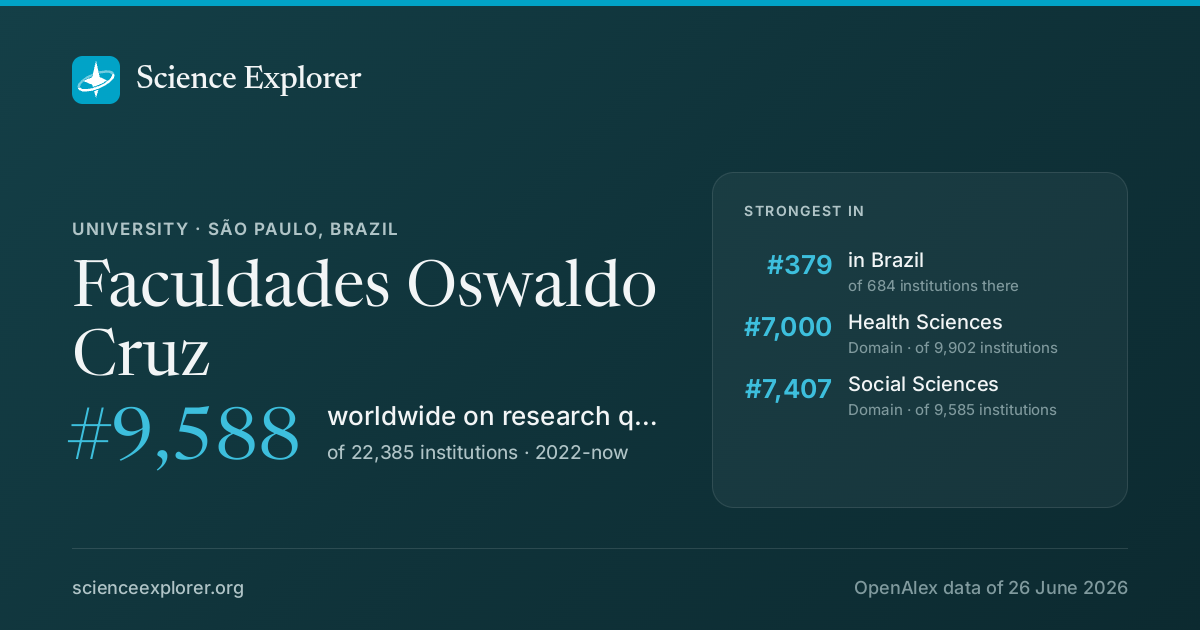
Faculdades Oswaldo Cruz on Science Explorer

A card with Faculdades Oswaldo Cruz's standing and the fields it leads in, for a post or a slide. A link to this page previews as the same card.

Download the card

1200 × 630 PNG, sized for social posts, drawn from the latest snapshot.

Badges for a website1Each links back here and updates with every snapshot

Research measures only: rankings here say nothing about teaching, admissions or student experience. Comparable institutions and collaboration partners have tabs of their own, above.

Discussion

Ask a question or share a note about Faculdades Oswaldo Cruz. Posts are plain text and can be reported.