Science Explorer Back to mapMap
Discussion
World rank, all time
#33,109
of 34,923
Rank in United Kingdom
#1,778
of 1,844
Research works
175
▼ 18% vs 2018-21
Citations
2.6k
14.8 per fractional work
Top-10% rate
11.8%
all institutions 10.0%
vs its own fields
0.87×
1.00× is exactly expected
Open access
45%
world 40%
International
10%
world 18%

Which fields of science does Field Studies Council work in?

In all years, 59% of research at Field Studies Council is in Physical Sciences, 26% in Life Sciences. Its largest fields are Environmental Science (37%), Agricultural and Biological Sciences (19%), Earth and Planetary Sciences (15%). It does 1.6× the world's share of Life Sciences.

Physical Sciences: 103 fractional works · 59.1% of its workEnvironmental Science: 65 fractional works · 37.3% of its workEcology: 19 fractional works · 10.7% of its workPollution: 14 fractional works · 8.0% of its workGlobal and Planetary Change: 10 fractional works · 5.9% of its workNature and Landscape Conservation: 5 fractional works · 2.8% of its workManagement, Monitoring, Policy and Law: 5 fractional works · 2.7% of its workHealth, Toxicology and Mutagenesis: 4 fractional works · 2.1% of its workWater Science and Technology: 4 fractional works · 2.0% of its workEnvironmental Chemistry: 2 fractional works · 1.2% of its workEcological Modeling: 1 fractional works · 0.8% of its workIndustrial and Manufacturing Engineering: 1 fractional works · 0.7% of its workEnvironmental Engineering: 1 fractional works · 0.6% of its workEarth and Planetary Sciences: 27 fractional works · 15.3% of its workOceanography: 20 fractional works · 11.2% of its workEarth-Surface Processes: 2 fractional works · 1.3% of its workGeology: 2 fractional works · 1.3% of its workAtmospheric Science: 2 fractional works · 0.9% of its workPaleontology: 1 fractional works · 0.5% of its workSmaller subfields together: 0 fractional works · 0.1% of its workEngineering: 5 fractional works · 2.6% of its workOcean Engineering: 3 fractional works · 1.9% of its workBiomedical Engineering: 1 fractional works · 0.3% of its workSmaller subfields together: 1 fractional works · 0.5% of its workComputer Science: 3 fractional works · 1.6% of its workInformation Systems: 1 fractional works · 0.7% of its workArtificial Intelligence: 1 fractional works · 0.7% of its workComputer Networks and Communications: 0 fractional works · 0.3% of its workChemistry: 2 fractional works · 0.9% of its workOrganic Chemistry: 1 fractional works · 0.7% of its workSmaller subfields together: 0 fractional works · 0.2% of its workPhysics and Astronomy: 1 fractional works · 0.6% of its workNuclear and High Energy Physics: 1 fractional works · 0.6% of its workEnergy: 1 fractional works · 0.4% of its workRenewable Energy, Sustainability and the Environment: 1 fractional works · 0.4% of its workMaterials Science: 0 fractional works · 0.2% of its workChemical Engineering: 0 fractional works · 0.0% of its workMathematics: 0 fractional works · 0.0% of its workLife Sciences: 45 fractional works · 25.5% of its workAgricultural and Biological Sciences: 33 fractional works · 19.0% of its workInsect Science: 17 fractional works · 9.9% of its workEcology, Evolution, Behavior and Systematics: 9 fractional works · 5.4% of its workPlant Science: 3 fractional works · 1.6% of its workSoil Science: 1 fractional works · 0.5% of its workAgronomy and Crop Science: 1 fractional works · 0.5% of its workAnimal Science and Zoology: 1 fractional works · 0.4% of its workAquatic Science: 1 fractional works · 0.3% of its workGeneral Agricultural and Biological Sciences: 0 fractional works · 0.3% of its workSmaller subfields together: 0 fractional works · 0.2% of its workBiochemistry, Genetics and Molecular Biology: 10 fractional works · 5.9% of its workGenetics: 7 fractional works · 3.8% of its workCancer Research: 1 fractional works · 0.7% of its workCell Biology: 1 fractional works · 0.6% of its workMolecular Biology: 1 fractional works · 0.4% of its workBiochemistry: 1 fractional works · 0.3% of its workSmaller subfields together: 0 fractional works · 0.1% of its workImmunology and Microbiology: 1 fractional works · 0.6% of its workParasitology: 1 fractional works · 0.6% of its workSmaller subfields together: 0 fractional works · 0.0% of its workSocial Sciences: 23 fractional works · 13.3% of its workSocial Sciences: 9 fractional works · 5.0% of its workSociology and Political Science: 4 fractional works · 2.1% of its workLaw: 2 fractional works · 1.1% of its workEducation: 1 fractional works · 0.6% of its workPolitical Science and International Relations: 1 fractional works · 0.5% of its workGeography, Planning and Development: 0 fractional works · 0.2% of its workSmaller subfields together: 1 fractional works · 0.4% of its workArts and Humanities: 4 fractional works · 2.3% of its workArcheology: 2 fractional works · 1.3% of its workHistory: 0 fractional works · 0.3% of its workSmaller subfields together: 1 fractional works · 0.7% of its workBusiness, Management and Accounting: 4 fractional works · 2.3% of its workMarketing: 3 fractional works · 1.9% of its workSmaller subfields together: 1 fractional works · 0.4% of its workEconomics, Econometrics and Finance: 4 fractional works · 2.0% of its workEconomics and Econometrics: 2 fractional works · 1.3% of its workGeneral Economics, Econometrics and Finance: 1 fractional works · 0.6% of its workSmaller subfields together: 0 fractional works · 0.2% of its workPsychology: 3 fractional works · 1.5% of its workSocial Psychology: 1 fractional works · 0.7% of its workClinical Psychology: 0 fractional works · 0.3% of its workGeneral Psychology: 0 fractional works · 0.3% of its workSmaller subfields together: 0 fractional works · 0.1% of its workDecision Sciences: 0 fractional works · 0.3% of its workInformation Systems and Management: 0 fractional works · 0.3% of its workHealth Sciences: 4 fractional works · 2.1% of its workMedicine: 3 fractional works · 1.6% of its workEpidemiology: 1 fractional works · 0.6% of its workInfectious Diseases: 0 fractional works · 0.3% of its workReproductive Medicine: 0 fractional works · 0.3% of its workSmaller subfields together: 1 fractional works · 0.4% of its workVeterinary: 1 fractional works · 0.3% of its workSmall Animals: 1 fractional works · 0.3% of its workHealth Professions: 0 fractional works · 0.2% of its workALL ITS WORKField StudiesCouncil175fractional works, all years
Life Sciences26%Physical Sciences59%Health Sciences2%Social Sciences13%

Each ring splits the one inside it: the four domains of science, their fields, their subfields. Size is fractional works in all years. Every slice is a page; the interactive view zooms down to single topics and colours each by how much more of it this institution does than the world.

Its 4 domains and 22 fields, with their numbers
    1. Environmental Science6537.3%
    2. Earth and Planetary Sciences2715.3%
    3. Engineering52.6%
    4. Computer Science31.6%
    5. Chemistry20.9%
    6. Physics and Astronomy10.6%
    7. Energy10.4%
    8. Materials Science00.2%
    9. Chemical Engineering00.0%
    10. Mathematics00.0%
    1. Agricultural and Biological Sciences3319.0%
    2. Biochemistry, Genetics and Molecular Biology105.9%
    3. Immunology and Microbiology10.6%
    1. Social Sciences95.0%
    2. Arts and Humanities42.3%
    3. Business, Management and Accounting42.3%
    4. Economics, Econometrics and Finance42.0%
    5. Psychology31.5%
    6. Decision Sciences00.3%
    1. Medicine31.6%
    2. Veterinary10.3%
    3. Health Professions00.2%
All of science, and how each field's share has moved since 1950: the Science domain explorer

Field profile

Location quotient across every field it publishes in: outside the ring is more than an institution of this size would be expected to publish, inside it is less.

Agricultural and Biological Sciences: 2.08× its world share, 0 worksAgricultural and Bio…Biochemistry, Genetics and Molecular Biology: 0.63× its world share, 0 worksBiochemistry, Geneti…Immunology and Microbiology: 2.05× its world share, 0 worksImmunology and Micro…Computer Science: 0.88× its world share, 0 worksComputer ScienceEnergy: 16.83× its world share, 0 worksEnergyEngineering: 1.09× its world share, 0 worksEngineeringEnvironmental Science: 3.37× its world share, 0 worksEnvironmental ScienceMedicine: 0.01× its world share, 0 worksMedicineArts and Humanities: 0.40× its world share, 0 worksArts and HumanitiesPsychology: 4.54× its world share, 0 worksPsychologySocial Sciences: 1.11× its world share, 0 worksSocial Sciences1×world share
more than its size predictsabout as predictedless

Rings at 0.5×, 1× and 2×. Widest outward: Energy, 16.8×. Every wedge is a field page.

All 11 fields, with their numbers
  1. Energy16.83×0 works
  2. Psychology4.54×0 works
  3. Environmental Science3.37×0 works
  4. Agricultural and Biological Sciences2.08×0 works
  5. Immunology and Microbiology2.05×0 works
  6. Social Sciences1.11×0 works
  7. Engineering1.09×0 works
  8. Computer Science0.88×0 works
  9. Biochemistry, Genetics and Molecular Biology0.63×0 works
  10. Arts and Humanities0.40×0 works
  11. Medicine0.01×0 works

Who are the top researchers at Field Studies Council?

Ranked on the quality score, Jenifer M. Baker, Brian Dicks and Eric B. Cowell lead among researchers whose main affiliation is Field Studies Council.

  1. 1 Jenifer M. Baker United Kingdom · #3,248,605 worldwide 1.1k citations · 61 works
  2. 2 Brian Dicks United Kingdom · #4,198,156 worldwide 493 citations · 36 works
  3. 3 Eric B. Cowell United Kingdom · #4,392,441 worldwide 220 citations · 17 works
  4. 4 G. A. Hobbs United Kingdom · #4,419,979 worldwide 1.1k citations · 37 works
  5. 5 J. P. Smith United Kingdom · #4,433,826 worldwide 112 citations · 20 works
  6. 6 David I. Little United Kingdom · #4,498,153 worldwide 479 citations · 49 works
  7. 7 John P. Hartley United Kingdom · #5,306,352 worldwide 636 citations · 45 works
All ranked researchers at Field Studies Council

What are the most cited papers from Field Studies Council?

The most cited paper from Field Studies Council is "Detection of initial effects of pollution on marine benthos: an example from the Ekofisk and Eldfisk oilfields, North Sea" (J. S. Gray, KR Clarke, R.M. Warwick et al., 1990), with 416 citations. Next come "Long-term microplastic retention causes reduced body condition in the langoustine, Nephrops norvegicus" (368) and "The effects of oils on plants" (243).

Most cited papers
#PaperReleasedCitations
1 Detection of initial effects of pollution on marine benthos: an example from the Ekofisk and Eldfisk oilfields, North Sea J. S. Gray, KR Clarke, R.M. Warwick et al. · Marine Ecology Progress Series Open access 1990 416
2 Long-term microplastic retention causes reduced body condition in the langoustine, Nephrops norvegicus Natalie Ann Cooper Welden, Phillip R. Cowie · Environmental Pollution 12 Aug 2016 368
3 The effects of oils on plants Jenifer M. Baker · Environmental Pollution (1970) Jul 1970 243
4 The ability of A-level students to name plants Anne Bebbington · Journal of Biological Education Mar 2005 241
5 Degradation of common polymer ropes in a sublittoral marine environment Natalie Ann Cooper Welden, Phillip R. Cowie · Marine Pollution Bulletin 3 Mar 2017 205
All 60 most cited papers, with filters and sorting

Which keywords describe research at Field Studies Council?

By fractional works in all years, weighted toward what it does more of than the world: Climate Change, Environmental Impact, Biogeography, Benthic Communities, Marine Biodiversity, Invasive Species, Remote Sensing and Marine Pollution.

▲ more of its work than of the world's◆ about the world's share▼ less than the world's

Size is fractional works in all years in the topics tagged with each word; colour is the word's share of this institution's work against its share of the world's. The 40 words are chosen for being large and distinctive. Each links to the topic it comes from most.

All 40 words, with their numbers
  1. Climate Change32▲ 7.0×37 topics
  2. Environmental Impact23▲ 9.8×11 topics
  3. Biogeography15▲ 25×11 topics
  4. Benthic Communities15▲ 98×2 topics
  5. Marine Biodiversity15▲ 98×2 topics
  6. Invasive Species14▲ 14×16 topics
  7. Remote Sensing14▲ 7.3×6 topics
  8. Marine Pollution13▲ 360×2 topics
  9. Biodegradation13▲ 70×3 topics
  10. Health Effects13▲ 13×2 topics
  11. Deepwater Horizon13▲ 683×1 topic
  12. Oil Spill Detection13▲ 683×1 topic
  13. Ecosystem Functioning11▲ 31×4 topics
  14. Sustainability11▲ 3.4×14 topics
  15. Coastal Protection10▲ 82×2 topics
  16. Biodiversity10▲ 7.3×14 topics
  17. Conservation8▲ 10×15 topics
  18. Deep-Sea Ecology8▲ 96×1 topic
  19. Estuarine Quality8▲ 96×1 topic
  20. Ocean Acidification8▲ 53×2 topics
  21. Microbiota8▲ 19×4 topics
  22. Fisheries Sustainability7▲ 32×2 topics
  23. Climate Change Impacts7▲ 28×3 topics
  24. Microbial Community7▲ 41×2 topics
  25. Symbiosis7▲ 32×2 topics
  26. Ecosystem Resilience7▲ 26×3 topics
  27. Decomposition6▲ 342×1 topic
  28. Forensic Entomology6▲ 342×1 topic
  29. Kelp Forests6▲ 100×1 topic
  30. Seagrasses6▲ 100×1 topic
  31. Population Dynamics6▲ 12×7 topics
  32. Holocene6▲ 22×3 topics
  33. Phylogeny6▲ 19×10 topics
  34. Genomics6▲ 9.9×3 topics
  35. Trophic Cascades6▲ 29×2 topics
  36. Ecosystem Services6▲ 9.7×4 topics
  37. Honey Bees6▲ 46×1 topic
  38. Neonicotinoids6▲ 46×1 topic
  39. Ants6▲ 59×1 topic
  40. Social Insects6▲ 59×1 topic

Which research topics does Field Studies Council publish most on?

By volume in 2022-now: Global Energy and Sustainability Research, Advanced Theoretical and Applied Studies in Material Sciences and Geometry, Biomedical and Engineering Education and Innovative Educational Technologies.

  1. 1 Global Energy and Sustainability Research Renewable Energy, Sustainability and the Environment 0 works
  2. 2 Advanced Theoretical and Applied Studies in Material Sciences and Geometry Biomedical Engineering 0 works
  3. 3 Biomedical and Engineering Education Biomedical Engineering 0 works
  4. 4 Innovative Educational Technologies Information Systems 0 works
  5. 5 Aquatic Ecosystems and Biodiversity Ecology 0 works
  6. 6 Soil and Environmental Studies Soil Science 0 works
  7. 7 Agriculture and Biological Studies General Agricultural and Biological Sciences 0 works
  8. 8 Diverse Scientific Research in Ukraine Global and Planetary Change 0 works
  9. 9 Outdoor and Experiential Education Social Psychology 0 works
  10. 10 Indigenous and Place-Based Education Education 0 works

How open and international is its research?

Against the world's own shares: the tick on each track. Both are shares of its output, so they sit on one scale and can be read against each other as well as against the world.

openly available45.2%not open54.8%

World: 40% of research is openly available.

with international co-authors10.5%domestic only89.5%

World: 18% is written across borders.

How has Field Studies Council's research output changed?

Output in 2022-2025 was 18% lower than in 2018-2021.

still counting1990200020102020
grewheldshrank

The same series as a ribbon: one cell per year, darker for more. The line above answers how much; this answers when.

Its share of all research

Growing output can still be a shrinking share: all of science grows. This is Field Studies Council as a percentage of every work published that year, 0.0000063% in 2024.

still counting0.0020%0.0040%Field Studies Council0.000016% in 202519801990200020102020

Fractional works of Field Studies Council over all fractional works that year. How the balance of science has shifted.

Other research institutions in Shrewsbury

All research institutions in Shrewsbury

Share Field Studies Council's ranking
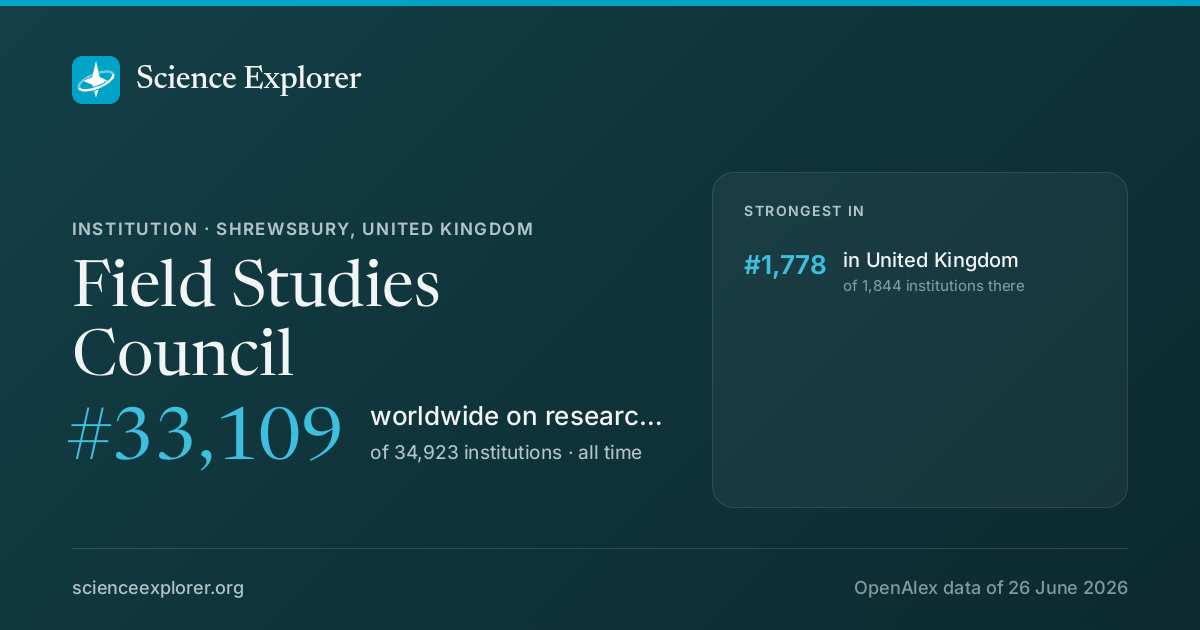
Field Studies Council on Science Explorer

A card with Field Studies Council's standing and the fields it leads in, for a post or a slide. A link to this page previews as the same card.

Download the card

1200 × 630 PNG, sized for social posts, drawn from the latest snapshot.

Badges for a website1Each links back here and updates with every snapshot

Research measures only: rankings here say nothing about teaching, admissions or student experience. Comparable institutions and collaboration partners have tabs of their own, above.

Discussion

Ask a question or share a note about Field Studies Council. Keep it to the research: no personal attacks, advertising or links. Any reader can report a post, which collapses it for everyone until it is opened.