Science Explorer Back to mapMap
Discussion
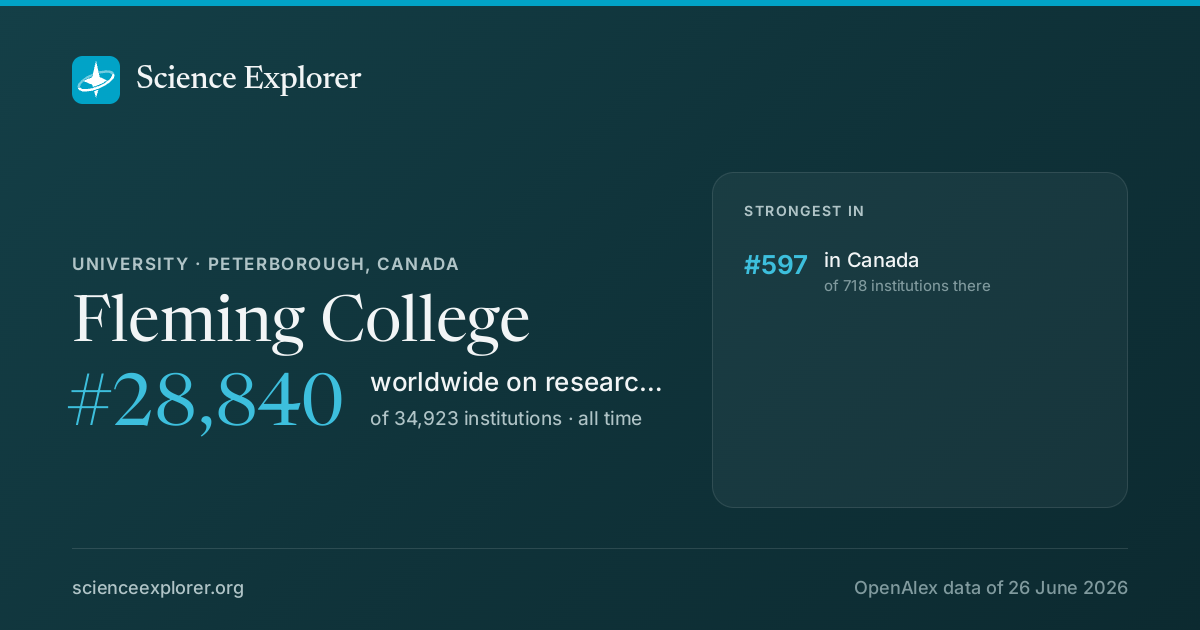
University · Peterborough · Canada

Fleming College

World rank, all time
#28,840
of 34,923
Rank in Canada
#597
of 718
Research works
132
▲ 12% vs 2018-21
Citations
2.6k
20.0 per fractional work
Top-10% rate
5.0%
all institutions 10.0%
vs its own fields
0.93×
1.00× is exactly expected
Open access
42%
world 40%
International
32%
world 18%

Which fields of science does Fleming College work in?

In 2022-now, 36% of research at Fleming College is in Social Sciences, 29% in Health Sciences. Its largest fields are Social Sciences (17%), Health Professions (15%), Medicine (13%). It does 1.3× the world's share of Social Sciences.

Social Sciences: 8 fractional works · 35.6% of its workSocial Sciences: 4 fractional works · 17.2% of its workSociology and Political Science: 1 fractional works · 3.7% of its workEducation: 1 fractional works · 3.6% of its workSafety Research: 1 fractional works · 2.9% of its workPolitical Science and International Relations: 1 fractional works · 2.4% of its workDemography: 0 fractional works · 2.1% of its workTransportation: 0 fractional works · 1.7% of its workHealth: 0 fractional works · 0.7% of its workPsychology: 3 fractional works · 11.6% of its workSocial Psychology: 2 fractional works · 6.5% of its workClinical Psychology: 1 fractional works · 4.3% of its workApplied Psychology: 0 fractional works · 0.7% of its workEconomics, Econometrics and Finance: 1 fractional works · 4.0% of its workEconomics and Econometrics: 1 fractional works · 4.0% of its workArts and Humanities: 0 fractional works · 2.1% of its workPhilosophy: 0 fractional works · 2.1% of its workBusiness, Management and Accounting: 0 fractional works · 0.7% of its workOrganizational Behavior and Human Resource Management: 0 fractional works · 0.7% of its workHealth Sciences: 7 fractional works · 28.6% of its workHealth Professions: 4 fractional works · 15.3% of its workGeneral Health Professions: 2 fractional works · 9.7% of its workEmergency Medical Services: 0 fractional works · 2.0% of its workOccupational Therapy: 0 fractional works · 1.4% of its workRadiological and Ultrasound Technology: 0 fractional works · 1.1% of its workPharmacy: 0 fractional works · 0.7% of its workPhysical Therapy, Sports Therapy and Rehabilitation: 0 fractional works · 0.5% of its workMedicine: 3 fractional works · 12.7% of its workPublic Health, Environmental and Occupational Health: 1 fractional works · 5.0% of its workPhysiology: 0 fractional works · 2.1% of its workEpidemiology: 0 fractional works · 1.5% of its workPulmonary and Respiratory Medicine: 0 fractional works · 1.1% of its workRadiology, Nuclear Medicine and Imaging: 0 fractional works · 0.7% of its workRehabilitation: 0 fractional works · 0.5% of its workCritical Care and Intensive Care Medicine: 0 fractional works · 0.4% of its workOncology: 0 fractional works · 0.4% of its workInfectious Diseases: 0 fractional works · 0.3% of its workHepatology: 0 fractional works · 0.3% of its workSmaller subfields together: 0 fractional works · 0.3% of its workNursing: 0 fractional works · 0.6% of its workResearch and Theory: 0 fractional works · 0.6% of its workPhysical Sciences: 7 fractional works · 28.5% of its workEngineering: 3 fractional works · 10.9% of its workCivil and Structural Engineering: 1 fractional works · 3.2% of its workMechanical Engineering: 1 fractional works · 2.3% of its workAutomotive Engineering: 0 fractional works · 1.4% of its workIndustrial and Manufacturing Engineering: 0 fractional works · 1.4% of its workMechanics of Materials: 0 fractional works · 0.7% of its workOcean Engineering: 0 fractional works · 0.7% of its workBiomedical Engineering: 0 fractional works · 0.6% of its workElectrical and Electronic Engineering: 0 fractional works · 0.4% of its workEnvironmental Science: 2 fractional works · 10.7% of its workIndustrial and Manufacturing Engineering: 1 fractional works · 3.1% of its workGlobal and Planetary Change: 1 fractional works · 2.9% of its workEcology: 0 fractional works · 1.8% of its workEcological Modeling: 0 fractional works · 1.0% of its workNature and Landscape Conservation: 0 fractional works · 0.6% of its workEnvironmental Chemistry: 0 fractional works · 0.5% of its workPollution: 0 fractional works · 0.5% of its workWater Science and Technology: 0 fractional works · 0.3% of its workSmaller subfields together: 0 fractional works · 0.1% of its workMaterials Science: 0 fractional works · 1.8% of its workMaterials Chemistry: 0 fractional works · 1.8% of its workComputer Science: 0 fractional works · 1.6% of its workComputer Science Applications: 0 fractional works · 0.9% of its workArtificial Intelligence: 0 fractional works · 0.5% of its workComputational Theory and Mathematics: 0 fractional works · 0.2% of its workEnergy: 0 fractional works · 1.6% of its workRenewable Energy, Sustainability and the Environment: 0 fractional works · 1.6% of its workChemistry: 0 fractional works · 1.5% of its workOrganic Chemistry: 0 fractional works · 1.2% of its workElectrochemistry: 0 fractional works · 0.2% of its workSmaller subfields together: 0 fractional works · 0.2% of its workChemical Engineering: 0 fractional works · 0.3% of its workLife Sciences: 2 fractional works · 7.3% of its workAgricultural and Biological Sciences: 1 fractional works · 3.0% of its workGeneral Agricultural and Biological Sciences: 0 fractional works · 2.1% of its workInsect Science: 0 fractional works · 0.5% of its workPlant Science: 0 fractional works · 0.3% of its workSmaller subfields together: 0 fractional works · 0.2% of its workNeuroscience: 1 fractional works · 3.0% of its workCognitive Neuroscience: 1 fractional works · 3.0% of its workBiochemistry, Genetics and Molecular Biology: 0 fractional works · 1.3% of its workMolecular Biology: 0 fractional works · 1.3% of its workALL ITS WORKFleming College23fractional works, 2022-now
Life Sciences7%Physical Sciences28%Health Sciences29%Social Sciences36%

Each ring splits the one inside it: the four domains of science, their fields, their subfields. Size is fractional works in 2022-now. Every slice is a page; the interactive view zooms down to single topics and colours each by how much more of it this institution does than the world.

Its 4 domains and 18 fields, with their numbers
    1. Social Sciences417.2%
    2. Psychology311.6%
    3. Economics, Econometrics and Finance14.0%
    4. Arts and Humanities02.1%
    5. Business, Management and Accounting00.7%
    1. Health Professions415.3%
    2. Medicine312.7%
    3. Nursing00.6%
    1. Engineering310.9%
    2. Environmental Science210.7%
    3. Materials Science01.8%
    4. Computer Science01.6%
    5. Energy01.6%
    6. Chemistry01.5%
    7. Chemical Engineering00.3%
    1. Agricultural and Biological Sciences13.0%
    2. Neuroscience13.0%
    3. Biochemistry, Genetics and Molecular Biology01.3%
All of science, and how each field's share has moved since 1950: the Science domain explorer

Field profile

Location quotient across every field it publishes in: outside the ring is more than an institution of this size would be expected to publish, inside it is less.

Agricultural and Biological Sciences: 0.64× its world share, 1 worksAgricultural and Bio…Biochemistry, Genetics and Molecular Biology: 0.24× its world share, 0 worksBiochemistry, Geneti…Neuroscience: 1.84× its world share, 1 worksNeuroscienceChemical Engineering: 0.75× its world share, 0 worksChemical EngineeringChemistry: 0.99× its world share, 0 worksChemistryComputer Science: 0.21× its world share, 0 worksComputer ScienceEnergy: 1.78× its world share, 0 worksEnergyEngineering: 0.73× its world share, 2 worksEngineeringEnvironmental Science: 2.16× its world share, 2 worksEnvironmental ScienceMaterials Science: 0.50× its world share, 0 worksMaterials ScienceHealth Professions: 5.82× its world share, 4 worksHealth ProfessionsMedicine: 0.66× its world share, 3 worksMedicineNursing: 1.16× its world share, 0 worksNursingArts and Humanities: 0.74× its world share, 0 worksArts and HumanitiesBusiness, Management and Accounting: 0.22× its world share, 0 worksBusiness, Management…Economics, Econometrics and Finance: 1.89× its world share, 1 worksEconomics, Econometr…Psychology: 3.79× its world share, 3 worksPsychologySocial Sciences: 1.36× its world share, 4 worksSocial Sciences1×world share
more than its size predictsabout as predictedless

Rings at 0.5×, 1× and 2×. Widest outward: Health Professions, 5.8×. Every wedge is a field page.

All 18 fields, with their numbers
  1. Health Professions5.82×4 works
  2. Psychology3.79×3 works
  3. Environmental Science2.16×2 works
  4. Economics, Econometrics and Finance1.89×1 works
  5. Neuroscience1.84×1 works
  6. Energy1.78×0 works
  7. Social Sciences1.36×4 works
  8. Nursing1.16×0 works
  9. Chemistry0.99×0 works
  10. Chemical Engineering0.75×0 works
  11. Arts and Humanities0.74×0 works
  12. Engineering0.73×2 works
  13. Medicine0.66×3 works
  14. Agricultural and Biological Sciences0.64×1 works
  15. Materials Science0.50×0 works
  16. Biochemistry, Genetics and Molecular Biology0.24×0 works
  17. Business, Management and Accounting0.22×0 works
  18. Computer Science0.21×0 works

Who are the top researchers at Fleming College?

Ranked on the quality score, Kim Ēnglish, Noel Savage and Brent C. Wootton lead among researchers whose main affiliation is Fleming College.

  1. 1 Kim Ēnglish Canada · #2,258,246 worldwide 750 citations · 39 works
  2. 2 Noel Savage Canada · #4,292,764 worldwide 5 citations · 16 works
  3. 3 Brent C. Wootton Canada · #4,343,146 worldwide 264 citations · 33 works
  4. 4 Shawna Taylor Canada · #6,175,444 worldwide 5 citations · 51 works
All ranked researchers at Fleming College

What are the most cited papers from Fleming College?

The most cited paper from Fleming College is "Asynchronous carbon sink saturation in African and Amazonian tropical forests" (Wannes Hubau et al., 2020), with 968 citations. Next come "Epidemiology of Childhood Depressive Disorders: A Critical Review" (705) and "Academic achievement in high school: does emotional intelligence matter?" (391).

Most cited papers
#PaperReleasedCitations
1 Asynchronous carbon sink saturation in African and Amazonian tropical forests Wannes Hubau et al. · Nature Open access106 authors 4 Mar 2020 968
2 Epidemiology of Childhood Depressive Disorders: A Critical Review Jan E. Fleming, David R. Offord · Journal of the American Academy of Child & Adolescent Psychiatry Jul 1990 705
3 Academic achievement in high school: does emotional intelligence matter? James D. A. Parker, Ronald E. Creque, David L. Barnhart et al. · Personality and Individual Differences 6 Mar 2004 391
4 Characterization of biochar-derived dissolved organic matter using UV–visible absorption and excitation–emission fluorescence spectroscopies Tyler Jacob Ross Jamieson, Eric P. S. Sager, Céline Guéguen · Chemosphere 17 Dec 2013 212
5 Atrial Premature Beats Predict Atrial Fibrillation in Cryptogenic Stroke David J. Gladstone et al. · Stroke 125 authors 20 Feb 2015 205
All 60 most cited papers, with filters and sorting

Which research topics does Fleming College publish most on?

By volume in 2022-now: Down syndrome and intellectual disability research, COVID-19 Pandemic Impacts, Diverse Educational Innovations Studies and Education and Critical Thinking Development.

  1. 1 Down syndrome and intellectual disability research Public Health, Environmental and Occupational Health 1 works
  2. 2 COVID-19 Pandemic Impacts Economics and Econometrics 1 works
  3. 3 Diverse Educational Innovations Studies General Agricultural and Biological Sciences 0 works
  4. 4 Education and Critical Thinking Development Education 0 works
  5. 5 Linguistics and Discourse Analysis Philosophy 0 works
  6. 6 Employment and Welfare Studies General Health Professions 0 works
  7. 7 Geotechnical Engineering and Underground Structures Civil and Structural Engineering 0 works
  8. 8 Urban Transport and Accessibility Transportation 0 works
  9. 9 Interprofessional Education and Collaboration General Health Professions 0 works
  10. 10 Cultural Competency in Health Care Sociology and Political Science 0 works

How open and international is its research?

Against the world's own shares: the tick on each track. Both are shares of its output, so they sit on one scale and can be read against each other as well as against the world.

openly available41.9%not open58.1%

World: 40% of research is openly available.

with international co-authors32.1%domestic only67.9%

World: 18% is written across borders.

How has Fleming College's research output changed?

Output in 2022-2025 was 12% higher than in 2018-2021.

still counting1990200020102020
grewheldshrank

The same series as a ribbon: one cell per year, darker for more. The line above answers how much; this answers when.

Its share of all research

Growing output can still be a shrinking share: all of science grows. This is Fleming College as a percentage of every work published that year, 0.00011% in 2024.

still counting0.00050%0.0010%Fleming College0.00010% in 202519801990200020102020

Fractional works of Fleming College over all fractional works that year. How the balance of science has shifted.

Other research institutions in Peterborough

All research institutions in Peterborough

Share Fleming College's ranking

Fleming College on Science Explorer

A card with Fleming College's standing and the fields it leads in, for a post or a slide. A link to this page previews as the same card.

Download the card

1200 × 630 PNG, sized for social posts, drawn from the latest snapshot.

Badges for a website1Each links back here and updates with every snapshot

Research measures only: rankings here say nothing about teaching, admissions or student experience. Comparable institutions and collaboration partners have tabs of their own, above.

Discussion

Ask a question or share a note about Fleming College. Posts are plain text and can be reported.