Science Explorer Back to mapMap
Hospital / health system · Winterthur · Switzerland

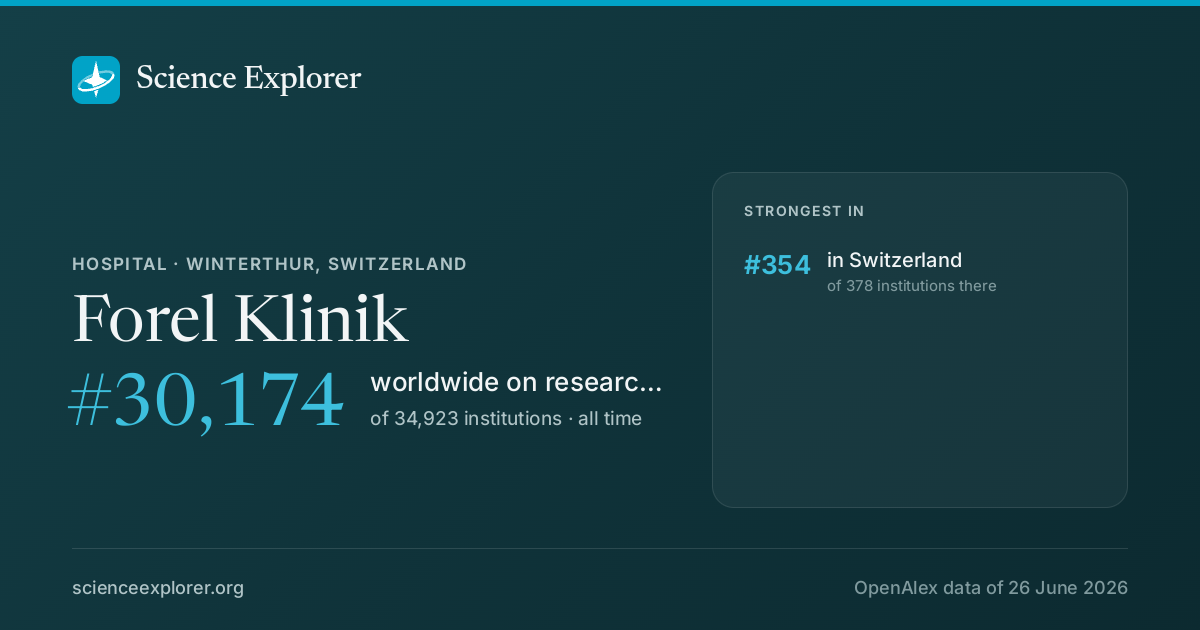
Forel Klinik

World rank, all time
#30,174
of 34,923
Rank in Switzerland
#354
of 378
Research works
150
▼ 65% vs 2018-21
Citations
5.6k
37.3 per fractional work
Top-10% rate
10.6%
all institutions 10.0%
vs its own fields
1.00×
1.00× is exactly expected
Open access
31%
world 40%
International
42%
world 18%

Which fields of science does Forel Klinik work in?

In all years, 57% of research at Forel Klinik is in Physical Sciences, 21% in Social Sciences. Its largest fields are Environmental Science (35%), Earth and Planetary Sciences (12%), Medicine (11%). It does 1.4× the world's share of Physical Sciences.

Physical Sciences: 85 fractional works · 56.6% of its workEnvironmental Science: 53 fractional works · 35.0% of its workHealth, Toxicology and Mutagenesis: 12 fractional works · 8.0% of its workPollution: 12 fractional works · 7.8% of its workEnvironmental Chemistry: 10 fractional works · 6.5% of its workWater Science and Technology: 7 fractional works · 4.4% of its workEcology: 5 fractional works · 3.4% of its workIndustrial and Manufacturing Engineering: 2 fractional works · 1.6% of its workEnvironmental Engineering: 2 fractional works · 1.2% of its workGlobal and Planetary Change: 1 fractional works · 0.8% of its workNature and Landscape Conservation: 1 fractional works · 0.5% of its workManagement, Monitoring, Policy and Law: 1 fractional works · 0.4% of its workEcological Modeling: 0 fractional works · 0.2% of its workEarth and Planetary Sciences: 18 fractional works · 12.1% of its workAtmospheric Science: 5 fractional works · 3.5% of its workGeochemistry and Petrology: 4 fractional works · 2.9% of its workOceanography: 4 fractional works · 2.5% of its workEarth-Surface Processes: 2 fractional works · 1.5% of its workGeophysics: 2 fractional works · 1.3% of its workPaleontology: 1 fractional works · 0.4% of its workSmaller subfields together: 0 fractional works · 0.1% of its workChemistry: 6 fractional works · 4.2% of its workAnalytical Chemistry: 3 fractional works · 2.1% of its workInorganic Chemistry: 1 fractional works · 0.6% of its workPhysical and Theoretical Chemistry: 1 fractional works · 0.5% of its workElectrochemistry: 1 fractional works · 0.5% of its workSpectroscopy: 0 fractional works · 0.2% of its workOrganic Chemistry: 0 fractional works · 0.2% of its workEngineering: 3 fractional works · 2.1% of its workMechanics of Materials: 1 fractional works · 0.5% of its workOcean Engineering: 1 fractional works · 0.5% of its workMechanical Engineering: 0 fractional works · 0.3% of its workBiomedical Engineering: 0 fractional works · 0.3% of its workComputational Mechanics: 0 fractional works · 0.2% of its workElectrical and Electronic Engineering: 0 fractional works · 0.2% of its workSmaller subfields together: 0 fractional works · 0.1% of its workComputer Science: 2 fractional works · 1.3% of its workArtificial Intelligence: 2 fractional works · 1.1% of its workSmaller subfields together: 0 fractional works · 0.2% of its workMaterials Science: 1 fractional works · 0.8% of its workMaterials Chemistry: 1 fractional works · 0.4% of its workBiomaterials: 0 fractional works · 0.3% of its workSmaller subfields together: 0 fractional works · 0.1% of its workChemical Engineering: 1 fractional works · 0.4% of its workBioengineering: 1 fractional works · 0.4% of its workSmaller subfields together: 0 fractional works · 0.1% of its workPhysics and Astronomy: 1 fractional works · 0.3% of its workAtomic and Molecular Physics, and Optics: 0 fractional works · 0.3% of its workSmaller subfields together: 0 fractional works · 0.1% of its workEnergy: 0 fractional works · 0.3% of its workRenewable Energy, Sustainability and the Environment: 0 fractional works · 0.3% of its workSocial Sciences: 31 fractional works · 20.7% of its workSocial Sciences: 12 fractional works · 8.2% of its workLaw: 4 fractional works · 2.7% of its workSociology and Political Science: 3 fractional works · 2.1% of its workPolitical Science and International Relations: 3 fractional works · 2.0% of its workCultural Studies: 1 fractional works · 0.8% of its workEducation: 0 fractional works · 0.3% of its workSmaller subfields together: 0 fractional works · 0.3% of its workPsychology: 11 fractional works · 7.4% of its workClinical Psychology: 6 fractional works · 3.8% of its workSocial Psychology: 4 fractional works · 2.3% of its workExperimental and Cognitive Psychology: 1 fractional works · 1.0% of its workApplied Psychology: 0 fractional works · 0.3% of its workArts and Humanities: 3 fractional works · 2.1% of its workPhilosophy: 1 fractional works · 0.9% of its workMuseology: 1 fractional works · 0.7% of its workHistory and Philosophy of Science: 0 fractional works · 0.3% of its workLanguage and Linguistics: 0 fractional works · 0.2% of its workSmaller subfields together: 0 fractional works · 0.1% of its workBusiness, Management and Accounting: 3 fractional works · 1.8% of its workOrganizational Behavior and Human Resource Management: 2 fractional works · 1.3% of its workAccounting: 0 fractional works · 0.2% of its workStrategy and Management: 0 fractional works · 0.2% of its workEconomics, Econometrics and Finance: 2 fractional works · 1.1% of its workEconomics and Econometrics: 2 fractional works · 1.1% of its workDecision Sciences: 0 fractional works · 0.1% of its workHealth Sciences: 20 fractional works · 13.5% of its workMedicine: 16 fractional works · 10.7% of its workEpidemiology: 5 fractional works · 3.2% of its workNeurology: 3 fractional works · 2.1% of its workPathology and Forensic Medicine: 2 fractional works · 1.7% of its workPublic Health, Environmental and Occupational Health: 1 fractional works · 0.9% of its workDermatology: 1 fractional works · 0.8% of its workOncology: 0 fractional works · 0.3% of its workPhysiology: 0 fractional works · 0.3% of its workCardiology and Cardiovascular Medicine: 0 fractional works · 0.2% of its workSmaller subfields together: 2 fractional works · 1.2% of its workHealth Professions: 4 fractional works · 2.5% of its workGeneral Health Professions: 3 fractional works · 1.8% of its workPhysical Therapy, Sports Therapy and Rehabilitation: 0 fractional works · 0.3% of its workComplementary and Manual Therapy: 0 fractional works · 0.2% of its workSmaller subfields together: 0 fractional works · 0.2% of its workNursing: 0 fractional works · 0.2% of its workVeterinary: 0 fractional works · 0.1% of its workLife Sciences: 14 fractional works · 9.2% of its workAgricultural and Biological Sciences: 5 fractional works · 3.6% of its workPlant Science: 2 fractional works · 1.6% of its workSoil Science: 2 fractional works · 1.0% of its workEcology, Evolution, Behavior and Systematics: 1 fractional works · 0.7% of its workSmaller subfields together: 0 fractional works · 0.2% of its workBiochemistry, Genetics and Molecular Biology: 5 fractional works · 3.5% of its workMolecular Biology: 3 fractional works · 2.1% of its workGenetics: 1 fractional works · 0.5% of its workBiochemistry: 1 fractional works · 0.4% of its workCancer Research: 0 fractional works · 0.2% of its workSmaller subfields together: 1 fractional works · 0.4% of its workNeuroscience: 3 fractional works · 1.8% of its workCellular and Molecular Neuroscience: 1 fractional works · 0.7% of its workCognitive Neuroscience: 1 fractional works · 0.7% of its workNeurology: 0 fractional works · 0.3% of its workPharmacology, Toxicology and Pharmaceutics: 0 fractional works · 0.2% of its workImmunology and Microbiology: 0 fractional works · 0.1% of its workALL ITS WORKForel Klinik150fractional works, all years
Life Sciences9%Physical Sciences57%Health Sciences14%Social Sciences21%

Each ring splits the one inside it: the four domains of science, their fields, their subfields. Size is fractional works in all years. Every slice is a page; the interactive view zooms down to single topics and colours each by how much more of it this institution does than the world.

Its 4 domains and 24 fields, with their numbers
    1. Environmental Science5335.0%
    2. Earth and Planetary Sciences1812.1%
    3. Chemistry64.2%
    4. Engineering32.1%
    5. Computer Science21.3%
    6. Materials Science10.8%
    7. Chemical Engineering10.4%
    8. Physics and Astronomy10.3%
    9. Energy00.3%
    1. Social Sciences128.2%
    2. Psychology117.4%
    3. Arts and Humanities32.1%
    4. Business, Management and Accounting31.8%
    5. Economics, Econometrics and Finance21.1%
    6. Decision Sciences00.1%
    1. Medicine1610.7%
    2. Health Professions42.5%
    3. Nursing00.2%
    4. Veterinary00.1%
    1. Agricultural and Biological Sciences53.6%
    2. Biochemistry, Genetics and Molecular Biology53.5%
    3. Neuroscience31.8%
    4. Pharmacology, Toxicology and Pharmaceutics00.2%
    5. Immunology and Microbiology00.1%
All of science, and how each field's share has moved since 1950: the Science domain explorer

Field profile

Location quotient across every field it publishes in: outside the ring is more than an institution of this size would be expected to publish, inside it is less.

Biochemistry, Genetics and Molecular Biology: 0.24× its world share, 0 worksBiochemistry, Geneti…Neuroscience: 0.97× its world share, 0 worksNeurosciencePharmacology, Toxicology and Pharmaceutics: 3.56× its world share, 0 worksPharmacology, Toxico…Chemistry: 0.80× its world share, 0 worksChemistryEarth and Planetary Sciences: 0.64× its world share, 0 worksEarth and Planetary …Engineering: 0.17× its world share, 0 worksEngineeringEnvironmental Science: 0.34× its world share, 0 worksEnvironmental ScienceMaterials Science: 0.14× its world share, 0 worksMaterials ScienceHealth Professions: 3.52× its world share, 1 worksHealth ProfessionsMedicine: 0.67× its world share, 2 worksMedicineArts and Humanities: 1.91× its world share, 1 worksArts and HumanitiesBusiness, Management and Accounting: 4.67× its world share, 2 worksBusiness, Management…Economics, Econometrics and Finance: 1.17× its world share, 0 worksEconomics, Econometr…Psychology: 9.73× its world share, 4 worksPsychologySocial Sciences: 1.10× its world share, 2 worksSocial Sciences1×world share
more than its size predictsabout as predictedless

Rings at 0.5×, 1× and 2×. Widest outward: Psychology, 9.7×. Every wedge is a field page.

All 15 fields, with their numbers
  1. Psychology9.73×4 works
  2. Business, Management and Accounting4.67×2 works
  3. Pharmacology, Toxicology and Pharmaceutics3.56×0 works
  4. Health Professions3.52×1 works
  5. Arts and Humanities1.91×1 works
  6. Economics, Econometrics and Finance1.17×0 works
  7. Social Sciences1.10×2 works
  8. Neuroscience0.97×0 works
  9. Chemistry0.80×0 works
  10. Medicine0.67×2 works
  11. Earth and Planetary Sciences0.64×0 works
  12. Environmental Science0.34×0 works
  13. Biochemistry, Genetics and Molecular Biology0.24×0 works
  14. Engineering0.17×0 works
  15. Materials Science0.14×0 works

Who are the top researchers at Forel Klinik?

Ranked on the quality score, Susanne Rösner and Michel Pardos lead among researchers whose main affiliation is Forel Klinik.

  1. 1 Susanne Rösner Switzerland · #2,856,136 worldwide 1.4k citations · 48 works
  2. 2 Michel Pardos Switzerland · #3,447,562 worldwide 820 citations · 22 works
All ranked researchers at Forel Klinik

What are the most cited papers from Forel Klinik?

The most cited paper from Forel Klinik is "Beyond the Plankton Ecology Group (PEG) Model: Mechanisms Driving Plankton Succession" (Ulrich J. Sommer, Rita Adrian, Lisette N. de Senerpont Domis et al., 2012), with 917 citations. Next come "Global trends in tropical cyclone risk" (809) and "The interaction between climate warming and eutrophication to promote cyanobacteria is dependent on trophic state and varies among taxa" (458).

Most cited papers
#PaperReleasedCitations
1 Beyond the Plankton Ecology Group (PEG) Model: Mechanisms Driving Plankton Succession Ulrich J. Sommer, Rita Adrian, Lisette N. de Senerpont Domis et al. · Annual Review of Ecology Evolution and Systematics ReviewOpen access 14 Sep 2012 917
2 Global trends in tropical cyclone risk Pascal Peduzzi, Bruno Chatenoux, Hy Dao et al. · Nature Climate Change Open access 10 Feb 2012 809
3 The interaction between climate warming and eutrophication to promote cyanobacteria is dependent on trophic state and varies among taxa Anna Rigosi, Cayelan C. Carey, Bas W. Ibelings et al. · Limnology and Oceanography Open access 15 Dec 2013 458
4 Colloid analysis by single particle inductively coupled plasma-mass spectroscopy: a feasibility study Claude André Degueldre, P.‐Y. Favarger · Colloids and Surfaces A Physicochemical and Engineering Aspects Open access Apr 2003 367
5 Artificial mixing to control cyanobacterial blooms: a review P. Visser, Bas W. Ibelings, Myriam Bormans et al. · Aquatic Ecology Open access 18 Aug 2015 336
All 61 most cited papers, with filters and sorting

Which keywords describe research at Forel Klinik?

By fractional works in all years, weighted toward what it does more of than the world: Water Quality, Toxicity, Climate Change, Heavy Metals, Remediation, Contamination, Pollution and Health Risk.

▲ more of its work than of the world's◆ about the world's share▼ less than the world's

Size is fractional works in all years in the topics tagged with each word; colour is the word's share of this institution's work against its share of the world's. The 40 words are chosen for being large and distinctive. Each links to the topic it comes from most.

All 40 words, with their numbers
  1. Climate Change16▲ 4.1×25 topics
  2. Water Quality14▲ 21×10 topics
  3. Toxicity13▲ 19×8 topics
  4. Heavy Metals12▲ 43×3 topics
  5. Oxidative Stress12▲ 4.2×14 topics
  6. Remediation12▲ 105×2 topics
  7. Contamination11▲ 80×2 topics
  8. Pollution10▲ 49×3 topics
  9. Health Risk10▲ 112×1 topic
  10. Soil10▲ 112×1 topic
  11. Eutrophication9▲ 40×4 topics
  12. Bioaccumulation8▲ 45×3 topics
  13. Health Effects8▲ 8.9×8 topics
  14. Environmental Impact6▲ 3.3×15 topics
  15. Harmful Algal Blooms6▲ 40×2 topics
  16. Environmental Impacts6▲ 17×5 topics
  17. Toxicology5▲ 16×3 topics
  18. Emissions5▲ 17×2 topics
  19. Environmental5▲ 56×1 topic
  20. Mercury5▲ 101×1 topic
  21. Global Burden of Disease5▲ 15×3 topics
  22. Holocene4▲ 18×3 topics
  23. Impulsivity4▲ 53×2 topics
  24. Psychiatric Disorders4▲ 19×2 topics
  25. Sea Level4▲ 21×2 topics
  26. Substance Use Disorders4▲ 44×2 topics
  27. Alcohol Dependence4▲ 65×1 topic
  28. Motivational Interviewing4▲ 65×1 topic
  29. Phosphorus4▲ 28×2 topics
  30. Toxins4▲ 23×2 topics
  31. Cyanobacteria4▲ 49×2 topics
  32. Freshwater Ecosystems4▲ 72×1 topic
  33. Nutrient Control4▲ 72×1 topic
  34. Paleoclimatology4▲ 21×2 topics
  35. Solar Influence4▲ 23×2 topics
  36. Geochemistry4▲ 39×2 topics
  37. Glacial Cycles4▲ 24×1 topic
  38. Monsoon Dynamics4▲ 24×1 topic
  39. Groundwater4▲ 28×3 topics
  40. Metal Toxicity4▲ 30×2 topics

Which research topics does Forel Klinik publish most on?

By volume in 2022-now: Psychology, Coaching, and Therapy, Corporate Management and Leadership, Psychoanalysis and Social Critique and Organizational Management and Change.

  1. 1 Psychology, Coaching, and Therapy Social Psychology 2 works
  2. 2 Corporate Management and Leadership Organizational Behavior and Human Resource Management 1 works
  3. 3 Psychoanalysis and Social Critique Cultural Studies 1 works
  4. 4 Organizational Management and Change Organizational Behavior and Human Resource Management 1 works
  5. 5 Substance Abuse Treatment and Outcomes Epidemiology 1 works
  6. 6 Health, psychology, and well-being General Health Professions 0 works
  7. 7 Psychiatric care and mental health services Clinical Psychology 0 works
  8. 8 Alcoholism and Thiamine Deficiency Neurology 0 works
  9. 9 Decadence, Literature, and Society Sociology and Political Science 0 works
  10. 10 Sports Science and Education History and Philosophy of Science 0 works

How open and international is its research?

Against the world's own shares: the tick on each track. Both are shares of its output, so they sit on one scale and can be read against each other as well as against the world.

openly available30.8%not open69.2%

World: 40% of research is openly available.

with international co-authors42.1%domestic only57.9%

World: 18% is written across borders.

How has Forel Klinik's research output changed?

Output in 2022-2025 was 65% lower than in 2018-2021.

still counting1990200020102020
grewheldshrank

The same series as a ribbon: one cell per year, darker for more. The line above answers how much; this answers when.

Its share of all research

Growing output can still be a shrinking share: all of science grows. This is Forel Klinik as a percentage of every work published that year, 0.000047% in 2024.

still counting0.00050%0.0010%0.0015%Forel Klinik0.000026% in 202519801990200020102020

Fractional works of Forel Klinik over all fractional works that year. How the balance of science has shifted.

Other research institutions in Winterthur

All research institutions in Winterthur

Share Forel Klinik's ranking

Forel Klinik on Science Explorer

A card with Forel Klinik's standing and the fields it leads in, for a post or a slide. A link to this page previews as the same card.

Download the card

1200 × 630 PNG, sized for social posts, drawn from the latest snapshot.

Badges for a website1Each links back here and updates with every snapshot

Research measures only: rankings here say nothing about teaching, admissions or student experience. Comparable institutions and collaboration partners have tabs of their own, above.

Discussion

Ask a question or share a note about Forel Klinik. Posts are plain text and can be reported.