Science Explorer Back to mapMap
Nonprofit · Flat Rock · United States

Four Seasons

World rank, all time
#25,953
of 34,923
Rank in United States
#5,428
of 7,310
Research works
151
▼ 43% vs 2018-21
Citations
1.4k
9.6 per fractional work
Top-10% rate
6.3%
all institutions 10.0%
vs its own fields
0.98×
1.00× is exactly expected
Open access
37%
world 40%
International
23%
world 18%

Which fields of science does Four Seasons work in?

In 2022-now, 37% of research at Four Seasons is in Health Sciences, 28% in Social Sciences. Its largest fields are Medicine (26%), Social Sciences (15%), Engineering (10%). It does 1.4× the world's share of Health Sciences.

Health Sciences: 9 fractional works · 36.5% of its workMedicine: 6 fractional works · 26.4% of its workPublic Health, Environmental and Occupational Health: 2 fractional works · 6.6% of its workSurgery: 1 fractional works · 4.0% of its workDermatology: 1 fractional works · 2.9% of its workEpidemiology: 1 fractional works · 2.2% of its workRadiology, Nuclear Medicine and Imaging: 0 fractional works · 1.6% of its workPediatrics, Perinatology and Child Health: 0 fractional works · 1.5% of its workPhysiology: 0 fractional works · 0.9% of its workRheumatology: 0 fractional works · 0.9% of its workGastroenterology: 0 fractional works · 0.9% of its workPathology and Forensic Medicine: 0 fractional works · 0.8% of its workAnesthesiology and Pain Medicine: 0 fractional works · 0.7% of its workOtorhinolaryngology: 0 fractional works · 0.7% of its workPharmacology: 0 fractional works · 0.7% of its workCardiology and Cardiovascular Medicine: 0 fractional works · 0.5% of its workNeurology: 0 fractional works · 0.5% of its workObstetrics and Gynecology: 0 fractional works · 0.5% of its workPulmonary and Respiratory Medicine: 0 fractional works · 0.3% of its workHealth Professions: 2 fractional works · 7.8% of its workGeneral Health Professions: 1 fractional works · 3.7% of its workHealth Information Management: 0 fractional works · 2.1% of its workEmergency Medical Services: 0 fractional works · 0.9% of its workPharmacy: 0 fractional works · 0.7% of its workSpeech and Hearing: 0 fractional works · 0.3% of its workDentistry: 0 fractional works · 1.1% of its workOral Surgery: 0 fractional works · 0.5% of its workOrthodontics: 0 fractional works · 0.3% of its workPeriodontics: 0 fractional works · 0.3% of its workNursing: 0 fractional works · 1.1% of its workIssues, ethics and legal aspects: 0 fractional works · 0.5% of its workResearch and Theory: 0 fractional works · 0.5% of its workSmaller subfields together: 0 fractional works · 0.0% of its workVeterinary: 0 fractional works · 0.2% of its workSmall Animals: 0 fractional works · 0.2% of its workSocial Sciences: 7 fractional works · 28.0% of its workSocial Sciences: 3 fractional works · 14.7% of its workLaw: 2 fractional works · 6.4% of its workAnthropology: 1 fractional works · 2.9% of its workSociology and Political Science: 1 fractional works · 2.3% of its workDemography: 0 fractional works · 1.4% of its workEducation: 0 fractional works · 1.2% of its workGeography, Planning and Development: 0 fractional works · 0.3% of its workPolitical Science and International Relations: 0 fractional works · 0.3% of its workPsychology: 2 fractional works · 8.0% of its workClinical Psychology: 1 fractional works · 5.3% of its workSocial Psychology: 0 fractional works · 1.4% of its workExperimental and Cognitive Psychology: 0 fractional works · 0.9% of its workDevelopmental and Educational Psychology: 0 fractional works · 0.5% of its workBusiness, Management and Accounting: 1 fractional works · 2.9% of its workMarketing: 0 fractional works · 1.4% of its workOrganizational Behavior and Human Resource Management: 0 fractional works · 1.4% of its workSmaller subfields together: 0 fractional works · 0.0% of its workEconomics, Econometrics and Finance: 1 fractional works · 2.4% of its workEconomics and Econometrics: 1 fractional works · 2.4% of its workLife Sciences: 4 fractional works · 18.8% of its workBiochemistry, Genetics and Molecular Biology: 2 fractional works · 6.9% of its workCell Biology: 1 fractional works · 2.8% of its workGenetics: 0 fractional works · 2.1% of its workMolecular Biology: 0 fractional works · 1.3% of its workCancer Research: 0 fractional works · 0.7% of its workAgricultural and Biological Sciences: 2 fractional works · 6.8% of its workFood Science: 0 fractional works · 2.1% of its workAnimal Science and Zoology: 0 fractional works · 1.9% of its workPlant Science: 0 fractional works · 0.8% of its workAquatic Science: 0 fractional works · 0.5% of its workGeneral Agricultural and Biological Sciences: 0 fractional works · 0.5% of its workSoil Science: 0 fractional works · 0.5% of its workInsect Science: 0 fractional works · 0.3% of its workAgronomy and Crop Science: 0 fractional works · 0.3% of its workSmaller subfields together: 0 fractional works · 0.0% of its workNeuroscience: 1 fractional works · 3.2% of its workCognitive Neuroscience: 0 fractional works · 1.6% of its workEndocrine and Autonomic Systems: 0 fractional works · 1.4% of its workSmaller subfields together: 0 fractional works · 0.2% of its workPharmacology, Toxicology and Pharmaceutics: 0 fractional works · 1.9% of its workPharmacology: 0 fractional works · 1.9% of its workPhysical Sciences: 4 fractional works · 16.7% of its workEngineering: 2 fractional works · 10.1% of its workElectrical and Electronic Engineering: 1 fractional works · 5.3% of its workBiomedical Engineering: 0 fractional works · 1.9% of its workCivil and Structural Engineering: 0 fractional works · 1.9% of its workMechanical Engineering: 0 fractional works · 0.9% of its workEnvironmental Science: 1 fractional works · 5.1% of its workEnvironmental Chemistry: 0 fractional works · 2.1% of its workPollution: 0 fractional works · 1.8% of its workNature and Landscape Conservation: 0 fractional works · 0.5% of its workWater Science and Technology: 0 fractional works · 0.5% of its workEcology: 0 fractional works · 0.3% of its workMaterials Science: 0 fractional works · 0.7% of its workSurfaces, Coatings and Films: 0 fractional works · 0.7% of its workEarth and Planetary Sciences: 0 fractional works · 0.5% of its workGeophysics: 0 fractional works · 0.5% of its workMathematics: 0 fractional works · 0.3% of its workStatistics and Probability: 0 fractional works · 0.3% of its workALL ITS WORKFour Seasons23fractional works, 2022-now
Life Sciences19%Physical Sciences17%Health Sciences37%Social Sciences28%

Each ring splits the one inside it: the four domains of science, their fields, their subfields. Size is fractional works in 2022-now. Every slice is a page; the interactive view zooms down to single topics and colours each by how much more of it this institution does than the world.

Its 4 domains and 18 fields, with their numbers
    1. Medicine626.4%
    2. Health Professions27.8%
    3. Dentistry01.1%
    4. Nursing01.1%
    5. Veterinary00.2%
    1. Social Sciences314.7%
    2. Psychology28.0%
    3. Business, Management and Accounting12.9%
    4. Economics, Econometrics and Finance12.4%
    1. Biochemistry, Genetics and Molecular Biology26.9%
    2. Agricultural and Biological Sciences26.8%
    3. Neuroscience13.2%
    4. Pharmacology, Toxicology and Pharmaceutics01.9%
    1. Engineering210.1%
    2. Environmental Science15.1%
    3. Materials Science00.7%
    4. Earth and Planetary Sciences00.5%
    5. Mathematics00.3%
All of science, and how each field's share has moved since 1950: the Science domain explorer

Field profile

Location quotient across every field it publishes in: outside the ring is more than an institution of this size would be expected to publish, inside it is less.

Agricultural and Biological Sciences: 1.43× its world share, 2 worksAgricultural and Bio…Biochemistry, Genetics and Molecular Biology: 1.30× its world share, 2 worksBiochemistry, Geneti…Neuroscience: 1.98× its world share, 1 worksNeurosciencePharmacology, Toxicology and Pharmaceutics: 5.39× its world share, 0 worksPharmacology, Toxico…Earth and Planetary Sciences: 0.30× its world share, 0 worksEarth and Planetary …Engineering: 0.67× its world share, 2 worksEngineeringEnvironmental Science: 1.03× its world share, 1 worksEnvironmental ScienceMaterials Science: 0.20× its world share, 0 worksMaterials ScienceMathematics: 0.24× its world share, 0 worksMathematicsDentistry: 2.20× its world share, 0 worksDentistryHealth Professions: 2.95× its world share, 2 worksHealth ProfessionsMedicine: 1.37× its world share, 6 worksMedicineNursing: 2.18× its world share, 0 worksNursingVeterinary: 1.50× its world share, 0 worksVeterinaryBusiness, Management and Accounting: 0.88× its world share, 1 worksBusiness, Management…Economics, Econometrics and Finance: 1.11× its world share, 1 worksEconomics, Econometr…Psychology: 2.63× its world share, 2 worksPsychologySocial Sciences: 1.17× its world share, 3 worksSocial Sciences1×world share
more than its size predictsabout as predictedless

Rings at 0.5×, 1× and 2×. Widest outward: Pharmacology, Toxicology and Pharmaceutics, 5.4×. Every wedge is a field page.

All 18 fields, with their numbers
  1. Pharmacology, Toxicology and Pharmaceutics5.39×0 works
  2. Health Professions2.95×2 works
  3. Psychology2.63×2 works
  4. Dentistry2.20×0 works
  5. Nursing2.18×0 works
  6. Neuroscience1.98×1 works
  7. Veterinary1.50×0 works
  8. Agricultural and Biological Sciences1.43×2 works
  9. Medicine1.37×6 works
  10. Biochemistry, Genetics and Molecular Biology1.30×2 works
  11. Social Sciences1.17×3 works
  12. Economics, Econometrics and Finance1.11×1 works
  13. Environmental Science1.03×1 works
  14. Business, Management and Accounting0.88×1 works
  15. Engineering0.67×2 works
  16. Earth and Planetary Sciences0.30×0 works
  17. Mathematics0.24×0 works
  18. Materials Science0.20×0 works

Who are the top researchers at Four Seasons?

Ranked on the quality score, Janet Bull, John Lawrence Sharpe and Lisa Massie lead among researchers whose main affiliation is Four Seasons.

  1. 1 Janet Bull United States · #523,174 worldwide 6.6k citations · 124 works
  2. 2 John Lawrence Sharpe United States · #2,830,799 worldwide 64 citations · 29 works
  3. 3 Lisa Massie United States · #3,030,505 worldwide 562 citations · 20 works
  4. 4 John Morris United States · #4,628,249 worldwide 160 citations · 16 works
  5. 5 Joanne Strain United States · #5,128,427 worldwide 53 citations · 23 works
All ranked researchers at Four Seasons

What are the most cited papers from Four Seasons?

The most cited paper from Four Seasons is "Safety and Benefit of Discontinuing Statin Therapy in the Setting of Advanced, Life-Limiting Illness" (Jean S. Kutner et al., 2015), with 505 citations. Next come "Effect of palliative oxygen versus room air in relief of breathlessness in patients with refractory dyspnoea: a double-blind, randomised controlled trial" (496) and "Future of the Palliative Care Workforce: Preview to an Impending Crisis" (253).

Most cited papers
#PaperReleasedCitations
1 Safety and Benefit of Discontinuing Statin Therapy in the Setting of Advanced, Life-Limiting Illness Jean S. Kutner et al. · JAMA Internal Medicine Open access 23 Mar 2015 505
2 Effect of palliative oxygen versus room air in relief of breathlessness in patients with refractory dyspnoea: a double-blind, randomised controlled trial Amy P. Abernethy, Christine Faye McDonald, Peter Anthony Frith et al. · The Lancet Open access Sep 2010 496
3 Future of the Palliative Care Workforce: Preview to an Impending Crisis Arif H. Kamal, Janet Bull, Keith Mark Swetz et al. · The American Journal of Medicine Open access 29 Sep 2016 253
4 Exercise and Fitness in the Age of Social Distancing During the COVID-19 Pandemic Sharmilee Maria Nyenhuis, Justin C. Greiwe, Joanna S. Zeiger et al. · The Journal of Allergy and Clinical Immunology In Practice Open access 28 Apr 2020 218
5 Evaluating the Feasibility and Acceptability of a Telehealth Program in a Rural Palliative Care Population: TapCloud for Palliative Care Lindsay Bonsignore, Nicholas Bloom, Karen E. Steinhauser et al. · Journal of Pain and Symptom Management Open access 18 Mar 2018 166
All 59 most cited papers, with filters and sorting

Which research topics does Four Seasons publish most on?

By volume in 2022-now: Advanced DC-DC Converters, Palliative Care and End-of-Life Issues, Evolving Legal Systems and Governance and Legal and cultural studies analysis.

  1. 1 Advanced DC-DC Converters Electrical and Electronic Engineering 1 works
  2. 2 Palliative Care and End-of-Life Issues Public Health, Environmental and Occupational Health 1 works
  3. 3 Evolving Legal Systems and Governance Law 1 works
  4. 4 Legal and cultural studies analysis Anthropology 1 works
  5. 5 Judicial and Constitutional Studies Law 1 works
  6. 6 Grief, Bereavement, and Mental Health Clinical Psychology 1 works
  7. 7 Myofascial pain diagnosis and treatment Cell Biology 0 works
  8. 8 Environmental Chemistry and Analysis Environmental Chemistry 0 works
  9. 9 Cultural Competency in Health Care Sociology and Political Science 0 works
  10. 10 Cardiovascular Conditions and Treatments Radiology, Nuclear Medicine and Imaging 0 works

How open and international is its research?

Against the world's own shares: the tick on each track. Both are shares of its output, so they sit on one scale and can be read against each other as well as against the world.

openly available36.9%not open63.1%

World: 40% of research is openly available.

with international co-authors22.7%domestic only77.3%

World: 18% is written across borders.

How has Four Seasons's research output changed?

Output in 2022-2025 was 43% lower than in 2018-2021.

still counting1990200020102020
grewheldshrank

The same series as a ribbon: one cell per year, darker for more. The line above answers how much; this answers when.

Its share of all research

Growing output can still be a shrinking share: all of science grows. This is Four Seasons as a percentage of every work published that year, 0.000057% in 2024.

still counting0.00020%0.00040%Four Seasons0.000078% in 202519801990200020102020

Fractional works of Four Seasons over all fractional works that year. How the balance of science has shifted.

Share Four Seasons's ranking
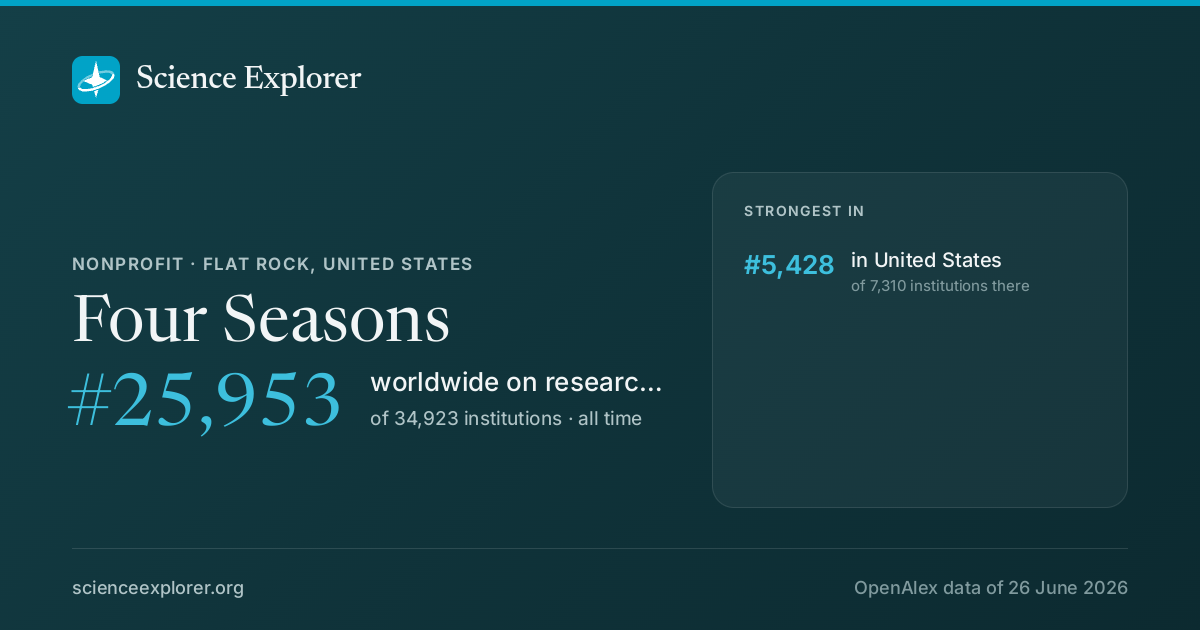
Four Seasons on Science Explorer

A card with Four Seasons's standing and the fields it leads in, for a post or a slide. A link to this page previews as the same card.

Download the card

1200 × 630 PNG, sized for social posts, drawn from the latest snapshot.

Badges for a website1Each links back here and updates with every snapshot

Research measures only: rankings here say nothing about teaching, admissions or student experience. Comparable institutions and collaboration partners have tabs of their own, above.

Discussion

Ask a question or share a note about Four Seasons. Keep it to the research: no personal attacks, advertising or links. Any reader can report a post, which collapses it for everyone until it is opened.
