FPT University
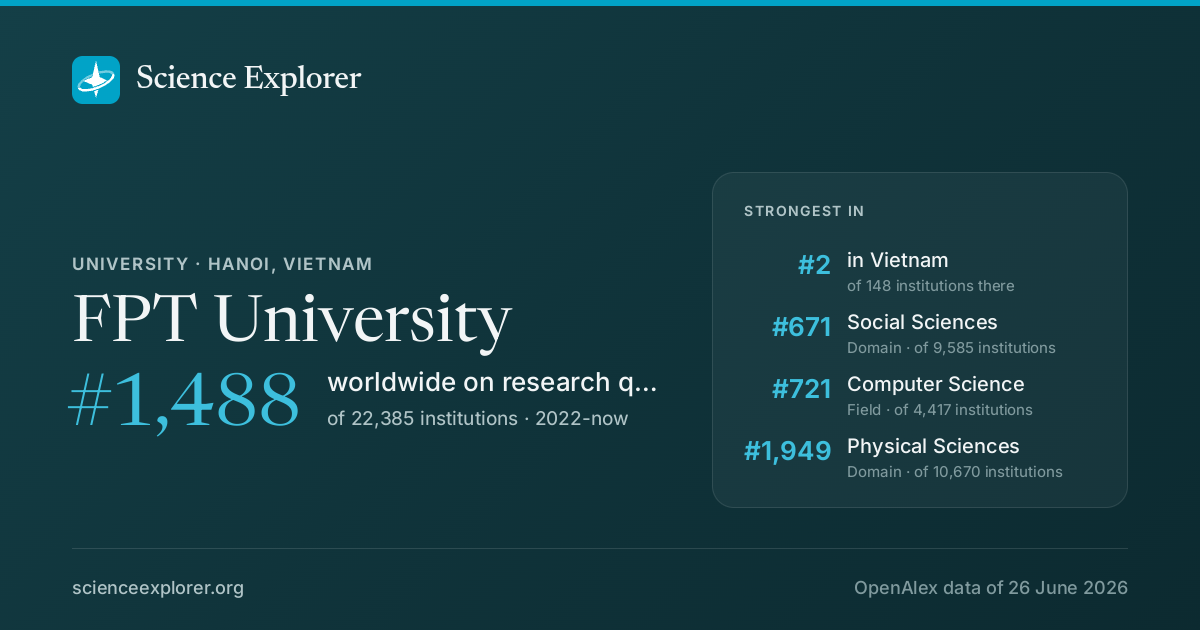
In research, FPT University stands highest in Social Sciences (#671 of 9,585 worldwide), Social Sciences (#885 of 5,988 worldwide) and Computer Science (#721 of 4,417 worldwide), 2022-now. Relative to its size it is most specialised in Information Systems and Management, Computer Science Applications and Marketing (Information Systems and Management is 7.6× its share of world research).
- World rank, 2022-now
- #1,488 of 22,385 · #3,557 all time
- Rank in Vietnam
- #2 of 148
- Research works
- 2.4k ▲ 306% vs 2018-21
- Citations
- 12k 5.0 per fractional work
- Top-10% rate
- 10.4% all institutions 10.0%
- vs its own fields
- 1.11× 1.00× is exactly expected
- Open access
- 41% world 40%
- International
- 16% world 18%
What is FPT University known for in research?
The fields where it stands highest, 2022-now, ranked among every institution above the floor in each field.
| Field | World rank | Where that sits | Top-10% rate | Works | All time |
|---|---|---|---|---|---|
| Social SciencesDomain | #671 of 9,585 | 15.2% | 683 | #1586 | |
| Social SciencesField | #885 of 5,988 | 16.1% | 278 | #2169 | |
| Computer ScienceField | #721 of 4,417 | 6.0% | 519 | #1450 | |
| Physical SciencesDomain | #1,949 of 10,670 | 6.8% | 824 | #3700 | |
| PsychologyField | #538 of 2,121 | 11.4% | 63 | - | |
| Business, Management and AccountingField | #682 of 2,581 | 16.5% | 180 | #1468 | |
| EngineeringField | #1,572 of 5,901 | 8.7% | 185 | #3392 | |
| EducationSubfield | #556 of 1,930 | 19.7% | 119 | #1410 | |
| Life SciencesDomain | #2,509 of 6,403 | 11.2% | 76 | - | |
| Artificial IntelligenceSubfield | #748 of 1,862 | 6.8% | 139 | #1316 |
Each strip is that field's whole ranked pool, with the notch where FPT University sits in it, in the colour of the band that rank falls in. The track under the rate is the rate itself: it carries no average mark, because the average differs by field (from about 6% in Dentistry to 21% in Economics).
Which of those standings moved
The same fields on both windows: where it stood over the whole record, and where it stands in 2022-now. The distance is the story, and it is the one thing the two rank columns above cannot show.
- Social Sciences#1,586 #671
- Social Sciences#2,169 #885
- Computer Science#1,450 #721
- Physical Sciences#3,700 #1,949
- Business, Management and Accounting#1,468 #682
- Engineering#3,392 #1,572
- Education#1,410 #556
- Artificial Intelligence#1,316 #748
A dot further right is a better standing. Fields it was not ranked in over the whole record are left out.
Which fields of science does FPT University work in?
In 2022-now, 50% of research at FPT University is in Physical Sciences, 41% in Social Sciences. Its largest fields are Computer Science (31%), Social Sciences (16%), Engineering (11%). It does 1.6× the world's share of Social Sciences.
Each ring splits the one inside it: the four domains of science, their fields, their subfields. Size is fractional works in 2022-now. Every slice is a page; the interactive view zooms down to single topics and colours each by how much more of it this institution does than the world.
Its 4 domains and 25 fields, with their numbers
- Physical Sciences95850.0%
- Computer Science60031.4%
- Engineering21311.1%
- Mathematics633.3%
- Environmental Science432.3%
- Chemistry130.7%
- Physics and Astronomy90.4%
- Materials Science70.3%
- Energy50.3%
- Earth and Planetary Sciences40.2%
- Chemical Engineering10.1%
- Social Sciences77840.6%
- Social Sciences30916.2%
- Business, Management and Accounting20510.7%
- Decision Sciences814.2%
- Psychology723.8%
- Economics, Econometrics and Finance623.3%
- Arts and Humanities482.5%
- Life Sciences904.7%
- Health Sciences884.6%
- Medicine643.4%
- Health Professions181.0%
- Nursing40.2%
- Dentistry20.1%
- Veterinary00.0%
What does FPT University specialise in?
Where its research is concentrated relative to its size: Information Systems and Management takes 7.6× the share of its output that it takes of world research.
- Information Systems and ManagementSubfield · 41.3 works7.6×
- Computer Science ApplicationsSubfield · 35.6 works7.5×
- MarketingSubfield · 54.3 works6.7×
- Signal ProcessingSubfield · 35.6 works6.1×
- Computer Vision and Pattern RecognitionSubfield · 128.3 works5.3×
Location quotient, a volume reading rather than an impact one. It surfaces small, lopsided specialities.
Field profile
Location quotient across every field it publishes in: outside the ring is more than an institution of this size would be expected to publish, inside it is less.
Rings at 0.5×, 1× and 2×. Widest outward: Decision Sciences, 4.4×. Every wedge is a field page.
All 25 fields, with their numbers
- Decision Sciences4.36×81 works
- Computer Science4.03×600 works
- Business, Management and Accounting3.33×205 works
- Mathematics2.82×63 works
- Economics, Econometrics and Finance1.52×62 works
- Social Sciences1.28×309 works
- Psychology1.24×72 works
- Arts and Humanities0.86×48 works
- Engineering0.74×213 works
- Agricultural and Biological Sciences0.66×60 works
- Environmental Science0.46×43 works
- Nursing0.43×4 works
- Chemistry0.42×12 works
- Neuroscience0.41×13 works
- Health Professions0.36×18 works
- Energy0.29×5 works
- Physics and Astronomy0.20×9 works
- Dentistry0.17×2 works
- Medicine0.17×64 works
- Veterinary0.17×0 works
- Biochemistry, Genetics and Molecular Biology0.16×16 works
- Chemical Engineering0.16×1 works
- Earth and Planetary Sciences0.14×4 works
- Materials Science0.10×6 works
- Immunology and Microbiology0.07×1 works
- Decision Sciences 4.4×
- Computer Science 4.0×
- Business, Management and Accounting 3.3×
- Mathematics 2.8×
- Economics, Econometrics and Finance 1.5×
- Social Sciences 1.3×
- Psychology 1.2×
- Arts and Humanities 0.9×
- Engineering 0.7×
- Agricultural and Biological Sciences 0.7×
- Environmental Science 0.5×
- Nursing 0.4×
- Chemistry 0.4×
- Neuroscience 0.4×
- Health Professions 0.4×
- Energy 0.3×
- Physics and Astronomy 0.2×
- Dentistry 0.2×
- Medicine 0.2×
- Veterinary 0.2×
- Biochemistry, Genetics and Molecular Biology 0.2×
- Chemical Engineering 0.2×
- Earth and Planetary Sciences 0.1×
- Materials Science 0.1×
- Immunology and Microbiology 0.1×
Who are the top researchers at FPT University?
Ranked on the quality score, Thi Thuy An Ngo, Ha Van Le and Ha Xuan Son lead among researchers whose main affiliation is FPT University.
- 1
Thi Thuy An Ngo
 Vietnam · #57,262 worldwide
957 citations · 51 works
- 2
Ha Van Le
Vietnam · #121,925 worldwide
400 citations · 39 works
- 3
Ha Xuan Son
Vietnam · #152,357 worldwide
1.1k citations · 47 works
- 4
Long Quoc Nguyen
Vietnam · #387,839 worldwide
248 citations · 21 works
- 5
Phi-Hung Nguyen
Vietnam · #418,767 worldwide
1.1k citations · 88 works
- 6
Quan Hoang Nguyen Tran
Vietnam · #552,287 worldwide
440 citations · 40 works
- 7
M. T. Tran
Vietnam · #659,376 worldwide
1.3k citations · 24 works
- 8
Minh Hoang Dang
Vietnam · #671,686 worldwide
304 citations · 32 works
- 9
Luan Thanh Le
Vietnam · #825,933 worldwide
366 citations · 18 works
- 10
Nghi D. Q. Bui
Vietnam · #872,775 worldwide
412 citations · 61 works
Which keywords describe research at FPT University?
By fractional works in 2022-now, weighted toward what it does more of than the world: Deep Learning, Machine Learning, Neural Networks, Convolutional Neural Networks, Online Learning, Internet of Things, Supply Chain Management and Healthcare.
- MOOCs
- Distance Education
- Electronic Word-of-Mouth
- Customer Experience
- Consumer Trust
- Technology Acceptance Model
- Online Shopping
- Cryptocurrencies
- User Satisfaction
- Smart Contracts
- E-commerce
- Consumer Behavior
- Big Data
- Student Engagement
- Social Media
- Supply Chain Management
- Internet of Things
- Online Learning
- Convolutional Neural Networks
- Machine Learning
- Deep Learning
- Neural Networks
- Artificial Intelligence
- Healthcare
- Educational Technology
- E-Learning
- Security
- Privacy
- Higher Education
- Student Satisfaction
- Technology Integration
- Blockchain
- Information Systems
- Decentralization
- Structural Equation Modeling
- Feature Extraction
- Partial Least Squares
- Consumer Engagement
- Learning Analytics
- Security and Privacy
Size is fractional works in 2022-now in the topics tagged with each word; colour is the word's share of this institution's work against its share of the world's. The 40 words are chosen for being large and distinctive. Each links to the topic it comes from most.
All 40 words, with their numbers
- Deep Learning316▲ 4.8×74 topics
- Machine Learning215▲ 3.4×81 topics
- Neural Networks115▲ 3.9×36 topics
- Convolutional Neural Networks88▲ 6.3×14 topics
- Artificial Intelligence85▲ 3.1×42 topics
- Online Learning85▲ 5.3×13 topics
- Healthcare82▲ 3.8×13 topics
- Internet of Things82▲ 5.0×22 topics
- Educational Technology79▲ 3.5×30 topics
- Supply Chain Management78▲ 4.5×22 topics
- E-Learning73▲ 4.0×14 topics
- Social Media72▲ 2.7×22 topics
- Security62▲ 4.9×20 topics
- Student Engagement54▲ 7.0×12 topics
- Privacy51▲ 9.3×7 topics
- Big Data50▲ 2.7×23 topics
- Higher Education49▲ 4.8×16 topics
- Consumer Behavior47▲ 3.9×13 topics
- Student Satisfaction47▲ 13×2 topics
- E-commerce46▲ 4.2×9 topics
- Technology Integration44▲ 7.3×8 topics
- Smart Contracts42▲ 14×2 topics
- Blockchain42▲ 9.8×2 topics
- User Satisfaction42▲ 11×4 topics
- Information Systems41▲ 12×4 topics
- Cryptocurrencies41▲ 16×1 topic
- Decentralization41▲ 10×1 topic
- Online Shopping40▲ 12×2 topics
- Structural Equation Modeling40▲ 11×4 topics
- Technology Acceptance Model40▲ 13×2 topics
- Feature Extraction40▲ 4.6×10 topics
- Consumer Trust39▲ 22×1 topic
- Partial Least Squares39▲ 22×1 topic
- Customer Experience38▲ 12×3 topics
- Consumer Engagement32▲ 14×1 topic
- Electronic Word-of-Mouth32▲ 14×1 topic
- Learning Analytics31▲ 13×2 topics
- Distance Education31▲ 8.2×4 topics
- Security and Privacy29▲ 8.1×3 topics
- MOOCs29▲ 16×2 topics
Which research topics does FPT University publish most on?
By volume in 2022-now: Blockchain Technology Applications and Security, Technology Adoption and User Behaviour, Digital Marketing and Social Media and Online Learning and Analytics.
Area is fractional works; colour is the subfield each topic belongs to.
- 1 Blockchain Technology Applications and Security Information Systems 41 works
- 2 Technology Adoption and User Behaviour Information Systems and Management 39 works
- 3 Digital Marketing and Social Media Sociology and Political Science 32 works
- 4 Online Learning and Analytics Computer Science Applications 29 works
- 5 Technology-Enhanced Education Studies Education 24 works
- 6 Online and Blended Learning Education 22 works
- 7 AI in Service Interactions Artificial Intelligence 22 works
- 8 Smart Agriculture and AI Plant Science 22 works
- 9 Advanced Neural Network Applications Computer Vision and Pattern Recognition 22 works
- 10 EFL/ESL Teaching and Learning Language and Linguistics 18 works
How open and international is its research?
Against the world's own shares: the tick on each track. Both are shares of its output, so they sit on one scale and can be read against each other as well as against the world.
World: 40% of research is openly available.
World: 18% is written across borders.
How has FPT University's research output changed?
Output in 2022-2025 was 306% higher than in 2018-2021.
The same series as a ribbon: one cell per year, darker for more. The line above answers how much; this answers when.
Its share of all research
Growing output can still be a shrinking share: all of science grows. This is FPT University as a percentage of every work published that year, 0.0088% in 2024.
Fractional works of FPT University over all fractional works that year. How the balance of science has shifted.
How much of it reaches the world top 10%
Year by year, against all institutions in the same year.
Of each year's output, the share that reached the world's 10% most cited for its field and year. Peak 11.5% in 2023.
Other research institutions in Hanoi
- Vietnam Academy of Science and Technology
- Vietnam National University, Hanoi
- Hanoi University of Science and Technology
- General Department of Preventive Medicine
- Le Quy Don Technical University
- Hanoi National University of Education
- National Economics University
- Hanoi University

Share FPT University's ranking



Research measures only: rankings here say nothing about teaching, admissions or student experience. Comparable institutions and collaboration partners have tabs of their own, above.
Discussion
Ask a question or share a note about FPT University. Posts are plain text and can be reported.