GGz centraal
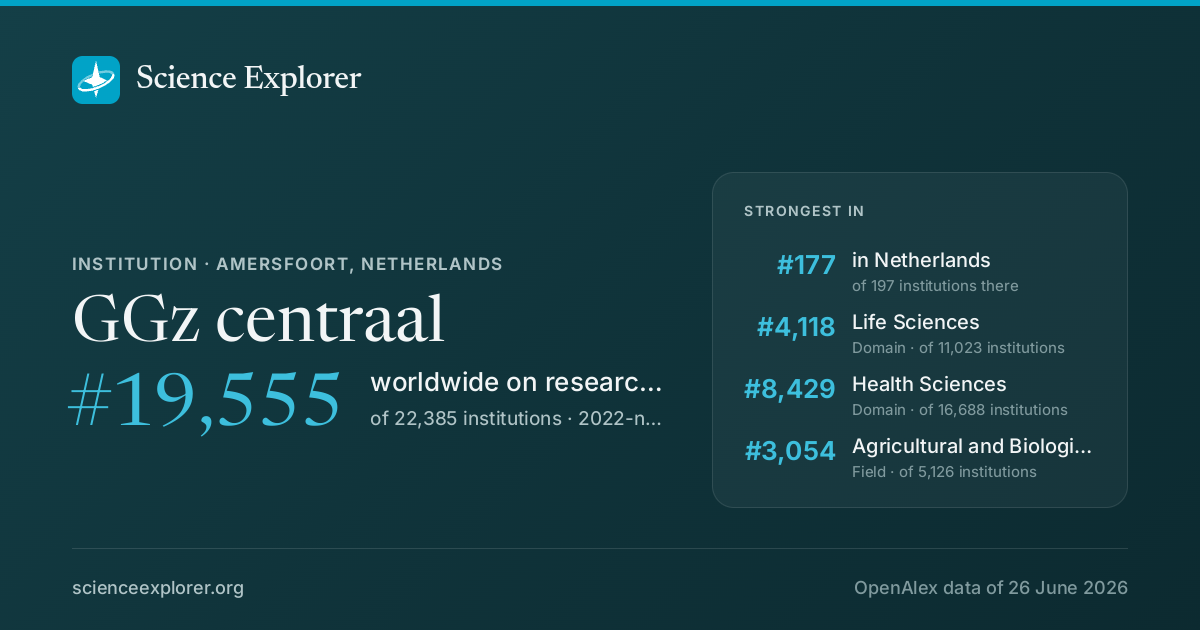
In research, GGz centraal stands highest in Life Sciences (#4,118 of 11,023 worldwide), Health Sciences (#8,429 of 16,688 worldwide) and Agricultural and Biological Sciences (#3,054 of 5,126 worldwide), over all time. Relative to its size it is most specialised in Psychology (Psychology is 8.5× its share of world research).
- World rank, 2022-now
- #19,555 of 22,385 · #9,474 all time
- Rank in Netherlands
- #177 of 197
- Research works
- 1.2k ◆ 0% vs 2018-21
- Citations
- 31k 26.7 per fractional work
- Top-10% rate
- 8.0% all institutions 10.0%
- vs its own fields
- 1.00× 1.00× is exactly expected
- Open access
- 21% world 40%
- International
- 28% world 18%
What is GGz centraal known for in research?
The fields where it stands highest, over all time, ranked among every institution above the floor in each field.
| Field | World rank | Where that sits | Top-10% rate | Works |
|---|---|---|---|---|
| Life SciencesDomain | #4,118 of 11,023 | 11.7% | 502 | |
| Health SciencesDomain | #8,429 of 16,688 | 10.2% | 243 | |
| Agricultural and Biological SciencesField | #3,054 of 5,126 | 9.7% | 246 | |
| MedicineField | #9,044 of 14,558 | 10.3% | 199 | |
| Biochemistry, Genetics and Molecular BiologyField | #3,736 of 5,801 | 14.2% | 227 | |
| Plant ScienceSubfield | #1,713 of 2,489 | 9.9% | 138 | |
| Social SciencesDomain | #11,607 of 14,833 | 8.6% | 190 | |
| Physical SciencesDomain | #14,661 of 17,446 | 12.6% | 225 |
Each strip is that field's whole ranked pool, with the notch where GGz centraal sits in it, in the colour of the band that rank falls in. The track under the rate is the rate itself: it carries no average mark, because the average differs by field (from about 6% in Dentistry to 21% in Economics).
Which fields of science does GGz centraal work in?
In 2022-now, 47% of research at GGz centraal is in Social Sciences, 34% in Health Sciences. Its largest fields are Psychology (26%), Medicine (24%), Social Sciences (13%). It does 1.8× the world's share of Social Sciences.
Each ring splits the one inside it: the four domains of science, their fields, their subfields. Size is fractional works in 2022-now. Every slice is a page; the interactive view zooms down to single topics and colours each by how much more of it this institution does than the world.
Its 4 domains and 22 fields, with their numbers
- Social Sciences3647.1%
- Psychology2025.9%
- Social Sciences1012.8%
- Arts and Humanities45.1%
- Economics, Econometrics and Finance22.0%
- Business, Management and Accounting10.8%
- Decision Sciences00.5%
- Health Sciences2633.8%
- Medicine1924.3%
- Health Professions78.7%
- Veterinary00.4%
- Dentistry00.2%
- Nursing00.1%
- Physical Sciences810.8%
- Engineering45.4%
- Computer Science33.6%
- Environmental Science10.8%
- Materials Science00.4%
- Earth and Planetary Sciences00.4%
- Mathematics00.2%
- Energy00.1%
- Life Sciences68.3%
What does GGz centraal specialise in?
Where its research is concentrated relative to its size: Psychology takes 8.5× the share of its output that it takes of world research.
- PsychologyField · 20.0 works8.5×
Location quotient, a volume reading rather than an impact one. It surfaces small, lopsided specialities.
Field profile
Location quotient across every field it publishes in: outside the ring is more than an institution of this size would be expected to publish, inside it is less.
Rings at 0.5×, 1× and 2×. Widest outward: Psychology, 8.5×. Every wedge is a field page.
All 22 fields, with their numbers
- Psychology8.51×20 works
- Health Professions3.30×7 works
- Neuroscience3.26×4 works
- Veterinary3.25×0 works
- Arts and Humanities1.76×4 works
- Medicine1.26×19 works
- Social Sciences1.01×10 works
- Economics, Econometrics and Finance0.94×2 works
- Decision Sciences0.47×0 works
- Computer Science0.46×3 works
- Dentistry0.44×0 works
- Engineering0.36×4 works
- Agricultural and Biological Sciences0.31×1 works
- Nursing0.29×0 works
- Biochemistry, Genetics and Molecular Biology0.28×1 works
- Business, Management and Accounting0.26×1 works
- Earth and Planetary Sciences0.23×0 works
- Environmental Science0.16×1 works
- Mathematics0.15×0 works
- Materials Science0.12×0 works
- Energy0.09×0 works
- Pharmacology, Toxicology and Pharmaceutics0.04×0 works
- Psychology 8.5×
- Health Professions 3.3×
- Neuroscience 3.3×
- Veterinary 3.2×
- Arts and Humanities 1.8×
- Medicine 1.3×
- Social Sciences 1.0×
- Economics, Econometrics and Finance 0.9×
- Decision Sciences 0.5×
- Computer Science 0.5×
- Dentistry 0.4×
- Engineering 0.4×
- Agricultural and Biological Sciences 0.3×
- Nursing 0.3×
- Biochemistry, Genetics and Molecular Biology 0.3×
- Business, Management and Accounting 0.3×
- Earth and Planetary Sciences 0.2×
- Environmental Science 0.2×
- Mathematics 0.1×
- Materials Science 0.1×
- Energy 0.1×
- Pharmacology, Toxicology and Pharmaceutics 0.0×
Who are the top researchers at GGz centraal?
Ranked on the quality score, Jeroen Deenik, L. C. E. Struik and J. Heijboer lead among researchers whose main affiliation is GGz centraal.
- 1
Jeroen Deenik
 Netherlands · #728,210 worldwide
1.8k citations · 78 works
- 2
L. C. E. Struik
Netherlands · #1,099,936 worldwide
3.9k citations · 51 works
- 3
J. Heijboer
Netherlands · #1,103,091 worldwide
899 citations · 19 works
- 4
Pieter Roberto Bakker
Netherlands · #1,481,292 worldwide
1k citations · 54 works
- 5
Han Berghuis
Netherlands · #1,583,817 worldwide
755 citations · 38 works
- 6
Yvette Roke
Netherlands · #1,925,001 worldwide
372 citations · 38 works
- 7
F.J. Ritter
Netherlands · #2,059,798 worldwide
1.4k citations · 56 works
- 8
W. Gams
Netherlands · #2,132,258 worldwide
18k citations · 339 works
- 9
C. M. van Herk
Netherlands · #2,149,257 worldwide
1.1k citations · 29 works
- 10
C. J. Persoons
Netherlands · #2,367,946 worldwide
993 citations · 39 works
Which keywords describe research at GGz centraal?
By fractional works in 2022-now, weighted toward what it does more of than the world: Depression, Genetics, Anxiety, Meta-Analysis, Psychopathology, Prevalence, Mental Health and Social Cognition.
- Patient Engagement
- Evidence-Based Practice
- DSM-5
- Social Support
- Neurodevelopmental Disorders
- Executive Functioning
- Personality Traits
- Mental Disorders
- Brain Connectivity
- Cognitive Behavioral Therapy
- Neurocognitive Deficits
- Antipsychotic Drugs
- Metabolic Syndrome
- Autism Spectrum Disorders
- Social Cognition
- Public Health
- Quality of Life
- Meta-Analysis
- Anxiety
- Epidemiology
- Depression
- Genetics
- Mental Health
- Psychopathology
- Prevalence
- Cognitive Therapy
- Well-being
- Adherence
- Mobile Health
- Comorbidity
- Neurobiological Correlates
- Neurobiology
- Emotion Recognition
- Neuroanatomy
- Behavioral Activation
- Internet-based Interventions
- Social Skills Interventions
- Borderline Personality Disorder
- Emotion Regulation
- Neuroimaging
Size is fractional works in 2022-now in the topics tagged with each word; colour is the word's share of this institution's work against its share of the world's. The 40 words are chosen for being large and distinctive. Each links to the topic it comes from most.
All 40 words, with their numbers
- Depression7▲ 11×14 topics
- Epidemiology6▲ 2.1×15 topics
- Genetics5▲ 9.9×7 topics
- Anxiety5▲ 14×9 topics
- Mental Health5▲ 4.6×19 topics
- Meta-Analysis5▲ 10×8 topics
- Psychopathology4▲ 33×3 topics
- Quality of Life4▲ 3.9×14 topics
- Prevalence4▲ 13×7 topics
- Public Health4▲ 3.1×13 topics
- Cognitive Therapy3▲ 39×3 topics
- Social Cognition3▲ 24×3 topics
- Well-being3▲ 11×8 topics
- Autism Spectrum Disorders3▲ 42×2 topics
- Adherence3▲ 33×2 topics
- Metabolic Syndrome3▲ 5.0×3 topics
- Mobile Health3▲ 28×2 topics
- Antipsychotic Drugs3▲ 98×1 topic
- Comorbidity3▲ 34×4 topics
- Neurocognitive Deficits3▲ 98×1 topic
- Neurobiological Correlates3▲ 37×3 topics
- Cognitive Behavioral Therapy3▲ 26×2 topics
- Neurobiology3▲ 14×7 topics
- Brain Connectivity3▲ 37×2 topics
- Emotion Recognition3▲ 18×2 topics
- Mental Disorders3▲ 29×3 topics
- Neuroanatomy3▲ 32×2 topics
- Personality Traits3▲ 26×2 topics
- Behavioral Activation2▲ 49×1 topic
- Executive Functioning2▲ 26×1 topic
- Internet-based Interventions2▲ 49×1 topic
- Neurodevelopmental Disorders2▲ 25×2 topics
- Social Skills Interventions2▲ 51×1 topic
- Social Support2▲ 6.0×7 topics
- Borderline Personality Disorder2▲ 147×1 topic
- DSM-52▲ 147×1 topic
- Emotion Regulation2▲ 8.4×6 topics
- Evidence-Based Practice2▲ 20×5 topics
- Neuroimaging2▲ 9.9×5 topics
- Patient Engagement2▲ 20×3 topics
Which research topics does GGz centraal publish most on?
By volume in 2022-now: Schizophrenia research and treatment, Digital Mental Health Interventions, Autism Spectrum Disorder Research and Personality Disorders and Psychopathology.
Area is fractional works; colour is the subfield each topic belongs to.
- 1 Schizophrenia research and treatment Psychiatry and Mental health 3 works
- 2 Digital Mental Health Interventions Applied Psychology 2 works
- 3 Autism Spectrum Disorder Research Cognitive Neuroscience 2 works
- 4 Personality Disorders and Psychopathology Clinical Psychology 2 works
- 5 Attention Deficit Hyperactivity Disorder Psychiatry and Mental health 2 works
- 6 Mental Health Research Topics Experimental and Cognitive Psychology 2 works
- 7 Family and Disability Support Research Clinical Psychology 1 works
- 8 Mental Health and Patient Involvement General Health Professions 1 works
- 9 Dutch Social and Cultural Studies Education 1 works
- 10 Fashion and Cultural Textiles Museology 1 works
How open and international is its research?
Against the world's own shares: the tick on each track. Both are shares of its output, so they sit on one scale and can be read against each other as well as against the world.
World: 40% of research is openly available.
World: 18% is written across borders.
How has GGz centraal's research output changed?
Output in 2022-2025 was 0% higher than in 2018-2021.
The same series as a ribbon: one cell per year, darker for more. The line above answers how much; this answers when.
Its share of all research
Growing output can still be a shrinking share: all of science grows. This is GGz centraal as a percentage of every work published that year, 0.00026% in 2024.
Fractional works of GGz centraal over all fractional works that year. How the balance of science has shifted.
How much of it reaches the world top 10%
Year by year, against all institutions in the same year.
Of each year's output, the share that reached the world's 10% most cited for its field and year. Peak 18.4% in 2005.
Other research institutions in Amersfoort
- 's Heeren Loo
- Meander Medisch Centrum
- Koninklijk Nederlands Genootschap voor Fysiotherapie
- FrieslandCampina (Netherlands)
- Cultural Heritage Agency of Netherlands
- Royal HaskoningDHV (Netherlands)
- M&I/Partners
- SOMT University of Physiotherapy

Share GGz centraal's ranking
Badges for a website1Each links back here and updates with every snapshot

Research measures only: rankings here say nothing about teaching, admissions or student experience. Comparable institutions and collaboration partners have tabs of their own, above.
Discussion
Ask a question or share a note about GGz centraal. Posts are plain text and can be reported.