Science Explorer Back to mapMap
Discussion
University · Lamoni · United States

Graceland University

In research, Graceland University stands highest in Social Sciences (#7,709 of 14,833 worldwide), over all time.

World rank, all time
#24,949
of 34,923
Rank in United States
#5,197
of 7,310
Research works
241
▼ 27% vs 2018-21
Citations
3k
12.6 per fractional work
Top-10% rate
6.4%
all institutions 10.0%
vs its own fields
0.93×
1.00× is exactly expected
Open access
24%
world 40%
International
9%
world 18%

What is Graceland University known for in research?

The fields where it stands highest, over all time, ranked among every institution above the floor in each field.

FieldWorld rankWhere that sitsTop-10% rateWorks
Social SciencesDomain #7,709 of 14,833 6.9%171

Each strip is that field's whole ranked pool, with the notch where Graceland University sits in it, in the colour of the band that rank falls in. The track under the rate is the rate itself: it carries no average mark, because the average differs by field (from about 6% in Dentistry to 21% in Economics).

Which fields of science does Graceland University work in?

In 2022-now, 60% of research at Graceland University is in Social Sciences, 25% in Health Sciences. Its largest fields are Social Sciences (18%), Medicine (17%), Business, Management and Accounting (16%). It does 2.0× the world's share of Social Sciences.

Social Sciences: 20 fractional works · 60.4% of its workSocial Sciences: 6 fractional works · 18.1% of its workSociology and Political Science: 3 fractional works · 8.0% of its workAnthropology: 1 fractional works · 2.8% of its workGender Studies: 1 fractional works · 2.2% of its workPolitical Science and International Relations: 1 fractional works · 2.1% of its workEducation: 0 fractional works · 1.2% of its workCommunication: 0 fractional works · 1.0% of its workCultural Studies: 0 fractional works · 0.6% of its workGeneral Social Sciences: 0 fractional works · 0.2% of its workBusiness, Management and Accounting: 5 fractional works · 15.6% of its workAccounting: 1 fractional works · 4.4% of its workMarketing: 1 fractional works · 3.0% of its workOrganizational Behavior and Human Resource Management: 1 fractional works · 2.2% of its workManagement Information Systems: 1 fractional works · 1.8% of its workBusiness and International Management: 0 fractional works · 1.5% of its workManagement of Technology and Innovation: 0 fractional works · 1.5% of its workStrategy and Management: 0 fractional works · 1.2% of its workPsychology: 4 fractional works · 13.2% of its workClinical Psychology: 2 fractional works · 5.1% of its workGeneral Psychology: 1 fractional works · 4.1% of its workSocial Psychology: 1 fractional works · 2.2% of its workApplied Psychology: 0 fractional works · 1.5% of its workExperimental and Cognitive Psychology: 0 fractional works · 0.3% of its workArts and Humanities: 2 fractional works · 6.1% of its workHistory and Philosophy of Science: 1 fractional works · 4.1% of its workHistory: 0 fractional works · 1.0% of its workReligious studies: 0 fractional works · 1.0% of its workEconomics, Econometrics and Finance: 2 fractional works · 4.8% of its workEconomics and Econometrics: 1 fractional works · 3.5% of its workFinance: 0 fractional works · 1.3% of its workDecision Sciences: 1 fractional works · 2.5% of its workInformation Systems and Management: 0 fractional works · 1.5% of its workStatistics, Probability and Uncertainty: 0 fractional works · 0.7% of its workManagement Science and Operations Research: 0 fractional works · 0.2% of its workHealth Sciences: 8 fractional works · 25.1% of its workMedicine: 5 fractional works · 16.6% of its workPublic Health, Environmental and Occupational Health: 2 fractional works · 5.2% of its workSurgery: 1 fractional works · 1.7% of its workRehabilitation: 1 fractional works · 1.7% of its workEpidemiology: 0 fractional works · 1.3% of its workOrthopedics and Sports Medicine: 0 fractional works · 1.0% of its workPediatrics, Perinatology and Child Health: 0 fractional works · 0.9% of its workPharmacology: 0 fractional works · 0.8% of its workRadiology, Nuclear Medicine and Imaging: 0 fractional works · 0.7% of its workNeurology: 0 fractional works · 0.5% of its workUrology: 0 fractional works · 0.5% of its workPhysiology: 0 fractional works · 0.4% of its workFamily Practice: 0 fractional works · 0.3% of its workOphthalmology: 0 fractional works · 0.3% of its workEmergency Medicine: 0 fractional works · 0.2% of its workPathology and Forensic Medicine: 0 fractional works · 0.2% of its workPsychiatry and Mental health: 0 fractional works · 0.2% of its workComplementary and alternative medicine: 0 fractional works · 0.2% of its workRheumatology: 0 fractional works · 0.2% of its workSmaller subfields together: 0 fractional works · 0.2% of its workHealth Professions: 2 fractional works · 7.1% of its workGeneral Health Professions: 1 fractional works · 3.3% of its workOccupational Therapy: 1 fractional works · 1.7% of its workHealth Information Management: 0 fractional works · 0.8% of its workPhysical Therapy, Sports Therapy and Rehabilitation: 0 fractional works · 0.7% of its workSpeech and Hearing: 0 fractional works · 0.5% of its workNursing: 0 fractional works · 1.3% of its workResearch and Theory: 0 fractional works · 1.0% of its workNutrition and Dietetics: 0 fractional works · 0.3% of its workPhysical Sciences: 3 fractional works · 9.3% of its workEnvironmental Science: 1 fractional works · 3.1% of its workGlobal and Planetary Change: 0 fractional works · 1.5% of its workEnvironmental Engineering: 0 fractional works · 0.7% of its workEcology: 0 fractional works · 0.6% of its workSmaller subfields together: 0 fractional works · 0.3% of its workMaterials Science: 1 fractional works · 3.1% of its workPolymers and Plastics: 0 fractional works · 1.5% of its workMaterials Chemistry: 0 fractional works · 1.0% of its workCeramics and Composites: 0 fractional works · 0.5% of its workComputer Science: 1 fractional works · 2.2% of its workArtificial Intelligence: 1 fractional works · 2.1% of its workSmaller subfields together: 0 fractional works · 0.1% of its workEngineering: 0 fractional works · 0.4% of its workBiomedical Engineering: 0 fractional works · 0.3% of its workSmaller subfields together: 0 fractional works · 0.2% of its workEnergy: 0 fractional works · 0.3% of its workRenewable Energy, Sustainability and the Environment: 0 fractional works · 0.3% of its workMathematics: 0 fractional works · 0.2% of its workLife Sciences: 2 fractional works · 5.2% of its workAgricultural and Biological Sciences: 1 fractional works · 2.3% of its workPlant Science: 0 fractional works · 1.0% of its workAgronomy and Crop Science: 0 fractional works · 0.3% of its workAquatic Science: 0 fractional works · 0.3% of its workFood Science: 0 fractional works · 0.3% of its workSmaller subfields together: 0 fractional works · 0.3% of its workBiochemistry, Genetics and Molecular Biology: 1 fractional works · 1.8% of its workMolecular Biology: 0 fractional works · 1.0% of its workGenetics: 0 fractional works · 0.6% of its workCell Biology: 0 fractional works · 0.2% of its workSmaller subfields together: 0 fractional works · 0.0% of its workNeuroscience: 0 fractional works · 1.0% of its workCognitive Neuroscience: 0 fractional works · 0.8% of its workNeurology: 0 fractional works · 0.2% of its workALL ITS WORKGracelandUniversity33fractional works, 2022-now
Life Sciences5%Physical Sciences9%Health Sciences25%Social Sciences60%

Each ring splits the one inside it: the four domains of science, their fields, their subfields. Size is fractional works in 2022-now. Every slice is a page; the interactive view zooms down to single topics and colours each by how much more of it this institution does than the world.

Its 4 domains and 18 fields, with their numbers
    1. Social Sciences618.1%
    2. Business, Management and Accounting515.6%
    3. Psychology413.2%
    4. Arts and Humanities26.1%
    5. Economics, Econometrics and Finance24.8%
    6. Decision Sciences12.5%
    1. Medicine516.6%
    2. Health Professions27.1%
    3. Nursing01.3%
    1. Environmental Science13.1%
    2. Materials Science13.1%
    3. Computer Science12.2%
    4. Engineering00.4%
    5. Energy00.3%
    6. Mathematics00.2%
    1. Agricultural and Biological Sciences12.3%
    2. Biochemistry, Genetics and Molecular Biology11.8%
    3. Neuroscience01.0%
All of science, and how each field's share has moved since 1950: the Science domain explorer

Field profile

Location quotient across every field it publishes in: outside the ring is more than an institution of this size would be expected to publish, inside it is less.

Agricultural and Biological Sciences: 0.49× its world share, 1 worksAgricultural and Bio…Biochemistry, Genetics and Molecular Biology: 0.34× its world share, 1 worksBiochemistry, Geneti…Neuroscience: 0.63× its world share, 0 worksNeuroscienceComputer Science: 0.28× its world share, 1 worksComputer ScienceEnergy: 0.36× its world share, 0 worksEnergyEngineering: 0.03× its world share, 0 worksEngineeringEnvironmental Science: 0.63× its world share, 1 worksEnvironmental ScienceMaterials Science: 0.88× its world share, 1 worksMaterials ScienceMathematics: 0.14× its world share, 0 worksMathematicsHealth Professions: 2.71× its world share, 2 worksHealth ProfessionsMedicine: 0.87× its world share, 5 worksMedicineNursing: 2.78× its world share, 0 worksNursingArts and Humanities: 2.12× its world share, 2 worksArts and HumanitiesBusiness, Management and Accounting: 4.85× its world share, 5 worksBusiness, Management…Decision Sciences: 2.60× its world share, 1 worksDecision SciencesEconomics, Econometrics and Finance: 2.25× its world share, 2 worksEconomics, Econometr…Psychology: 4.34× its world share, 4 worksPsychologySocial Sciences: 1.43× its world share, 6 worksSocial Sciences1×world share
more than its size predictsabout as predictedless

Rings at 0.5×, 1× and 2×. Widest outward: Business, Management and Accounting, 4.8×. Every wedge is a field page.

All 18 fields, with their numbers
  1. Business, Management and Accounting4.85×5 works
  2. Psychology4.34×4 works
  3. Nursing2.78×0 works
  4. Health Professions2.71×2 works
  5. Decision Sciences2.60×1 works
  6. Economics, Econometrics and Finance2.25×2 works
  7. Arts and Humanities2.12×2 works
  8. Social Sciences1.43×6 works
  9. Materials Science0.88×1 works
  10. Medicine0.87×5 works
  11. Neuroscience0.63×0 works
  12. Environmental Science0.63×1 works
  13. Agricultural and Biological Sciences0.49×1 works
  14. Energy0.36×0 works
  15. Biochemistry, Genetics and Molecular Biology0.34×1 works
  16. Computer Science0.28×1 works
  17. Mathematics0.14×0 works
  18. Engineering0.03×0 works

Who are the top researchers at Graceland University?

Ranked on the quality score, Leah Fredman, Wilaiporn Rojjanasrirat and Vladimira Varbanova lead among researchers whose main affiliation is Graceland University.

  1. 1 Leah Fredman United States · #1,818,043 worldwide 119 citations · 42 works
  2. 2 Wilaiporn Rojjanasrirat United States · #2,006,538 worldwide 3.9k citations · 30 works
  3. 3 Vladimira Varbanova United States · #2,262,706 worldwide 118 citations · 25 works
  4. 4 David O. Clark United States · #2,276,138 worldwide 88 citations · 58 works
  5. 5 Melissa Sapio United States · #2,541,554 worldwide 15 citations · 31 works
  6. 6 Cara Aloisio United States · #2,557,750 worldwide 11 citations · 30 works
  7. 7 Jacqueline Borkes United States · #2,647,500 worldwide 0 citations · 25 works
  8. 8 George A. Aiken United States · #2,730,886 worldwide 23 citations · 26 works
  9. 9 Michael Meir United States · #2,790,110 worldwide 3 citations · 19 works
  10. 10 Sally Capanzano United States · #2,818,855 worldwide 3 citations · 18 works
All ranked researchers at Graceland University

What are the most cited papers from Graceland University?

The most cited paper from Graceland University is "Translation, adaptation and validation of instruments or scales for use in cross‐cultural health care research: a clear and user‐friendly guideline" (Valmi D. Sousa, Wilaiporn Rojjanasrirat, 2010), with 3,365 citations. Next come "The Reward Deficiency Syndrome: A Biogenetic Model for the Diagnosis and Treatment of Impulsive, Addictive and Compulsive Behaviors" (979) and "Teacher Empathy: A Model of Empathy for Teaching for Student Success" (207).

Most cited papers
#PaperReleasedCitations
1 Translation, adaptation and validation of instruments or scales for use in cross‐cultural health care research: a clear and user‐friendly guideline Valmi D. Sousa, Wilaiporn Rojjanasrirat · Journal of Evaluation in Clinical Practice 28 Sep 2010 3,365
2 The Reward Deficiency Syndrome: A Biogenetic Model for the Diagnosis and Treatment of Impulsive, Addictive and Compulsive Behaviors Kenneth Blum, Eric R. Braverman, Jay M. Holder et al. · Journal of Psychoactive Drugs Nov 2000 979
3 Teacher Empathy: A Model of Empathy for Teaching for Student Success Sal Meyers, Katherine R. Rowell, M. Cyrene Wells et al. · College Teaching 9 Apr 2019 207
4 Does sustainable environmental agenda matter? The role of globalization toward energy consumption, economic growth, and carbon dioxide emissions in South Asian countries Misbah Sadiq, Desti Kannaiah, Ghulam Yahya Khan et al. · Environment Development and Sustainability 30 Jan 2022 135
5 Correlates of falls and fear of falling among adults with rheumatoid arthritis Marian Jamison, Geri Budesheim Neuberger, Peggy A. Miller · Arthritis Care & Research 7 Oct 2003 111
All 62 most cited papers, with filters and sorting

Which keywords describe research at Graceland University?

By fractional works in 2022-now, weighted toward what it does more of than the world: History, Science, Ethics, Neoliberalism, Colonialism, Feminism, Medicine and Corporate Governance.

▲ more of its work than of the world's◆ about the world's share▼ less than the world's

Size is fractional works in 2022-now in the topics tagged with each word; colour is the word's share of this institution's work against its share of the world's. The 22 words are chosen for being large and distinctive. Each links to the topic it comes from most.

All 22 words, with their numbers
  1. History3▲ 15×5 topics
  2. Science3▲ 36×4 topics
  3. Ethics2▲ 14×3 topics
  4. Neoliberalism2▲ 18×3 topics
  5. Epidemiology2▲ 1.61×13 topics
  6. Colonialism2▲ 11×5 topics
  7. Feminism2▲ 17×2 topics
  8. Medicine2▲ 61×3 topics
  9. Corporate Governance2▲ 6.6×6 topics
  10. Psychology1▲ 32×2 topics
  11. Epistemology1▲ 140×1 topic
  12. Innovation1▲ 3.8×5 topics
  13. Social Sciences1▲ 28×1 topic
  14. Sustainability1▲ 1.63×5 topics
  15. Culture1▲ 6.8×2 topics
  16. Globalization1▲ 1.90×6 topics
  17. Social Media1▲ 2.7×3 topics
  18. Well-being1▲ 9.8×2 topics
  19. Climate Change1▲ 1.29×5 topics
  20. Environmental Ethics1▲ 51×3 topics
  21. Evidence-Based Practice1▲ 26×3 topics
  22. Public Perception1▲ 23×2 topics

Which research topics does Graceland University publish most on?

By volume in 2022-now: Academic and Historical Perspectives in Psychology, History of Science and Medicine, Islamic Finance and Banking Studies and Mindfulness and Compassion Interventions.

  1. 1 Academic and Historical Perspectives in Psychology General Psychology 1 works
  2. 2 History of Science and Medicine History and Philosophy of Science 1 works
  3. 3 Islamic Finance and Banking Studies Accounting 1 works
  4. 4 Mindfulness and Compassion Interventions Clinical Psychology 1 works
  5. 5 Digital Marketing and Social Media Sociology and Political Science 1 works
  6. 6 Occupational Therapy Practice and Research Occupational Therapy 1 works
  7. 7 Innovations in Medical Education Public Health, Environmental and Occupational Health 1 works
  8. 8 Diverse Historical and Scientific Studies History and Philosophy of Science 0 works
  9. 9 Medical Education and Admissions Public Health, Environmental and Occupational Health 0 works
  10. 10 Technology Adoption and User Behaviour Information Systems and Management 0 works

How open and international is its research?

Against the world's own shares: the tick on each track. Both are shares of its output, so they sit on one scale and can be read against each other as well as against the world.

openly available23.9%not open76.1%

World: 40% of research is openly available.

with international co-authors9.1%domestic only90.9%

World: 18% is written across borders.

How has Graceland University's research output changed?

Output in 2022-2025 was 27% lower than in 2018-2021.

still counting1990200020102020
grewheldshrank

The same series as a ribbon: one cell per year, darker for more. The line above answers how much; this answers when.

Its share of all research

Growing output can still be a shrinking share: all of science grows. This is Graceland University as a percentage of every work published that year, 0.00016% in 2024.

still counting0.00050%0.0010%0.0015%Graceland University0.00012% in 202519801990200020102020

Fractional works of Graceland University over all fractional works that year. How the balance of science has shifted.

Share Graceland University's ranking
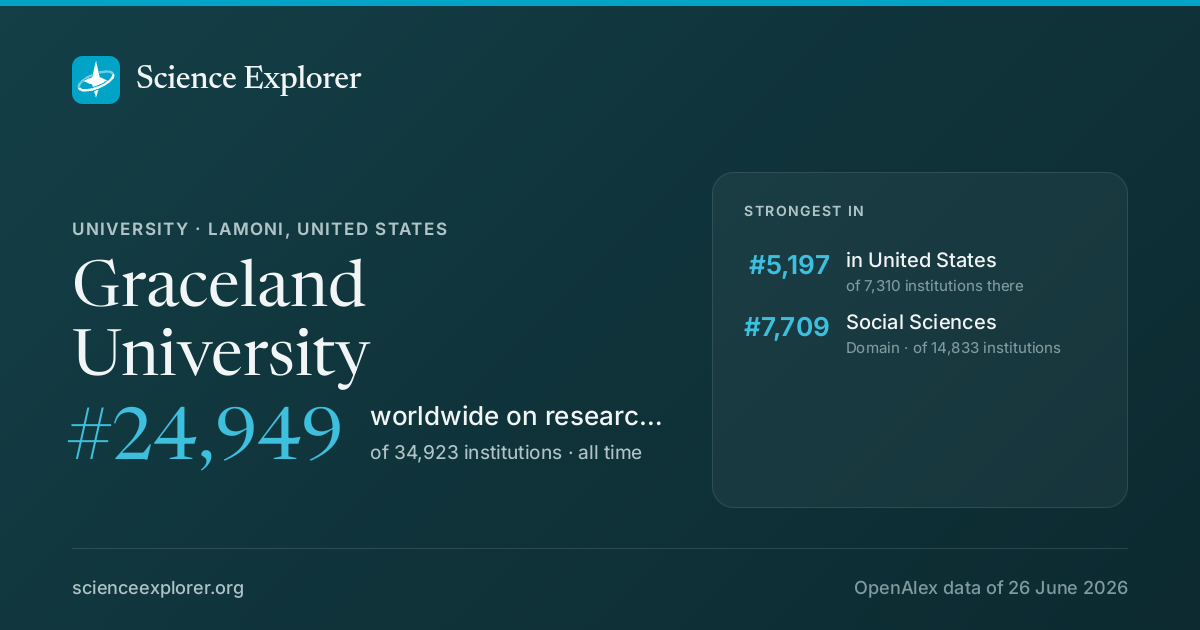
Graceland University on Science Explorer

A card with Graceland University's standing and the fields it leads in, for a post or a slide. A link to this page previews as the same card.

Download the card

1200 × 630 PNG, sized for social posts, drawn from the latest snapshot.

Badges for a website1Each links back here and updates with every snapshot

Research measures only: rankings here say nothing about teaching, admissions or student experience. Comparable institutions and collaboration partners have tabs of their own, above.

Discussion

Ask a question or share a note about Graceland University. Keep it to the research: no personal attacks, advertising or links. Any reader can report a post, which collapses it for everyone until it is opened.
