Science Explorer Back to mapMap
Discussion
Hospital / health system · Saint Paul · United States

HealthEast Care System

World rank, all time
#33,635
of 34,923
Rank in United States
#7,061
of 7,310
Research works
125
▼ 87% vs 2018-21
Citations
2.3k
18.6 per fractional work
Top-10% rate
4.9%
all institutions 10.0%
vs its own fields
0.93×
1.00× is exactly expected
Open access
25%
world 40%
International
8%
world 18%

Which fields of science does HealthEast Care System work in?

In all years, 74% of research at HealthEast Care System is in Health Sciences, 15% in Social Sciences. Its largest fields are Medicine (56%), Health Professions (16%), Social Sciences (4%). It does 3.0× the world's share of Health Sciences.

Health Sciences: 92 fractional works · 73.7% of its workMedicine: 70 fractional works · 56.3% of its workSurgery: 12 fractional works · 9.8% of its workPulmonary and Respiratory Medicine: 8 fractional works · 6.1% of its workCardiology and Cardiovascular Medicine: 7 fractional works · 5.4% of its workEpidemiology: 5 fractional works · 3.9% of its workPublic Health, Environmental and Occupational Health: 4 fractional works · 3.3% of its workNeurology: 4 fractional works · 3.1% of its workOrthopedics and Sports Medicine: 4 fractional works · 3.0% of its workEmergency Medicine: 2 fractional works · 1.8% of its workOncology: 2 fractional works · 1.8% of its workGeriatrics and Gerontology: 2 fractional works · 1.7% of its workPathology and Forensic Medicine: 2 fractional works · 1.5% of its workEndocrinology, Diabetes and Metabolism: 2 fractional works · 1.2% of its workPhysiology: 1 fractional works · 1.2% of its workCritical Care and Intensive Care Medicine: 1 fractional works · 1.1% of its workHematology: 1 fractional works · 1.1% of its workInfectious Diseases: 1 fractional works · 1.1% of its workPsychiatry and Mental health: 1 fractional works · 1.1% of its workAnesthesiology and Pain Medicine: 1 fractional works · 1.0% of its workComplementary and alternative medicine: 1 fractional works · 0.9% of its workNephrology: 1 fractional works · 0.9% of its workPediatrics, Perinatology and Child Health: 1 fractional works · 0.8% of its workRehabilitation: 1 fractional works · 0.7% of its workPharmacology: 1 fractional works · 0.7% of its workInternal Medicine: 1 fractional works · 0.6% of its workRadiology, Nuclear Medicine and Imaging: 1 fractional works · 0.5% of its workObstetrics and Gynecology: 0 fractional works · 0.4% of its workRheumatology: 0 fractional works · 0.3% of its workReproductive Medicine: 0 fractional works · 0.3% of its workBiochemistry: 0 fractional works · 0.3% of its workFamily Practice: 0 fractional works · 0.2% of its workOtorhinolaryngology: 0 fractional works · 0.2% of its workSmaller subfields together: 0 fractional works · 0.4% of its workHealth Professions: 20 fractional works · 16.2% of its workGeneral Health Professions: 9 fractional works · 7.0% of its workHealth Information Management: 3 fractional works · 2.6% of its workEmergency Medical Services: 3 fractional works · 2.1% of its workSpeech and Hearing: 2 fractional works · 1.5% of its workPharmacy: 2 fractional works · 1.2% of its workRadiological and Ultrasound Technology: 1 fractional works · 0.9% of its workOccupational Therapy: 0 fractional works · 0.4% of its workMedical Laboratory Technology: 0 fractional works · 0.3% of its workMedical Terminology: 0 fractional works · 0.3% of its workNursing: 1 fractional works · 0.9% of its workIssues, ethics and legal aspects: 1 fractional works · 0.8% of its workSmaller subfields together: 0 fractional works · 0.1% of its workDentistry: 0 fractional works · 0.2% of its workOral Surgery: 0 fractional works · 0.2% of its workSocial Sciences: 19 fractional works · 15.4% of its workSocial Sciences: 6 fractional works · 4.5% of its workSociology and Political Science: 3 fractional works · 2.6% of its workEducation: 1 fractional works · 0.6% of its workHealth: 1 fractional works · 0.5% of its workDemography: 0 fractional works · 0.4% of its workTransportation: 0 fractional works · 0.3% of its workSmaller subfields together: 0 fractional works · 0.1% of its workPsychology: 5 fractional works · 3.9% of its workClinical Psychology: 2 fractional works · 1.7% of its workExperimental and Cognitive Psychology: 1 fractional works · 1.0% of its workSocial Psychology: 1 fractional works · 1.0% of its workApplied Psychology: 0 fractional works · 0.3% of its workEconomics, Econometrics and Finance: 4 fractional works · 3.3% of its workEconomics and Econometrics: 4 fractional works · 3.3% of its workBusiness, Management and Accounting: 4 fractional works · 3.0% of its workStrategy and Management: 1 fractional works · 0.9% of its workAccounting: 1 fractional works · 0.8% of its workOrganizational Behavior and Human Resource Management: 1 fractional works · 0.7% of its workManagement Information Systems: 0 fractional works · 0.3% of its workMarketing: 0 fractional works · 0.3% of its workArts and Humanities: 1 fractional works · 0.5% of its workMuseology: 0 fractional works · 0.3% of its workSmaller subfields together: 0 fractional works · 0.2% of its workDecision Sciences: 0 fractional works · 0.3% of its workManagement Science and Operations Research: 0 fractional works · 0.3% of its workSmaller subfields together: 0 fractional works · 0.0% of its workPhysical Sciences: 9 fractional works · 6.8% of its workEngineering: 3 fractional works · 2.6% of its workMechanical Engineering: 1 fractional works · 0.8% of its workBiomedical Engineering: 1 fractional works · 0.5% of its workBuilding and Construction: 0 fractional works · 0.3% of its workComputational Mechanics: 0 fractional works · 0.3% of its workControl and Systems Engineering: 0 fractional works · 0.3% of its workSmaller subfields together: 1 fractional works · 0.4% of its workPhysics and Astronomy: 2 fractional works · 1.9% of its workAtomic and Molecular Physics, and Optics: 1 fractional works · 0.8% of its workStatistical and Nonlinear Physics: 1 fractional works · 0.5% of its workRadiation: 1 fractional works · 0.4% of its workSmaller subfields together: 0 fractional works · 0.1% of its workEnvironmental Science: 2 fractional works · 1.3% of its workHealth, Toxicology and Mutagenesis: 1 fractional works · 0.8% of its workEnvironmental Engineering: 0 fractional works · 0.3% of its workGlobal and Planetary Change: 0 fractional works · 0.3% of its workEarth and Planetary Sciences: 1 fractional works · 0.5% of its workAtmospheric Science: 1 fractional works · 0.5% of its workEnergy: 0 fractional works · 0.3% of its workRenewable Energy, Sustainability and the Environment: 0 fractional works · 0.3% of its workChemistry: 0 fractional works · 0.1% of its workChemical Engineering: 0 fractional works · 0.0% of its workLife Sciences: 5 fractional works · 4.1% of its workBiochemistry, Genetics and Molecular Biology: 2 fractional works · 1.5% of its workGenetics: 1 fractional works · 0.6% of its workClinical Biochemistry: 1 fractional works · 0.5% of its workMolecular Biology: 0 fractional works · 0.3% of its workSmaller subfields together: 0 fractional works · 0.1% of its workNeuroscience: 2 fractional works · 1.3% of its workCognitive Neuroscience: 1 fractional works · 0.9% of its workCellular and Molecular Neuroscience: 0 fractional works · 0.2% of its workSmaller subfields together: 0 fractional works · 0.2% of its workPharmacology, Toxicology and Pharmaceutics: 1 fractional works · 0.6% of its workPharmacology: 0 fractional works · 0.4% of its workSmaller subfields together: 0 fractional works · 0.2% of its workImmunology and Microbiology: 1 fractional works · 0.4% of its workAgricultural and Biological Sciences: 0 fractional works · 0.3% of its workALL ITS WORKHealthEast CareSystem125fractional works, all years
Life Sciences4%Physical Sciences7%Health Sciences74%Social Sciences15%

Each ring splits the one inside it: the four domains of science, their fields, their subfields. Size is fractional works in all years. Every slice is a page; the interactive view zooms down to single topics and colours each by how much more of it this institution does than the world.

Its 4 domains and 22 fields, with their numbers
    1. Medicine7056.3%
    2. Health Professions2016.2%
    3. Nursing10.9%
    4. Dentistry00.2%
    1. Social Sciences64.5%
    2. Psychology53.9%
    3. Economics, Econometrics and Finance43.3%
    4. Business, Management and Accounting43.0%
    5. Arts and Humanities10.5%
    6. Decision Sciences00.3%
    1. Engineering32.6%
    2. Physics and Astronomy21.9%
    3. Environmental Science21.3%
    4. Earth and Planetary Sciences10.5%
    5. Energy00.3%
    6. Chemistry00.1%
    7. Chemical Engineering00.0%
    1. Biochemistry, Genetics and Molecular Biology21.5%
    2. Neuroscience21.3%
    3. Pharmacology, Toxicology and Pharmaceutics10.6%
    4. Immunology and Microbiology10.4%
    5. Agricultural and Biological Sciences00.3%
All of science, and how each field's share has moved since 1950: the Science domain explorer

Field profile

Location quotient across every field it publishes in: outside the ring is more than an institution of this size would be expected to publish, inside it is less.

Agricultural and Biological Sciences: 1.27× its world share, 0 worksAgricultural and Bio…Biochemistry, Genetics and Molecular Biology: 1.33× its world share, 0 worksBiochemistry, Geneti…Immunology and Microbiology: 2.57× its world share, 0 worksImmunology and Micro…Neuroscience: 4.47× its world share, 0 worksNeurosciencePharmacology, Toxicology and Pharmaceutics: 2.57× its world share, 0 worksPharmacology, Toxico…Environmental Science: 0.91× its world share, 0 worksEnvironmental ScienceHealth Professions: 4.59× its world share, 0 worksHealth ProfessionsMedicine: 2.15× its world share, 1 worksMedicineBusiness, Management and Accounting: 2.81× its world share, 0 worksBusiness, Management…Economics, Econometrics and Finance: 4.24× its world share, 0 worksEconomics, Econometr…1×world share
more than its size predictsabout as predictedless

Rings at 0.5×, 1× and 2×. Widest outward: Health Professions, 4.6×. Every wedge is a field page.

All 10 fields, with their numbers
  1. Health Professions4.59×0 works
  2. Neuroscience4.47×0 works
  3. Economics, Econometrics and Finance4.24×0 works
  4. Business, Management and Accounting2.81×0 works
  5. Immunology and Microbiology2.57×0 works
  6. Pharmacology, Toxicology and Pharmaceutics2.57×0 works
  7. Medicine2.15×1 works
  8. Biochemistry, Genetics and Molecular Biology1.33×0 works
  9. Agricultural and Biological Sciences1.27×0 works
  10. Environmental Science0.91×0 works

Who are the top researchers at HealthEast Care System?

Ranked on the quality score, Susan Mehle, Christine Simonelli and Penny J. Tatman lead among researchers whose main affiliation is HealthEast Care System.

  1. 1 Susan Mehle United States · #1,140,051 worldwide 1.2k citations · 24 works
  2. 2 Christine Simonelli United States · #1,920,810 worldwide 933 citations · 26 works
  3. 3 Penny J. Tatman United States · #2,240,707 worldwide 684 citations · 21 works
  4. 4 Bill Lindsay United States · #3,454,331 worldwide 248 citations · 15 works
  5. 5 Keith Wesley United States · #3,782,803 worldwide 1.5k citations · 66 works
  6. 6 Mark A. Laliberte United States · #3,877,081 worldwide 292 citations · 15 works
  7. 7 Swaroopa Pulivarthi United States · #4,889,966 worldwide 118 citations · 16 works
  8. 8 Murali Krishna Gurram United States · #5,615,010 worldwide 159 citations · 31 works
All ranked researchers at HealthEast Care System

What are the most cited papers from HealthEast Care System?

The most cited paper from HealthEast Care System is "Recent warming by latitude associated with increased length of ragweed pollen season in central North America" (Lewis Hans Ziska, Kim Knowlton, Christine A. Rogers et al., 2011), with 395 citations. Next come "Screening Elders for Risk of Hospital Admission" (340) and "Fat phobia scale revisited: the short form" (339).

Most cited papers
#PaperReleasedCitations
1 Recent warming by latitude associated with increased length of ragweed pollen season in central North America Lewis Hans Ziska, Kim Knowlton, Christine A. Rogers et al. · Proceedings of the National Academy of Sciences Open access 22 Feb 2011 395
2 Screening Elders for Risk of Hospital Admission Chad Boult, Bryan E Dowd, David J. McCaffrey et al. · Journal of the American Geriatrics Society Aug 1993 340
3 Fat phobia scale revisited: the short form JG Bacon, KE Scheltema, BE Robinson · International Journal of Obesity Feb 2001 339
4 Weight loss and proteinuria: systematic review of clinical trials and comparative cohorts Farsad Afshinnia, Timothy J Wilt, Sue Duval et al. · Nephrology Dialysis Transplantation Review 27 Nov 2009 242
5 Fracture risk following bariatric surgery: a population-based study Koji Nakamura, Elizabeth Haglind, J. A. Clowes et al. · Osteoporosis International Open access 2 Aug 2013 231
All 59 most cited papers, with filters and sorting

Which keywords describe research at HealthEast Care System?

By fractional works in all years, weighted toward what it does more of than the world: Primary Care, Epidemiology, Patient Satisfaction, Quality Improvement, Complications, Revision Surgery, Total Hip Replacement and Quality of Life.

▲ more of its work than of the world's◆ about the world's share▼ less than the world's

Size is fractional works in all years in the topics tagged with each word; colour is the word's share of this institution's work against its share of the world's. The 40 words are chosen for being large and distinctive. Each links to the topic it comes from most.

All 40 words, with their numbers
  1. Epidemiology11▲ 2.3×35 topics
  2. Primary Care9▲ 17×9 topics
  3. Quality of Life6▲ 3.6×14 topics
  4. Patient Satisfaction6▲ 19×6 topics
  5. Public Health5▲ 3.1×18 topics
  6. Quality Improvement5▲ 20×7 topics
  7. Risk Factors5▲ 3.7×15 topics
  8. Complications5▲ 7.2×4 topics
  9. Revision Surgery4▲ 29×2 topics
  10. Total Hip Replacement4▲ 29×2 topics
  11. Management4▲ 4.3×10 topics
  12. Treatment4▲ 2.6×12 topics
  13. Mortality3▲ 5.4×8 topics
  14. Parathyroid Hormone3▲ 26×3 topics
  15. Health Care Utilization3▲ 19×3 topics
  16. Bone Mineral Density3▲ 28×1 topic
  17. Clinical Practice Guidelines3▲ 4.3×5 topics
  18. Fractures3▲ 53×1 topic
  19. Arthroplasty3▲ 28×2 topics
  20. Chronic Disease Management3▲ 16×4 topics
  21. Elderly Patients3▲ 18×4 topics
  22. Rehabilitation3▲ 6.2×6 topics
  23. Health Care Spending3▲ 33×1 topic
  24. Health-related Quality of Life3▲ 9.9×2 topics
  25. Insurance Markets3▲ 33×1 topic
  26. Meta-Analysis3▲ 3.9×5 topics
  27. Outcomes3▲ 28×1 topic
  28. Total Knee Replacement3▲ 37×1 topic
  29. Psychological Adjustment2▲ 17×4 topics
  30. Continuity of Care2▲ 29×2 topics
  31. Healthcare Quality2▲ 16×4 topics
  32. Circadian Rhythms2▲ 21×2 topics
  33. Surgery2▲ 5.4×3 topics
  34. Elderly2▲ 6.8×2 topics
  35. Health Policy2▲ 10×3 topics
  36. Patient-Centered Medical Home2▲ 32×1 topic
  37. Pay for Performance2▲ 32×1 topic
  38. Collaborative Practice2▲ 35×2 topics
  39. Inappropriate Medication Use2▲ 39×1 topic
  40. Polypharmacy2▲ 39×1 topic

Which research topics does HealthEast Care System publish most on?

By volume in 2022-now: Telemedicine and Telehealth Implementation, Healthcare Policy and Management, Total Knee Arthroplasty Outcomes and Healthcare Operations and Scheduling Optimization.

  1. 1 Telemedicine and Telehealth Implementation Public Health, Environmental and Occupational Health 0 works
  2. 2 Healthcare Policy and Management Economics and Econometrics 0 works
  3. 3 Total Knee Arthroplasty Outcomes Surgery 0 works
  4. 4 Healthcare Operations and Scheduling Optimization Emergency Medical Services 0 works
  5. 5 Healthcare Systems and Technology Organizational Behavior and Human Resource Management 0 works
  6. 6 Coronary Artery Anomalies Pulmonary and Respiratory Medicine 0 works
  7. 7 Neurotransmitter Receptor Influence on Behavior Cellular and Molecular Neuroscience 0 works
  8. 8 Tryptophan and brain disorders Biological Psychiatry 0 works
  9. 9 Treatment of Major Depression Pharmacology 0 works
  10. 10 Fermentation and Sensory Analysis Food Science 0 works

How open and international is its research?

Against the world's own shares: the tick on each track. Both are shares of its output, so they sit on one scale and can be read against each other as well as against the world.

openly available24.9%not open75.1%

World: 40% of research is openly available.

with international co-authors7.7%domestic only92.3%

World: 18% is written across borders.

How has HealthEast Care System's research output changed?

Output in 2022-2025 was 87% lower than in 2018-2021.

still counting1990200020102020
grewheldshrank

The same series as a ribbon: one cell per year, darker for more. The line above answers how much; this answers when.

Its share of all research

Growing output can still be a shrinking share: all of science grows. This is HealthEast Care System as a percentage of every work published that year, 0.000011% in 2024.

still counting0.00020%0.00040%HealthEast Care System0.0000029% in 202519801990200020102020

Fractional works of HealthEast Care System over all fractional works that year. How the balance of science has shifted.

Other research institutions in Saint Paul

All research institutions in Saint Paul

Share HealthEast Care System's ranking
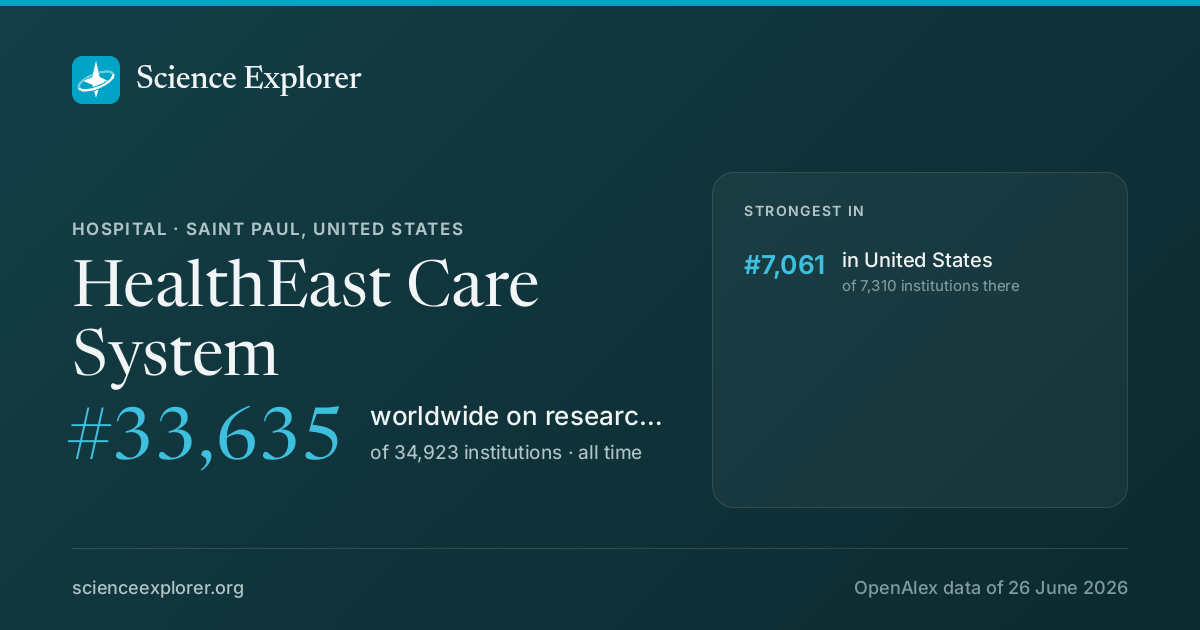
HealthEast Care System on Science Explorer

A card with HealthEast Care System's standing and the fields it leads in, for a post or a slide. A link to this page previews as the same card.

Download the card

1200 × 630 PNG, sized for social posts, drawn from the latest snapshot.

Badges for a website1Each links back here and updates with every snapshot

Research measures only: rankings here say nothing about teaching, admissions or student experience. Comparable institutions and collaboration partners have tabs of their own, above.

Discussion

Ask a question or share a note about HealthEast Care System. Keep it to the research: no personal attacks, advertising or links. Any reader can report a post, which collapses it for everyone until it is opened.