Hebei University
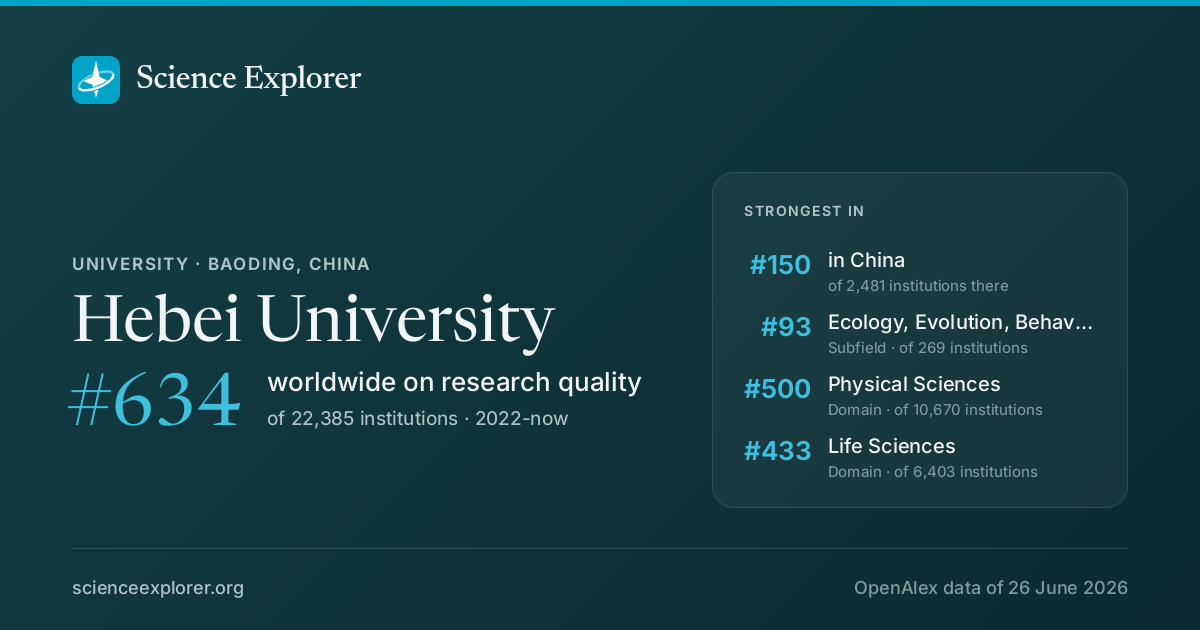
In research, Hebei University stands highest in Physical Sciences (#500 of 10,670 worldwide), Life Sciences (#433 of 6,403 worldwide) and Agricultural and Biological Sciences (#223 of 3,157 worldwide), 2022-now. Relative to its size it is most specialised in Paleontology, Ecology, Evolution, Behavior and Systematics and Spectroscopy (Paleontology is 8.5× its share of world research).
- World rank, 2022-now
- #634 of 22,385 · #933 all time
- Rank in China
- #150 of 2,481
- Research works
- 20k ▲ 113% vs 2018-21
- Citations
- 181k 9.2 per fractional work
- Top-10% rate
- 11.5% all institutions 10.0%
- vs its own fields
- 0.99× 1.00× is exactly expected
- Open access
- 24% world 40%
- International
- 6% world 18%
What is Hebei University known for in research?
The fields where it stands highest, 2022-now, ranked among every institution above the floor in each field.
| Field | World rank | Where that sits | Top-10% rate | Works | All time |
|---|---|---|---|---|---|
| Physical SciencesDomain | #500 of 10,670 | 10.8% | 3,130 | #817 | |
| Life SciencesDomain | #433 of 6,403 | 13.3% | 857 | #830 | |
| Agricultural and Biological SciencesField | #223 of 3,157 | 16.0% | 343 | #500 | |
| EngineeringField | #423 of 5,901 | 11.5% | 1,002 | #600 | |
| Materials ScienceField | #222 of 2,276 | 12.6% | 591 | #553 | |
| Electrical and Electronic EngineeringSubfield | #250 of 2,176 | 11.9% | 458 | #535 | |
| Computer ScienceField | #532 of 4,417 | 7.2% | 593 | #764 | |
| Social SciencesDomain | #1,157 of 9,585 | 10.4% | 411 | #1511 | |
| Health SciencesDomain | #1,222 of 9,902 | 13.5% | 311 | #2190 | |
| Materials ChemistrySubfield | #186 of 1,473 | 11.3% | 389 | #520 |
Each strip is that field's whole ranked pool, with the notch where Hebei University sits in it, in the colour of the band that rank falls in. The track under the rate is the rate itself: it carries no average mark, because the average differs by field (from about 6% in Dentistry to 21% in Economics).
Which of those standings moved
The same fields on both windows: where it stood over the whole record, and where it stands in 2022-now. The distance is the story, and it is the one thing the two rank columns above cannot show.
- Physical Sciences#817 #500
- Life Sciences#830 #433
- Agricultural and Biological Sciences#500 #223
- Engineering#600 #423
- Materials Science#553 #222
- Electrical and Electronic Engineering#535 #250
- Computer Science#764 #532
- Social Sciences#1,511 #1,157
- Health Sciences#2,190 #1,222
- Materials Chemistry#520 #186
A dot further right is a better standing. Fields it was not ranked in over the whole record are left out.
Which fields of science does Hebei University work in?
In 2022-now, 66% of research at Hebei University is in Physical Sciences, 19% in Life Sciences. Its largest fields are Engineering (21%), Materials Science (12%), Computer Science (12%). It does 1.7× the world's share of Physical Sciences.
Each ring splits the one inside it: the four domains of science, their fields, their subfields. Size is fractional works in 2022-now. Every slice is a page; the interactive view zooms down to single topics and colours each by how much more of it this institution does than the world.
Its 4 domains and 26 fields, with their numbers
- Physical Sciences3,54165.9%
- Engineering1,11820.8%
- Materials Science65812.3%
- Computer Science65612.2%
- Environmental Science3386.3%
- Chemistry2855.3%
- Physics and Astronomy1743.2%
- Energy1112.1%
- Earth and Planetary Sciences991.8%
- Mathematics641.2%
- Chemical Engineering370.7%
- Life Sciences1,00518.7%
- Social Sciences4598.5%
- Social Sciences1572.9%
- Business, Management and Accounting971.8%
- Psychology711.3%
- Economics, Econometrics and Finance681.3%
- Decision Sciences410.8%
- Arts and Humanities260.5%
- Health Sciences3656.8%
- Medicine3326.2%
- Health Professions180.3%
- Nursing110.2%
- Dentistry20.0%
- Veterinary10.0%
What does Hebei University specialise in?
Where its research is concentrated relative to its size: Paleontology takes 8.5× the share of its output that it takes of world research.
- PaleontologySubfield · 55.1 works8.5×
- Ecology, Evolution, Behavior and SystematicsSubfield · 119.2 works4.7×
- SpectroscopySubfield · 49.3 works4.2×
- Materials ChemistrySubfield · 432.1 works4.1×
- Inorganic ChemistrySubfield · 49.4 works3.7×
- Polymers and PlasticsSubfield · 78.3 works3.6×
Location quotient, a volume reading rather than an impact one. It surfaces small, lopsided specialities.
Field profile
Location quotient across every field it publishes in: outside the ring is more than an institution of this size would be expected to publish, inside it is less.
Rings at 0.5×, 1× and 2×. Widest outward: Materials Science, 3.5×. Every wedge is a field page.
All 26 fields, with their numbers
- Materials Science3.51×658 works
- Chemistry3.39×285 works
- Energy2.26×112 works
- Chemical Engineering1.99×37 works
- Agricultural and Biological Sciences1.60×408 works
- Computer Science1.57×656 works
- Pharmacology, Toxicology and Pharmaceutics1.55×29 works
- Biochemistry, Genetics and Molecular Biology1.50×429 works
- Physics and Astronomy1.46×174 works
- Engineering1.39×1,118 works
- Environmental Science1.27×338 works
- Earth and Planetary Sciences1.17×98 works
- Neuroscience1.05×91 works
- Mathematics1.01×64 works
- Immunology and Microbiology0.88×48 works
- Decision Sciences0.79×41 works
- Economics, Econometrics and Finance0.59×68 works
- Business, Management and Accounting0.56×97 works
- Nursing0.43×11 works
- Psychology0.43×70 works
- Medicine0.32×332 works
- Social Sciences0.23×157 works
- Arts and Humanities0.17×26 works
- Veterinary0.15×1 works
- Health Professions0.13×18 works
- Dentistry0.08×2 works
- Materials Science 3.5×
- Chemistry 3.4×
- Energy 2.3×
- Chemical Engineering 2.0×
- Agricultural and Biological Sciences 1.6×
- Computer Science 1.6×
- Pharmacology, Toxicology and Pharmaceutics 1.6×
- Biochemistry, Genetics and Molecular Biology 1.5×
- Physics and Astronomy 1.5×
- Engineering 1.4×
- Environmental Science 1.3×
- Earth and Planetary Sciences 1.2×
- Neuroscience 1.1×
- Mathematics 1.0×
- Immunology and Microbiology 0.9×
- Decision Sciences 0.8×
- Economics, Econometrics and Finance 0.6×
- Business, Management and Accounting 0.6×
- Nursing 0.4×
- Psychology 0.4×
- Medicine 0.3×
- Social Sciences 0.2×
- Arts and Humanities 0.2×
- Veterinary 0.1×
- Health Professions 0.1×
- Dentistry 0.1×
Who are the top researchers at Hebei University?
Ranked on the quality score, Ning Zhang, Huilong Du and Jianhui Zhao lead among researchers whose main affiliation is Hebei University.
- 1
Ning Zhang
 China · #23,823 worldwide
20k citations · 237 works
- 2
Huilong Du
China · #38,723 worldwide
5.5k citations · 58 works
- 3
Jianhui Zhao
China · #69,008 worldwide
6.5k citations · 104 works
- 4
Yufan Zhang
China · #88,537 worldwide
13k citations · 619 works
- 5
Yuanyuan Wang
China · #107,238 worldwide
9.1k citations · 223 works
- 6
Hao Suo
China · #107,507 worldwide
2.5k citations · 80 works
- 7
Shuaiqi Liu
China · #111,885 worldwide
3.7k citations · 184 works
- 8
Xiaobing Yan
China · #119,623 worldwide
9.1k citations · 217 works
- 9
Yaguang Li
China · #141,102 worldwide
8.9k citations · 173 works
- 10
Hongkun Xue
China · #142,933 worldwide
1.5k citations · 34 works
Which keywords describe research at Hebei University?
By fractional works in 2022-now, weighted toward what it does more of than the world: Deep Learning, Biomedical Applications, Nanomaterials, Bioimaging, Crystal Growth, Evolution, Efficiency and Nanocrystals.
- Nanocrystal Synthesis
- Perovskite Solar Cells
- Luminescent Materials
- Solar Cells
- Stability
- Rechargeable Batteries
- Drug Delivery
- Taxonomy
- Solar Cell Efficiency
- Semiconductors
- Biogeography
- DNA Barcoding
- Nanocrystals
- Crystal Growth
- Bioimaging
- Graphene
- Nanocomposites
- Energy Storage
- Nanomaterials
- Machine Learning
- Deep Learning
- Biomedical Applications
- Neural Networks
- Nanoparticles
- Catalysis
- Cathode Materials
- Efficiency
- Evolution
- Biodiversity
- Semiconductor
- Metal-Organic Frameworks
- Chemical Sensors
- Phylogeny
- Biosensors
- Photovoltaics
- Water Splitting
- Phylogenetic Analysis
- Light-Emitting Diodes
- Organometal Halide Perovskites
- Solid-State Lighting
Size is fractional works in 2022-now in the topics tagged with each word; colour is the word's share of this institution's work against its share of the world's. The 40 words are chosen for being large and distinctive. Each links to the topic it comes from most.
All 40 words, with their numbers
- Deep Learning360▲ 1.94×83 topics
- Machine Learning210▲ 1.17×79 topics
- Biomedical Applications201▲ 3.2×35 topics
- Nanomaterials191▲ 3.4×18 topics
- Neural Networks166▲ 2.0×37 topics
- Energy Storage134▲ 3.8×11 topics
- Nanoparticles133▲ 1.96×40 topics
- Nanocomposites129▲ 3.0×21 topics
- Catalysis124▲ 3.5×27 topics
- Graphene119▲ 3.3×11 topics
- Cathode Materials118▲ 5.7×3 topics
- Bioimaging117▲ 9.7×6 topics
- Efficiency117▲ 7.3×6 topics
- Crystal Growth116▲ 7.9×12 topics
- Evolution114▲ 7.9×14 topics
- Nanocrystals112▲ 8.1×5 topics
- Biodiversity110▲ 2.7×25 topics
- DNA Barcoding107▲ 11×9 topics
- Semiconductor107▲ 6.1×7 topics
- Biogeography105▲ 7.0×18 topics
- Metal-Organic Frameworks104▲ 4.7×6 topics
- Semiconductors100▲ 6.4×5 topics
- Chemical Sensors94▲ 7.6×3 topics
- Solar Cell Efficiency94▲ 17×2 topics
- Phylogeny90▲ 10.0×15 topics
- Taxonomy89▲ 11×12 topics
- Biosensors88▲ 3.3×12 topics
- Drug Delivery88▲ 3.0×16 topics
- Photovoltaics83▲ 10×4 topics
- Rechargeable Batteries81▲ 5.7×2 topics
- Water Splitting81▲ 4.1×4 topics
- Stability76▲ 6.3×7 topics
- Phylogenetic Analysis74▲ 4.4×16 topics
- Solar Cells70▲ 6.5×7 topics
- Light-Emitting Diodes60▲ 7.4×3 topics
- Luminescent Materials59▲ 16×3 topics
- Organometal Halide Perovskites58▲ 9.9×1 topic
- Perovskite Solar Cells58▲ 9.9×1 topic
- Solid-State Lighting56▲ 14×2 topics
- Nanocrystal Synthesis54▲ 22×1 topic
Which research topics does Hebei University publish most on?
By volume in 2022-now: Perovskite Materials and Applications, Luminescence Properties of Advanced Materials, Advanced Photocatalysis Techniques and Advancements in Battery Materials.
Area is fractional works; colour is the subfield each topic belongs to.
- 1 Perovskite Materials and Applications Electrical and Electronic Engineering 58 works
- 2 Luminescence Properties of Advanced Materials Materials Chemistry 54 works
- 3 Advanced Photocatalysis Techniques Renewable Energy, Sustainability and the Environment 45 works
- 4 Advancements in Battery Materials Electrical and Electronic Engineering 43 works
- 5 Luminescence and Fluorescent Materials Materials Chemistry 40 works
- 6 Chalcogenide Semiconductor Thin Films Electrical and Electronic Engineering 39 works
- 7 Advanced battery technologies research Electrical and Electronic Engineering 38 works
- 8 Advanced Battery Materials and Technologies Electrical and Electronic Engineering 37 works
- 9 Quantum Dots Synthesis And Properties Materials Chemistry 33 works
- 10 Privacy-Preserving Technologies in Data Artificial Intelligence 32 works
How open and international is its research?
Against the world's own shares: the tick on each track. Both are shares of its output, so they sit on one scale and can be read against each other as well as against the world.
World: 40% of research is openly available.
World: 18% is written across borders.
How has Hebei University's research output changed?
Output in 2022-2025 was 113% higher than in 2018-2021.
The same series as a ribbon: one cell per year, darker for more. The line above answers how much; this answers when.
Its share of all research
Growing output can still be a shrinking share: all of science grows. This is Hebei University as a percentage of every work published that year, 0.023% in 2024.
Fractional works of Hebei University over all fractional works that year. How the balance of science has shifted.
How much of it reaches the world top 10%
Year by year, against all institutions in the same year.
Of each year's output, the share that reached the world's 10% most cited for its field and year. Peak 12.7% in 2023.
Other research institutions in Baoding
- Hebei Agricultural University
- Baoding University
- Affiliated Hospital of Hebei University
- Baoding People's Hospital
- Hebei Finance University
- Great Wall Motors (China)
- Hebei Mental Health Center
Compare Hebei University with
- vs
 Science for Life Laboratory
- vs
 Consejo Nacional de Investigaciones Científicas y Técnicas
- vs
 Università della Svizzera italiana
- vs
 Medizinische Hochschule Hannover
- vs
 University of Perugia
- vs University of Pavia
Share Hebei University's ranking



Research measures only: rankings here say nothing about teaching, admissions or student experience. Comparable institutions and collaboration partners have tabs of their own, above.
Discussion
Ask a question or share a note about Hebei University. Posts are plain text and can be reported.