Science Explorer Back to mapMap
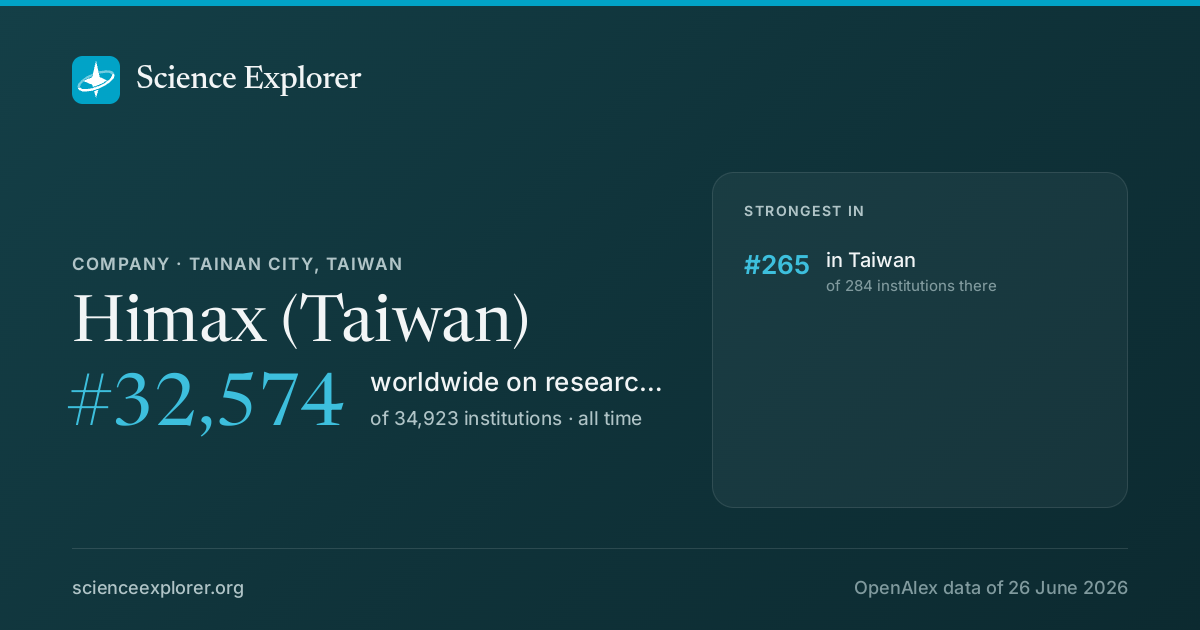
Company · Tainan City · Taiwan

Himax (Taiwan)

World rank, all time
#32,574
of 34,923
Rank in Taiwan
#265
of 284
Research works
133
▲ 80% vs 2018-21
Citations
1.2k
8.8 per fractional work
Top-10% rate
5.1%
all institutions 10.0%
vs its own fields
0.89×
1.00× is exactly expected
Open access
18%
world 40%
International
20%
world 18%

Which fields of science does Himax (Taiwan) work in?

In 2022-now, 74% of research at Himax (Taiwan) is in Physical Sciences, 16% in Social Sciences. Its largest fields are Engineering (47%), Computer Science (11%), Materials Science (7%). It does 1.7× the world's share of Physical Sciences.

Physical Sciences: 17 fractional works · 74.0% of its workEngineering: 11 fractional works · 47.3% of its workElectrical and Electronic Engineering: 5 fractional works · 20.4% of its workAerospace Engineering: 2 fractional works · 7.4% of its workMedia Technology: 1 fractional works · 5.7% of its workComputational Mechanics: 1 fractional works · 4.0% of its workBiomedical Engineering: 1 fractional works · 3.9% of its workMechanical Engineering: 0 fractional works · 1.8% of its workCivil and Structural Engineering: 0 fractional works · 1.4% of its workControl and Systems Engineering: 0 fractional works · 1.4% of its workSafety, Risk, Reliability and Quality: 0 fractional works · 0.7% of its workIndustrial and Manufacturing Engineering: 0 fractional works · 0.5% of its workComputer Science: 3 fractional works · 11.1% of its workInformation Systems: 1 fractional works · 2.6% of its workSignal Processing: 1 fractional works · 2.5% of its workComputer Vision and Pattern Recognition: 0 fractional works · 1.9% of its workArtificial Intelligence: 0 fractional works · 1.8% of its workComputer Graphics and Computer-Aided Design: 0 fractional works · 1.4% of its workComputer Networks and Communications: 0 fractional works · 0.9% of its workMaterials Science: 2 fractional works · 7.3% of its workMaterials Chemistry: 1 fractional works · 2.4% of its workCeramics and Composites: 0 fractional works · 2.1% of its workElectronic, Optical and Magnetic Materials: 0 fractional works · 2.1% of its workSurfaces, Coatings and Films: 0 fractional works · 0.7% of its workEnvironmental Science: 1 fractional works · 4.0% of its workHealth, Toxicology and Mutagenesis: 0 fractional works · 1.4% of its workEcology: 0 fractional works · 0.7% of its workManagement, Monitoring, Policy and Law: 0 fractional works · 0.7% of its workPollution: 0 fractional works · 0.7% of its workEnvironmental Engineering: 0 fractional works · 0.5% of its workEarth and Planetary Sciences: 0 fractional works · 1.9% of its workAtmospheric Science: 0 fractional works · 1.4% of its workGeology: 0 fractional works · 0.5% of its workPhysics and Astronomy: 0 fractional works · 0.9% of its workAstronomy and Astrophysics: 0 fractional works · 0.5% of its workAtomic and Molecular Physics, and Optics: 0 fractional works · 0.5% of its workChemical Engineering: 0 fractional works · 0.7% of its workFluid Flow and Transfer Processes: 0 fractional works · 0.7% of its workChemistry: 0 fractional works · 0.6% of its workSpectroscopy: 0 fractional works · 0.6% of its workMathematics: 0 fractional works · 0.1% of its workSocial Sciences: 4 fractional works · 16.4% of its workSocial Sciences: 1 fractional works · 5.9% of its workPolitical Science and International Relations: 1 fractional works · 3.6% of its workEducation: 0 fractional works · 1.4% of its workTransportation: 0 fractional works · 0.7% of its workSafety Research: 0 fractional works · 0.2% of its workEconomics, Econometrics and Finance: 1 fractional works · 3.6% of its workEconomics and Econometrics: 1 fractional works · 3.6% of its workPsychology: 1 fractional works · 2.6% of its workNeuropsychology and Physiological Psychology: 0 fractional works · 2.1% of its workSocial Psychology: 0 fractional works · 0.5% of its workArts and Humanities: 0 fractional works · 2.1% of its workLanguage and Linguistics: 0 fractional works · 2.1% of its workDecision Sciences: 0 fractional works · 2.1% of its workManagement Science and Operations Research: 0 fractional works · 2.1% of its workHealth Sciences: 1 fractional works · 5.1% of its workMedicine: 1 fractional works · 5.1% of its workHealth Informatics: 0 fractional works · 2.1% of its workEndocrinology, Diabetes and Metabolism: 0 fractional works · 1.4% of its workCardiology and Cardiovascular Medicine: 0 fractional works · 0.7% of its workPublic Health, Environmental and Occupational Health: 0 fractional works · 0.5% of its workGenetics: 0 fractional works · 0.2% of its workSmaller subfields together: 0 fractional works · 0.2% of its workLife Sciences: 1 fractional works · 4.5% of its workBiochemistry, Genetics and Molecular Biology: 1 fractional works · 3.6% of its workMolecular Biology: 1 fractional works · 2.4% of its workCancer Research: 0 fractional works · 0.7% of its workGenetics: 0 fractional works · 0.5% of its workPharmacology, Toxicology and Pharmaceutics: 0 fractional works · 0.7% of its workPharmaceutical Science: 0 fractional works · 0.7% of its workNeuroscience: 0 fractional works · 0.3% of its workCognitive Neuroscience: 0 fractional works · 0.3% of its workALL ITS WORKHimax (Taiwan)23fractional works, 2022-now
Life Sciences5%Physical Sciences74%Health Sciences5%Social Sciences16%

Each ring splits the one inside it: the four domains of science, their fields, their subfields. Size is fractional works in 2022-now. Every slice is a page; the interactive view zooms down to single topics and colours each by how much more of it this institution does than the world.

Its 4 domains and 18 fields, with their numbers
    1. Engineering1147.3%
    2. Computer Science311.1%
    3. Materials Science27.3%
    4. Environmental Science14.0%
    5. Earth and Planetary Sciences01.9%
    6. Physics and Astronomy00.9%
    7. Chemical Engineering00.7%
    8. Chemistry00.6%
    9. Mathematics00.1%
    1. Social Sciences15.9%
    2. Economics, Econometrics and Finance13.6%
    3. Psychology12.6%
    4. Arts and Humanities02.1%
    5. Decision Sciences02.1%
    1. Medicine15.1%
    1. Biochemistry, Genetics and Molecular Biology13.6%
    2. Pharmacology, Toxicology and Pharmaceutics00.7%
    3. Neuroscience00.3%
All of science, and how each field's share has moved since 1950: the Science domain explorer

Field profile

Location quotient across every field it publishes in: outside the ring is more than an institution of this size would be expected to publish, inside it is less.

Biochemistry, Genetics and Molecular Biology: 0.66× its world share, 1 worksBiochemistry, Geneti…Neuroscience: 0.16× its world share, 0 worksNeurosciencePharmacology, Toxicology and Pharmaceutics: 2.03× its world share, 0 worksPharmacology, Toxico…Chemical Engineering: 2.04× its world share, 0 worksChemical EngineeringChemistry: 0.39× its world share, 0 worksChemistryComputer Science: 1.42× its world share, 3 worksComputer ScienceEarth and Planetary Sciences: 1.21× its world share, 0 worksEarth and Planetary …Engineering: 3.15× its world share, 11 worksEngineeringEnvironmental Science: 0.81× its world share, 1 worksEnvironmental ScienceMaterials Science: 2.10× its world share, 2 worksMaterials ScienceMathematics: 0.11× its world share, 0 worksMathematicsPhysics and Astronomy: 0.43× its world share, 0 worksPhysics and AstronomyMedicine: 0.26× its world share, 1 worksMedicineArts and Humanities: 0.74× its world share, 0 worksArts and HumanitiesDecision Sciences: 2.22× its world share, 0 worksDecision SciencesEconomics, Econometrics and Finance: 1.67× its world share, 1 worksEconomics, Econometr…Psychology: 0.86× its world share, 1 worksPsychologySocial Sciences: 0.47× its world share, 1 worksSocial Sciences1×world share
more than its size predictsabout as predictedless

Rings at 0.5×, 1× and 2×. Widest outward: Engineering, 3.1×. Every wedge is a field page.

All 18 fields, with their numbers
  1. Engineering3.15×11 works
  2. Decision Sciences2.22×0 works
  3. Materials Science2.10×2 works
  4. Chemical Engineering2.04×0 works
  5. Pharmacology, Toxicology and Pharmaceutics2.03×0 works
  6. Economics, Econometrics and Finance1.67×1 works
  7. Computer Science1.42×3 works
  8. Earth and Planetary Sciences1.21×0 works
  9. Psychology0.86×1 works
  10. Environmental Science0.81×1 works
  11. Arts and Humanities0.74×0 works
  12. Biochemistry, Genetics and Molecular Biology0.66×1 works
  13. Social Sciences0.47×1 works
  14. Physics and Astronomy0.43×0 works
  15. Chemistry0.39×0 works
  16. Medicine0.26×1 works
  17. Neuroscience0.16×0 works
  18. Mathematics0.11×0 works

Who are the top researchers at Himax (Taiwan)?

Ranked on the quality score, Kuan‐Hsu Fan‐Chiang and Hsien‐Chang Tsai lead among researchers whose main affiliation is Himax (Taiwan).

  1. 1 Kuan‐Hsu Fan‐Chiang Taiwan · #3,887,400 worldwide 271 citations · 24 works
  2. 2 Hsien‐Chang Tsai Taiwan · #4,682,990 worldwide 219 citations · 35 works
All ranked researchers at Himax (Taiwan)

What are the most cited papers from Himax (Taiwan)?

The most cited paper from Himax (Taiwan) is "Tailored design of electrospun composite nanofibers with staged release of multiple angiogenic growth factors for chronic wound healing" (Huan-Ju Lai, Chen‐Hsiang Kuan, Hsi‐Chin Wu et al., 2014), with 332 citations. Next come "A 10b 100MS/s 1.13mW SAR ADC with binary-scaled error compensation" (317) and "Power Allocation for a Downlink Non-Orthogonal Multiple Access System" (185).

Most cited papers
#PaperReleasedCitations
1 Tailored design of electrospun composite nanofibers with staged release of multiple angiogenic growth factors for chronic wound healing Huan-Ju Lai, Chen‐Hsiang Kuan, Hsi‐Chin Wu et al. · Acta Biomaterialia 9 May 2014 332
2 A 10b 100MS/s 1.13mW SAR ADC with binary-scaled error compensation Chun-Cheng Liu, Soon-Jyh Chang, Guan‐Ying Huang et al. Conference paper Feb 2010 317
3 Power Allocation for a Downlink Non-Orthogonal Multiple Access System Chin-Liang Wang, Jyun-Yu Chen, Yi-Jhen Chen · IEEE Wireless Communications Letters 9 Aug 2016 185
4 Modular On-Road AGV Wireless Charging Systems Via Interoperable Power Adjustment Shyh‐Jier Huang, Tsong-Shing Lee, Weihua Li et al. · IEEE Transactions on Industrial Electronics 16 Oct 2018 100
5 A 1V 11fJ/conversion-step 10bit 10MS/s asynchronous SAR ADC in 0.18µm CMOS Chun-Cheng Liu, Soon-Jyh Chang, Guan‐Ying Huang et al. Conference paper Jun 2010 90
All 61 most cited papers, with filters and sorting

Which research topics does Himax (Taiwan) publish most on?

By volume in 2022-now: Advanced Optical Imaging Technologies, Electromagnetic Compatibility and Measurements, Surface Roughness and Optical Measurements and 3D IC and TSV technologies.

  1. 1 Advanced Optical Imaging Technologies Media Technology 1 works
  2. 2 Electromagnetic Compatibility and Measurements Electrical and Electronic Engineering 1 works
  3. 3 Surface Roughness and Optical Measurements Computational Mechanics 1 works
  4. 4 3D IC and TSV technologies Electrical and Electronic Engineering 0 works
  5. 5 Liquid Crystal Research Advancements Electronic, Optical and Magnetic Materials 0 works
  6. 6 Artificial Intelligence in Healthcare and Education Health Informatics 0 works
  7. 7 High-Temperature Coating Behaviors Aerospace Engineering 0 works
  8. 8 Blockchain Technology Applications and Security Information Systems 0 works
  9. 9 Thin-Film Transistor Technologies Electrical and Electronic Engineering 0 works
  10. 10 Electromagnetic Compatibility and Noise Suppression Electrical and Electronic Engineering 0 works

How open and international is its research?

Against the world's own shares: the tick on each track. Both are shares of its output, so they sit on one scale and can be read against each other as well as against the world.

openly available18.0%not open82.0%

World: 40% of research is openly available.

with international co-authors20.1%domestic only79.9%

World: 18% is written across borders.

How has Himax (Taiwan)'s research output changed?

Output in 2022-2025 was 80% higher than in 2018-2021.

still counting1990200020102020
grewheldshrank

The same series as a ribbon: one cell per year, darker for more. The line above answers how much; this answers when.

Its share of all research

Growing output can still be a shrinking share: all of science grows. This is Himax (Taiwan) as a percentage of every work published that year, 0.000065% in 2024.

still counting0.00020%0.00040%0.00060%Himax (Taiwan)0.00013% in 202519801990200020102020

Fractional works of Himax (Taiwan) over all fractional works that year. How the balance of science has shifted.

Other research institutions in Tainan City

All research institutions in Tainan City

Share Himax (Taiwan)'s ranking

Himax (Taiwan) on Science Explorer

A card with Himax (Taiwan)'s standing and the fields it leads in, for a post or a slide. A link to this page previews as the same card.

Download the card

1200 × 630 PNG, sized for social posts, drawn from the latest snapshot.

Badges for a website1Each links back here and updates with every snapshot

Research measures only: rankings here say nothing about teaching, admissions or student experience. Comparable institutions and collaboration partners have tabs of their own, above.

Discussion

Ask a question or share a note about Himax (Taiwan). Posts are plain text and can be reported.