Science Explorer Back to mapMap
Discussion
University · Tainan City · Taiwan

Kun Shan University

In research, Kun Shan University stands highest in Physical Sciences (#8,077 of 10,670 worldwide), 2022-now.

World rank, 2022-now
#14,153
of 22,385 · #20,808 all time
Rank in Taiwan
#125
of 185
Research works
2.3k
▼ 27% vs 2018-21
Citations
39k
17.1 per fractional work
Top-10% rate
4.6%
all institutions 10.0%
vs its own fields
0.83×
1.00× is exactly expected
Open access
19%
world 40%
International
7%
world 18%

What is Kun Shan University known for in research?

The fields where it stands highest, 2022-now, ranked among every institution above the floor in each field.

FieldWorld rankWhere that sitsTop-10% rateWorksAll time
Physical SciencesDomain #8,077 of 10,670 4.5%98 #15445

Each strip is that field's whole ranked pool, with the notch where Kun Shan University sits in it, in the colour of the band that rank falls in. The track under the rate is the rate itself: it carries no average mark, because the average differs by field (from about 6% in Dentistry to 21% in Economics).

Which fields of science does Kun Shan University work in?

In 2022-now, 65% of research at Kun Shan University is in Physical Sciences, 23% in Social Sciences. Its largest fields are Engineering (33%), Computer Science (14%), Social Sciences (9%). It does 1.7× the world's share of Physical Sciences.

Physical Sciences: 107 fractional works · 65.5% of its workEngineering: 53 fractional works · 32.5% of its workElectrical and Electronic Engineering: 18 fractional works · 11.2% of its workMechanical Engineering: 10 fractional works · 6.3% of its workControl and Systems Engineering: 6 fractional works · 3.4% of its workBiomedical Engineering: 5 fractional works · 3.4% of its workOcean Engineering: 2 fractional works · 1.3% of its workAutomotive Engineering: 2 fractional works · 1.2% of its workIndustrial and Manufacturing Engineering: 2 fractional works · 1.2% of its workComputational Mechanics: 2 fractional works · 1.1% of its workMechanics of Materials: 1 fractional works · 0.8% of its workCivil and Structural Engineering: 1 fractional works · 0.7% of its workSafety, Risk, Reliability and Quality: 1 fractional works · 0.7% of its workAerospace Engineering: 1 fractional works · 0.7% of its workMedia Technology: 1 fractional works · 0.4% of its workBuilding and Construction: 0 fractional works · 0.3% of its workComputer Science: 23 fractional works · 14.0% of its workInformation Systems: 6 fractional works · 3.8% of its workArtificial Intelligence: 5 fractional works · 3.3% of its workComputer Networks and Communications: 3 fractional works · 1.5% of its workComputer Vision and Pattern Recognition: 2 fractional works · 1.4% of its workSignal Processing: 2 fractional works · 1.3% of its workSoftware: 2 fractional works · 0.9% of its workComputer Graphics and Computer-Aided Design: 1 fractional works · 0.6% of its workHuman-Computer Interaction: 1 fractional works · 0.5% of its workComputational Theory and Mathematics: 1 fractional works · 0.4% of its workComputer Science Applications: 0 fractional works · 0.3% of its workMaterials Science: 13 fractional works · 7.7% of its workMaterials Chemistry: 6 fractional works · 3.8% of its workPolymers and Plastics: 2 fractional works · 1.5% of its workElectronic, Optical and Magnetic Materials: 2 fractional works · 1.5% of its workBiomaterials: 1 fractional works · 0.7% of its workSmaller subfields together: 0 fractional works · 0.1% of its workEnvironmental Science: 8 fractional works · 4.8% of its workManagement, Monitoring, Policy and Law: 2 fractional works · 1.1% of its workEcology: 1 fractional works · 0.9% of its workEnvironmental Engineering: 1 fractional works · 0.7% of its workNature and Landscape Conservation: 1 fractional works · 0.7% of its workHealth, Toxicology and Mutagenesis: 1 fractional works · 0.6% of its workGlobal and Planetary Change: 1 fractional works · 0.4% of its workSmaller subfields together: 0 fractional works · 0.2% of its workEnergy: 6 fractional works · 3.7% of its workRenewable Energy, Sustainability and the Environment: 6 fractional works · 3.6% of its workSmaller subfields together: 0 fractional works · 0.1% of its workChemistry: 2 fractional works · 0.9% of its workOrganic Chemistry: 1 fractional works · 0.7% of its workSmaller subfields together: 0 fractional works · 0.2% of its workEarth and Planetary Sciences: 1 fractional works · 0.7% of its workAtmospheric Science: 1 fractional works · 0.4% of its workEarth-Surface Processes: 1 fractional works · 0.4% of its workPhysics and Astronomy: 1 fractional works · 0.7% of its workCondensed Matter Physics: 1 fractional works · 0.5% of its workAtomic and Molecular Physics, and Optics: 0 fractional works · 0.2% of its workChemical Engineering: 0 fractional works · 0.3% of its workCatalysis: 0 fractional works · 0.2% of its workSmaller subfields together: 0 fractional works · 0.1% of its workMathematics: 0 fractional works · 0.1% of its workSocial Sciences: 38 fractional works · 23.2% of its workSocial Sciences: 14 fractional works · 8.8% of its workEducation: 8 fractional works · 4.9% of its workSociology and Political Science: 4 fractional works · 2.3% of its workDemography: 1 fractional works · 0.5% of its workCultural Studies: 0 fractional works · 0.3% of its workLaw: 0 fractional works · 0.3% of its workSmaller subfields together: 1 fractional works · 0.6% of its workBusiness, Management and Accounting: 13 fractional works · 7.7% of its workStrategy and Management: 4 fractional works · 2.2% of its workMarketing: 3 fractional works · 1.9% of its workOrganizational Behavior and Human Resource Management: 3 fractional works · 1.6% of its workManagement of Technology and Innovation: 2 fractional works · 1.4% of its workBusiness and International Management: 0 fractional works · 0.3% of its workAccounting: 0 fractional works · 0.2% of its workSmaller subfields together: 0 fractional works · 0.1% of its workDecision Sciences: 4 fractional works · 2.7% of its workManagement Science and Operations Research: 3 fractional works · 1.7% of its workInformation Systems and Management: 2 fractional works · 1.0% of its workPsychology: 4 fractional works · 2.3% of its workClinical Psychology: 1 fractional works · 0.7% of its workDevelopmental and Educational Psychology: 1 fractional works · 0.7% of its workSocial Psychology: 1 fractional works · 0.5% of its workSmaller subfields together: 0 fractional works · 0.2% of its workEconomics, Econometrics and Finance: 2 fractional works · 1.1% of its workEconomics and Econometrics: 2 fractional works · 1.0% of its workSmaller subfields together: 0 fractional works · 0.0% of its workArts and Humanities: 1 fractional works · 0.7% of its workLanguage and Linguistics: 1 fractional works · 0.4% of its workLiterature and Literary Theory: 0 fractional works · 0.2% of its workSmaller subfields together: 0 fractional works · 0.1% of its workLife Sciences: 9 fractional works · 5.7% of its workAgricultural and Biological Sciences: 5 fractional works · 3.1% of its workEcology, Evolution, Behavior and Systematics: 2 fractional works · 1.3% of its workFood Science: 1 fractional works · 0.6% of its workInsect Science: 1 fractional works · 0.4% of its workPlant Science: 1 fractional works · 0.4% of its workGeneral Agricultural and Biological Sciences: 0 fractional works · 0.2% of its workSmaller subfields together: 0 fractional works · 0.2% of its workBiochemistry, Genetics and Molecular Biology: 3 fractional works · 1.8% of its workMolecular Biology: 2 fractional works · 1.0% of its workGenetics: 1 fractional works · 0.3% of its workBiotechnology: 0 fractional works · 0.3% of its workSmaller subfields together: 0 fractional works · 0.2% of its workImmunology and Microbiology: 1 fractional works · 0.4% of its workImmunology: 1 fractional works · 0.4% of its workSmaller subfields together: 0 fractional works · 0.0% of its workNeuroscience: 1 fractional works · 0.4% of its workCellular and Molecular Neuroscience: 0 fractional works · 0.3% of its workSmaller subfields together: 0 fractional works · 0.1% of its workHealth Sciences: 9 fractional works · 5.6% of its workHealth Professions: 5 fractional works · 2.9% of its workHealth Information Management: 1 fractional works · 0.7% of its workRadiological and Ultrasound Technology: 1 fractional works · 0.6% of its workPhysical Therapy, Sports Therapy and Rehabilitation: 1 fractional works · 0.5% of its workMedical Laboratory Technology: 1 fractional works · 0.4% of its workOccupational Therapy: 0 fractional works · 0.2% of its workSpeech and Hearing: 0 fractional works · 0.2% of its workSmaller subfields together: 0 fractional works · 0.3% of its workMedicine: 4 fractional works · 2.5% of its workComplementary and alternative medicine: 1 fractional works · 0.8% of its workEndocrinology, Diabetes and Metabolism: 0 fractional works · 0.2% of its workSurgery: 0 fractional works · 0.2% of its workPediatrics, Perinatology and Child Health: 0 fractional works · 0.2% of its workSmaller subfields together: 2 fractional works · 1.0% of its workNursing: 0 fractional works · 0.1% of its workALL ITS WORKKun ShanUniversity163fractional works, 2022-now
Life Sciences6%Physical Sciences65%Health Sciences6%Social Sciences23%

Each ring splits the one inside it: the four domains of science, their fields, their subfields. Size is fractional works in 2022-now. Every slice is a page; the interactive view zooms down to single topics and colours each by how much more of it this institution does than the world.

Its 4 domains and 23 fields, with their numbers
    1. Engineering5332.5%
    2. Computer Science2314.0%
    3. Materials Science137.7%
    4. Environmental Science84.8%
    5. Energy63.7%
    6. Chemistry20.9%
    7. Earth and Planetary Sciences10.7%
    8. Physics and Astronomy10.7%
    9. Chemical Engineering00.3%
    10. Mathematics00.1%
    1. Social Sciences148.8%
    2. Business, Management and Accounting137.7%
    3. Decision Sciences42.7%
    4. Psychology42.3%
    5. Economics, Econometrics and Finance21.1%
    6. Arts and Humanities10.7%
    1. Agricultural and Biological Sciences53.1%
    2. Biochemistry, Genetics and Molecular Biology31.8%
    3. Immunology and Microbiology10.4%
    4. Neuroscience10.4%
    1. Health Professions52.9%
    2. Medicine42.5%
    3. Nursing00.1%
All of science, and how each field's share has moved since 1950: the Science domain explorer

Field profile

Location quotient across every field it publishes in: outside the ring is more than an institution of this size would be expected to publish, inside it is less.

Agricultural and Biological Sciences: 0.66× its world share, 5 worksAgricultural and Bio…Biochemistry, Genetics and Molecular Biology: 0.33× its world share, 3 worksBiochemistry, Geneti…Immunology and Microbiology: 0.44× its world share, 1 worksImmunology and Micro…Neuroscience: 0.24× its world share, 1 worksNeuroscienceChemical Engineering: 0.78× its world share, 0 worksChemical EngineeringChemistry: 0.59× its world share, 2 worksChemistryComputer Science: 1.80× its world share, 23 worksComputer ScienceEarth and Planetary Sciences: 0.47× its world share, 1 worksEarth and Planetary …Energy: 4.06× its world share, 6 worksEnergyEngineering: 2.17× its world share, 53 worksEngineeringEnvironmental Science: 0.96× its world share, 8 worksEnvironmental ScienceMaterials Science: 2.21× its world share, 13 worksMaterials ScienceMathematics: 0.09× its world share, 0 worksMathematicsPhysics and Astronomy: 0.30× its world share, 1 worksPhysics and AstronomyHealth Professions: 1.12× its world share, 5 worksHealth ProfessionsMedicine: 0.13× its world share, 4 worksMedicineNursing: 0.21× its world share, 0 worksNursingArts and Humanities: 0.24× its world share, 1 worksArts and HumanitiesBusiness, Management and Accounting: 2.39× its world share, 13 worksBusiness, Management…Decision Sciences: 2.77× its world share, 4 worksDecision SciencesEconomics, Econometrics and Finance: 0.50× its world share, 2 worksEconomics, Econometr…Psychology: 0.74× its world share, 4 worksPsychologySocial Sciences: 0.70× its world share, 14 worksSocial Sciences1×world share
more than its size predictsabout as predictedless

Rings at 0.5×, 1× and 2×. Widest outward: Energy, 4.1×. Every wedge is a field page.

All 23 fields, with their numbers
  1. Energy4.06×6 works
  2. Decision Sciences2.77×4 works
  3. Business, Management and Accounting2.39×13 works
  4. Materials Science2.21×13 works
  5. Engineering2.17×53 works
  6. Computer Science1.80×23 works
  7. Health Professions1.12×5 works
  8. Environmental Science0.96×8 works
  9. Chemical Engineering0.78×0 works
  10. Psychology0.74×4 works
  11. Social Sciences0.70×14 works
  12. Agricultural and Biological Sciences0.66×5 works
  13. Chemistry0.59×2 works
  14. Economics, Econometrics and Finance0.50×2 works
  15. Earth and Planetary Sciences0.47×1 works
  16. Immunology and Microbiology0.44×1 works
  17. Biochemistry, Genetics and Molecular Biology0.33×3 works
  18. Physics and Astronomy0.30×1 works
  19. Neuroscience0.24×1 works
  20. Arts and Humanities0.24×1 works
  21. Nursing0.21×0 works
  22. Medicine0.13×4 works
  23. Mathematics0.09×0 works

Who are the top researchers at Kun Shan University?

Ranked on the quality score, Fu‐Chen Chen, Wen-Lih Chen and Yeong‐Chan Chang lead among researchers whose main affiliation is Kun Shan University.

  1. 1 Fu‐Chen Chen Taiwan · #1,475,124 worldwide 3.1k citations · 103 works
  2. 2 Wen-Lih Chen Taiwan · #2,132,556 worldwide 796 citations · 39 works
  3. 3 Yeong‐Chan Chang Taiwan · #2,891,158 worldwide 1.9k citations · 42 works
  4. 4 Hsiao-Chung Lin Taiwan · #2,899,246 worldwide 542 citations · 29 works
  5. 5 Bor‐Kuan Chen Taiwan · #3,104,716 worldwide 1.3k citations · 29 works
  6. 6 Yu-Ching Yang Taiwan · #3,115,087 worldwide 749 citations · 33 works
  7. 7 Li‐Yueh Lee Taiwan · #3,256,343 worldwide 927 citations · 20 works
  8. 8 Jung-Chang Hsu Taiwan · #3,444,235 worldwide 663 citations · 16 works
  9. 9 Shuhn-Shyurng Hou Taiwan · #3,659,980 worldwide 2.1k citations · 106 works
  10. 10 Ming-Chien Hsiao Taiwan · #4,016,848 worldwide 592 citations · 22 works
All ranked researchers at Kun Shan University

What are the most cited papers from Kun Shan University?

The most cited paper from Kun Shan University is "Review on thermal energy storage with phase change materials and applications" (Atul Sharma, V.V. Tyagi, C.R. Chen et al., 2008), with 5,917 citations. Next come "Solar-energy drying systems: A review" (536) and "Online hotel booking: The effects of brand image, price, trust and value on purchase intentions" (530).

Most cited papers
#PaperReleasedCitations
1 Review on thermal energy storage with phase change materials and applications Atul Sharma, V.V. Tyagi, C.R. Chen et al. · Renewable and Sustainable Energy Reviews 11 Feb 2008 5,917
2 Solar-energy drying systems: A review Atul Sharma, C.R. Chen, Nguyen Vu Lan · Renewable and Sustainable Energy Reviews 15 Oct 2008 536
3 Online hotel booking: The effects of brand image, price, trust and value on purchase intentions Che-Hui Lien, Miin-Jye Wen, Li‐Ching Huang et al. · Asia Pacific Management Review Open access 23 Jun 2015 530
4 A Weather-Based Hybrid Method for 1-Day Ahead Hourly Forecasting of PV Power Output Hong‐Tzer Yang, Chao‐Ming Huang, Yann-Chang Huang et al. · IEEE Transactions on Sustainable Energy 18 Apr 2014 472
5 A cluster validity index for fuzzy clustering Kuo-Lung Wu, Miin‐Shen Yang · Pattern Recognition Letters 22 Dec 2004 444
All 60 most cited papers, with filters and sorting

Which keywords describe research at Kun Shan University?

By fractional works in 2022-now, weighted toward what it does more of than the world: Machine Learning, Renewable Energy, Deep Learning, Solar Energy, Renewable Energy Integration, Semiconductors, Nanomaterials and Nanostructures.

▲ more of its work than of the world's◆ about the world's share▼ less than the world's

Size is fractional works in 2022-now in the topics tagged with each word; colour is the word's share of this institution's work against its share of the world's. The 40 words are chosen for being large and distinctive. Each links to the topic it comes from most.

All 40 words, with their numbers
  1. Machine Learning16▲ 2.9×25 topics
  2. Deep Learning11▲ 2.0×24 topics
  3. Renewable Energy10▲ 4.4×20 topics
  4. Nanomaterials6▲ 3.7×10 topics
  5. Neural Networks6▲ 2.5×11 topics
  6. Artificial Intelligence5▲ 2.2×12 topics
  7. Educational Technology5▲ 2.6×12 topics
  8. Supply Chain Management5▲ 3.2×7 topics
  9. Nanostructures5▲ 7.0×6 topics
  10. Solar Energy5▲ 9.0×4 topics
  11. Energy Storage4▲ 4.1×7 topics
  12. Renewable Energy Integration4▲ 8.3×4 topics
  13. Semiconductors4▲ 9.3×4 topics
  14. E-Learning4▲ 2.7×8 topics
  15. Customer Satisfaction4▲ 8.2×6 topics
  16. IoT Security4▲ 8.3×3 topics
  17. Power Electronics4▲ 7.9×6 topics
  18. Graphene4▲ 3.7×7 topics
  19. Energy Efficiency4▲ 2.5×9 topics
  20. Leadership4▲ 4.5×6 topics
  21. Nanowires4▲ 15×5 topics
  22. Consumer Behavior4▲ 3.4×6 topics
  23. Nanocomposites4▲ 2.7×9 topics
  24. Virtual Reality3▲ 3.9×5 topics
  25. Digital Transformation3▲ 3.4×6 topics
  26. Environmental Management3▲ 4.5×4 topics
  27. Student Engagement3▲ 4.5×7 topics
  28. Behavioral Analysis3▲ 14×2 topics
  29. Neural Network3▲ 8.9×4 topics
  30. Path Planning3▲ 13×2 topics
  31. Detection2▲ 5.5×3 topics
  32. Doping2▲ 15×2 topics
  33. Grid Integration2▲ 14×3 topics
  34. Photodetectors2▲ 18×2 topics
  35. Security Analysis2▲ 8.5×2 topics
  36. Android Malware2▲ 17×1 topic
  37. Permission Analysis2▲ 17×1 topic
  38. Student Satisfaction2▲ 7.2×2 topics
  39. Solar Radiation2▲ 29×1 topic
  40. Transparent Conductors2▲ 11×2 topics

Which research topics does Kun Shan University publish most on?

By volume in 2022-now: Advanced Malware Detection Techniques, Solar Radiation and Photovoltaics, Photovoltaic System Optimization Techniques and ZnO doping and properties.

  1. 1 Advanced Malware Detection Techniques Signal Processing 2 works
  2. 2 Solar Radiation and Photovoltaics Artificial Intelligence 2 works
  3. 3 Photovoltaic System Optimization Techniques Renewable Energy, Sustainability and the Environment 2 works
  4. 4 ZnO doping and properties Materials Chemistry 2 works
  5. 5 Advanced DC-DC Converters Electrical and Electronic Engineering 2 works
  6. 6 Supercapacitor Materials and Fabrication Electronic, Optical and Magnetic Materials 2 works
  7. 7 Network Security and Intrusion Detection Computer Networks and Communications 2 works
  8. 8 Multilevel Inverters and Converters Electrical and Electronic Engineering 2 works
  9. 9 Energy Load and Power Forecasting Electrical and Electronic Engineering 2 works
  10. 10 Solar Thermal and Photovoltaic Systems Renewable Energy, Sustainability and the Environment 2 works

How open and international is its research?

Against the world's own shares: the tick on each track. Both are shares of its output, so they sit on one scale and can be read against each other as well as against the world.

openly available19.1%not open80.9%

World: 40% of research is openly available.

with international co-authors6.8%domestic only93.2%

World: 18% is written across borders.

How has Kun Shan University's research output changed?

Output in 2022-2025 was 27% lower than in 2018-2021.

still counting1990200020102020
grewheldshrank

The same series as a ribbon: one cell per year, darker for more. The line above answers how much; this answers when.

Its share of all research

Growing output can still be a shrinking share: all of science grows. This is Kun Shan University as a percentage of every work published that year, 0.00058% in 2024.

still counting0.0025%0.0050%0.0075%Kun Shan University0.00058% in 202519801990200020102020

Fractional works of Kun Shan University over all fractional works that year. How the balance of science has shifted.

How much of it reaches the world top 10%

Year by year, against all institutions in the same year.

still counting5%10%15%all institutions10.0% in 2025Kun Shan University7.2% in 202520102020

Of each year's output, the share that reached the world's 10% most cited for its field and year. Peak 13.3% in 2000.

Other research institutions in Tainan City

All research institutions in Tainan City

Share Kun Shan University's ranking
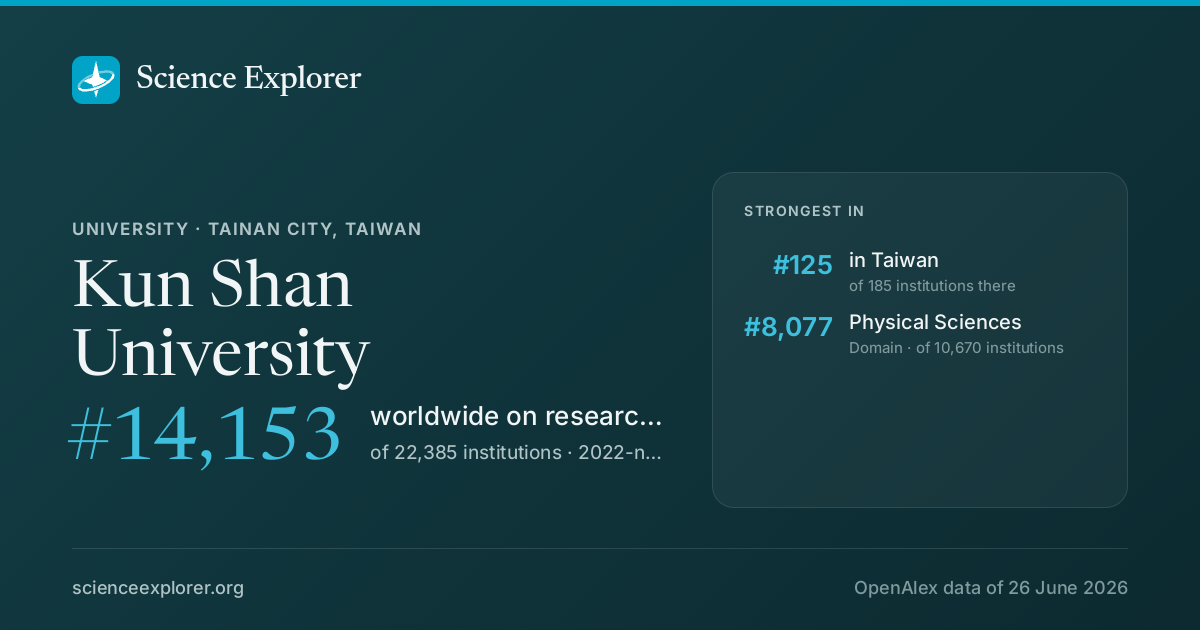
Kun Shan University on Science Explorer

A card with Kun Shan University's standing and the fields it leads in, for a post or a slide. A link to this page previews as the same card.

Download the card

1200 × 630 PNG, sized for social posts, drawn from the latest snapshot.

Badges for a website1Each links back here and updates with every snapshot

Research measures only: rankings here say nothing about teaching, admissions or student experience. Comparable institutions and collaboration partners have tabs of their own, above.

Discussion

Ask a question or share a note about Kun Shan University. Posts are plain text and can be reported.