Science Explorer Back to mapMap
Discussion

HLL Lifecare (India)

World rank, all time
#30,166
of 34,923
Rank in India
#1,421
of 1,754
Research works
128
▲ 8% vs 2018-21
Citations
2.2k
16.9 per fractional work
Top-10% rate
8.5%
all institutions 10.0%
vs its own fields
0.98×
1.00× is exactly expected
Open access
35%
world 40%
International
18%
world 18%

Which fields of science does HLL Lifecare (India) work in?

In 2022-now, 47% of research at HLL Lifecare (India) is in Physical Sciences, 29% in Health Sciences. Its largest fields are Medicine (26%), Materials Science (16%), Engineering (15%). It does 1.3× the world's share of Life Sciences.

Physical Sciences: 22 fractional works · 47.4% of its workMaterials Science: 8 fractional works · 16.4% of its workBiomaterials: 3 fractional works · 5.6% of its workPolymers and Plastics: 2 fractional works · 4.9% of its workMaterials Chemistry: 2 fractional works · 4.5% of its workElectronic, Optical and Magnetic Materials: 0 fractional works · 0.9% of its workSurfaces, Coatings and Films: 0 fractional works · 0.5% of its workEngineering: 7 fractional works · 14.6% of its workBiomedical Engineering: 3 fractional works · 6.3% of its workElectrical and Electronic Engineering: 2 fractional works · 4.4% of its workAerospace Engineering: 1 fractional works · 1.3% of its workAutomotive Engineering: 0 fractional works · 0.9% of its workIndustrial and Manufacturing Engineering: 0 fractional works · 0.7% of its workCivil and Structural Engineering: 0 fractional works · 0.2% of its workComputational Mechanics: 0 fractional works · 0.2% of its workControl and Systems Engineering: 0 fractional works · 0.2% of its workSmaller subfields together: 0 fractional works · 0.2% of its workComputer Science: 4 fractional works · 8.7% of its workComputer Vision and Pattern Recognition: 2 fractional works · 3.5% of its workInformation Systems: 1 fractional works · 2.1% of its workComputer Networks and Communications: 1 fractional works · 1.3% of its workArtificial Intelligence: 0 fractional works · 0.9% of its workSignal Processing: 0 fractional works · 0.4% of its workSoftware: 0 fractional works · 0.4% of its workComputational Theory and Mathematics: 0 fractional works · 0.2% of its workChemistry: 2 fractional works · 3.3% of its workOrganic Chemistry: 1 fractional works · 2.7% of its workInorganic Chemistry: 0 fractional works · 0.6% of its workEnvironmental Science: 1 fractional works · 3.1% of its workHealth, Toxicology and Mutagenesis: 1 fractional works · 1.4% of its workGlobal and Planetary Change: 0 fractional works · 0.7% of its workPollution: 0 fractional works · 0.7% of its workWater Science and Technology: 0 fractional works · 0.2% of its workEnergy: 0 fractional works · 0.7% of its workRenewable Energy, Sustainability and the Environment: 0 fractional works · 0.7% of its workPhysics and Astronomy: 0 fractional works · 0.5% of its workAstronomy and Astrophysics: 0 fractional works · 0.2% of its workStatistical and Nonlinear Physics: 0 fractional works · 0.2% of its workEarth and Planetary Sciences: 0 fractional works · 0.2% of its workHealth Sciences: 14 fractional works · 29.5% of its workMedicine: 12 fractional works · 25.7% of its workComplementary and alternative medicine: 3 fractional works · 6.4% of its workSurgery: 1 fractional works · 3.0% of its workEndocrinology, Diabetes and Metabolism: 1 fractional works · 2.3% of its workRadiology, Nuclear Medicine and Imaging: 1 fractional works · 1.9% of its workPublic Health, Environmental and Occupational Health: 1 fractional works · 1.8% of its workEpidemiology: 1 fractional works · 1.4% of its workInfectious Diseases: 1 fractional works · 1.3% of its workNeurology: 1 fractional works · 1.2% of its workPhysiology: 0 fractional works · 0.9% of its workCardiology and Cardiovascular Medicine: 0 fractional works · 0.8% of its workPathology and Forensic Medicine: 0 fractional works · 0.8% of its workPharmacology: 0 fractional works · 0.7% of its workPsychiatry and Mental health: 0 fractional works · 0.7% of its workUrology: 0 fractional works · 0.6% of its workPulmonary and Respiratory Medicine: 0 fractional works · 0.5% of its workOncology: 0 fractional works · 0.4% of its workOrthopedics and Sports Medicine: 0 fractional works · 0.2% of its workRehabilitation: 0 fractional works · 0.2% of its workSmaller subfields together: 0 fractional works · 0.5% of its workHealth Professions: 1 fractional works · 2.0% of its workGeneral Health Professions: 1 fractional works · 1.8% of its workComplementary and Manual Therapy: 0 fractional works · 0.2% of its workNursing: 1 fractional works · 1.4% of its workNutrition and Dietetics: 1 fractional works · 1.4% of its workDentistry: 0 fractional works · 0.4% of its workPeriodontics: 0 fractional works · 0.4% of its workLife Sciences: 9 fractional works · 19.0% of its workAgricultural and Biological Sciences: 4 fractional works · 8.1% of its workPlant Science: 1 fractional works · 2.5% of its workFood Science: 1 fractional works · 1.8% of its workSoil Science: 1 fractional works · 1.8% of its workAgronomy and Crop Science: 0 fractional works · 1.1% of its workEcology, Evolution, Behavior and Systematics: 0 fractional works · 0.9% of its workBiochemistry, Genetics and Molecular Biology: 3 fractional works · 5.6% of its workMolecular Biology: 1 fractional works · 2.6% of its workGenetics: 0 fractional works · 0.9% of its workMolecular Medicine: 0 fractional works · 0.6% of its workCancer Research: 0 fractional works · 0.4% of its workCell Biology: 0 fractional works · 0.4% of its workBiochemistry: 0 fractional works · 0.2% of its workBiophysics: 0 fractional works · 0.2% of its workSmaller subfields together: 0 fractional works · 0.3% of its workPharmacology, Toxicology and Pharmaceutics: 1 fractional works · 3.1% of its workPharmaceutical Science: 1 fractional works · 1.9% of its workPharmacology: 0 fractional works · 0.7% of its workDrug Discovery: 0 fractional works · 0.4% of its workToxicology: 0 fractional works · 0.2% of its workNeuroscience: 1 fractional works · 2.2% of its workNeurology: 0 fractional works · 0.7% of its workSensory Systems: 0 fractional works · 0.7% of its workCellular and Molecular Neuroscience: 0 fractional works · 0.6% of its workSmaller subfields together: 0 fractional works · 0.2% of its workSocial Sciences: 2 fractional works · 4.1% of its workArts and Humanities: 1 fractional works · 2.3% of its workLanguage and Linguistics: 0 fractional works · 0.7% of its workPhilosophy: 0 fractional works · 0.7% of its workReligious studies: 0 fractional works · 0.7% of its workSmaller subfields together: 0 fractional works · 0.1% of its workSocial Sciences: 0 fractional works · 0.7% of its workPolitical Science and International Relations: 0 fractional works · 0.7% of its workBusiness, Management and Accounting: 0 fractional works · 0.7% of its workManagement Information Systems: 0 fractional works · 0.7% of its workEconomics, Econometrics and Finance: 0 fractional works · 0.4% of its workEconomics and Econometrics: 0 fractional works · 0.3% of its workSmaller subfields together: 0 fractional works · 0.0% of its workALL ITS WORKHLL Lifecare(India)47fractional works, 2022-now
Life Sciences19%Physical Sciences47%Health Sciences29%Social Sciences4%

Each ring splits the one inside it: the four domains of science, their fields, their subfields. Size is fractional works in 2022-now. Every slice is a page; the interactive view zooms down to single topics and colours each by how much more of it this institution does than the world.

Its 4 domains and 20 fields, with their numbers
    1. Materials Science816.4%
    2. Engineering714.6%
    3. Computer Science48.7%
    4. Chemistry23.3%
    5. Environmental Science13.1%
    6. Energy00.7%
    7. Physics and Astronomy00.5%
    8. Earth and Planetary Sciences00.2%
    1. Medicine1225.7%
    2. Health Professions12.0%
    3. Nursing11.4%
    4. Dentistry00.4%
    1. Agricultural and Biological Sciences48.1%
    2. Biochemistry, Genetics and Molecular Biology35.6%
    3. Pharmacology, Toxicology and Pharmaceutics13.1%
    4. Neuroscience12.2%
    1. Arts and Humanities12.3%
    2. Social Sciences00.7%
    3. Business, Management and Accounting00.7%
    4. Economics, Econometrics and Finance00.4%
All of science, and how each field's share has moved since 1950: the Science domain explorer

Field profile

Location quotient across every field it publishes in: outside the ring is more than an institution of this size would be expected to publish, inside it is less.

Agricultural and Biological Sciences: 1.70× its world share, 4 worksAgricultural and Bio…Biochemistry, Genetics and Molecular Biology: 1.05× its world share, 3 worksBiochemistry, Geneti…Neuroscience: 1.38× its world share, 1 worksNeurosciencePharmacology, Toxicology and Pharmaceutics: 8.82× its world share, 2 worksPharmacology, Toxico…Chemistry: 2.09× its world share, 2 worksChemistryComputer Science: 1.12× its world share, 4 worksComputer ScienceEarth and Planetary Sciences: 0.15× its world share, 0 worksEarth and Planetary …Energy: 0.77× its world share, 0 worksEnergyEngineering: 0.97× its world share, 7 worksEngineeringEnvironmental Science: 0.62× its world share, 1 worksEnvironmental ScienceMaterials Science: 4.70× its world share, 8 worksMaterials SciencePhysics and Astronomy: 0.21× its world share, 0 worksPhysics and AstronomyDentistry: 0.73× its world share, 0 worksDentistryHealth Professions: 0.77× its world share, 1 worksHealth ProfessionsMedicine: 1.33× its world share, 12 worksMedicineNursing: 2.90× its world share, 1 worksNursingArts and Humanities: 0.78× its world share, 1 worksArts and HumanitiesBusiness, Management and Accounting: 0.22× its world share, 0 worksBusiness, Management…Economics, Econometrics and Finance: 0.17× its world share, 0 worksEconomics, Econometr…Social Sciences: 0.06× its world share, 0 worksSocial Sciences1×world share
more than its size predictsabout as predictedless

Rings at 0.5×, 1× and 2×. Widest outward: Pharmacology, Toxicology and Pharmaceutics, 8.8×. Every wedge is a field page.

All 20 fields, with their numbers
  1. Pharmacology, Toxicology and Pharmaceutics8.82×2 works
  2. Materials Science4.70×8 works
  3. Nursing2.90×1 works
  4. Chemistry2.09×2 works
  5. Agricultural and Biological Sciences1.70×4 works
  6. Neuroscience1.38×1 works
  7. Medicine1.33×12 works
  8. Computer Science1.12×4 works
  9. Biochemistry, Genetics and Molecular Biology1.05×3 works
  10. Engineering0.97×7 works
  11. Arts and Humanities0.78×1 works
  12. Energy0.77×0 works
  13. Health Professions0.77×1 works
  14. Dentistry0.73×0 works
  15. Environmental Science0.62×1 works
  16. Business, Management and Accounting0.22×0 works
  17. Physics and Astronomy0.21×0 works
  18. Economics, Econometrics and Finance0.17×0 works
  19. Earth and Planetary Sciences0.15×0 works
  20. Social Sciences0.06×0 works

Who are the top researchers at HLL Lifecare (India)?

Ranked on the quality score, Abi Santhosh Aprem, Shilpa Ravindran and M. J. Rosemary lead among researchers whose main affiliation is HLL Lifecare (India).

  1. 1 Abi Santhosh Aprem India · #3,478,011 worldwide 1.2k citations · 43 works
  2. 2 Shilpa Ravindran India · #3,813,736 worldwide 634 citations · 17 works
  3. 3 M. J. Rosemary India · #3,827,774 worldwide 428 citations · 20 works
  4. 4 S Yamini Sudha Lakshmi India · #4,583,914 worldwide 583 citations · 25 works
  5. 5 Diksha Painuly India · #5,470,568 worldwide 172 citations · 18 works
  6. 6 Lakshminarayanan Ragupathy India · #5,690,407 worldwide 271 citations · 22 works
All ranked researchers at HLL Lifecare (India)

What are the most cited papers from HLL Lifecare (India)?

The most cited paper from HLL Lifecare (India) is "Procalcitonin: a promising diagnostic marker for sepsis and antibiotic therapy" (Ashitha L. Vijayan, Vanimaya, Shilpa Ravindran et al., 2017), with 490 citations. Next come "Effect of fiber surface modification on the mechanical and water absorption characteristics of sisal/polyester composites fabricated by resin transfer molding" (372) and "Nanoparticle-Based Drug Delivery System: The Magic Bullet for the Treatment of Chronic Pulmonary Diseases" (147).

Most cited papers
#PaperReleasedCitations
1 Procalcitonin: a promising diagnostic marker for sepsis and antibiotic therapy Ashitha L. Vijayan, Vanimaya, Shilpa Ravindran et al. · Journal of Intensive Care Open access 3 Aug 2017 490
2 Effect of fiber surface modification on the mechanical and water absorption characteristics of sisal/polyester composites fabricated by resin transfer molding P.A. Sreekumar, Selvin P. Thomas, Selvin P. Thomas et al. · Composites Part A Applied Science and Manufacturing 27 Aug 2009 372
3 Nanoparticle-Based Drug Delivery System: The Magic Bullet for the Treatment of Chronic Pulmonary Diseases Sheersha Pramanik, Sourav Mohanto, Ravi Manne et al. · Molecular Pharmaceutics 7 Sep 2021 147
4 MoS2 based nanomaterials: Advanced antibacterial agents for future A.S. Sethulekshmi, Appukuttan Saritha, Kuruvilla Joseph et al. · Journal of Controlled Release 7 Jun 2022 138
5 Ultrasound-Guided Shoulder Injections in the Treatment of Subacromial Bursitis Max J. L. Chen, Henry L. Lew, Tsz-Ching Hsu et al. · American Journal of Physical Medicine & Rehabilitation 15 Dec 2005 134
All 60 most cited papers, with filters and sorting

Which keywords describe research at HLL Lifecare (India)?

By fractional works in 2022-now, weighted toward what it does more of than the world: Nanocomposites, Biomedical Applications, Tissue Engineering, Drug Delivery, Antioxidant, Nanoparticles, Herbal Medicine and Regenerative Medicine.

▲ more of its work than of the world's◆ about the world's share▼ less than the world's

Size is fractional works in 2022-now in the topics tagged with each word; colour is the word's share of this institution's work against its share of the world's. The 36 words are chosen for being large and distinctive. Each links to the topic it comes from most.

All 36 words, with their numbers
  1. Nanocomposites5▲ 13×9 topics
  2. Biomedical Applications4▲ 7.7×14 topics
  3. Deep Learning3▲ 2.0×12 topics
  4. Tissue Engineering3▲ 10×6 topics
  5. Drug Delivery3▲ 11×6 topics
  6. Nanoparticles3▲ 4.8×8 topics
  7. Antioxidant2▲ 7.3×8 topics
  8. Herbal Medicine2▲ 16×5 topics
  9. Regenerative Medicine2▲ 18×4 topics
  10. Epidemiology2◆ 1.00×11 topics
  11. Nanofibers2▲ 19×2 topics
  12. Neuroprotective2▲ 24×5 topics
  13. COVID-192▲ 2.6×4 topics
  14. Cancer2▲ 2.6×5 topics
  15. Inflammation2▲ 1.56×13 topics
  16. Treatment2▲ 2.8×8 topics
  17. Convolutional Neural Networks2▲ 4.4×5 topics
  18. Microwave Filters2▲ 61×1 topic
  19. Social Impact2▲ 8.2×2 topics
  20. Substrate Integrated Waveguide2▲ 61×1 topic
  21. Electrospinning1▲ 42×1 topic
  22. Graphene1▲ 4.3×5 topics
  23. Polymer Nanofibers1▲ 42×1 topic
  24. Vaccine1▲ 7.4×5 topics
  25. Oxidative Stress1▲ 1.67×7 topics
  26. Traditional Medicine1▲ 20×2 topics
  27. Biomaterials1▲ 10×4 topics
  28. Mechanical1▲ 47×2 topics
  29. Ocimum sanctum1▲ 100×1 topic
  30. Pandemic1▲ 2.5×4 topics
  31. Precision Medicine1▲ 5.0×3 topics
  32. Properties1▲ 30×2 topics
  33. Withania somnifera1▲ 100×1 topic
  34. Biodegradable Polymers1▲ 13×3 topics
  35. Diabetes1▲ 4.4×7 topics
  36. Nanomaterials1▲ 2.1×5 topics

Which research topics does HLL Lifecare (India) publish most on?

By volume in 2022-now: Microwave Engineering and Waveguides, Electrospun Nanofibers in Biomedical Applications, Phytochemicals and Medicinal Plants and Advanced Neural Network Applications.

  1. 1 Microwave Engineering and Waveguides Electrical and Electronic Engineering 2 works
  2. 2 Electrospun Nanofibers in Biomedical Applications Biomaterials 1 works
  3. 3 Phytochemicals and Medicinal Plants Complementary and alternative medicine 1 works
  4. 4 Advanced Neural Network Applications Computer Vision and Pattern Recognition 1 works
  5. 5 Polymer Nanocomposites and Properties Polymers and Plastics 1 works
  6. 6 Traditional Chinese Medicine Studies Complementary and alternative medicine 1 works
  7. 7 Diverse Scientific Research Studies General Health Professions 1 works
  8. 8 Complementary and Alternative Medicine Studies Complementary and alternative medicine 1 works
  9. 9 Menstrual Health and Disorders Public Health, Environmental and Occupational Health 1 works
  10. 10 Polymer Nanocomposite Synthesis and Irradiation Polymers and Plastics 1 works

How open and international is its research?

Against the world's own shares: the tick on each track. Both are shares of its output, so they sit on one scale and can be read against each other as well as against the world.

openly available34.8%not open65.2%

World: 40% of research is openly available.

with international co-authors17.9%domestic only82.1%

World: 18% is written across borders.

How has HLL Lifecare (India)'s research output changed?

Output in 2022-2025 was 8% higher than in 2018-2021.

still counting200020052010201520202025
grewheldshrank

The same series as a ribbon: one cell per year, darker for more. The line above answers how much; this answers when.

Its share of all research

Growing output can still be a shrinking share: all of science grows. This is HLL Lifecare (India) as a percentage of every work published that year, 0.00020% in 2024.

still counting0.00020%0.00040%HLL Lifecare (India)0.00018% in 2025200020102020

Fractional works of HLL Lifecare (India) over all fractional works that year. How the balance of science has shifted.

Other research institutions in Thiruvananthapuram

All research institutions in Thiruvananthapuram

Share HLL Lifecare (India)'s ranking
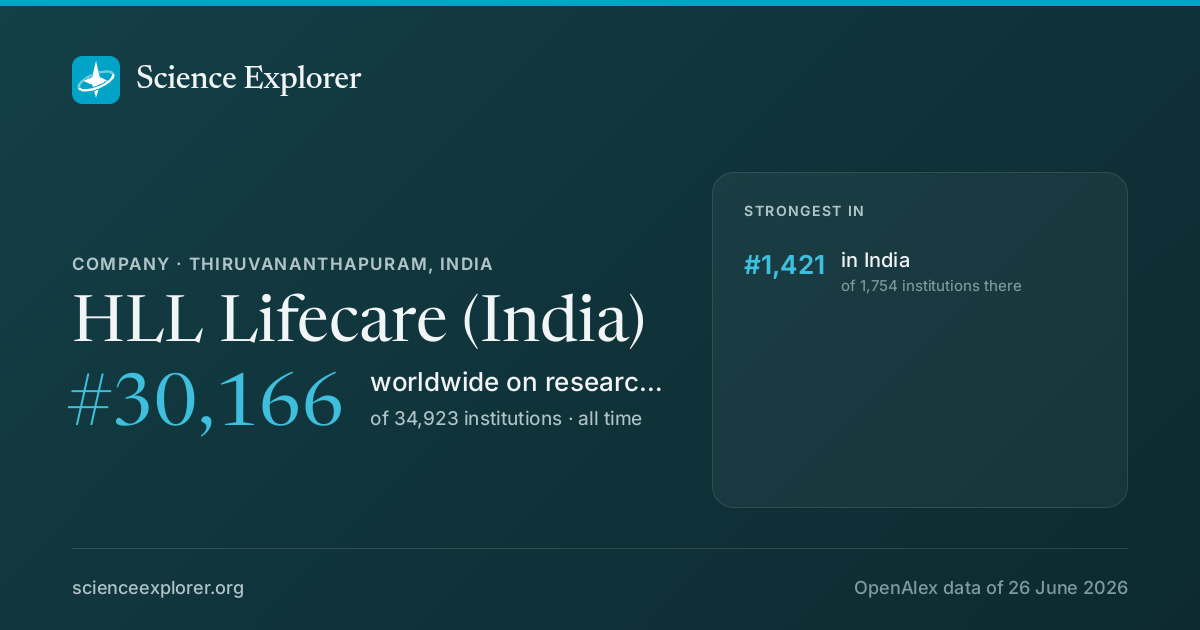
HLL Lifecare (India) on Science Explorer

A card with HLL Lifecare (India)'s standing and the fields it leads in, for a post or a slide. A link to this page previews as the same card.

Download the card

1200 × 630 PNG, sized for social posts, drawn from the latest snapshot.

Badges for a website1Each links back here and updates with every snapshot

Research measures only: rankings here say nothing about teaching, admissions or student experience. Comparable institutions and collaboration partners have tabs of their own, above.

Discussion

Ask a question or share a note about HLL Lifecare (India). Posts are plain text and can be reported.