Idemitsu Kosan (Japan)
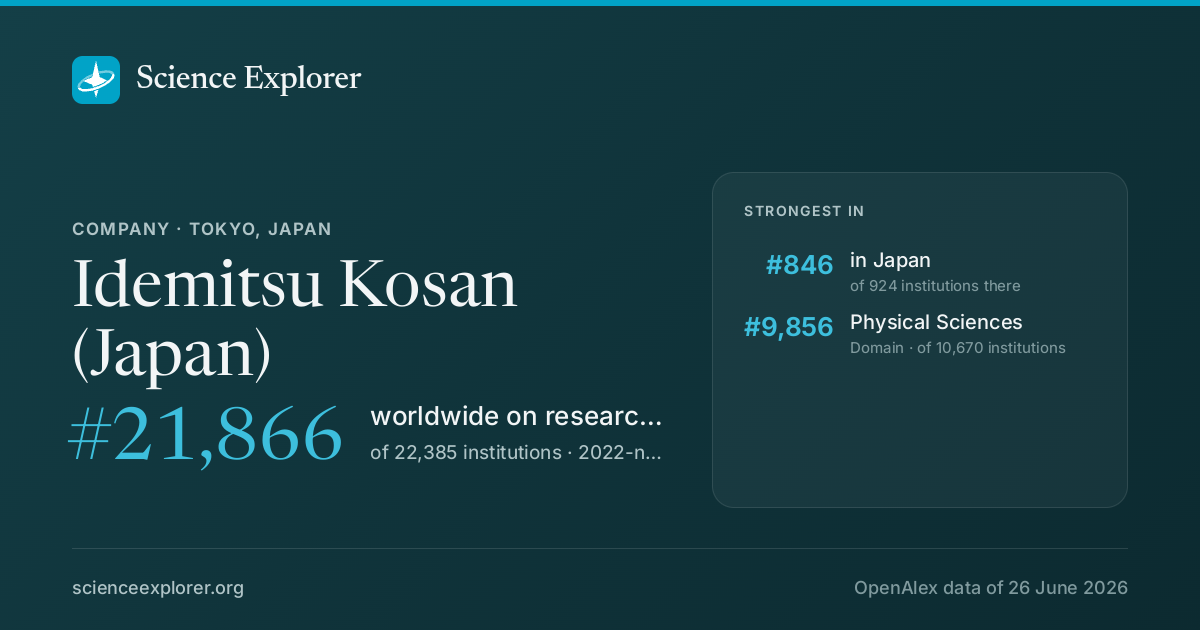
In research, Idemitsu Kosan (Japan) stands highest in Physical Sciences (#9,856 of 10,670 worldwide), 2022-now.
- World rank, 2022-now
- #21,866 of 22,385 · #26,182 all time
- Rank in Japan
- #846 of 924
- Research works
- 1.1k ▼ 2% vs 2018-21
- Citations
- 17k 15.5 per fractional work
- Top-10% rate
- 2.6% all institutions 10.0%
- vs its own fields
- 0.88× 1.00× is exactly expected
- Open access
- 40% world 40%
- International
- 11% world 18%
What is Idemitsu Kosan (Japan) known for in research?
The fields where it stands highest, 2022-now, ranked among every institution above the floor in each field.
| Field | World rank | Where that sits | Top-10% rate | Works | All time |
|---|---|---|---|---|---|
| Physical SciencesDomain | #9,856 of 10,670 | 2.3% | 65 | #15276 |
Each strip is that field's whole ranked pool, with the notch where Idemitsu Kosan (Japan) sits in it, in the colour of the band that rank falls in. The track under the rate is the rate itself: it carries no average mark, because the average differs by field (from about 6% in Dentistry to 21% in Economics).
Which fields of science does Idemitsu Kosan (Japan) work in?
In 2022-now, 88% of research at Idemitsu Kosan (Japan) is in Physical Sciences, 7% in Social Sciences. Its largest fields are Engineering (63%), Materials Science (12%), Social Sciences (3%). It does 2.2× the world's share of Physical Sciences.
Each ring splits the one inside it: the four domains of science, their fields, their subfields. Size is fractional works in 2022-now. Every slice is a page; the interactive view zooms down to single topics and colours each by how much more of it this institution does than the world.
Its 4 domains and 19 fields, with their numbers
- Physical Sciences7288.3%
- Engineering5162.6%
- Materials Science1012.3%
- Chemistry23.0%
- Earth and Planetary Sciences22.7%
- Chemical Engineering22.5%
- Computer Science11.5%
- Environmental Science11.3%
- Energy11.2%
- Physics and Astronomy11.2%
- Social Sciences56.6%
- Social Sciences33.3%
- Arts and Humanities11.6%
- Economics, Econometrics and Finance10.8%
- Decision Sciences00.4%
- Psychology00.4%
- Life Sciences33.7%
- Health Sciences11.4%
- Medicine11.2%
- Health Professions00.2%
Field profile
Location quotient across every field it publishes in: outside the ring is more than an institution of this size would be expected to publish, inside it is less.
Rings at 0.5×, 1× and 2×. Widest outward: Chemical Engineering, 7.1×. Every wedge is a field page.
All 19 fields, with their numbers
- Chemical Engineering7.06×2 works
- Engineering4.17×51 works
- Materials Science3.54×10 works
- Chemistry1.91×2 works
- Earth and Planetary Sciences1.74×2 works
- Energy1.31×1 works
- Pharmacology, Toxicology and Pharmaceutics0.97×0 works
- Arts and Humanities0.57×1 works
- Physics and Astronomy0.52×1 works
- Agricultural and Biological Sciences0.43×2 works
- Decision Sciences0.42×0 works
- Economics, Econometrics and Finance0.40×1 works
- Environmental Science0.26×1 works
- Social Sciences0.26×3 works
- Biochemistry, Genetics and Molecular Biology0.25×1 works
- Computer Science0.19×1 works
- Psychology0.13×0 works
- Health Professions0.08×0 works
- Medicine0.06×1 works
- Chemical Engineering 7.1×
- Engineering 4.2×
- Materials Science 3.5×
- Chemistry 1.9×
- Earth and Planetary Sciences 1.7×
- Energy 1.3×
- Pharmacology, Toxicology and Pharmaceutics 1.0×
- Arts and Humanities 0.6×
- Physics and Astronomy 0.5×
- Agricultural and Biological Sciences 0.4×
- Decision Sciences 0.4×
- Economics, Econometrics and Finance 0.4×
- Environmental Science 0.3×
- Social Sciences 0.3×
- Biochemistry, Genetics and Molecular Biology 0.2×
- Computer Science 0.2×
- Psychology 0.1×
- Health Professions 0.1×
- Medicine 0.1×
Who are the top researchers at Idemitsu Kosan (Japan)?
Ranked on the quality score, Tadashi Kusumoto, Chishio Hosokawa and Yukio Shimane lead among researchers whose main affiliation is Idemitsu Kosan (Japan).
- 1
Tadashi Kusumoto
 Japan · #2,244,923 worldwide
1.2k citations · 22 works
- 2
Chishio Hosokawa
Japan · #2,269,823 worldwide
1.6k citations · 35 works
- 3
Yukio Shimane
Japan · #2,443,339 worldwide
1.4k citations · 18 works
- 4
Tetsuya Fukunaga
Japan · #2,532,158 worldwide
1.2k citations · 22 works
- 5
Nobuhide Ishihara
Japan · #2,738,827 worldwide
2.3k citations · 33 works
- 6
Hiroshi Tokailin
Japan · #3,372,823 worldwide
900 citations · 22 works
- 7
Tomoaki Takebe
Japan · #3,547,225 worldwide
521 citations · 44 works
- 8
Hitoshi Kuma
Japan · #3,725,523 worldwide
682 citations · 32 works
- 9
Masaya Okamoto
Japan · #3,965,664 worldwide
3.5k citations · 97 works
- 10
Kazuyoshi Shigematsu
Japan · #3,972,674 worldwide
925 citations · 24 works
Which keywords describe research at Idemitsu Kosan (Japan)?
By fractional works in 2022-now, weighted toward what it does more of than the world: Nanoparticles, Ionic Liquids, Friction, Graphene, Renewable Resources, Tribological Performance, Lubricants and Tribology.
- Solar Cells
- Electroluminescence
- Wear Behavior
- Polymer Tribology
- Thermal Management
- Heat Transfer
- Battery Materials
- Battery Technology
- Photovoltaics
- Semiconductor
- Lithium-Sulfur Batteries
- Polymer Composites
- Friction Reduction
- Mesh Stiffness
- Mechanical Properties
- Nanocomposites
- Tribology
- Tribological Performance
- Graphene
- Ionic Liquids
- Nanoparticles
- Friction
- Renewable Resources
- Lubricants
- Vibration Analysis
- Cathode Materials
- Gear Dynamics
- Lithium-ion Batteries
- Laser Surface Texturing
- Efficiency
- Nanocrystals
- Solid-State Electrolytes
- Optimization
- Energy Storage
- CZTS
- Nanostructured Anodes
- Thin-Film Solar Cells
- Surface Roughness
- Semiconductors
- Finite Element Analysis
Size is fractional works in 2022-now in the topics tagged with each word; colour is the word's share of this institution's work against its share of the world's. The 40 words are chosen for being large and distinctive. Each links to the topic it comes from most.
All 40 words, with their numbers
- Nanoparticles7▲ 6.9×10 topics
- Ionic Liquids5▲ 24×4 topics
- Friction5▲ 113×2 topics
- Graphene5▲ 9.2×2 topics
- Renewable Resources5▲ 35×2 topics
- Tribological Performance5▲ 105×2 topics
- Lubricants5▲ 271×1 topic
- Tribology5▲ 179×1 topic
- Vibration Analysis5▲ 21×2 topics
- Nanocomposites5▲ 7.2×10 topics
- Cathode Materials4▲ 14×2 topics
- Mechanical Properties4▲ 5.1×9 topics
- Gear Dynamics4▲ 150×1 topic
- Mesh Stiffness4▲ 150×1 topic
- Lithium-ion Batteries3▲ 9.4×2 topics
- Friction Reduction3▲ 134×1 topic
- Laser Surface Texturing3▲ 134×1 topic
- Polymer Composites3▲ 14×5 topics
- Efficiency3▲ 11×2 topics
- Lithium-Sulfur Batteries2▲ 21×1 topic
- Nanocrystals2▲ 12×3 topics
- Semiconductor2▲ 9.0×3 topics
- Solid-State Electrolytes2▲ 24×1 topic
- Photovoltaics2▲ 18×2 topics
- Optimization2▲ 5.8×5 topics
- Battery Technology2▲ 8.7×2 topics
- Energy Storage2▲ 3.8×2 topics
- Battery Materials2▲ 14×1 topic
- CZTS2▲ 44×1 topic
- Heat Transfer2▲ 4.7×7 topics
- Nanostructured Anodes2▲ 14×1 topic
- Thermal Management2▲ 7.0×3 topics
- Thin-Film Solar Cells2▲ 44×1 topic
- Polymer Tribology2▲ 76×1 topic
- Surface Roughness2▲ 17×3 topics
- Wear Behavior2▲ 65×1 topic
- Semiconductors2▲ 7.2×4 topics
- Electroluminescence2▲ 50×2 topics
- Finite Element Analysis2▲ 8.1×3 topics
- Solar Cells2▲ 8.8×3 topics
Which research topics does Idemitsu Kosan (Japan) publish most on?
By volume in 2022-now: Lubricants and Their Additives, Gear and Bearing Dynamics Analysis, Tribology and Lubrication Engineering and Advanced Battery Materials and Technologies.
Area is fractional works; colour is the subfield each topic belongs to.
- 1 Lubricants and Their Additives Mechanical Engineering 5 works
- 2 Gear and Bearing Dynamics Analysis Mechanical Engineering 4 works
- 3 Tribology and Lubrication Engineering Mechanical Engineering 3 works
- 4 Advanced Battery Materials and Technologies Electrical and Electronic Engineering 2 works
- 5 Advancements in Battery Materials Electrical and Electronic Engineering 2 works
- 6 Chalcogenide Semiconductor Thin Films Electrical and Electronic Engineering 2 works
- 7 Tribology and Wear Analysis Mechanics of Materials 2 works
- 8 Advanced Battery Technologies Research Automotive Engineering 1 works
- 9 Fermentation and Sensory Analysis Food Science 1 works
- 10 Conducting polymers and applications Polymers and Plastics 1 works
How open and international is its research?
Against the world's own shares: the tick on each track. Both are shares of its output, so they sit on one scale and can be read against each other as well as against the world.
World: 40% of research is openly available.
World: 18% is written across borders.
How has Idemitsu Kosan (Japan)'s research output changed?
Output in 2022-2025 was 2% lower than in 2018-2021.
The same series as a ribbon: one cell per year, darker for more. The line above answers how much; this answers when.
Its share of all research
Growing output can still be a shrinking share: all of science grows. This is Idemitsu Kosan (Japan) as a percentage of every work published that year, 0.00031% in 2024.
Fractional works of Idemitsu Kosan (Japan) over all fractional works that year. How the balance of science has shifted.
How much of it reaches the world top 10%
Year by year, against all institutions in the same year.
Of each year's output, the share that reached the world's 10% most cited for its field and year. Peak 12.2% in 1992.
Other research institutions in Tokyo
- The University of Tokyo
- Tokyo Institute of Technology
- Keio University
- Waseda University
- Tokyo University of Science
- Nihon University
- Hitachi (Japan)
- NTT (Japan)


Share Idemitsu Kosan (Japan)'s ranking
Badges for a website1Each links back here and updates with every snapshot

Research measures only: rankings here say nothing about teaching, admissions or student experience. Comparable institutions and collaboration partners have tabs of their own, above.
Discussion
Ask a question or share a note about Idemitsu Kosan (Japan). Keep it to the research: no personal attacks, advertising or links. Any reader can report a post, which collapses it for everyone until it is opened.