Science Explorer Back to mapMap
Discussion
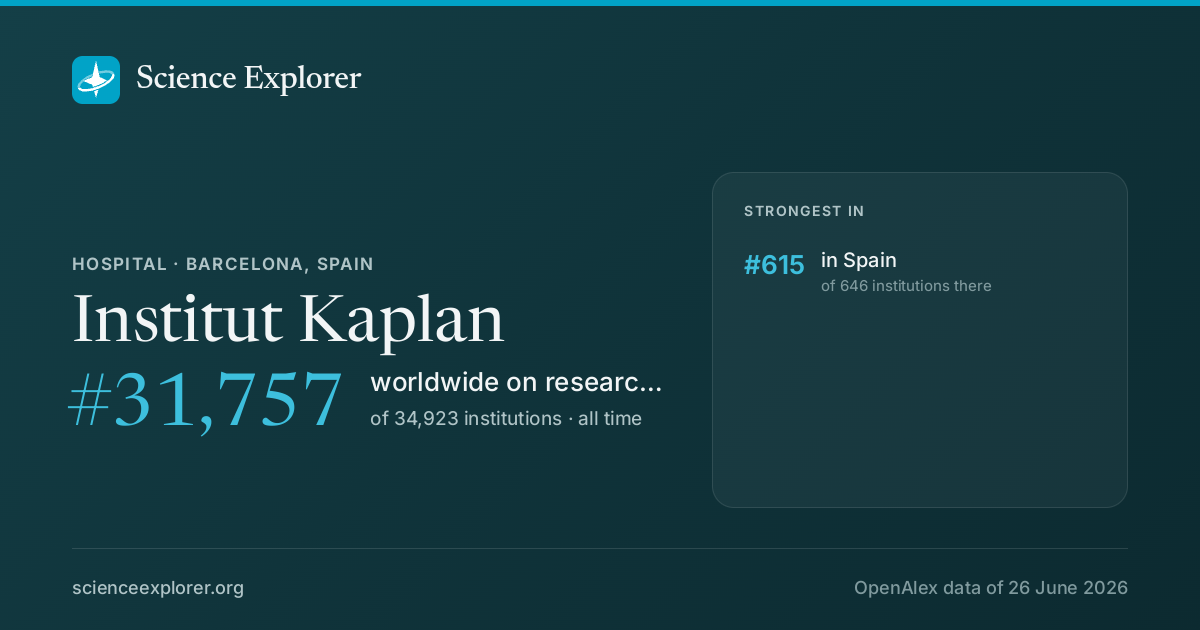
Hospital / health system · Barcelona · Spain

Institut Kaplan

World rank, all time
#31,757
of 34,923
Rank in Spain
#615
of 646
Research works
125
◆ 1% vs 2018-21
Citations
3k
24.0 per fractional work
Top-10% rate
5.7%
all institutions 10.0%
vs its own fields
1.09×
1.00× is exactly expected
Open access
24%
world 40%
International
22%
world 18%

Which fields of science does Institut Kaplan work in?

In all years, 80% of research at Institut Kaplan is in Health Sciences, 12% in Social Sciences. Its largest fields are Medicine (76%), Arts and Humanities (4%), Social Sciences (4%). It does 3.2× the world's share of Health Sciences.

Health Sciences: 100 fractional works · 80.3% of its workMedicine: 95 fractional works · 76.3% of its workSurgery: 40 fractional works · 32.0% of its workRehabilitation: 19 fractional works · 15.3% of its workRadiology, Nuclear Medicine and Imaging: 7 fractional works · 5.5% of its workRheumatology: 6 fractional works · 5.0% of its workEpidemiology: 6 fractional works · 5.0% of its workOrthopedics and Sports Medicine: 4 fractional works · 3.3% of its workPulmonary and Respiratory Medicine: 2 fractional works · 1.5% of its workDermatology: 1 fractional works · 1.1% of its workPharmacology: 1 fractional works · 0.9% of its workHealth Informatics: 1 fractional works · 0.8% of its workPublic Health, Environmental and Occupational Health: 1 fractional works · 0.8% of its workCardiology and Cardiovascular Medicine: 1 fractional works · 0.8% of its workOncology: 1 fractional works · 0.7% of its workOphthalmology: 1 fractional works · 0.6% of its workPhysiology: 1 fractional works · 0.4% of its workNeurology: 0 fractional works · 0.3% of its workAnatomy: 0 fractional works · 0.3% of its workBiochemistry: 0 fractional works · 0.3% of its workGenetics: 0 fractional works · 0.3% of its workHematology: 0 fractional works · 0.3% of its workInfectious Diseases: 0 fractional works · 0.3% of its workPathology and Forensic Medicine: 0 fractional works · 0.2% of its workSmaller subfields together: 1 fractional works · 0.6% of its workHealth Professions: 4 fractional works · 3.1% of its workPharmacy: 2 fractional works · 1.5% of its workRadiological and Ultrasound Technology: 1 fractional works · 0.8% of its workGeneral Health Professions: 1 fractional works · 0.5% of its workSpeech and Hearing: 0 fractional works · 0.3% of its workSmaller subfields together: 0 fractional works · 0.1% of its workDentistry: 1 fractional works · 0.5% of its workOral Surgery: 1 fractional works · 0.5% of its workNursing: 0 fractional works · 0.3% of its workNutrition and Dietetics: 0 fractional works · 0.3% of its workVeterinary: 0 fractional works · 0.1% of its workSocial Sciences: 15 fractional works · 12.0% of its workArts and Humanities: 5 fractional works · 4.0% of its workVisual Arts and Performing Arts: 2 fractional works · 1.6% of its workHistory: 1 fractional works · 0.8% of its workMuseology: 1 fractional works · 0.5% of its workReligious studies: 0 fractional works · 0.4% of its workClassics: 0 fractional works · 0.3% of its workLiterature and Literary Theory: 0 fractional works · 0.3% of its workSmaller subfields together: 0 fractional works · 0.1% of its workSocial Sciences: 5 fractional works · 3.8% of its workEducation: 1 fractional works · 0.9% of its workCultural Studies: 1 fractional works · 0.8% of its workUrban Studies: 1 fractional works · 0.8% of its workDemography: 0 fractional works · 0.4% of its workGender Studies: 0 fractional works · 0.3% of its workAnthropology: 0 fractional works · 0.3% of its workSmaller subfields together: 0 fractional works · 0.3% of its workBusiness, Management and Accounting: 2 fractional works · 1.7% of its workAccounting: 2 fractional works · 1.3% of its workStrategy and Management: 0 fractional works · 0.4% of its workPsychology: 2 fractional works · 1.6% of its workSocial Psychology: 1 fractional works · 0.8% of its workDevelopmental and Educational Psychology: 0 fractional works · 0.4% of its workExperimental and Cognitive Psychology: 0 fractional works · 0.3% of its workSmaller subfields together: 0 fractional works · 0.1% of its workDecision Sciences: 1 fractional works · 0.5% of its workStatistics, Probability and Uncertainty: 0 fractional works · 0.4% of its workSmaller subfields together: 0 fractional works · 0.1% of its workEconomics, Econometrics and Finance: 1 fractional works · 0.5% of its workEconomics and Econometrics: 1 fractional works · 0.5% of its workLife Sciences: 7 fractional works · 5.8% of its workBiochemistry, Genetics and Molecular Biology: 4 fractional works · 3.2% of its workDevelopmental Biology: 3 fractional works · 2.2% of its workGenetics: 1 fractional works · 0.5% of its workCell Biology: 0 fractional works · 0.3% of its workSmaller subfields together: 0 fractional works · 0.1% of its workImmunology and Microbiology: 2 fractional works · 1.6% of its workVirology: 1 fractional works · 1.1% of its workImmunology: 1 fractional works · 0.4% of its workSmaller subfields together: 0 fractional works · 0.1% of its workAgricultural and Biological Sciences: 1 fractional works · 0.6% of its workSoil Science: 0 fractional works · 0.4% of its workSmaller subfields together: 0 fractional works · 0.2% of its workNeuroscience: 0 fractional works · 0.3% of its workCognitive Neuroscience: 0 fractional works · 0.3% of its workPharmacology, Toxicology and Pharmaceutics: 0 fractional works · 0.1% of its workPhysical Sciences: 2 fractional works · 1.9% of its workEngineering: 1 fractional works · 1.2% of its workBiomedical Engineering: 1 fractional works · 0.4% of its workMechanical Engineering: 0 fractional works · 0.3% of its workMechanics of Materials: 0 fractional works · 0.3% of its workSmaller subfields together: 0 fractional works · 0.2% of its workEnvironmental Science: 1 fractional works · 0.5% of its workManagement, Monitoring, Policy and Law: 0 fractional works · 0.3% of its workSmaller subfields together: 0 fractional works · 0.1% of its workPhysics and Astronomy: 0 fractional works · 0.3% of its workAstronomy and Astrophysics: 0 fractional works · 0.3% of its workALL ITS WORKInstitut Kaplan125fractional works, all years
Life Sciences6%Physical Sciences2%Health Sciences80%Social Sciences12%

Each ring splits the one inside it: the four domains of science, their fields, their subfields. Size is fractional works in all years. Every slice is a page; the interactive view zooms down to single topics and colours each by how much more of it this institution does than the world.

Its 4 domains and 19 fields, with their numbers
    1. Medicine9576.3%
    2. Health Professions43.1%
    3. Dentistry10.5%
    4. Nursing00.3%
    5. Veterinary00.1%
    1. Arts and Humanities54.0%
    2. Social Sciences53.8%
    3. Business, Management and Accounting21.7%
    4. Psychology21.6%
    5. Decision Sciences10.5%
    6. Economics, Econometrics and Finance10.5%
    1. Biochemistry, Genetics and Molecular Biology43.2%
    2. Immunology and Microbiology21.6%
    3. Agricultural and Biological Sciences10.6%
    4. Neuroscience00.3%
    5. Pharmacology, Toxicology and Pharmaceutics00.1%
    1. Engineering11.2%
    2. Environmental Science10.5%
    3. Physics and Astronomy00.3%
All of science, and how each field's share has moved since 1950: the Science domain explorer

Field profile

Location quotient across every field it publishes in: outside the ring is more than an institution of this size would be expected to publish, inside it is less.

Agricultural and Biological Sciences: 1.06× its world share, 0 worksAgricultural and Bio…Biochemistry, Genetics and Molecular Biology: 0.74× its world share, 0 worksBiochemistry, Geneti…Immunology and Microbiology: 0.83× its world share, 0 worksImmunology and Micro…Engineering: 0.17× its world share, 0 worksEngineeringEnvironmental Science: 0.50× its world share, 0 worksEnvironmental ScienceHealth Professions: 0.36× its world share, 0 worksHealth ProfessionsMedicine: 4.25× its world share, 8 worksMedicineSocial Sciences: 0.19× its world share, 0 worksSocial Sciences1×world share
more than its size predictsabout as predictedless

Rings at 0.5×, 1× and 2×. Widest outward: Medicine, 4.2×. Every wedge is a field page.

All 8 fields, with their numbers
  1. Medicine4.25×8 works
  2. Agricultural and Biological Sciences1.06×0 works
  3. Immunology and Microbiology0.83×0 works
  4. Biochemistry, Genetics and Molecular Biology0.74×0 works
  5. Environmental Science0.50×0 works
  6. Health Professions0.36×0 works
  7. Social Sciences0.19×0 works
  8. Engineering0.17×0 works

Who are the top researchers at Institut Kaplan?

Ranked on the quality score, Marc García‐Elías, Alberto L. Lluch and Guillem Salvà-Coll lead among researchers whose main affiliation is Institut Kaplan.

  1. 1 Marc García‐Elías Spain · #899,301 worldwide 6.8k citations · 201 works
  2. 2 Alberto L. Lluch Spain · #1,924,768 worldwide 1.2k citations · 39 works
  3. 3 Guillem Salvà-Coll Spain · #2,691,179 worldwide 450 citations · 29 works
  4. 4 Mireia Esplugas Spain · #2,910,801 worldwide 615 citations · 35 works
  5. 5 Àngel Ferreres Spain · #3,581,719 worldwide 723 citations · 41 works
  6. 6 Alex Lluch Spain · #4,557,074 worldwide 1.1k citations · 85 works
  7. 7 Albert Curto i Homedes Spain · #5,112,238 worldwide 12 citations · 29 works
All ranked researchers at Institut Kaplan

What are the most cited papers from Institut Kaplan?

The most cited paper from Institut Kaplan is "Three-Ligament Tenodesis for the Treatment of Scapholunate Dissociation: Indications and Surgical Technique" (Marc García‐Elías, Alberto L. Lluch, John K. Stanley, 2006), with 466 citations. Next come "2007 IFSSH Committee Report of Wrist Biomechanics Committee: Biomechanics of the So-Called Dart-Throwing Motion of the Wrist" (166) and "Effect of ambient air pollution on the incidence of appendicitis" (160).

Most cited papers
#PaperReleasedCitations
1 Three-Ligament Tenodesis for the Treatment of Scapholunate Dissociation: Indications and Surgical Technique Marc García‐Elías, Alberto L. Lluch, John K. Stanley · The Journal Of Hand Surgery 2006 466
2 2007 IFSSH Committee Report of Wrist Biomechanics Committee: Biomechanics of the So-Called Dart-Throwing Motion of the Wrist Hisao Moritomo, Emmanuel P. Apergis, Guillaume Herzberg et al. · The Journal Of Hand Surgery Nov 2007 166
3 Effect of ambient air pollution on the incidence of appendicitis Gilaad G. Kaplan, Elijah Dixon, Remo Panaccione et al. · Canadian Medical Association Journal Open access 5 Oct 2009 160
4 Treatment of radiocarpal degenerative osteoarthritis by radioscapholunate arthrodesis and distal scaphoidectomy Marc García‐Elías, Alberto L. Lluch, Àngel Ferreres et al. · The Journal Of Hand Surgery 2005 149
5 Hand injury costs Joseph J. Dias, Marc García‐Elías · Injury 15 Oct 2006 140
All 61 most cited papers, with filters and sorting

Which keywords describe research at Institut Kaplan?

By fractional works in all years, weighted toward what it does more of than the world: Distal Radius Fractures, Flexor Tendon Repair, Elbow Injuries, Ulnar Collateral Ligament Reconstruction, Epidemiology, Carpal Tunnel Syndrome, Electrodiagnostic Studies and Shoulder Function.

▲ more of its work than of the world's◆ about the world's share▼ less than the world's

Size is fractional works in all years in the topics tagged with each word; colour is the word's share of this institution's work against its share of the world's. The 40 words are chosen for being large and distinctive. Each links to the topic it comes from most.

All 40 words, with their numbers
  1. Distal Radius Fractures29▲ 371×1 topic
  2. Flexor Tendon Repair29▲ 371×1 topic
  3. Elbow Injuries18▲ 659×1 topic
  4. Ulnar Collateral Ligament Reconstruction18▲ 659×1 topic
  5. Epidemiology14▲ 2.8×21 topics
  6. Carpal Tunnel Syndrome6▲ 220×1 topic
  7. Electrodiagnostic Studies6▲ 220×1 topic
  8. Biomechanics5▲ 13×3 topics
  9. Shoulder Function5▲ 51×2 topics
  10. Radiotherapy5▲ 10×3 topics
  11. Rehabilitation5▲ 11×2 topics
  12. Pigmented Villonodular Synovitis4▲ 188×1 topic
  13. Synovial Chondromatosis4▲ 188×1 topic
  14. Infection Prevention4▲ 33×2 topics
  15. Rotator Cuff Tears4▲ 48×1 topic
  16. Shoulder Pathology4▲ 48×1 topic
  17. Surgical Management4▲ 6.1×7 topics
  18. Bone Healing3▲ 52×1 topic
  19. Fracture Epidemiology3▲ 52×1 topic
  20. Complications3▲ 4.5×5 topics
  21. Genetic Heterogeneity3▲ 92×1 topic
  22. Limb Malformations3▲ 247×1 topic
  23. Identity2▲ 2.6×7 topics
  24. Reconstruction2▲ 9.8×2 topics
  25. Stem Cells2▲ 6.6×2 topics
  26. Culture2▲ 3.8×6 topics
  27. Clinical Guidelines2▲ 5.6×2 topics
  28. Extracellular Matrix2▲ 7.0×1 topic
  29. Regeneration2▲ 9.5×2 topics
  30. Tendon2▲ 55×1 topic
  31. Leadership2▲ 4.6×2 topics
  32. Brachial Plexus2▲ 59×1 topic
  33. Nerve Transfer2▲ 59×1 topic
  34. Defensive Medicine2▲ 44×1 topic
  35. Malpractice Risk2▲ 44×1 topic
  36. Financial Reporting2▲ 12×3 topics
  37. Acromioclavicular Joint2▲ 46×1 topic
  38. Clavicle Fractures2▲ 46×1 topic
  39. Financial Analysis2▲ 15×2 topics
  40. Anatomy1▲ 14×2 topics

Which research topics does Institut Kaplan publish most on?

By volume in 2022-now: Orthopedic Surgery and Rehabilitation, Elbow and Forearm Trauma Treatment, Artificial Intelligence in Healthcare and Education and Tendon Structure and Treatment.

  1. 1 Orthopedic Surgery and Rehabilitation Surgery 2 works
  2. 2 Elbow and Forearm Trauma Treatment Rehabilitation 2 works
  3. 3 Artificial Intelligence in Healthcare and Education Health Informatics 1 works
  4. 4 Tendon Structure and Treatment Orthopedics and Sports Medicine 0 works
  5. 5 Peripheral Nerve Disorders Radiology, Nuclear Medicine and Imaging 0 works
  6. 6 Land Rights and Reforms Soil Science 0 works
  7. 7 Shoulder Injury and Treatment Surgery 0 works
  8. 8 Congenital limb and hand anomalies Developmental Biology 0 works
  9. 9 Trauma Management and Diagnosis Surgery 0 works
  10. 10 Foot and Ankle Surgery Orthopedics and Sports Medicine 0 works

How open and international is its research?

Against the world's own shares: the tick on each track. Both are shares of its output, so they sit on one scale and can be read against each other as well as against the world.

openly available24.5%not open75.5%

World: 40% of research is openly available.

with international co-authors22.5%domestic only77.5%

World: 18% is written across borders.

How has Institut Kaplan's research output changed?

Output in 2022-2025 was 1% lower than in 2018-2021.

still counting1990200020102020
grewheldshrank

The same series as a ribbon: one cell per year, darker for more. The line above answers how much; this answers when.

Its share of all research

Growing output can still be a shrinking share: all of science grows. This is Institut Kaplan as a percentage of every work published that year, 0.000035% in 2024.

still counting0.00020%0.00040%0.00060%Institut Kaplan0.000023% in 202519801990200020102020

Fractional works of Institut Kaplan over all fractional works that year. How the balance of science has shifted.

Other research institutions in Barcelona

All research institutions in Barcelona

Share Institut Kaplan's ranking

Institut Kaplan on Science Explorer

A card with Institut Kaplan's standing and the fields it leads in, for a post or a slide. A link to this page previews as the same card.

Download the card

1200 × 630 PNG, sized for social posts, drawn from the latest snapshot.

Badges for a website1Each links back here and updates with every snapshot

Research measures only: rankings here say nothing about teaching, admissions or student experience. Comparable institutions and collaboration partners have tabs of their own, above.

Discussion

Ask a question or share a note about Institut Kaplan. Keep it to the research: no personal attacks, advertising or links. Any reader can report a post, which collapses it for everyone until it is opened.