Science Explorer Back to mapMap
Discussion
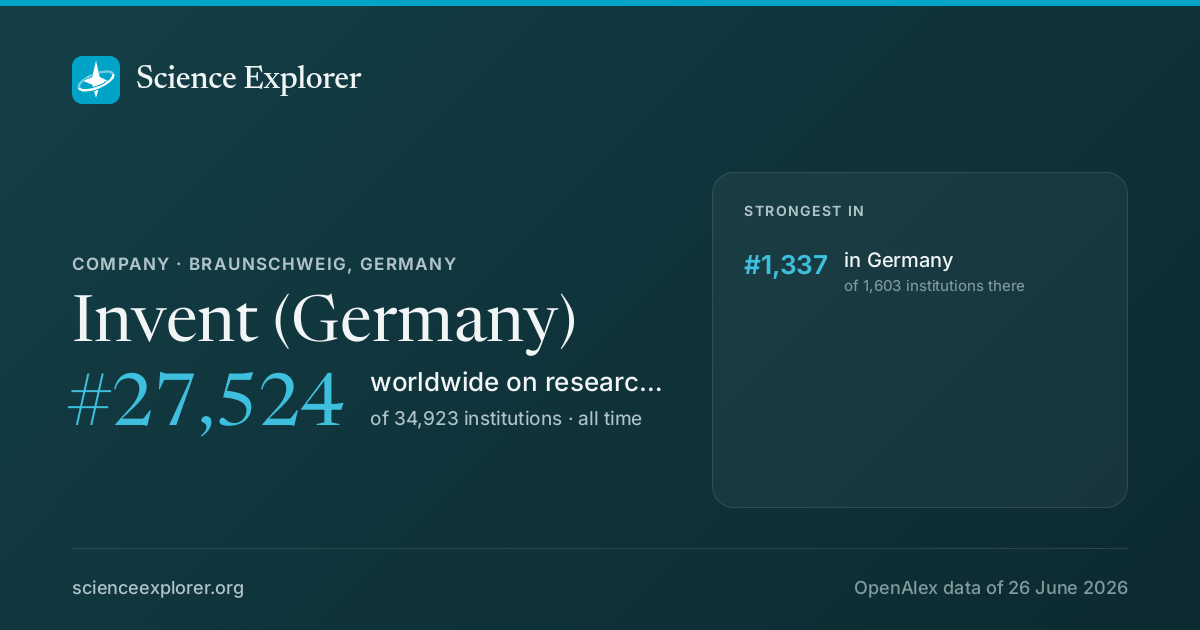
Company · Braunschweig · Germany

Invent (Germany)

World rank, all time
#27,524
of 34,923
Rank in Germany
#1,337
of 1,603
Research works
153
▼ 22% vs 2018-21
Citations
862
5.6 per fractional work
Top-10% rate
7.4%
all institutions 10.0%
vs its own fields
0.92×
1.00× is exactly expected
Open access
52%
world 40%
International
45%
world 18%

Which fields of science does Invent (Germany) work in?

In 2022-now, 50% of research at Invent (Germany) is in Physical Sciences, 26% in Social Sciences. Its largest fields are Engineering (20%), Computer Science (18%), Medicine (9%).

Physical Sciences: 13 fractional works · 50.1% of its workEngineering: 5 fractional works · 19.5% of its workIndustrial and Manufacturing Engineering: 1 fractional works · 4.7% of its workMechanical Engineering: 1 fractional works · 2.9% of its workMechanics of Materials: 1 fractional works · 2.9% of its workBiomedical Engineering: 1 fractional works · 2.8% of its workElectrical and Electronic Engineering: 0 fractional works · 1.5% of its workCivil and Structural Engineering: 0 fractional works · 1.3% of its workAutomotive Engineering: 0 fractional works · 0.9% of its workAerospace Engineering: 0 fractional works · 0.7% of its workComputational Mechanics: 0 fractional works · 0.7% of its workSafety, Risk, Reliability and Quality: 0 fractional works · 0.7% of its workControl and Systems Engineering: 0 fractional works · 0.3% of its workComputer Science: 5 fractional works · 18.2% of its workArtificial Intelligence: 1 fractional works · 5.0% of its workInformation Systems: 1 fractional works · 3.3% of its workHuman-Computer Interaction: 1 fractional works · 3.0% of its workComputer Networks and Communications: 1 fractional works · 2.6% of its workHardware and Architecture: 1 fractional works · 2.6% of its workComputer Science Applications: 0 fractional works · 1.7% of its workPhysics and Astronomy: 1 fractional works · 5.0% of its workAstronomy and Astrophysics: 1 fractional works · 3.3% of its workAtomic and Molecular Physics, and Optics: 0 fractional works · 1.3% of its workStatistical and Nonlinear Physics: 0 fractional works · 0.4% of its workSmaller subfields together: 0 fractional works · 0.0% of its workMaterials Science: 1 fractional works · 3.8% of its workMaterials Chemistry: 0 fractional works · 1.9% of its workBiomaterials: 0 fractional works · 0.7% of its workPolymers and Plastics: 0 fractional works · 0.5% of its workElectronic, Optical and Magnetic Materials: 0 fractional works · 0.4% of its workGeneral Materials Science: 0 fractional works · 0.3% of its workEnvironmental Science: 1 fractional works · 3.2% of its workPollution: 0 fractional works · 1.7% of its workManagement, Monitoring, Policy and Law: 0 fractional works · 0.7% of its workGlobal and Planetary Change: 0 fractional works · 0.4% of its workHealth, Toxicology and Mutagenesis: 0 fractional works · 0.3% of its workSmaller subfields together: 0 fractional works · 0.2% of its workChemistry: 0 fractional works · 0.3% of its workAnalytical Chemistry: 0 fractional works · 0.3% of its workSocial Sciences: 7 fractional works · 26.5% of its workEconomics, Econometrics and Finance: 2 fractional works · 7.6% of its workEconomics and Econometrics: 2 fractional works · 6.9% of its workGeneral Economics, Econometrics and Finance: 0 fractional works · 0.7% of its workBusiness, Management and Accounting: 2 fractional works · 6.7% of its workManagement Information Systems: 1 fractional works · 2.6% of its workStrategy and Management: 0 fractional works · 1.7% of its workOrganizational Behavior and Human Resource Management: 0 fractional works · 1.0% of its workManagement of Technology and Innovation: 0 fractional works · 0.7% of its workMarketing: 0 fractional works · 0.7% of its workSocial Sciences: 2 fractional works · 6.4% of its workSociology and Political Science: 1 fractional works · 2.2% of its workEducation: 0 fractional works · 1.3% of its workCultural Studies: 0 fractional works · 0.9% of its workHuman Factors and Ergonomics: 0 fractional works · 0.7% of its workPolitical Science and International Relations: 0 fractional works · 0.5% of its workUrban Studies: 0 fractional works · 0.5% of its workDemography: 0 fractional works · 0.3% of its workArts and Humanities: 1 fractional works · 3.1% of its workHistory and Philosophy of Science: 0 fractional works · 2.0% of its workLiterature and Literary Theory: 0 fractional works · 0.7% of its workMuseology: 0 fractional works · 0.4% of its workDecision Sciences: 0 fractional works · 1.6% of its workManagement Science and Operations Research: 0 fractional works · 1.3% of its workInformation Systems and Management: 0 fractional works · 0.2% of its workSmaller subfields together: 0 fractional works · 0.0% of its workPsychology: 0 fractional works · 1.1% of its workClinical Psychology: 0 fractional works · 0.7% of its workSocial Psychology: 0 fractional works · 0.4% of its workLife Sciences: 3 fractional works · 12.6% of its workNeuroscience: 1 fractional works · 4.7% of its workCognitive Neuroscience: 1 fractional works · 4.1% of its workNeurology: 0 fractional works · 0.5% of its workAgricultural and Biological Sciences: 1 fractional works · 3.5% of its workAgronomy and Crop Science: 0 fractional works · 1.3% of its workGeneral Agricultural and Biological Sciences: 0 fractional works · 1.3% of its workEcology, Evolution, Behavior and Systematics: 0 fractional works · 0.6% of its workPlant Science: 0 fractional works · 0.3% of its workSmaller subfields together: 0 fractional works · 0.0% of its workBiochemistry, Genetics and Molecular Biology: 1 fractional works · 3.5% of its workMolecular Biology: 1 fractional works · 3.1% of its workBiotechnology: 0 fractional works · 0.3% of its workSmaller subfields together: 0 fractional works · 0.1% of its workImmunology and Microbiology: 0 fractional works · 0.6% of its workVirology: 0 fractional works · 0.3% of its workSmaller subfields together: 0 fractional works · 0.3% of its workPharmacology, Toxicology and Pharmaceutics: 0 fractional works · 0.4% of its workPharmacology: 0 fractional works · 0.4% of its workHealth Sciences: 3 fractional works · 10.8% of its workMedicine: 2 fractional works · 9.3% of its workOncology: 1 fractional works · 3.9% of its workCritical Care and Intensive Care Medicine: 0 fractional works · 2.0% of its workOrthopedics and Sports Medicine: 0 fractional works · 1.3% of its workPhysiology: 0 fractional works · 1.3% of its workRadiology, Nuclear Medicine and Imaging: 0 fractional works · 0.3% of its workReproductive Medicine: 0 fractional works · 0.3% of its workPulmonary and Respiratory Medicine: 0 fractional works · 0.2% of its workHealth Professions: 0 fractional works · 1.2% of its workGeneral Health Professions: 0 fractional works · 0.8% of its workHealth Information Management: 0 fractional works · 0.4% of its workVeterinary: 0 fractional works · 0.3% of its workSmall Animals: 0 fractional works · 0.3% of its workALL ITS WORKInvent (Germany)25fractional works, 2022-now
Life Sciences13%Physical Sciences50%Health Sciences11%Social Sciences26%

Each ring splits the one inside it: the four domains of science, their fields, their subfields. Size is fractional works in 2022-now. Every slice is a page; the interactive view zooms down to single topics and colours each by how much more of it this institution does than the world.

Its 4 domains and 20 fields, with their numbers
    1. Engineering519.5%
    2. Computer Science518.2%
    3. Physics and Astronomy15.0%
    4. Materials Science13.8%
    5. Environmental Science13.2%
    6. Chemistry00.3%
    1. Economics, Econometrics and Finance27.6%
    2. Business, Management and Accounting26.7%
    3. Social Sciences26.4%
    4. Arts and Humanities13.1%
    5. Decision Sciences01.6%
    6. Psychology01.1%
    1. Neuroscience14.7%
    2. Agricultural and Biological Sciences13.5%
    3. Biochemistry, Genetics and Molecular Biology13.5%
    4. Immunology and Microbiology00.6%
    5. Pharmacology, Toxicology and Pharmaceutics00.4%
    1. Medicine29.3%
    2. Health Professions01.2%
    3. Veterinary00.3%
All of science, and how each field's share has moved since 1950: the Science domain explorer

Field profile

Location quotient across every field it publishes in: outside the ring is more than an institution of this size would be expected to publish, inside it is less.

Agricultural and Biological Sciences: 0.74× its world share, 1 worksAgricultural and Bio…Biochemistry, Genetics and Molecular Biology: 0.65× its world share, 1 worksBiochemistry, Geneti…Immunology and Microbiology: 0.59× its world share, 0 worksImmunology and Micro…Neuroscience: 2.88× its world share, 1 worksNeurosciencePharmacology, Toxicology and Pharmaceutics: 1.12× its world share, 0 worksPharmacology, Toxico…Chemistry: 0.21× its world share, 0 worksChemistryComputer Science: 2.34× its world share, 5 worksComputer ScienceEngineering: 1.30× its world share, 5 worksEngineeringEnvironmental Science: 0.65× its world share, 1 worksEnvironmental ScienceMaterials Science: 1.09× its world share, 1 worksMaterials SciencePhysics and Astronomy: 2.27× its world share, 1 worksPhysics and AstronomyHealth Professions: 0.45× its world share, 0 worksHealth ProfessionsMedicine: 0.49× its world share, 2 worksMedicineVeterinary: 1.93× its world share, 0 worksVeterinaryArts and Humanities: 1.06× its world share, 1 worksArts and HumanitiesBusiness, Management and Accounting: 2.07× its world share, 2 worksBusiness, Management…Decision Sciences: 1.62× its world share, 0 worksDecision SciencesEconomics, Econometrics and Finance: 3.56× its world share, 2 worksEconomics, Econometr…Psychology: 0.36× its world share, 0 worksPsychologySocial Sciences: 0.51× its world share, 2 worksSocial Sciences1×world share
more than its size predictsabout as predictedless

Rings at 0.5×, 1× and 2×. Widest outward: Economics, Econometrics and Finance, 3.6×. Every wedge is a field page.

All 20 fields, with their numbers
  1. Economics, Econometrics and Finance3.56×2 works
  2. Neuroscience2.88×1 works
  3. Computer Science2.34×5 works
  4. Physics and Astronomy2.27×1 works
  5. Business, Management and Accounting2.07×2 works
  6. Veterinary1.93×0 works
  7. Decision Sciences1.62×0 works
  8. Engineering1.30×5 works
  9. Pharmacology, Toxicology and Pharmaceutics1.12×0 works
  10. Materials Science1.09×1 works
  11. Arts and Humanities1.06×1 works
  12. Agricultural and Biological Sciences0.74×1 works
  13. Biochemistry, Genetics and Molecular Biology0.65×1 works
  14. Environmental Science0.65×1 works
  15. Immunology and Microbiology0.59×0 works
  16. Social Sciences0.51×2 works
  17. Medicine0.49×2 works
  18. Health Professions0.45×0 works
  19. Psychology0.36×0 works
  20. Chemistry0.21×0 works

Who are the top researchers at Invent (Germany)?

Ranked on the quality score, Richard J. Leider and Dave Cridland lead among researchers whose main affiliation is Invent (Germany).

  1. 1 Richard J. Leider Germany · #4,256,856 worldwide 53 citations · 27 works
  2. 2 Dave Cridland Germany · #4,936,171 worldwide 16 citations · 28 works
All ranked researchers at Invent (Germany)

What are the most cited papers from Invent (Germany)?

The most cited paper from Invent (Germany) is "International benchmarking of terrestrial laser scanning approaches for forest inventories" (Xinlian Liang et al., 2018), with 483 citations. Next come "Identifying Ecoregion Boundaries" (218) and "Association of organic matter with iron and aluminum across a range of soils determined via selective dissolution techniques coupled with dissolved nitrogen analysis" (148).

Most cited papers
#PaperReleasedCitations
1 International benchmarking of terrestrial laser scanning approaches for forest inventories Xinlian Liang et al. · ISPRS Journal of Photogrammetry and Remote Sensing Open access 24 Jul 2018 483
2 Identifying Ecoregion Boundaries Robert G. Bailey · Environmental Management Apr 2004 218
3 Association of organic matter with iron and aluminum across a range of soils determined via selective dissolution techniques coupled with dissolved nitrogen analysis Rota Wagai, Lawrence M. Mayer, Kanehiro Kitayama et al. · Biogeochemistry 29 Sep 2011 148
4 Solar sail technology development and demonstration Michaela Leipold, Michael J. Eiden, Charles Garner et al. · Acta Astronautica 2003 141
5 Synthesis and antifungal activity of 1,2,3-triazole phenylhydrazone derivatives Zhicheng Dai, Yongfei Chen, Mao Zhang et al. · Organic & Biomolecular Chemistry 20 Oct 2014 126
All 61 most cited papers, with filters and sorting

Which research topics does Invent (Germany) publish most on?

By volume in 2022-now: Cytokine Signaling Pathways and Interactions, Natural Language Processing Techniques, VLSI and Analog Circuit Testing and Advanced Statistical Modeling Techniques.

  1. 1 Cytokine Signaling Pathways and Interactions Oncology 1 works
  2. 2 Natural Language Processing Techniques Artificial Intelligence 1 works
  3. 3 VLSI and Analog Circuit Testing Hardware and Architecture 1 works
  4. 4 Advanced Statistical Modeling Techniques Computer Networks and Communications 1 works
  5. 5 Tactile and Sensory Interactions Cognitive Neuroscience 1 works
  6. 6 Intensive Care Unit Cognitive Disorders Critical Care and Intensive Care Medicine 0 works
  7. 7 Memory and Neural Mechanisms Cognitive Neuroscience 0 works
  8. 8 Historical Studies and Socio-cultural Analysis History and Philosophy of Science 0 works
  9. 9 French Urban and Social Studies Sociology and Political Science 0 works
  10. 10 Gaze Tracking and Assistive Technology Human-Computer Interaction 0 works

How open and international is its research?

Against the world's own shares: the tick on each track. Both are shares of its output, so they sit on one scale and can be read against each other as well as against the world.

openly available52.5%not open47.5%

World: 40% of research is openly available.

with international co-authors45.3%domestic only54.7%

World: 18% is written across borders.

How has Invent (Germany)'s research output changed?

Output in 2022-2025 was 22% lower than in 2018-2021.

still counting1990200020102020
grewheldshrank

The same series as a ribbon: one cell per year, darker for more. The line above answers how much; this answers when.

Its share of all research

Growing output can still be a shrinking share: all of science grows. This is Invent (Germany) as a percentage of every work published that year, 0.000068% in 2024.

still counting0.00020%0.00040%0.00060%Invent (Germany)0.000053% in 202519801990200020102020

Fractional works of Invent (Germany) over all fractional works that year. How the balance of science has shifted.

Other research institutions in Braunschweig

All research institutions in Braunschweig

Share Invent (Germany)'s ranking

Invent (Germany) on Science Explorer

A card with Invent (Germany)'s standing and the fields it leads in, for a post or a slide. A link to this page previews as the same card.

Download the card

1200 × 630 PNG, sized for social posts, drawn from the latest snapshot.

Badges for a website1Each links back here and updates with every snapshot

Research measures only: rankings here say nothing about teaching, admissions or student experience. Comparable institutions and collaboration partners have tabs of their own, above.

Discussion

Ask a question or share a note about Invent (Germany). Posts are plain text and can be reported.