Science Explorer Back to mapMap
Discussion
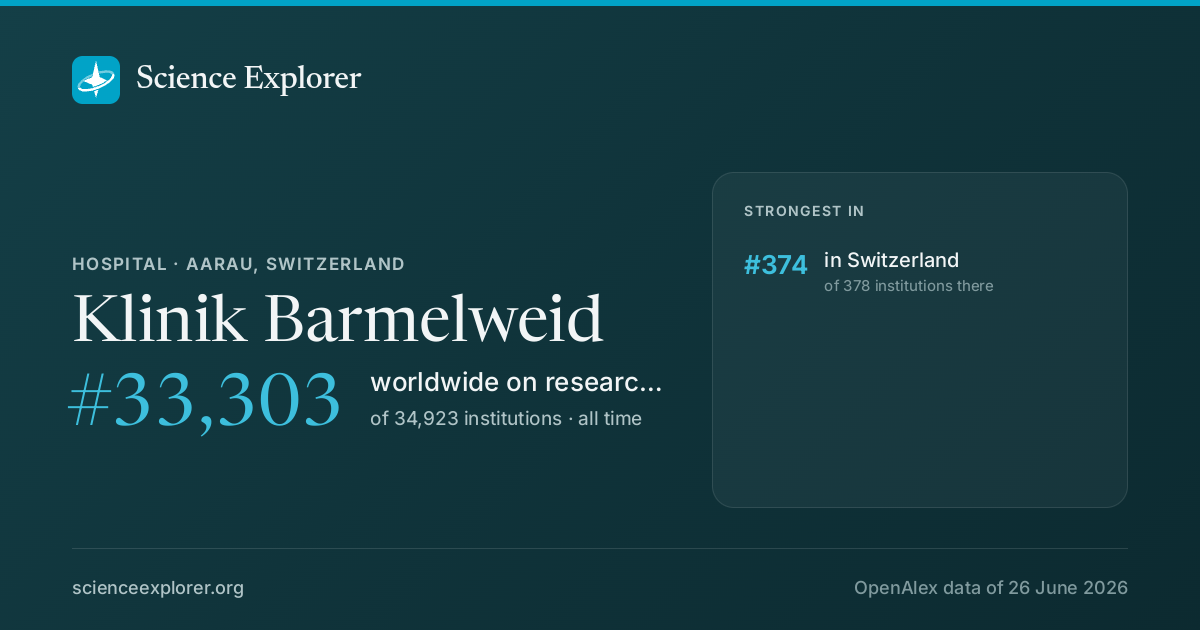
Hospital / health system · Aarau · Switzerland

Klinik Barmelweid

World rank, all time
#33,303
of 34,923
Rank in Switzerland
#374
of 378
Research works
142
▲ 20% vs 2018-21
Citations
2k
14.4 per fractional work
Top-10% rate
8.5%
all institutions 10.0%
vs its own fields
0.92×
1.00× is exactly expected
Open access
46%
world 40%
International
32%
world 18%

Which fields of science does Klinik Barmelweid work in?

In 2022-now, 62% of research at Klinik Barmelweid is in Health Sciences, 22% in Social Sciences. Its largest fields are Medicine (55%), Psychology (15%), Neuroscience (11%). It does 2.2× the world's share of Health Sciences.

Health Sciences: 20 fractional works · 61.8% of its workMedicine: 18 fractional works · 54.7% of its workPhysiology: 3 fractional works · 10.6% of its workPulmonary and Respiratory Medicine: 3 fractional works · 8.4% of its workPsychiatry and Mental health: 2 fractional works · 5.3% of its workCardiology and Cardiovascular Medicine: 2 fractional works · 5.2% of its workPublic Health, Environmental and Occupational Health: 2 fractional works · 5.0% of its workEpidemiology: 1 fractional works · 3.4% of its workGeriatrics and Gerontology: 1 fractional works · 3.1% of its workCritical Care and Intensive Care Medicine: 1 fractional works · 2.0% of its workOncology: 1 fractional works · 1.6% of its workPediatrics, Perinatology and Child Health: 0 fractional works · 1.3% of its workEndocrinology, Diabetes and Metabolism: 0 fractional works · 1.2% of its workPharmacology: 0 fractional works · 1.1% of its workInfectious Diseases: 0 fractional works · 1.0% of its workSurgery: 0 fractional works · 1.0% of its workRadiology, Nuclear Medicine and Imaging: 0 fractional works · 0.8% of its workOphthalmology: 0 fractional works · 0.7% of its workComplementary and alternative medicine: 0 fractional works · 0.5% of its workNeurology: 0 fractional works · 0.5% of its workRheumatology: 0 fractional works · 0.5% of its workRehabilitation: 0 fractional works · 0.3% of its workAnesthesiology and Pain Medicine: 0 fractional works · 0.3% of its workOrthopedics and Sports Medicine: 0 fractional works · 0.2% of its workEmergency Medicine: 0 fractional works · 0.2% of its workFamily Practice: 0 fractional works · 0.2% of its workSmaller subfields together: 0 fractional works · 0.3% of its workHealth Professions: 2 fractional works · 7.0% of its workGeneral Health Professions: 2 fractional works · 5.0% of its workRadiological and Ultrasound Technology: 0 fractional works · 1.4% of its workSpeech and Hearing: 0 fractional works · 0.3% of its workSmaller subfields together: 0 fractional works · 0.3% of its workNursing: 0 fractional works · 0.1% of its workSocial Sciences: 7 fractional works · 22.5% of its workPsychology: 5 fractional works · 14.6% of its workExperimental and Cognitive Psychology: 2 fractional works · 5.5% of its workClinical Psychology: 1 fractional works · 4.5% of its workSocial Psychology: 1 fractional works · 2.6% of its workApplied Psychology: 0 fractional works · 1.3% of its workNeuropsychology and Physiological Psychology: 0 fractional works · 0.4% of its workDevelopmental and Educational Psychology: 0 fractional works · 0.2% of its workArts and Humanities: 1 fractional works · 2.8% of its workVisual Arts and Performing Arts: 1 fractional works · 2.1% of its workPhilosophy: 0 fractional works · 0.3% of its workHistory: 0 fractional works · 0.2% of its workLiterature and Literary Theory: 0 fractional works · 0.2% of its workSocial Sciences: 1 fractional works · 2.2% of its workSociology and Political Science: 0 fractional works · 1.3% of its workDemography: 0 fractional works · 0.2% of its workHealth: 0 fractional works · 0.2% of its workPolitical Science and International Relations: 0 fractional works · 0.2% of its workSafety Research: 0 fractional works · 0.2% of its workBusiness, Management and Accounting: 1 fractional works · 2.1% of its workOrganizational Behavior and Human Resource Management: 1 fractional works · 2.1% of its workEconomics, Econometrics and Finance: 0 fractional works · 0.7% of its workEconomics and Econometrics: 0 fractional works · 0.7% of its workDecision Sciences: 0 fractional works · 0.1% of its workLife Sciences: 5 fractional works · 15.0% of its workNeuroscience: 4 fractional works · 11.1% of its workCognitive Neuroscience: 2 fractional works · 7.3% of its workEndocrine and Autonomic Systems: 1 fractional works · 1.8% of its workNeurology: 0 fractional works · 1.1% of its workBiological Psychiatry: 0 fractional works · 0.3% of its workDevelopmental Neuroscience: 0 fractional works · 0.3% of its workSmaller subfields together: 0 fractional works · 0.2% of its workBiochemistry, Genetics and Molecular Biology: 1 fractional works · 3.4% of its workMolecular Biology: 1 fractional works · 2.3% of its workGenetics: 0 fractional works · 0.5% of its workBiochemistry: 0 fractional works · 0.3% of its workAging: 0 fractional works · 0.2% of its workSmaller subfields together: 0 fractional works · 0.1% of its workPharmacology, Toxicology and Pharmaceutics: 0 fractional works · 0.5% of its workPharmacology: 0 fractional works · 0.2% of its workToxicology: 0 fractional works · 0.2% of its workPhysical Sciences: 0 fractional works · 0.8% of its workEnvironmental Science: 0 fractional works · 0.8% of its workEcological Modeling: 0 fractional works · 0.2% of its workEcology: 0 fractional works · 0.2% of its workGlobal and Planetary Change: 0 fractional works · 0.2% of its workSmaller subfields together: 0 fractional works · 0.0% of its workALL ITS WORKKlinik Barmelweid32fractional works, 2022-now
Life Sciences15%Physical Sciences1%Health Sciences62%Social Sciences22%

Each ring splits the one inside it: the four domains of science, their fields, their subfields. Size is fractional works in 2022-now. Every slice is a page; the interactive view zooms down to single topics and colours each by how much more of it this institution does than the world.

Its 4 domains and 13 fields, with their numbers
    1. Medicine1854.7%
    2. Health Professions27.0%
    3. Nursing00.1%
    1. Psychology514.6%
    2. Arts and Humanities12.8%
    3. Social Sciences12.2%
    4. Business, Management and Accounting12.1%
    5. Economics, Econometrics and Finance00.7%
    6. Decision Sciences00.1%
    1. Neuroscience411.1%
    2. Biochemistry, Genetics and Molecular Biology13.4%
    3. Pharmacology, Toxicology and Pharmaceutics00.5%
    1. Environmental Science00.8%
All of science, and how each field's share has moved since 1950: the Science domain explorer

Field profile

Location quotient across every field it publishes in: outside the ring is more than an institution of this size would be expected to publish, inside it is less.

Biochemistry, Genetics and Molecular Biology: 0.65× its world share, 1 worksBiochemistry, Geneti…Neuroscience: 6.83× its world share, 4 worksNeurosciencePharmacology, Toxicology and Pharmaceutics: 1.32× its world share, 0 worksPharmacology, Toxico…Environmental Science: 0.16× its world share, 0 worksEnvironmental ScienceHealth Professions: 2.64× its world share, 2 worksHealth ProfessionsMedicine: 2.84× its world share, 18 worksMedicineNursing: 0.26× its world share, 0 worksNursingArts and Humanities: 0.97× its world share, 1 worksArts and HumanitiesBusiness, Management and Accounting: 0.64× its world share, 1 worksBusiness, Management…Decision Sciences: 0.13× its world share, 0 worksDecision SciencesEconomics, Econometrics and Finance: 0.32× its world share, 0 worksEconomics, Econometr…Psychology: 4.78× its world share, 5 worksPsychologySocial Sciences: 0.18× its world share, 1 worksSocial Sciences1×world share
more than its size predictsabout as predictedless

Rings at 0.5×, 1× and 2×. Widest outward: Neuroscience, 6.8×. Every wedge is a field page.

All 13 fields, with their numbers
  1. Neuroscience6.83×4 works
  2. Psychology4.78×5 works
  3. Medicine2.84×18 works
  4. Health Professions2.64×2 works
  5. Pharmacology, Toxicology and Pharmaceutics1.32×0 works
  6. Arts and Humanities0.97×1 works
  7. Biochemistry, Genetics and Molecular Biology0.65×1 works
  8. Business, Management and Accounting0.64×1 works
  9. Economics, Econometrics and Finance0.32×0 works
  10. Nursing0.26×0 works
  11. Social Sciences0.18×1 works
  12. Environmental Science0.16×0 works
  13. Decision Sciences0.13×0 works

Who are the top researchers at Klinik Barmelweid?

Ranked on the quality score, Ramin Khatami, Mathias Schlögl and Mathias Schlögl lead among researchers whose main affiliation is Klinik Barmelweid.

  1. 1 Ramin Khatami Switzerland · #550,245 worldwide 6.4k citations · 177 works
  2. 2 Mathias Schlögl Switzerland · #1,137,810 worldwide 14 citations · 21 works
  3. 3 Mathias Schlögl Switzerland · #1,209,714 worldwide 1.4k citations · 97 works
  4. 4 Gilbert Büsching Switzerland · #1,419,916 worldwide 609 citations · 38 works
  5. 5 Martin Frey Switzerland · #1,636,441 worldwide 23k citations · 267 works
  6. 6 Zhongxing Zhang Switzerland · #2,119,055 worldwide 2k citations · 142 works
  7. 7 Thomas Sigrist Switzerland · #3,397,495 worldwide 653 citations · 78 works
  8. 8 Elisabeth Olliges Switzerland · #3,512,941 worldwide 193 citations · 31 works
  9. 9 Ming Qi Switzerland · #3,866,483 worldwide 972 citations · 55 works
All ranked researchers at Klinik Barmelweid

What are the most cited papers from Klinik Barmelweid?

The most cited paper from Klinik Barmelweid is "Secondary prevention through comprehensive cardiovascular rehabilitation: From knowledge to implementation. 2020 update. A position paper from the Secondary Prevention and Rehabilitation Section of the European Association of Preventive Cardiology" (Marco Ambrosetti et al., 2020), with 973 citations. Next come "Narcolepsy — clinical spectrum, aetiopathophysiology, diagnosis and treatment" (649) and "The minimal important difference of the hospital anxiety and depression scale in patients with chronic obstructive pulmonary disease" (589).

Most cited papers
#PaperReleasedCitations
1 Secondary prevention through comprehensive cardiovascular rehabilitation: From knowledge to implementation. 2020 update. A position paper from the Secondary Prevention and Rehabilitation Section of the European Association of Preventive Cardiology Marco Ambrosetti et al. · European Journal of Preventive Cardiology Open access 30 Mar 2020 973
2 Narcolepsy — clinical spectrum, aetiopathophysiology, diagnosis and treatment Claudio L. Bassetti, Antoine Adamantidis, Denis Burdakov et al. · Nature Reviews Neurology Review 19 Jul 2019 649
3 The minimal important difference of the hospital anxiety and depression scale in patients with chronic obstructive pulmonary disease Milo Alan Puhan, Martin Frey, Stefan Büchi et al. · Health and Quality of Life Outcomes Open access 2008 589
4 Expansion of the prognostic assessment of patients with chronic obstructive pulmonary disease: the updated BODE index and the ADO index Milo Alan Puhan, Judith García‐Aymerich, Martin Frey et al. · The Lancet Aug 2009 524
5 Self-administration and interviewer-administration of the German Chronic Respiratory Questionnaire: instrument development and assessment of validity and reliability in two randomised studies Milo Alan Puhan, Michaela Behnke, Martin Frey et al. · Health and Quality of Life Outcomes Open access 2004 395
All 59 most cited papers, with filters and sorting

Which keywords describe research at Klinik Barmelweid?

By fractional works in 2022-now, weighted toward what it does more of than the world: Epidemiology, Circadian Rhythms, Memory, Aging, Meta-Analysis, Anxiety, Consolidation and Sleep.

▲ more of its work than of the world's◆ about the world's share▼ less than the world's

Size is fractional works in 2022-now in the topics tagged with each word; colour is the word's share of this institution's work against its share of the world's. The 32 words are chosen for being large and distinctive. Each links to the topic it comes from most.

All 32 words, with their numbers
  1. Epidemiology5▲ 3.7×22 topics
  2. Circadian Rhythms3▲ 96×2 topics
  3. Inflammation2▲ 3.4×10 topics
  4. Quality of Life2▲ 4.9×13 topics
  5. Aging2▲ 13×6 topics
  6. Anxiety2▲ 14×8 topics
  7. Memory2▲ 28×3 topics
  8. Meta-Analysis2▲ 12×5 topics
  9. Consolidation2▲ 158×1 topic
  10. Sleep2▲ 158×1 topic
  11. Depression2▲ 6.5×11 topics
  12. Insulin Resistance2▲ 13×5 topics
  13. Cardiovascular Disease2▲ 4.5×9 topics
  14. Elderly Patients2▲ 31×4 topics
  15. Cognitive Behavioral Therapy2▲ 34×2 topics
  16. Hypertension2▲ 18×5 topics
  17. Psychometric Evaluation2▲ 51×2 topics
  18. Management2▲ 5.8×6 topics
  19. Diagnosis1▲ 4.6×6 topics
  20. Mortality1▲ 7.9×4 topics
  21. Health Consequences1▲ 14×2 topics
  22. Insomnia1▲ 55×1 topic
  23. Neurological Disorders1▲ 7.3×5 topics
  24. Sleep Duration1▲ 59×1 topic
  25. Obstructive Sleep Apnea1▲ 78×1 topic
  26. Sleep-Disordered Breathing1▲ 78×1 topic
  27. Intensive Care Unit1▲ 27×2 topics
  28. Obesity1▲ 4.3×10 topics
  29. Mental Health1▲ 2.2×9 topics
  30. Migraine1▲ 74×2 topics
  31. Mortality Risk1▲ 13×2 topics
  32. Palliative Care1▲ 21×3 topics

Which research topics does Klinik Barmelweid publish most on?

By volume in 2022-now: Sleep and Wakefulness Research, Sleep and related disorders, Obstructive Sleep Apnea Research and Chronic Obstructive Pulmonary Disease (COPD) Research.

  1. 1 Sleep and Wakefulness Research Cognitive Neuroscience 2 works
  2. 2 Sleep and related disorders Experimental and Cognitive Psychology 1 works
  3. 3 Obstructive Sleep Apnea Research Physiology 1 works
  4. 4 Chronic Obstructive Pulmonary Disease (COPD) Research Pulmonary and Respiratory Medicine 1 works
  5. 5 Frailty in Older Adults Geriatrics and Gerontology 1 works
  6. 6 Intensive Care Unit Cognitive Disorders Critical Care and Intensive Care Medicine 1 works
  7. 7 Nutrition and Health in Aging Physiology 1 works
  8. 8 Palliative Care and End-of-Life Issues Public Health, Environmental and Occupational Health 1 works
  9. 9 Restless Legs Syndrome Research Epidemiology 1 works
  10. 10 Cardiovascular and Diving-Related Complications Pulmonary and Respiratory Medicine 1 works

How open and international is its research?

Against the world's own shares: the tick on each track. Both are shares of its output, so they sit on one scale and can be read against each other as well as against the world.

openly available45.8%not open54.2%

World: 40% of research is openly available.

with international co-authors32.0%domestic only68.0%

World: 18% is written across borders.

How has Klinik Barmelweid's research output changed?

Output in 2022-2025 was 20% higher than in 2018-2021.

still counting1990200020102020
grewheldshrank

The same series as a ribbon: one cell per year, darker for more. The line above answers how much; this answers when.

Its share of all research

Growing output can still be a shrinking share: all of science grows. This is Klinik Barmelweid as a percentage of every work published that year, 0.00011% in 2024.

still counting0.00020%0.00040%0.00060%Klinik Barmelweid0.00013% in 20251990200020102020

Fractional works of Klinik Barmelweid over all fractional works that year. How the balance of science has shifted.

Other research institutions in Aarau

All research institutions in Aarau

Share Klinik Barmelweid's ranking

Klinik Barmelweid on Science Explorer

A card with Klinik Barmelweid's standing and the fields it leads in, for a post or a slide. A link to this page previews as the same card.

Download the card

1200 × 630 PNG, sized for social posts, drawn from the latest snapshot.

Badges for a website1Each links back here and updates with every snapshot

Research measures only: rankings here say nothing about teaching, admissions or student experience. Comparable institutions and collaboration partners have tabs of their own, above.

Discussion

Ask a question or share a note about Klinik Barmelweid. Posts are plain text and can be reported.