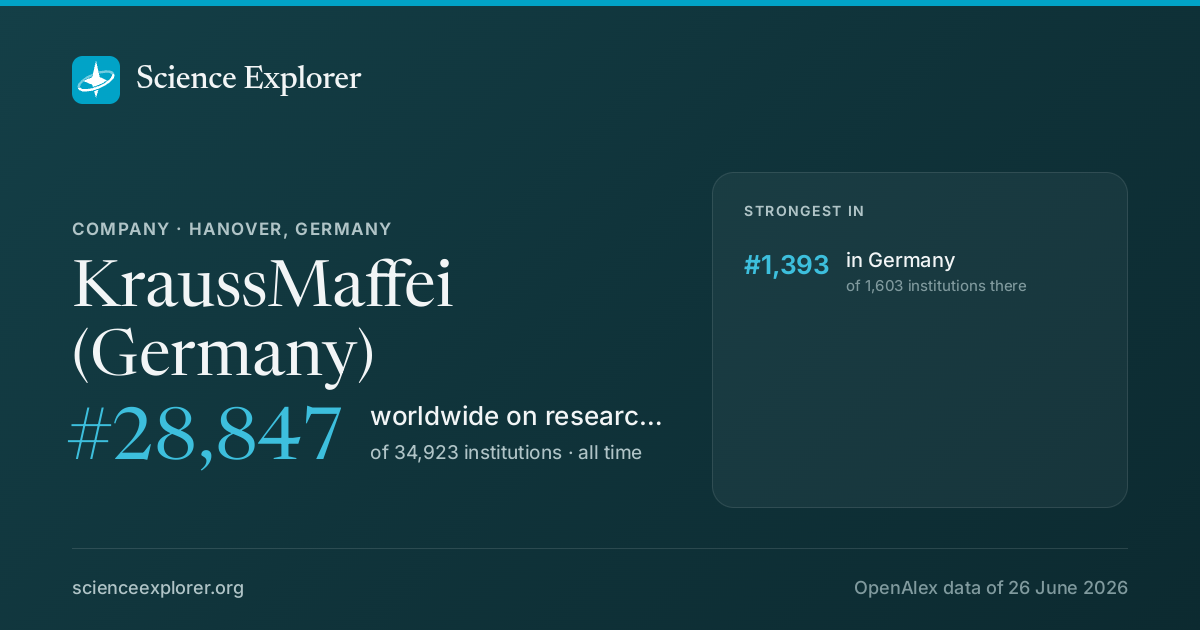
- World rank, all time
- #28,847 of 34,923
- Rank in Germany
- #1,393 of 1,603
- Research works
- 151 ▼ 27% vs 2018-21
- Citations
- 763 5.1 per fractional work
- Top-10% rate
- 8.7% all institutions 10.0%
- vs its own fields
- 0.94× 1.00× is exactly expected
- Open access
- 14% world 40%
- International
- 8% world 18%
Which fields of science does KraussMaffei (Germany) work in?
In 2022-now, 57% of research at KraussMaffei (Germany) is in Social Sciences, 24% in Health Sciences. Its largest fields are Arts and Humanities (33%), Medicine (19%), Social Sciences (18%). It does 1.9× the world's share of Social Sciences.
Each ring splits the one inside it: the four domains of science, their fields, their subfields. Size is fractional works in 2022-now. Every slice is a page; the interactive view zooms down to single topics and colours each by how much more of it this institution does than the world.
Its 4 domains and 15 fields, with their numbers
- Social Sciences1456.7%
- Arts and Humanities832.9%
- Social Sciences417.8%
- Business, Management and Accounting14.1%
- Psychology01.8%
- Health Sciences624.1%
- Medicine518.8%
- Health Professions15.3%
- Physical Sciences415.1%
- Engineering27.5%
- Environmental Science12.8%
- Computer Science01.4%
- Earth and Planetary Sciences01.4%
- Materials Science01.4%
- Chemical Engineering00.7%
- Life Sciences14.1%
Field profile
Location quotient across every field it publishes in: outside the ring is more than an institution of this size would be expected to publish, inside it is less.
Rings at 0.5×, 1× and 2×. Widest outward: Arts and Humanities, 11.4×. Every wedge is a field page.
All 15 fields, with their numbers
- Arts and Humanities11.40×8 works
- Health Professions2.00×1 works
- Chemical Engineering1.96×0 works
- Social Sciences1.41×4 works
- Immunology and Microbiology1.36×0 works
- Business, Management and Accounting1.28×1 works
- Medicine0.98×5 works
- Earth and Planetary Sciences0.87×0 works
- Psychology0.60×0 works
- Environmental Science0.55×1 works
- Engineering0.50×2 works
- Neuroscience0.42×0 works
- Biochemistry, Genetics and Molecular Biology0.39×0 works
- Materials Science0.39×0 works
- Computer Science0.18×0 works
- Arts and Humanities 11.4×
- Health Professions 2.0×
- Chemical Engineering 2.0×
- Social Sciences 1.4×
- Immunology and Microbiology 1.4×
- Business, Management and Accounting 1.3×
- Medicine 1.0×
- Earth and Planetary Sciences 0.9×
- Psychology 0.6×
- Environmental Science 0.6×
- Engineering 0.5×
- Neuroscience 0.4×
- Biochemistry, Genetics and Molecular Biology 0.4×
- Materials Science 0.4×
- Computer Science 0.2×
Who are the top researchers at KraussMaffei (Germany)?
Ranked on the quality score, Erwin Bürkle, Frank Wertheimer and Peter Heine lead among researchers whose main affiliation is KraussMaffei (Germany).
- 1
Erwin Bürkle
 Germany · #3,029,588 worldwide
17 citations · 29 works
- 2
Frank Wertheimer
Germany · #3,983,111 worldwide
54 citations · 22 works
- 3
Peter Heine
Germany · #4,883,561 worldwide
565 citations · 174 works
- 4
Franziska
Germany · #6,007,350 worldwide
14 citations · 44 works
- 5
Paolo
Germany · #7,650,999 worldwide
497 citations · 258 works
Which keywords describe research at KraussMaffei (Germany)?
By fractional works in 2022-now, weighted toward what it does more of than the world: Urban Development, Secularism, Archaeology, Arabia, Byzantine, Radiation Therapy, Retinoblastoma and Uveal Melanoma.
- Rome
- Glaucoma
- Religious Education
- Mediterranean
- Elderly Care
- Uveal Melanoma
- Radiation Therapy
- Arabia
- Archaeology
- Urban Development
- Secularism
- Byzantine
- Retinoblastoma
- Cultural Exchange
- Islamic reform
- Middle East
- Ceremonial
- Intraocular Pressure
Size is fractional works in 2022-now in the topics tagged with each word; colour is the word's share of this institution's work against its share of the world's. The 18 words are chosen for being large and distinctive. Each links to the topic it comes from most.
All 18 words, with their numbers
- Urban Development3▲ 33×3 topics
- Archaeology2▲ 59×4 topics
- Secularism2▲ 74×3 topics
- Arabia2▲ 223×1 topic
- Byzantine2▲ 223×1 topic
- Radiation Therapy1▲ 43×2 topics
- Retinoblastoma1▲ 362×1 topic
- Uveal Melanoma1▲ 362×1 topic
- Cultural Exchange1▲ 38×2 topics
- Elderly Care1▲ 31×2 topics
- Islamic reform1▲ 112×1 topic
- Mediterranean1▲ 54×2 topics
- Middle East1▲ 78×1 topic
- Religious Education1▲ 30×2 topics
- Ceremonial1▲ 212×1 topic
- Glaucoma1▲ 28×1 topic
- Intraocular Pressure1▲ 46×1 topic
- Rome1▲ 347×1 topic
Which research topics does KraussMaffei (Germany) publish most on?
By volume in 2022-now: Archaeology and Historical Studies, Ocular Oncology and Treatments, Islamic Studies and History and Historical and Religious Studies of Rome.
Area is fractional works; colour is the subfield each topic belongs to.
- 1 Archaeology and Historical Studies Archeology 2 works
- 2 Ocular Oncology and Treatments Ophthalmology 1 works
- 3 Islamic Studies and History Political Science and International Relations 1 works
- 4 Historical and Religious Studies of Rome History 1 works
- 5 Glaucoma and retinal disorders Ophthalmology 1 works
- 6 Religion, Theology, and Education Religious studies 1 works
- 7 Ancient Mediterranean Archaeology and History Archeology 1 works
- 8 Social Policies and Healthcare Reform General Health Professions 1 works
- 9 Drug-Induced Ocular Toxicity Ophthalmology 1 works
- 10 European history and politics Political Science and International Relations 0 works
How open and international is its research?
Against the world's own shares: the tick on each track. Both are shares of its output, so they sit on one scale and can be read against each other as well as against the world.
World: 40% of research is openly available.
World: 18% is written across borders.
How has KraussMaffei (Germany)'s research output changed?
Output in 2022-2025 was 27% lower than in 2018-2021.
The same series as a ribbon: one cell per year, darker for more. The line above answers how much; this answers when.
Its share of all research
Growing output can still be a shrinking share: all of science grows. This is KraussMaffei (Germany) as a percentage of every work published that year, 0.000081% in 2024.
Fractional works of KraussMaffei (Germany) over all fractional works that year. How the balance of science has shifted.
Other research institutions in Hanover
- Medizinische Hochschule Hannover
- Leibniz University Hannover
- University of Veterinary Medicine Hannover, Foundation
- Federal Institute for Geosciences and Natural Resources
- Laser Zentrum Hannover
- Hochschule Hannover
- Hannover Re (Germany)
- Continental (Germany)
Share KraussMaffei (Germany)'s ranking
Badges for a website1Each links back here and updates with every snapshot

Research measures only: rankings here say nothing about teaching, admissions or student experience. Comparable institutions and collaboration partners have tabs of their own, above.
Discussion
Ask a question or share a note about KraussMaffei (Germany). Posts are plain text and can be reported.