Science Explorer Back to mapMap
Discussion
University · Nainital · India

Kumaun University

In research, Kumaun University stands highest in Agricultural and Biological Sciences (#1,469 of 3,157 worldwide), Plant Science (#674 of 1,317 worldwide) and Life Sciences (#4,615 of 6,403 worldwide), 2022-now. Relative to its size it is most specialised in Nature and Landscape Conservation and Ecology, Evolution, Behavior and Systematics (Nature and Landscape Conservation is 10.1× its share of world research).

World rank, 2022-now
#9,129
of 22,385 · #17,981 all time
Rank in India
#567
of 1,562
Research works
3.1k
▲ 20% vs 2018-21
Citations
41k
13.3 per fractional work
Top-10% rate
8.7%
all institutions 10.0%
vs its own fields
0.77×
1.00× is exactly expected
Open access
42%
world 40%
International
9%
world 18%

What is Kumaun University known for in research?

The fields where it stands highest, 2022-now, ranked among every institution above the floor in each field.

FieldWorld rankWhere that sitsTop-10% rateWorksAll time
Agricultural and Biological SciencesField #1,469 of 3,157 15.1%161 #3545
Plant ScienceSubfield #674 of 1,317 18.4%78 #1893
Life SciencesDomain #4,615 of 6,403 11.7%232 #8997
Environmental ScienceField #2,481 of 3,334 10.3%106 #4776
Social SciencesDomain #8,609 of 9,585 7.4%136 #14502
Physical SciencesDomain #9,982 of 10,670 7.5%344 #16590
Health SciencesDomain #9,335 of 9,902 6.4%81 #15149
MedicineField #8,279 of 8,541 6.3%65 #13766

Each strip is that field's whole ranked pool, with the notch where Kumaun University sits in it, in the colour of the band that rank falls in. The track under the rate is the rate itself: it carries no average mark, because the average differs by field (from about 6% in Dentistry to 21% in Economics).

Which of those standings moved

The same fields on both windows: where it stood over the whole record, and where it stands in 2022-now. The distance is the story, and it is the one thing the two rank columns above cannot show.

  1. Agricultural and Biological Sciences#3,545 #1,469
  2. Plant Science#1,893 #674
  3. Life Sciences#8,997 #4,615
  4. Environmental Science#4,776 #2,481
  5. Social Sciences#14,502 #8,609
  6. Physical Sciences#16,590 #9,982
  7. Health Sciences#15,149 #9,335
  8. Medicine#13,766 #8,279
all time2022-now, better2022-now, worse

A dot further right is a better standing. Fields it was not ranked in over the whole record are left out.

Which fields of science does Kumaun University work in?

In 2022-now, 43% of research at Kumaun University is in Physical Sciences, 29% in Life Sciences. Its largest fields are Agricultural and Biological Sciences (20%), Environmental Science (13%), Medicine (8%). It does 2.2× the world's share of Life Sciences.

Physical Sciences: 383 fractional works · 42.8% of its workEnvironmental Science: 119 fractional works · 13.3% of its workNature and Landscape Conservation: 21 fractional works · 2.4% of its workGlobal and Planetary Change: 20 fractional works · 2.3% of its workWater Science and Technology: 18 fractional works · 2.0% of its workEcology: 14 fractional works · 1.6% of its workManagement, Monitoring, Policy and Law: 12 fractional works · 1.4% of its workEnvironmental Engineering: 9 fractional works · 1.0% of its workIndustrial and Manufacturing Engineering: 6 fractional works · 0.7% of its workPollution: 6 fractional works · 0.6% of its workEcological Modeling: 5 fractional works · 0.5% of its workEnvironmental Chemistry: 4 fractional works · 0.4% of its workHealth, Toxicology and Mutagenesis: 4 fractional works · 0.4% of its workEngineering: 62 fractional works · 6.9% of its workBiomedical Engineering: 16 fractional works · 1.8% of its workElectrical and Electronic Engineering: 12 fractional works · 1.3% of its workMechanical Engineering: 6 fractional works · 0.7% of its workControl and Systems Engineering: 4 fractional works · 0.5% of its workCivil and Structural Engineering: 4 fractional works · 0.4% of its workAerospace Engineering: 4 fractional works · 0.4% of its workMedia Technology: 3 fractional works · 0.3% of its workSafety, Risk, Reliability and Quality: 3 fractional works · 0.3% of its workMechanics of Materials: 2 fractional works · 0.3% of its workIndustrial and Manufacturing Engineering: 2 fractional works · 0.3% of its workAutomotive Engineering: 2 fractional works · 0.2% of its workSmaller subfields together: 4 fractional works · 0.4% of its workComputer Science: 43 fractional works · 4.8% of its workArtificial Intelligence: 17 fractional works · 1.9% of its workInformation Systems: 9 fractional works · 1.0% of its workComputational Theory and Mathematics: 8 fractional works · 0.8% of its workComputer Vision and Pattern Recognition: 4 fractional works · 0.5% of its workComputer Networks and Communications: 3 fractional works · 0.4% of its workSmaller subfields together: 2 fractional works · 0.2% of its workMaterials Science: 40 fractional works · 4.5% of its workMaterials Chemistry: 22 fractional works · 2.4% of its workElectronic, Optical and Magnetic Materials: 7 fractional works · 0.8% of its workBiomaterials: 6 fractional works · 0.6% of its workPolymers and Plastics: 5 fractional works · 0.6% of its workSmaller subfields together: 1 fractional works · 0.1% of its workEarth and Planetary Sciences: 40 fractional works · 4.5% of its workGeophysics: 17 fractional works · 1.9% of its workAtmospheric Science: 14 fractional works · 1.5% of its workEarth-Surface Processes: 3 fractional works · 0.3% of its workGeochemistry and Petrology: 3 fractional works · 0.3% of its workSmaller subfields together: 3 fractional works · 0.4% of its workPhysics and Astronomy: 27 fractional works · 3.0% of its workAstronomy and Astrophysics: 17 fractional works · 1.9% of its workAtomic and Molecular Physics, and Optics: 4 fractional works · 0.5% of its workNuclear and High Energy Physics: 3 fractional works · 0.3% of its workStatistical and Nonlinear Physics: 2 fractional works · 0.2% of its workSmaller subfields together: 1 fractional works · 0.1% of its workChemistry: 22 fractional works · 2.5% of its workOrganic Chemistry: 15 fractional works · 1.6% of its workAnalytical Chemistry: 3 fractional works · 0.3% of its workInorganic Chemistry: 2 fractional works · 0.2% of its workSmaller subfields together: 3 fractional works · 0.3% of its workMathematics: 19 fractional works · 2.2% of its workGeometry and Topology: 8 fractional works · 0.9% of its workApplied Mathematics: 6 fractional works · 0.7% of its workStatistics and Probability: 4 fractional works · 0.4% of its workSmaller subfields together: 2 fractional works · 0.2% of its workEnergy: 10 fractional works · 1.1% of its workRenewable Energy, Sustainability and the Environment: 9 fractional works · 1.0% of its workSmaller subfields together: 1 fractional works · 0.1% of its workChemical Engineering: 2 fractional works · 0.2% of its workLife Sciences: 259 fractional works · 28.9% of its workAgricultural and Biological Sciences: 178 fractional works · 19.9% of its workPlant Science: 85 fractional works · 9.5% of its workEcology, Evolution, Behavior and Systematics: 24 fractional works · 2.7% of its workFood Science: 19 fractional works · 2.1% of its workInsect Science: 13 fractional works · 1.4% of its workSoil Science: 11 fractional works · 1.2% of its workGeneral Agricultural and Biological Sciences: 8 fractional works · 0.9% of its workForestry: 7 fractional works · 0.8% of its workAquatic Science: 5 fractional works · 0.6% of its workAgronomy and Crop Science: 4 fractional works · 0.5% of its workSmaller subfields together: 2 fractional works · 0.2% of its workBiochemistry, Genetics and Molecular Biology: 55 fractional works · 6.1% of its workMolecular Biology: 36 fractional works · 4.0% of its workGenetics: 8 fractional works · 0.9% of its workCell Biology: 3 fractional works · 0.3% of its workCancer Research: 2 fractional works · 0.2% of its workSmaller subfields together: 7 fractional works · 0.7% of its workPharmacology, Toxicology and Pharmaceutics: 12 fractional works · 1.4% of its workPharmacology: 8 fractional works · 0.9% of its workPharmaceutical Science: 3 fractional works · 0.3% of its workSmaller subfields together: 2 fractional works · 0.2% of its workImmunology and Microbiology: 8 fractional works · 0.8% of its workImmunology: 4 fractional works · 0.5% of its workParasitology: 2 fractional works · 0.2% of its workSmaller subfields together: 1 fractional works · 0.1% of its workNeuroscience: 6 fractional works · 0.6% of its workCognitive Neuroscience: 2 fractional works · 0.2% of its workSmaller subfields together: 4 fractional works · 0.4% of its workSocial Sciences: 165 fractional works · 18.4% of its workSocial Sciences: 68 fractional works · 7.5% of its workSociology and Political Science: 23 fractional works · 2.6% of its workPolitical Science and International Relations: 14 fractional works · 1.6% of its workEducation: 11 fractional works · 1.2% of its workHealth: 4 fractional works · 0.4% of its workSafety Research: 3 fractional works · 0.4% of its workCultural Studies: 2 fractional works · 0.2% of its workTransportation: 2 fractional works · 0.2% of its workSmaller subfields together: 9 fractional works · 1.0% of its workArts and Humanities: 26 fractional works · 3.0% of its workPhilosophy: 9 fractional works · 1.0% of its workLiterature and Literary Theory: 5 fractional works · 0.5% of its workArcheology: 3 fractional works · 0.4% of its workVisual Arts and Performing Arts: 3 fractional works · 0.3% of its workReligious studies: 2 fractional works · 0.2% of its workSmaller subfields together: 4 fractional works · 0.5% of its workBusiness, Management and Accounting: 26 fractional works · 2.9% of its workStrategy and Management: 7 fractional works · 0.7% of its workMarketing: 6 fractional works · 0.6% of its workAccounting: 5 fractional works · 0.5% of its workManagement Information Systems: 4 fractional works · 0.5% of its workBusiness and International Management: 2 fractional works · 0.2% of its workSmaller subfields together: 3 fractional works · 0.3% of its workEconomics, Econometrics and Finance: 19 fractional works · 2.1% of its workEconomics and Econometrics: 16 fractional works · 1.8% of its workFinance: 2 fractional works · 0.3% of its workSmaller subfields together: 1 fractional works · 0.1% of its workDecision Sciences: 14 fractional works · 1.5% of its workManagement Science and Operations Research: 12 fractional works · 1.3% of its workSmaller subfields together: 2 fractional works · 0.2% of its workPsychology: 12 fractional works · 1.4% of its workSocial Psychology: 6 fractional works · 0.6% of its workClinical Psychology: 5 fractional works · 0.6% of its workSmaller subfields together: 2 fractional works · 0.2% of its workHealth Sciences: 89 fractional works · 10.0% of its workMedicine: 73 fractional works · 8.1% of its workComplementary and alternative medicine: 13 fractional works · 1.5% of its workPublic Health, Environmental and Occupational Health: 9 fractional works · 1.0% of its workPharmacology: 7 fractional works · 0.8% of its workBiochemistry: 7 fractional works · 0.7% of its workEndocrinology, Diabetes and Metabolism: 5 fractional works · 0.6% of its workInfectious Diseases: 4 fractional works · 0.5% of its workPhysiology: 4 fractional works · 0.4% of its workOncology: 3 fractional works · 0.4% of its workEpidemiology: 3 fractional works · 0.3% of its workPulmonary and Respiratory Medicine: 2 fractional works · 0.3% of its workPathology and Forensic Medicine: 2 fractional works · 0.2% of its workHealth Informatics: 2 fractional works · 0.2% of its workSmaller subfields together: 11 fractional works · 1.3% of its workHealth Professions: 9 fractional works · 1.1% of its workGeneral Health Professions: 5 fractional works · 0.5% of its workSmaller subfields together: 5 fractional works · 0.5% of its workNursing: 7 fractional works · 0.7% of its workNutrition and Dietetics: 7 fractional works · 0.7% of its workDentistry: 0 fractional works · 0.0% of its workALL ITS WORKKumaun University896fractional works, 2022-now
Life Sciences29%Physical Sciences43%Health Sciences10%Social Sciences18%

Each ring splits the one inside it: the four domains of science, their fields, their subfields. Size is fractional works in 2022-now. Every slice is a page; the interactive view zooms down to single topics and colours each by how much more of it this institution does than the world.

Its 4 domains and 26 fields, with their numbers
    1. Environmental Science11913.3%
    2. Engineering626.9%
    3. Computer Science434.8%
    4. Materials Science404.5%
    5. Earth and Planetary Sciences404.5%
    6. Physics and Astronomy273.0%
    7. Chemistry222.5%
    8. Mathematics192.2%
    9. Energy101.1%
    10. Chemical Engineering20.2%
    1. Agricultural and Biological Sciences17819.9%
    2. Biochemistry, Genetics and Molecular Biology556.1%
    3. Pharmacology, Toxicology and Pharmaceutics121.4%
    4. Immunology and Microbiology80.8%
    5. Neuroscience60.6%
    1. Social Sciences687.5%
    2. Arts and Humanities263.0%
    3. Business, Management and Accounting262.9%
    4. Economics, Econometrics and Finance192.1%
    5. Decision Sciences141.5%
    6. Psychology121.4%
    1. Medicine738.1%
    2. Health Professions91.1%
    3. Nursing70.7%
    4. Dentistry00.0%
    5. Veterinary00.0%
All of science, and how each field's share has moved since 1950: the Science domain explorer

What does Kumaun University specialise in?

Where its research is concentrated relative to its size: Nature and Landscape Conservation takes 10.1× the share of its output that it takes of world research.

  1. Nature and Landscape ConservationSubfield · 21.5 works10×
  2. Ecology, Evolution, Behavior and SystematicsSubfield · 24.2 works5.8×
← less than its size predicts1×more →

Location quotient, a volume reading rather than an impact one. It surfaces small, lopsided specialities.

Field profile

Location quotient across every field it publishes in: outside the ring is more than an institution of this size would be expected to publish, inside it is less.

Agricultural and Biological Sciences: 4.18× its world share, 178 worksAgricultural and Bio…Biochemistry, Genetics and Molecular Biology: 1.15× its world share, 55 worksBiochemistry, Geneti…Immunology and Microbiology: 0.84× its world share, 8 worksImmunology and Micro…Neuroscience: 0.39× its world share, 6 worksNeurosciencePharmacology, Toxicology and Pharmaceutics: 3.88× its world share, 12 worksPharmacology, Toxico…Chemical Engineering: 0.52× its world share, 2 worksChemical EngineeringChemistry: 1.56× its world share, 22 worksChemistryComputer Science: 0.61× its world share, 43 worksComputer ScienceEarth and Planetary Sciences: 2.84× its world share, 40 worksEarth and Planetary …Energy: 1.17× its world share, 10 worksEnergyEngineering: 0.46× its world share, 62 worksEngineeringEnvironmental Science: 2.68× its world share, 119 worksEnvironmental ScienceMaterials Science: 1.28× its world share, 40 worksMaterials ScienceMathematics: 1.83× its world share, 19 worksMathematicsPhysics and Astronomy: 1.34× its world share, 27 worksPhysics and AstronomyDentistry: 0.08× its world share, 0 worksDentistryHealth Professions: 0.40× its world share, 9 worksHealth ProfessionsMedicine: 0.42× its world share, 73 worksMedicineNursing: 1.52× its world share, 7 worksNursingVeterinary: 0.07× its world share, 0 worksVeterinaryArts and Humanities: 1.02× its world share, 26 worksArts and HumanitiesBusiness, Management and Accounting: 0.90× its world share, 26 worksBusiness, Management…Decision Sciences: 1.59× its world share, 14 worksDecision SciencesEconomics, Econometrics and Finance: 0.98× its world share, 19 worksEconomics, Econometr…Psychology: 0.45× its world share, 12 worksPsychologySocial Sciences: 0.60× its world share, 68 worksSocial Sciences1×world share
more than its size predictsabout as predictedless

Rings at 0.5×, 1× and 2×. Widest outward: Agricultural and Biological Sciences, 4.2×. Every wedge is a field page.

All 26 fields, with their numbers
  1. Agricultural and Biological Sciences4.18×178 works
  2. Pharmacology, Toxicology and Pharmaceutics3.88×12 works
  3. Earth and Planetary Sciences2.84×40 works
  4. Environmental Science2.68×119 works
  5. Mathematics1.83×19 works
  6. Decision Sciences1.59×14 works
  7. Chemistry1.56×22 works
  8. Nursing1.52×7 works
  9. Physics and Astronomy1.34×27 works
  10. Materials Science1.28×40 works
  11. Energy1.17×10 works
  12. Biochemistry, Genetics and Molecular Biology1.15×55 works
  13. Arts and Humanities1.02×26 works
  14. Economics, Econometrics and Finance0.98×19 works
  15. Business, Management and Accounting0.90×26 works
  16. Immunology and Microbiology0.84×8 works
  17. Computer Science0.61×43 works
  18. Social Sciences0.60×68 works
  19. Chemical Engineering0.52×2 works
  20. Engineering0.46×62 works
  21. Psychology0.45×12 works
  22. Medicine0.42×73 works
  23. Health Professions0.40×9 works
  24. Neuroscience0.39×6 works
  25. Dentistry0.08×0 works
  26. Veterinary0.07×0 works

Who are the top researchers at Kumaun University?

Ranked on the quality score, Kavita Khatri, Surendra Singh Bargali and Nanda Gopal Sahoo lead among researchers whose main affiliation is Kumaun University.

  1. 1 Kavita Khatri India · #892,395 worldwide 705 citations · 32 works
  2. 2 Surendra Singh Bargali India · #949,466 worldwide 4.7k citations · 178 works
  3. 3 Nanda Gopal Sahoo India · #1,152,968 worldwide 13k citations · 238 works
  4. 4 Kiran Bargali India · #1,179,825 worldwide 2.1k citations · 84 works
  5. 5 Archana Fartyal India · #1,435,625 worldwide 328 citations · 17 works
  6. 6 Prakash Chandra Tiwari India · #1,442,886 worldwide 1.1k citations · 62 works
  7. 7 Bhawna Negi India · #1,541,510 worldwide 583 citations · 23 works
  8. 8 Kiran Bargali India · #1,563,778 worldwide 1.5k citations · 50 works
  9. 9 Shah Raj Ali India · #1,953,299 worldwide 1.5k citations · 50 works
  10. 10 Tushar Joshi India · #2,165,841 worldwide 2.2k citations · 107 works
All ranked researchers at Kumaun University

What are the most cited papers from Kumaun University?

The most cited paper from Kumaun University is "Current status of pesticide effects on environment, human health and it’s eco-friendly management as bioremediation: A comprehensive review" (Vinay Mohan Pathak, Vijay Kumar Verma, Balwant Rawat et al., 2022), with 1,179 citations. Next come "Monitoring land use/cover change using remote sensing and GIS techniques: A case study of Hawalbagh block, district Almora, Uttarakhand, India" (806) and "Plant decomposition and soil respiration in terrestrial ecosystems" (797).

Most cited papers
#PaperReleasedCitations
1 Current status of pesticide effects on environment, human health and it’s eco-friendly management as bioremediation: A comprehensive review Vinay Mohan Pathak, Vijay Kumar Verma, Balwant Rawat et al. · Frontiers in Microbiology Open access 17 Aug 2022 1,179
2 Monitoring land use/cover change using remote sensing and GIS techniques: A case study of Hawalbagh block, district Almora, Uttarakhand, India Jiwan Singh Rawat, Manish Kumar · The Egyptian Journal of Remote Sensing and Space Science Open access 14 Mar 2015 806
3 Plant decomposition and soil respiration in terrestrial ecosystems Joginder Singh, S. R. Gupta · The Botanical Review Oct 1977 797
4 Natural products targeting the PI3K-Akt-mTOR signaling pathway in cancer: A novel therapeutic strategy Devesh Tewari, Pooja Patni, Anusha Bishayee et al. · Seminars in Cancer Biology 19 Dec 2019 661
5 Functionalization of carbon nanomaterials for advanced polymer nanocomposites: A comparison study between CNT and graphene Vinay Deep Punetha, Sravendra Rana, Hye Jin Yoo et al. · Progress in Polymer Science 14 Dec 2016 654
All 60 most cited papers, with filters and sorting

Which keywords describe research at Kumaun University?

By fractional works in 2022-now, weighted toward what it does more of than the world: Climate Change, Medicinal Plants, Biodiversity, Antioxidant, Invasive Species, Antioxidant Activity, Conservation and Natural Products.

▲ more of its work than of the world's◆ about the world's share▼ less than the world's

Size is fractional works in 2022-now in the topics tagged with each word; colour is the word's share of this institution's work against its share of the world's. The 40 words are chosen for being large and distinctive. Each links to the topic it comes from most.

All 40 words, with their numbers
  1. Climate Change86▲ 3.5×63 topics
  2. Medicinal Plants44▲ 12×15 topics
  3. Sustainability43▲ 1.96×47 topics
  4. Biodiversity40▲ 5.9×20 topics
  5. Antioxidant37▲ 6.1×42 topics
  6. Machine Learning35▲ 1.17×48 topics
  7. Antioxidant Activity33▲ 5.9×25 topics
  8. Remote Sensing31▲ 2.8×24 topics
  9. Invasive Species30▲ 7.8×16 topics
  10. Environmental Impact27▲ 1.75×32 topics
  11. Nanomaterials25▲ 2.7×13 topics
  12. Conservation25▲ 6.5×15 topics
  13. Natural Products22▲ 17×7 topics
  14. Anti-inflammatory22▲ 8.5×23 topics
  15. Global Change21▲ 8.7×7 topics
  16. Habitat Fragmentation20▲ 11×4 topics
  17. Herbal Medicine20▲ 8.0×10 topics
  18. Flavonoids19▲ 8.1×9 topics
  19. Graphene19▲ 3.1×10 topics
  20. Toxicity18▲ 4.7×18 topics
  21. Antioxidants17▲ 4.2×12 topics
  22. Ecosystem Services16▲ 4.5×11 topics
  23. Drug Discovery15▲ 7.6×9 topics
  24. India15▲ 23×3 topics
  25. Policy14▲ 7.5×6 topics
  26. Ecosystem14▲ 15×4 topics
  27. Antimicrobial Activity14▲ 9.5×5 topics
  28. Biogeography14▲ 5.5×15 topics
  29. Biological Activities14▲ 9.7×8 topics
  30. Essential Oils14▲ 14×2 topics
  31. Mode of Action13▲ 16×2 topics
  32. Ethnobotanical Survey12▲ 43×1 topic
  33. Traditional Ecological Knowledge12▲ 32×1 topic
  34. Phylogeny12▲ 8.3×13 topics
  35. Community Ecology12▲ 16×2 topics
  36. Biological Invasions12▲ 15×2 topics
  37. Weed Control12▲ 47×2 topics
  38. Antibacterial Agents11▲ 14×2 topics
  39. Functional Diversity11▲ 23×1 topic
  40. Species Richness11▲ 20×1 topic

Which research topics does Kumaun University publish most on?

By volume in 2022-now: Ethnobotanical and Medicinal Plants Studies, Ecology and Vegetation Dynamics Studies, Essential Oils and Antimicrobial Activity and Agricultural Economics and Practices.

  1. 1 Ethnobotanical and Medicinal Plants Studies Plant Science 12 works
  2. 2 Ecology and Vegetation Dynamics Studies Nature and Landscape Conservation 11 works
  3. 3 Essential Oils and Antimicrobial Activity Food Science 11 works
  4. 4 Agricultural Economics and Practices General Agricultural and Biological Sciences 8 works
  5. 5 Forest ecology and management Nature and Landscape Conservation 7 works
  6. 6 Allelopathy and phytotoxic interactions Plant Science 7 works
  7. 7 Computational Drug Discovery Methods Computational Theory and Mathematics 6 works
  8. 8 South Asian Studies and Conflicts Political Science and International Relations 6 works
  9. 9 Geological and Geochemical Analysis Geophysics 6 works
  10. 10 Plant Water Relations and Carbon Dynamics Global and Planetary Change 6 works

How open and international is its research?

Against the world's own shares: the tick on each track. Both are shares of its output, so they sit on one scale and can be read against each other as well as against the world.

openly available41.5%not open58.5%

World: 40% of research is openly available.

with international co-authors9.1%domestic only90.9%

World: 18% is written across borders.

How has Kumaun University's research output changed?

Output in 2022-2025 was 20% higher than in 2018-2021.

still counting1990200020102020
grewheldshrank

The same series as a ribbon: one cell per year, darker for more. The line above answers how much; this answers when.

Its share of all research

Growing output can still be a shrinking share: all of science grows. This is Kumaun University as a percentage of every work published that year, 0.0035% in 2024.

still counting0.0050%0.010%Kumaun University0.0034% in 202519801990200020102020

Fractional works of Kumaun University over all fractional works that year. How the balance of science has shifted.

How much of it reaches the world top 10%

Year by year, against all institutions in the same year.

still counting5%10%15%Kumaun University10.6% in 2025all institutions10.0% in 2025200020102020

Of each year's output, the share that reached the world's 10% most cited for its field and year. Peak 13.7% in 1995.

Other research institutions in Nainital

All research institutions in Nainital

Share Kumaun University's ranking
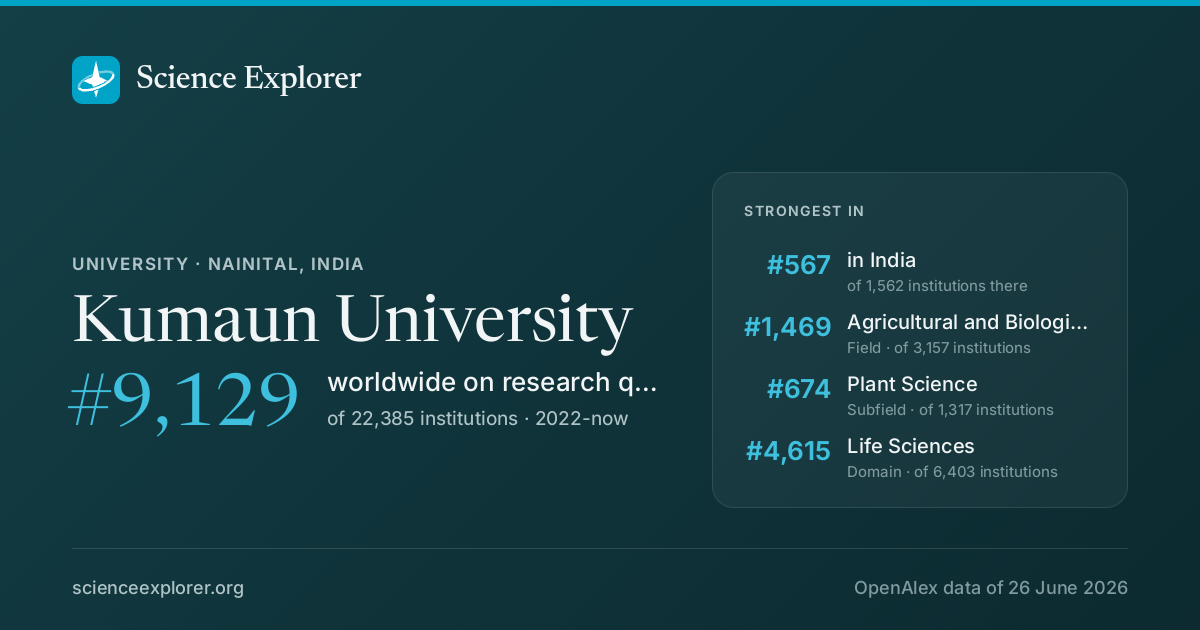
Kumaun University on Science Explorer

A card with Kumaun University's standing and the fields it leads in, for a post or a slide. A link to this page previews as the same card.

Download the card

1200 × 630 PNG, sized for social posts, drawn from the latest snapshot.

Badges for a website1Each links back here and updates with every snapshot

Research measures only: rankings here say nothing about teaching, admissions or student experience. Comparable institutions and collaboration partners have tabs of their own, above.

Discussion

Ask a question or share a note about Kumaun University. Posts are plain text and can be reported.