Science Explorer Back to mapMap
Discussion
Archive · Gothenburg · Sweden

Lindholmen Science Park

World rank, all time
#28,885
of 34,923
Rank in Sweden
#209
of 259
Research works
128
▲ 10% vs 2018-21
Citations
3.7k
28.9 per fractional work
Top-10% rate
11.9%
all institutions 10.0%
vs its own fields
1.00×
1.00× is exactly expected
Open access
35%
world 40%
International
19%
world 18%

Which fields of science does Lindholmen Science Park work in?

In 2022-now, 45% of research at Lindholmen Science Park is in Physical Sciences, 32% in Health Sciences. Its largest fields are Engineering (27%), Medicine (23%), Computer Science (16%).

Physical Sciences: 10 fractional works · 45.4% of its workEngineering: 6 fractional works · 26.5% of its workAutomotive Engineering: 2 fractional works · 8.4% of its workElectrical and Electronic Engineering: 2 fractional works · 7.4% of its workBuilding and Construction: 1 fractional works · 2.7% of its workCivil and Structural Engineering: 0 fractional works · 2.3% of its workSafety, Risk, Reliability and Quality: 0 fractional works · 1.5% of its workMedia Technology: 0 fractional works · 1.5% of its workAerospace Engineering: 0 fractional works · 1.4% of its workIndustrial and Manufacturing Engineering: 0 fractional works · 1.0% of its workControl and Systems Engineering: 0 fractional works · 0.3% of its workComputer Science: 4 fractional works · 16.3% of its workArtificial Intelligence: 2 fractional works · 6.9% of its workComputer Vision and Pattern Recognition: 1 fractional works · 4.3% of its workHuman-Computer Interaction: 1 fractional works · 2.8% of its workHardware and Architecture: 0 fractional works · 1.0% of its workInformation Systems: 0 fractional works · 1.0% of its workComputer Networks and Communications: 0 fractional works · 0.3% of its workEnvironmental Science: 0 fractional works · 2.0% of its workIndustrial and Manufacturing Engineering: 0 fractional works · 1.5% of its workSmaller subfields together: 0 fractional works · 0.5% of its workEnergy: 0 fractional works · 0.3% of its workRenewable Energy, Sustainability and the Environment: 0 fractional works · 0.3% of its workMaterials Science: 0 fractional works · 0.3% of its workMaterials Chemistry: 0 fractional works · 0.3% of its workHealth Sciences: 7 fractional works · 32.1% of its workMedicine: 5 fractional works · 23.1% of its workEmergency Medicine: 1 fractional works · 5.5% of its workEpidemiology: 1 fractional works · 2.5% of its workPulmonary and Respiratory Medicine: 0 fractional works · 2.3% of its workPhysiology: 0 fractional works · 2.2% of its workOncology: 0 fractional works · 1.9% of its workFamily Practice: 0 fractional works · 1.3% of its workPublic Health, Environmental and Occupational Health: 0 fractional works · 1.2% of its workCardiology and Cardiovascular Medicine: 0 fractional works · 1.0% of its workSurgery: 0 fractional works · 1.0% of its workCritical Care and Intensive Care Medicine: 0 fractional works · 0.8% of its workRehabilitation: 0 fractional works · 0.6% of its workHealth Informatics: 0 fractional works · 0.5% of its workNeurology: 0 fractional works · 0.5% of its workRadiology, Nuclear Medicine and Imaging: 0 fractional works · 0.5% of its workGeriatrics and Gerontology: 0 fractional works · 0.4% of its workPsychiatry and Mental health: 0 fractional works · 0.3% of its workAnesthesiology and Pain Medicine: 0 fractional works · 0.2% of its workPediatrics, Perinatology and Child Health: 0 fractional works · 0.2% of its workSmaller subfields together: 0 fractional works · 0.3% of its workHealth Professions: 2 fractional works · 7.9% of its workGeneral Health Professions: 1 fractional works · 3.0% of its workHealth Information Management: 0 fractional works · 2.3% of its workEmergency Medical Services: 0 fractional works · 1.0% of its workRadiological and Ultrasound Technology: 0 fractional works · 0.7% of its workSpeech and Hearing: 0 fractional works · 0.5% of its workOccupational Therapy: 0 fractional works · 0.3% of its workVeterinary: 0 fractional works · 0.6% of its workSmall Animals: 0 fractional works · 0.5% of its workSmaller subfields together: 0 fractional works · 0.1% of its workNursing: 0 fractional works · 0.5% of its workIssues, ethics and legal aspects: 0 fractional works · 0.5% of its workSocial Sciences: 4 fractional works · 19.7% of its workBusiness, Management and Accounting: 1 fractional works · 6.3% of its workManagement Information Systems: 1 fractional works · 2.8% of its workStrategy and Management: 0 fractional works · 1.5% of its workMarketing: 0 fractional works · 0.9% of its workManagement of Technology and Innovation: 0 fractional works · 0.5% of its workOrganizational Behavior and Human Resource Management: 0 fractional works · 0.5% of its workSmaller subfields together: 0 fractional works · 0.0% of its workPsychology: 1 fractional works · 4.8% of its workSocial Psychology: 1 fractional works · 4.0% of its workDevelopmental and Educational Psychology: 0 fractional works · 0.8% of its workSocial Sciences: 1 fractional works · 3.2% of its workTransportation: 0 fractional works · 1.9% of its workSociology and Political Science: 0 fractional works · 0.7% of its workGeography, Planning and Development: 0 fractional works · 0.3% of its workSafety Research: 0 fractional works · 0.3% of its workDecision Sciences: 1 fractional works · 3.1% of its workStatistics, Probability and Uncertainty: 0 fractional works · 2.3% of its workManagement Science and Operations Research: 0 fractional works · 0.8% of its workEconomics, Econometrics and Finance: 0 fractional works · 2.3% of its workEconomics and Econometrics: 0 fractional works · 2.3% of its workLife Sciences: 1 fractional works · 2.8% of its workBiochemistry, Genetics and Molecular Biology: 0 fractional works · 1.9% of its workCancer Research: 0 fractional works · 0.8% of its workBiophysics: 0 fractional works · 0.5% of its workMolecular Biology: 0 fractional works · 0.4% of its workSmaller subfields together: 0 fractional works · 0.3% of its workNeuroscience: 0 fractional works · 0.6% of its workCognitive Neuroscience: 0 fractional works · 0.3% of its workCellular and Molecular Neuroscience: 0 fractional works · 0.3% of its workAgricultural and Biological Sciences: 0 fractional works · 0.3% of its workALL ITS WORKLindholmenScience Park22fractional works, 2022-now
Life Sciences3%Physical Sciences45%Health Sciences32%Social Sciences20%

Each ring splits the one inside it: the four domains of science, their fields, their subfields. Size is fractional works in 2022-now. Every slice is a page; the interactive view zooms down to single topics and colours each by how much more of it this institution does than the world.

Its 4 domains and 17 fields, with their numbers
    1. Engineering626.5%
    2. Computer Science416.3%
    3. Environmental Science02.0%
    4. Energy00.3%
    5. Materials Science00.3%
    1. Medicine523.1%
    2. Health Professions27.9%
    3. Veterinary00.6%
    4. Nursing00.5%
    1. Business, Management and Accounting16.3%
    2. Psychology14.8%
    3. Social Sciences13.2%
    4. Decision Sciences13.1%
    5. Economics, Econometrics and Finance02.3%
    1. Biochemistry, Genetics and Molecular Biology01.9%
    2. Neuroscience00.6%
    3. Agricultural and Biological Sciences00.3%
All of science, and how each field's share has moved since 1950: the Science domain explorer

Field profile

Location quotient across every field it publishes in: outside the ring is more than an institution of this size would be expected to publish, inside it is less.

Agricultural and Biological Sciences: 0.05× its world share, 0 worksAgricultural and Bio…Biochemistry, Genetics and Molecular Biology: 0.37× its world share, 0 worksBiochemistry, Geneti…Neuroscience: 0.35× its world share, 0 worksNeuroscienceComputer Science: 2.10× its world share, 4 worksComputer ScienceEnergy: 0.28× its world share, 0 worksEnergyEngineering: 1.77× its world share, 6 worksEngineeringEnvironmental Science: 0.41× its world share, 0 worksEnvironmental ScienceMaterials Science: 0.07× its world share, 0 worksMaterials ScienceHealth Professions: 3.00× its world share, 2 worksHealth ProfessionsMedicine: 1.20× its world share, 5 worksMedicineNursing: 1.05× its world share, 0 worksNursingVeterinary: 4.43× its world share, 0 worksVeterinaryBusiness, Management and Accounting: 1.95× its world share, 1 worksBusiness, Management…Decision Sciences: 3.19× its world share, 1 worksDecision SciencesEconomics, Econometrics and Finance: 1.08× its world share, 0 worksEconomics, Econometr…Psychology: 1.56× its world share, 1 worksPsychologySocial Sciences: 0.25× its world share, 1 worksSocial Sciences1×world share
more than its size predictsabout as predictedless

Rings at 0.5×, 1× and 2×. Widest outward: Veterinary, 4.4×. Every wedge is a field page.

All 17 fields, with their numbers
  1. Veterinary4.43×0 works
  2. Decision Sciences3.19×1 works
  3. Health Professions3.00×2 works
  4. Computer Science2.10×4 works
  5. Business, Management and Accounting1.95×1 works
  6. Engineering1.77×6 works
  7. Psychology1.56×1 works
  8. Medicine1.20×5 works
  9. Economics, Econometrics and Finance1.08×0 works
  10. Nursing1.05×0 works
  11. Environmental Science0.41×0 works
  12. Biochemistry, Genetics and Molecular Biology0.37×0 works
  13. Neuroscience0.35×0 works
  14. Energy0.28×0 works
  15. Social Sciences0.25×1 works
  16. Materials Science0.07×0 works
  17. Agricultural and Biological Sciences0.05×0 works

Who are the top researchers at Lindholmen Science Park?

Ranked on the quality score, Gunnar Palmerud lead among researchers whose main affiliation is Lindholmen Science Park.

  1. 1 Gunnar Palmerud Sweden · #879,131 worldwide 1.9k citations · 28 works
All ranked researchers at Lindholmen Science Park

What are the most cited papers from Lindholmen Science Park?

The most cited paper from Lindholmen Science Park is "Design Principles for Competence Management Systems: A Synthesis of an Action Research Study1" (Lindgren, Ola Henfridsson, Ulrike Schultze, 2004), with 386 citations. Next come "Psychophysiological stress and emg activity of the trapezius muscle" (379) and "Development and implementation of Mobility-as-a-Service – A qualitative study of barriers and enabling factors" (210).

Most cited papers
#PaperReleasedCitations
1 Design Principles for Competence Management Systems: A Synthesis of an Action Research Study1 Lindgren, Ola Henfridsson, Ulrike Schultze · MIS Quarterly Sep 2004 386
2 Psychophysiological stress and emg activity of the trapezius muscle Ulf Lundberg, Roland Kadefors, Bo Melin et al. · International Journal of Behavioral Medicine Dec 1994 379
3 Development and implementation of Mobility-as-a-Service – A qualitative study of barriers and enabling factors MariAnne Karlsson, Dalia Mukhtar‐Landgren, Göran Smith et al. · Transportation Research Part A Policy and Practice Open access 28 Sep 2019 210
4 Review on Adhesives and Surface Treatments for Structural Applications: Recent Developments on Sustainability and Implementation for Metal and Composite Substrates Ana Clara Azola Marques, Alexandra Mocanu, Nataša Tomić et al. · Materials Open access 8 Dec 2020 188
5 Integrating a business model perspective into transition theory: The example of new mobility services Steven Sarasini, Marcus Linder · Environmental Innovation and Societal Transitions 12 Oct 2017 178
All 61 most cited papers, with filters and sorting

Which keywords describe research at Lindholmen Science Park?

By fractional works in 2022-now, weighted toward what it does more of than the world: Electric Vehicles, Deep Learning, Charging Infrastructure, Vehicle-to-Grid, Sustainability, Convolutional Neural Networks, Battery Management Systems and Lithium-ion Batteries.

▲ more of its work than of the world's◆ about the world's share▼ less than the world's

Size is fractional works in 2022-now in the topics tagged with each word; colour is the word's share of this institution's work against its share of the world's. The 9 words are chosen for being large and distinctive. Each links to the topic it comes from most.

All 9 words, with their numbers
  1. Deep Learning3▲ 4.1×13 topics
  2. Electric Vehicles3▲ 45×3 topics
  3. Sustainability2▲ 3.5×5 topics
  4. Charging Infrastructure1▲ 85×1 topic
  5. Neural Networks1▲ 3.8×6 topics
  6. Vehicle-to-Grid1▲ 85×1 topic
  7. Convolutional Neural Networks1▲ 7.6×4 topics
  8. Battery Management Systems1▲ 32×1 topic
  9. Lithium-ion Batteries1▲ 11×1 topic

Which research topics does Lindholmen Science Park publish most on?

By volume in 2022-now: Electric Vehicles and Infrastructure, Advanced Battery Technologies Research, Human-Automation Interaction and Safety and Advanced Neural Network Applications.

  1. 1 Electric Vehicles and Infrastructure Electrical and Electronic Engineering 1 works
  2. 2 Advanced Battery Technologies Research Automotive Engineering 1 works
  3. 3 Human-Automation Interaction and Safety Social Psychology 1 works
  4. 4 Advanced Neural Network Applications Computer Vision and Pattern Recognition 1 works
  5. 5 Emergency and Acute Care Studies Emergency Medicine 0 works
  6. 6 Electric and Hybrid Vehicle Technologies Automotive Engineering 0 works
  7. 7 scientometrics and bibliometrics research Statistics, Probability and Uncertainty 0 works
  8. 8 Transportation Safety and Impact Analysis Civil and Structural Engineering 0 works
  9. 9 Electronic Health Records Systems Health Information Management 0 works
  10. 10 Trauma and Emergency Care Studies Emergency Medicine 0 works

How open and international is its research?

Against the world's own shares: the tick on each track. Both are shares of its output, so they sit on one scale and can be read against each other as well as against the world.

openly available34.9%not open65.1%

World: 40% of research is openly available.

with international co-authors19.0%domestic only81.0%

World: 18% is written across borders.

How has Lindholmen Science Park's research output changed?

Output in 2022-2025 was 10% higher than in 2018-2021.

still counting1990200020102020
grewheldshrank

The same series as a ribbon: one cell per year, darker for more. The line above answers how much; this answers when.

Its share of all research

Growing output can still be a shrinking share: all of science grows. This is Lindholmen Science Park as a percentage of every work published that year, 0.000091% in 2024.

still counting0.00020%0.00040%0.00060%Lindholmen Science Park0.00013% in 202519801990200020102020

Fractional works of Lindholmen Science Park over all fractional works that year. How the balance of science has shifted.

Other research institutions in Gothenburg

All research institutions in Gothenburg

Share Lindholmen Science Park's ranking
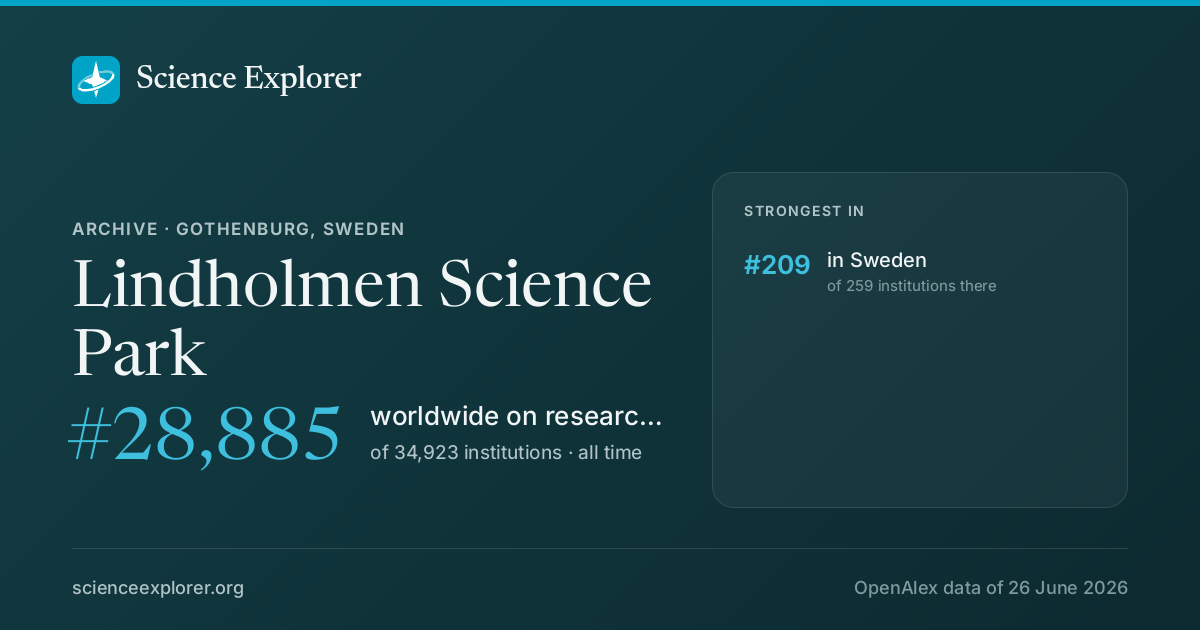
Lindholmen Science Park on Science Explorer

A card with Lindholmen Science Park's standing and the fields it leads in, for a post or a slide. A link to this page previews as the same card.

Download the card

1200 × 630 PNG, sized for social posts, drawn from the latest snapshot.

Badges for a website1Each links back here and updates with every snapshot

Research measures only: rankings here say nothing about teaching, admissions or student experience. Comparable institutions and collaboration partners have tabs of their own, above.

Discussion

Ask a question or share a note about Lindholmen Science Park. Posts are plain text and can be reported.