Science Explorer Back to mapMap
Discussion
University · Manchester · United Kingdom

Manchester Grammar School

World rank, all time
#32,814
of 34,923
Rank in United Kingdom
#1,763
of 1,844
Research works
127
▲ 252% vs 2018-21
Citations
844
6.6 per fractional work
Top-10% rate
6.3%
all institutions 10.0%
vs its own fields
0.91×
1.00× is exactly expected
Open access
11%
world 40%
International
4%
world 18%

Which fields of science does Manchester Grammar School work in?

In all years, 67% of research at Manchester Grammar School is in Social Sciences, 21% in Physical Sciences. Its largest fields are Social Sciences (37%), Arts and Humanities (17%), Engineering (6%). It does 3.0× the world's share of Social Sciences.

Social Sciences: 85 fractional works · 66.7% of its workSocial Sciences: 47 fractional works · 36.9% of its workPolitical Science and International Relations: 24 fractional works · 18.8% of its workSociology and Political Science: 5 fractional works · 3.6% of its workLaw: 4 fractional works · 3.5% of its workAnthropology: 4 fractional works · 3.4% of its workEducation: 4 fractional works · 3.0% of its workLinguistics and Language: 2 fractional works · 1.3% of its workUrban Studies: 1 fractional works · 1.0% of its workHuman Factors and Ergonomics: 1 fractional works · 0.9% of its workCommunication: 0 fractional works · 0.4% of its workGeography, Planning and Development: 0 fractional works · 0.4% of its workPublic Administration: 0 fractional works · 0.4% of its workArts and Humanities: 22 fractional works · 17.2% of its workHistory: 10 fractional works · 8.0% of its workLiterature and Literary Theory: 3 fractional works · 2.4% of its workHistory and Philosophy of Science: 3 fractional works · 2.1% of its workMuseology: 2 fractional works · 1.3% of its workPhilosophy: 2 fractional works · 1.3% of its workClassics: 1 fractional works · 0.7% of its workArcheology: 1 fractional works · 0.5% of its workGeneral Arts and Humanities: 0 fractional works · 0.4% of its workLanguage and Linguistics: 0 fractional works · 0.3% of its workVisual Arts and Performing Arts: 0 fractional works · 0.3% of its workPsychology: 7 fractional works · 5.5% of its workDevelopmental and Educational Psychology: 4 fractional works · 2.8% of its workSocial Psychology: 2 fractional works · 1.2% of its workClinical Psychology: 1 fractional works · 0.9% of its workExperimental and Cognitive Psychology: 1 fractional works · 0.7% of its workEconomics, Econometrics and Finance: 6 fractional works · 4.9% of its workEconomics and Econometrics: 6 fractional works · 4.6% of its workFinance: 0 fractional works · 0.3% of its workDecision Sciences: 2 fractional works · 1.4% of its workStatistics, Probability and Uncertainty: 1 fractional works · 0.9% of its workInformation Systems and Management: 0 fractional works · 0.4% of its workSmaller subfields together: 0 fractional works · 0.1% of its workBusiness, Management and Accounting: 1 fractional works · 0.7% of its workStrategy and Management: 0 fractional works · 0.3% of its workSmaller subfields together: 1 fractional works · 0.4% of its workPhysical Sciences: 26 fractional works · 20.7% of its workEngineering: 8 fractional works · 6.0% of its workElectrical and Electronic Engineering: 3 fractional works · 2.4% of its workMechanical Engineering: 1 fractional works · 0.8% of its workAutomotive Engineering: 1 fractional works · 0.8% of its workMedia Technology: 1 fractional works · 0.8% of its workSafety, Risk, Reliability and Quality: 0 fractional works · 0.4% of its workArchitecture: 0 fractional works · 0.3% of its workSmaller subfields together: 1 fractional works · 0.5% of its workComputer Science: 6 fractional works · 4.8% of its workHuman-Computer Interaction: 3 fractional works · 2.6% of its workArtificial Intelligence: 1 fractional works · 0.7% of its workInformation Systems: 1 fractional works · 0.7% of its workComputer Vision and Pattern Recognition: 1 fractional works · 0.6% of its workComputer Networks and Communications: 0 fractional works · 0.3% of its workPhysics and Astronomy: 5 fractional works · 3.8% of its workAstronomy and Astrophysics: 2 fractional works · 1.2% of its workNuclear and High Energy Physics: 1 fractional works · 1.0% of its workAtomic and Molecular Physics, and Optics: 1 fractional works · 0.8% of its workStatistical and Nonlinear Physics: 1 fractional works · 0.8% of its workMathematics: 4 fractional works · 3.2% of its workAlgebra and Number Theory: 1 fractional works · 1.0% of its workDiscrete Mathematics and Combinatorics: 1 fractional works · 1.0% of its workGeometry and Topology: 1 fractional works · 0.5% of its workNumerical Analysis: 1 fractional works · 0.5% of its workSmaller subfields together: 0 fractional works · 0.0% of its workEnvironmental Science: 2 fractional works · 1.4% of its workNature and Landscape Conservation: 1 fractional works · 0.7% of its workWater Science and Technology: 0 fractional works · 0.4% of its workSmaller subfields together: 0 fractional works · 0.3% of its workChemistry: 1 fractional works · 0.9% of its workSpectroscopy: 1 fractional works · 0.5% of its workOrganic Chemistry: 0 fractional works · 0.3% of its workSmaller subfields together: 0 fractional works · 0.1% of its workMaterials Science: 1 fractional works · 0.7% of its workSurfaces, Coatings and Films: 0 fractional works · 0.4% of its workSmaller subfields together: 0 fractional works · 0.3% of its workLife Sciences: 10 fractional works · 7.8% of its workAgricultural and Biological Sciences: 5 fractional works · 3.8% of its workEcology, Evolution, Behavior and Systematics: 2 fractional works · 1.6% of its workPlant Science: 1 fractional works · 0.9% of its workFood Science: 1 fractional works · 0.6% of its workAnimal Science and Zoology: 1 fractional works · 0.5% of its workSmaller subfields together: 0 fractional works · 0.1% of its workBiochemistry, Genetics and Molecular Biology: 3 fractional works · 2.2% of its workMolecular Biology: 2 fractional works · 1.3% of its workGenetics: 1 fractional works · 0.7% of its workSmaller subfields together: 0 fractional works · 0.1% of its workNeuroscience: 2 fractional works · 1.9% of its workCognitive Neuroscience: 2 fractional works · 1.9% of its workHealth Sciences: 6 fractional works · 4.8% of its workMedicine: 4 fractional works · 3.2% of its workPublic Health, Environmental and Occupational Health: 2 fractional works · 1.6% of its workReproductive Medicine: 1 fractional works · 0.5% of its workPsychiatry and Mental health: 0 fractional works · 0.4% of its workPhysiology: 0 fractional works · 0.3% of its workSmaller subfields together: 1 fractional works · 0.5% of its workHealth Professions: 2 fractional works · 1.3% of its workGeneral Health Professions: 2 fractional works · 1.2% of its workSmaller subfields together: 0 fractional works · 0.1% of its workVeterinary: 0 fractional works · 0.3% of its workSmall Animals: 0 fractional works · 0.3% of its workALL ITS WORKManchesterGrammar School127fractional works, all years
Life Sciences8%Physical Sciences21%Health Sciences5%Social Sciences67%

Each ring splits the one inside it: the four domains of science, their fields, their subfields. Size is fractional works in all years. Every slice is a page; the interactive view zooms down to single topics and colours each by how much more of it this institution does than the world.

Its 4 domains and 19 fields, with their numbers
    1. Social Sciences4736.9%
    2. Arts and Humanities2217.2%
    3. Psychology75.5%
    4. Economics, Econometrics and Finance64.9%
    5. Decision Sciences21.4%
    6. Business, Management and Accounting10.7%
    1. Engineering86.0%
    2. Computer Science64.8%
    3. Physics and Astronomy53.8%
    4. Mathematics43.2%
    5. Environmental Science21.4%
    6. Chemistry10.9%
    7. Materials Science10.7%
    1. Agricultural and Biological Sciences53.8%
    2. Biochemistry, Genetics and Molecular Biology32.2%
    3. Neuroscience21.9%
    1. Medicine43.2%
    2. Health Professions21.3%
    3. Veterinary00.3%
All of science, and how each field's share has moved since 1950: the Science domain explorer

Field profile

Location quotient across every field it publishes in: outside the ring is more than an institution of this size would be expected to publish, inside it is less.

Neuroscience: 5.68× its world share, 1 worksNeuroscienceComputer Science: 4.65× its world share, 3 worksComputer ScienceEngineering: 0.21× its world share, 0 worksEngineeringMaterials Science: 0.76× its world share, 0 worksMaterials ScienceHealth Professions: 5.38× its world share, 1 worksHealth ProfessionsMedicine: 0.41× its world share, 1 worksMedicineArts and Humanities: 2.46× its world share, 1 worksArts and HumanitiesBusiness, Management and Accounting: 1.47× its world share, 0 worksBusiness, Management…Decision Sciences: 1.83× its world share, 0 worksDecision SciencesEconomics, Econometrics and Finance: 0.83× its world share, 0 worksEconomics, Econometr…Psychology: 1.75× its world share, 0 worksPsychologySocial Sciences: 0.47× its world share, 1 worksSocial Sciences1×world share
more than its size predictsabout as predictedless

Rings at 0.5×, 1× and 2×. Widest outward: Neuroscience, 5.7×. Every wedge is a field page.

All 12 fields, with their numbers
  1. Neuroscience5.68×1 works
  2. Health Professions5.38×1 works
  3. Computer Science4.65×3 works
  4. Arts and Humanities2.46×1 works
  5. Decision Sciences1.83×0 works
  6. Psychology1.75×0 works
  7. Business, Management and Accounting1.47×0 works
  8. Economics, Econometrics and Finance0.83×0 works
  9. Materials Science0.76×0 works
  10. Social Sciences0.47×1 works
  11. Medicine0.41×1 works
  12. Engineering0.21×0 works

Who are the top researchers at Manchester Grammar School?

Ranked on the quality score, William Robert Guilfoyle, WILLIAM MARSHALL WATTS and N. H. Brasher lead among researchers whose main affiliation is Manchester Grammar School.

  1. 1 William Robert Guilfoyle United Kingdom · #1,812,002 worldwide 13 citations · 149 works
  2. 2 WILLIAM MARSHALL WATTS United Kingdom · #2,524,615 worldwide 54 citations · 36 works
  3. 3 N. H. Brasher United Kingdom · #2,648,954 worldwide 6 citations · 23 works
  4. 4 F. Holt Diggle United Kingdom · #2,776,148 worldwide 30 citations · 18 works
  5. 5 Anna McGlynn United Kingdom · #2,806,854 worldwide 6 citations · 17 works
  6. 6 Rachel Fenn United Kingdom · #2,960,491 worldwide 6 citations · 19 works
  7. 7 David Maland United Kingdom · #3,105,987 worldwide 72 citations · 29 works
  8. 8 Elizabeth R. McNamara United Kingdom · #3,468,292 worldwide 197 citations · 19 works
  9. 9 Peter G. Mason United Kingdom · #3,836,734 worldwide 845 citations · 144 works
  10. 10 Neil Sheldon United Kingdom · #4,610,774 worldwide 115 citations · 20 works
All ranked researchers at Manchester Grammar School

What are the most cited papers from Manchester Grammar School?

The most cited paper from Manchester Grammar School is "The value relevance of digital marketing capabilities to firm performance" (Christian Homburg, Dominik M. Wielgos, 2022), with 205 citations. Next come "Climatic change and the British butterfly fauna: Opportunities and constraints" (91) and "International education" (74).

Most cited papers
#PaperReleasedCitations
1 The value relevance of digital marketing capabilities to firm performance Christian Homburg, Dominik M. Wielgos · Journal of the Academy of Marketing Science Open access 20 Apr 2022 205
2 Climatic change and the British butterfly fauna: Opportunities and constraints Roger L. H. Dennis, Tim G. Shreeve · Biological Conservation 1991 91
3 International education Kieran Edmond James · Journal of Research in International Education 15 Nov 2005 74
4 Hostplant-habitat structure and the evolution of butterfly mate-locating behaviour Roger L. H. Dennis, Tim G. Shreeve · Zoological Journal of the Linnean Society Dec 1988 66
5 A multivariate approach to the determination of faunal structures among European butterfly species (Lepidoptera: Rhopalocera) Roger L. H. Dennis, W. Robert Williams, Tim G. Shreeve · Zoological Journal of the Linnean Society 1991 65
All 60 most cited papers, with filters and sorting

Which keywords describe research at Manchester Grammar School?

By fractional works in all years, weighted toward what it does more of than the world: Monetary Policy, British Politics, Depoliticisation, National Identity, Cultural Identity, Public Opinion, Nationalism and Literature.

▲ more of its work than of the world's◆ about the world's share▼ less than the world's

Size is fractional works in all years in the topics tagged with each word; colour is the word's share of this institution's work against its share of the world's. The 40 words are chosen for being large and distinctive. Each links to the topic it comes from most.

All 40 words, with their numbers
  1. Monetary Policy8▲ 23×2 topics
  2. British Politics8▲ 280×1 topic
  3. Depoliticisation8▲ 280×1 topic
  4. National Identity7▲ 45×4 topics
  5. Globalization7▲ 2.9×10 topics
  6. Cultural Identity6▲ 12×4 topics
  7. Public Opinion6▲ 27×3 topics
  8. Nationalism6▲ 8.0×6 topics
  9. Literature5▲ 8.5×7 topics
  10. Intergovernmental Relations5▲ 206×2 topics
  11. Reformation5▲ 90×2 topics
  12. Theology5▲ 35×2 topics
  13. Federalism5▲ 36×2 topics
  14. History5▲ 4.9×7 topics
  15. Education5▲ 3.0×10 topics
  16. Calvinism5▲ 98×1 topic
  17. Religious Controversy5▲ 98×1 topic
  18. Ancient Rome4▲ 77×1 topic
  19. Devolution4▲ 147×2 topics
  20. Greek Literature4▲ 77×1 topic
  21. Economic Growth4▲ 4.4×3 topics
  22. International Relations4▲ 16×4 topics
  23. Political Dynamics4▲ 77×2 topics
  24. Religion4▲ 5.4×8 topics
  25. Diplomacy4▲ 32×3 topics
  26. Decentralization4▲ 24×1 topic
  27. Multinational Federations4▲ 210×1 topic
  28. Biodiversity4▲ 3.7×7 topics
  29. American founding4▲ 37×1 topic
  30. Colonialism4▲ 5.5×5 topics
  31. Constitutional government4▲ 37×1 topic
  32. Legal History4▲ 66×3 topics
  33. Philosophy3▲ 5.8×6 topics
  34. Cross-Confessional3▲ 156×1 topic
  35. Early Modern3▲ 156×1 topic
  36. Society3▲ 10×5 topics
  37. Corrective Justice3▲ 90×1 topic
  38. Remedies3▲ 90×1 topic
  39. Europe3▲ 30×2 topics
  40. Cultural Impact2▲ 27×2 topics

Which research topics does Manchester Grammar School publish most on?

By volume in 2022-now: Interactive and Immersive Displays, Innovative Human-Technology Interaction, Tactile and Sensory Interactions and Aging, Elder Care, and Social Issues.

  1. 1 Interactive and Immersive Displays Human-Computer Interaction 2 works
  2. 2 Innovative Human-Technology Interaction Human-Computer Interaction 1 works
  3. 3 Tactile and Sensory Interactions Cognitive Neuroscience 1 works
  4. 4 Aging, Elder Care, and Social Issues General Health Professions 1 works
  5. 5 Hermeneutics and Narrative Identity Philosophy 1 works
  6. 6 Health, Medicine and Society General Health Professions 1 works
  7. 7 Health and Well-being Studies Clinical Psychology 0 works
  8. 8 Dementia and Cognitive Impairment Research Psychiatry and Mental health 0 works
  9. 9 Skin Protection and Aging Dermatology 0 works
  10. 10 Nanoparticles: synthesis and applications Materials Chemistry 0 works

How open and international is its research?

Against the world's own shares: the tick on each track. Both are shares of its output, so they sit on one scale and can be read against each other as well as against the world.

openly available11.2%not open88.8%

World: 40% of research is openly available.

with international co-authors4.5%domestic only95.5%

World: 18% is written across borders.

How has Manchester Grammar School's research output changed?

Output in 2022-2025 was 252% higher than in 2018-2021.

still counting1990200020102020
grewheldshrank

The same series as a ribbon: one cell per year, darker for more. The line above answers how much; this answers when.

Its share of all research

Growing output can still be a shrinking share: all of science grows. This is Manchester Grammar School as a percentage of every work published that year, 0.0000090% in 2024.

still counting0.0020%0.0040%Manchester Grammar School0.000017% in 202519801990200020102020

Fractional works of Manchester Grammar School over all fractional works that year. How the balance of science has shifted.

Other research institutions in Manchester

All research institutions in Manchester

Share Manchester Grammar School's ranking
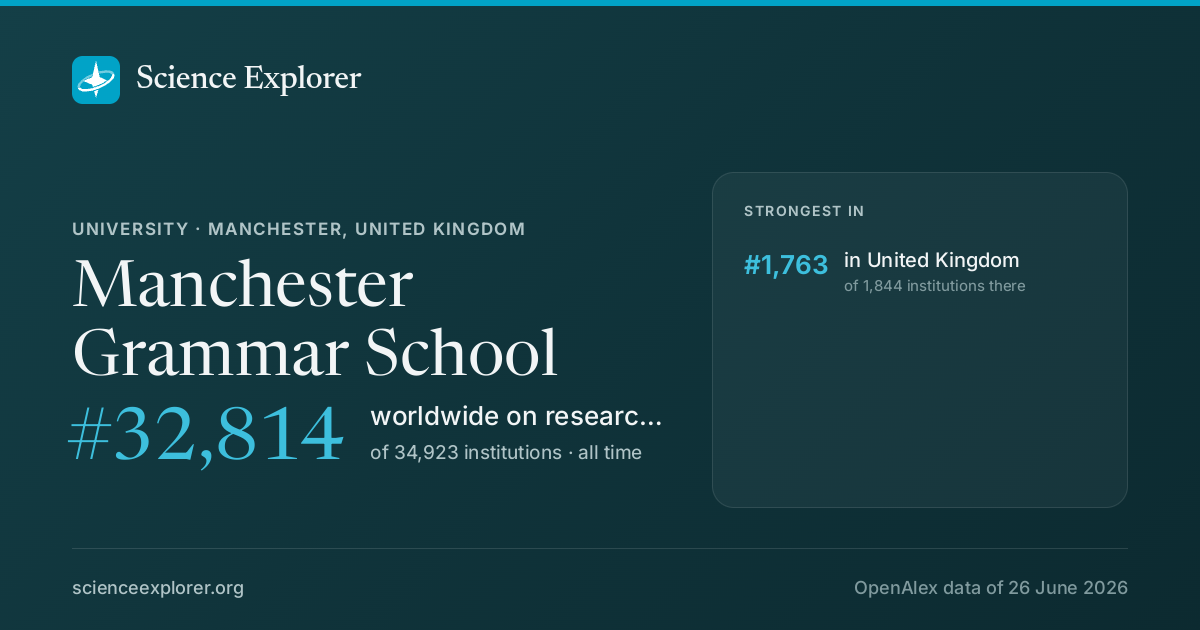
Manchester Grammar School on Science Explorer

A card with Manchester Grammar School's standing and the fields it leads in, for a post or a slide. A link to this page previews as the same card.

Download the card

1200 × 630 PNG, sized for social posts, drawn from the latest snapshot.

Badges for a website1Each links back here and updates with every snapshot

Research measures only: rankings here say nothing about teaching, admissions or student experience. Comparable institutions and collaboration partners have tabs of their own, above.

Discussion

Ask a question or share a note about Manchester Grammar School. Posts are plain text and can be reported.
