Science Explorer Back to mapMap
Discussion
Company · San Diego · United States

Maxwell Technologies (United States)

In research, Maxwell Technologies (United States) stands highest in Engineering (#4,230 of 9,532 worldwide), Physical Sciences (#9,048 of 17,446 worldwide) and Electrical and Electronic Engineering (#2,263 of 3,725 worldwide), over all time.

World rank, all time
#13,858
of 34,923
Rank in United States
#2,860
of 7,310
Research works
695
▼ 30% vs 2018-21
Citations
8.6k
12.3 per fractional work
Top-10% rate
11.8%
all institutions 10.0%
vs its own fields
0.86×
1.00× is exactly expected
Open access
14%
world 40%
International
10%
world 18%

What is Maxwell Technologies (United States) known for in research?

The fields where it stands highest, over all time, ranked among every institution above the floor in each field.

FieldWorld rankWhere that sitsTop-10% rateWorks
EngineeringField #4,230 of 9,532 6.8%322
Physical SciencesDomain #9,048 of 17,446 6.3%541
Electrical and Electronic EngineeringSubfield #2,263 of 3,725 6.2%139

Each strip is that field's whole ranked pool, with the notch where Maxwell Technologies (United States) sits in it, in the colour of the band that rank falls in. The track under the rate is the rate itself: it carries no average mark, because the average differs by field (from about 6% in Dentistry to 21% in Economics).

Which fields of science does Maxwell Technologies (United States) work in?

In 2022-now, 58% of research at Maxwell Technologies (United States) is in Physical Sciences, 19% in Social Sciences. Its largest fields are Engineering (18%), Medicine (14%), Materials Science (11%). It does 1.4× the world's share of Physical Sciences.

Physical Sciences: 21 fractional works · 57.6% of its workEngineering: 7 fractional works · 18.3% of its workElectrical and Electronic Engineering: 4 fractional works · 11.2% of its workMechanical Engineering: 1 fractional works · 2.0% of its workMechanics of Materials: 0 fractional works · 1.4% of its workBiomedical Engineering: 0 fractional works · 1.1% of its workCivil and Structural Engineering: 0 fractional works · 0.9% of its workMedia Technology: 0 fractional works · 0.5% of its workOcean Engineering: 0 fractional works · 0.4% of its workAutomotive Engineering: 0 fractional works · 0.3% of its workAerospace Engineering: 0 fractional works · 0.3% of its workSafety, Risk, Reliability and Quality: 0 fractional works · 0.2% of its workSmaller subfields together: 0 fractional works · 0.1% of its workMaterials Science: 4 fractional works · 11.5% of its workMaterials Chemistry: 3 fractional works · 9.3% of its workPolymers and Plastics: 0 fractional works · 1.0% of its workElectronic, Optical and Magnetic Materials: 0 fractional works · 0.6% of its workSurfaces, Coatings and Films: 0 fractional works · 0.5% of its workEnvironmental Science: 3 fractional works · 7.3% of its workHealth, Toxicology and Mutagenesis: 2 fractional works · 4.1% of its workEnvironmental Chemistry: 0 fractional works · 0.9% of its workEnvironmental Engineering: 0 fractional works · 0.8% of its workGlobal and Planetary Change: 0 fractional works · 0.5% of its workPollution: 0 fractional works · 0.5% of its workEcology: 0 fractional works · 0.4% of its workSmaller subfields together: 0 fractional works · 0.1% of its workPhysics and Astronomy: 2 fractional works · 5.1% of its workAstronomy and Astrophysics: 1 fractional works · 2.2% of its workAtomic and Molecular Physics, and Optics: 1 fractional works · 1.8% of its workStatistical and Nonlinear Physics: 0 fractional works · 0.9% of its workCondensed Matter Physics: 0 fractional works · 0.2% of its workComputer Science: 2 fractional works · 5.0% of its workArtificial Intelligence: 2 fractional works · 4.3% of its workInformation Systems: 0 fractional works · 0.5% of its workSmaller subfields together: 0 fractional works · 0.2% of its workEarth and Planetary Sciences: 2 fractional works · 4.4% of its workGeophysics: 1 fractional works · 2.7% of its workAtmospheric Science: 0 fractional works · 1.2% of its workGeochemistry and Petrology: 0 fractional works · 0.2% of its workOceanography: 0 fractional works · 0.2% of its workSmaller subfields together: 0 fractional works · 0.0% of its workEnergy: 1 fractional works · 2.4% of its workRenewable Energy, Sustainability and the Environment: 1 fractional works · 2.4% of its workMathematics: 1 fractional works · 1.8% of its workStatistics and Probability: 1 fractional works · 1.8% of its workChemistry: 1 fractional works · 1.4% of its workInorganic Chemistry: 0 fractional works · 0.5% of its workAnalytical Chemistry: 0 fractional works · 0.5% of its workElectrochemistry: 0 fractional works · 0.5% of its workChemical Engineering: 0 fractional works · 0.4% of its workBioengineering: 0 fractional works · 0.2% of its workCatalysis: 0 fractional works · 0.2% of its workSmaller subfields together: 0 fractional works · 0.0% of its workSocial Sciences: 7 fractional works · 18.9% of its workSocial Sciences: 3 fractional works · 7.7% of its workAnthropology: 1 fractional works · 2.7% of its workEducation: 1 fractional works · 2.4% of its workSafety Research: 0 fractional works · 0.9% of its workCommunication: 0 fractional works · 0.5% of its workPolitical Science and International Relations: 0 fractional works · 0.4% of its workSmaller subfields together: 0 fractional works · 0.7% of its workEconomics, Econometrics and Finance: 2 fractional works · 6.7% of its workEconomics and Econometrics: 2 fractional works · 4.6% of its workFinance: 0 fractional works · 1.2% of its workGeneral Economics, Econometrics and Finance: 0 fractional works · 0.9% of its workBusiness, Management and Accounting: 1 fractional works · 3.5% of its workAccounting: 1 fractional works · 2.7% of its workStrategy and Management: 0 fractional works · 0.5% of its workMarketing: 0 fractional works · 0.3% of its workDecision Sciences: 0 fractional works · 0.9% of its workInformation Systems and Management: 0 fractional works · 0.9% of its workPsychology: 0 fractional works · 0.2% of its workHealth Sciences: 7 fractional works · 17.8% of its workMedicine: 5 fractional works · 14.1% of its workCardiology and Cardiovascular Medicine: 1 fractional works · 2.7% of its workOncology: 1 fractional works · 1.9% of its workSurgery: 1 fractional works · 1.9% of its workPhysiology: 0 fractional works · 1.1% of its workHealth Informatics: 0 fractional works · 0.9% of its workEmergency Medicine: 0 fractional works · 0.8% of its workHepatology: 0 fractional works · 0.6% of its workPublic Health, Environmental and Occupational Health: 0 fractional works · 0.6% of its workRadiology, Nuclear Medicine and Imaging: 0 fractional works · 0.6% of its workPulmonary and Respiratory Medicine: 0 fractional works · 0.5% of its workDermatology: 0 fractional works · 0.5% of its workEpidemiology: 0 fractional works · 0.4% of its workNephrology: 0 fractional works · 0.4% of its workOrthopedics and Sports Medicine: 0 fractional works · 0.3% of its workSmaller subfields together: 0 fractional works · 1.0% of its workHealth Professions: 1 fractional works · 2.8% of its workEmergency Medical Services: 1 fractional works · 2.0% of its workGeneral Health Professions: 0 fractional works · 0.7% of its workSmaller subfields together: 0 fractional works · 0.1% of its workVeterinary: 0 fractional works · 0.8% of its workSmall Animals: 0 fractional works · 0.8% of its workDentistry: 0 fractional works · 0.1% of its workLife Sciences: 2 fractional works · 5.7% of its workImmunology and Microbiology: 1 fractional works · 2.1% of its workImmunology: 1 fractional works · 2.0% of its workSmaller subfields together: 0 fractional works · 0.2% of its workBiochemistry, Genetics and Molecular Biology: 1 fractional works · 1.8% of its workBiophysics: 0 fractional works · 0.9% of its workCancer Research: 0 fractional works · 0.6% of its workMolecular Biology: 0 fractional works · 0.2% of its workSmaller subfields together: 0 fractional works · 0.0% of its workAgricultural and Biological Sciences: 0 fractional works · 1.3% of its workAnimal Science and Zoology: 0 fractional works · 0.9% of its workEcology, Evolution, Behavior and Systematics: 0 fractional works · 0.2% of its workSmaller subfields together: 0 fractional works · 0.2% of its workNeuroscience: 0 fractional works · 0.5% of its workEndocrine and Autonomic Systems: 0 fractional works · 0.5% of its workALL ITS WORKMaxwellTechnologies…37fractional works, 2022-now
Life Sciences6%Physical Sciences58%Health Sciences18%Social Sciences19%

Each ring splits the one inside it: the four domains of science, their fields, their subfields. Size is fractional works in 2022-now. Every slice is a page; the interactive view zooms down to single topics and colours each by how much more of it this institution does than the world.

Its 4 domains and 23 fields, with their numbers
    1. Engineering718.3%
    2. Materials Science411.5%
    3. Environmental Science37.3%
    4. Physics and Astronomy25.1%
    5. Computer Science25.0%
    6. Earth and Planetary Sciences24.4%
    7. Energy12.4%
    8. Mathematics11.8%
    9. Chemistry11.4%
    10. Chemical Engineering00.4%
    1. Social Sciences37.7%
    2. Economics, Econometrics and Finance26.7%
    3. Business, Management and Accounting13.5%
    4. Decision Sciences00.9%
    5. Psychology00.2%
    1. Medicine514.1%
    2. Health Professions12.8%
    3. Veterinary00.8%
    4. Dentistry00.1%
    1. Immunology and Microbiology12.1%
    2. Biochemistry, Genetics and Molecular Biology11.8%
    3. Agricultural and Biological Sciences01.3%
    4. Neuroscience00.5%
All of science, and how each field's share has moved since 1950: the Science domain explorer

Field profile

Location quotient across every field it publishes in: outside the ring is more than an institution of this size would be expected to publish, inside it is less.

Agricultural and Biological Sciences: 0.28× its world share, 0 worksAgricultural and Bio…Biochemistry, Genetics and Molecular Biology: 0.33× its world share, 1 worksBiochemistry, Geneti…Immunology and Microbiology: 2.11× its world share, 1 worksImmunology and Micro…Neuroscience: 0.28× its world share, 0 worksNeuroscienceChemical Engineering: 1.23× its world share, 0 worksChemical EngineeringChemistry: 0.91× its world share, 0 worksChemistryComputer Science: 0.64× its world share, 2 worksComputer ScienceEarth and Planetary Sciences: 2.80× its world share, 2 worksEarth and Planetary …Energy: 2.61× its world share, 1 worksEnergyEngineering: 1.22× its world share, 7 worksEngineeringEnvironmental Science: 1.47× its world share, 3 worksEnvironmental ScienceMaterials Science: 3.29× its world share, 4 worksMaterials ScienceMathematics: 1.55× its world share, 1 worksMathematicsPhysics and Astronomy: 2.29× its world share, 2 worksPhysics and AstronomyDentistry: 0.23× its world share, 0 worksDentistryHealth Professions: 1.05× its world share, 1 worksHealth ProfessionsMedicine: 0.73× its world share, 5 worksMedicineVeterinary: 6.03× its world share, 0 worksVeterinaryBusiness, Management and Accounting: 1.09× its world share, 1 worksBusiness, Management…Decision Sciences: 0.94× its world share, 0 worksDecision SciencesEconomics, Econometrics and Finance: 3.12× its world share, 2 worksEconomics, Econometr…Psychology: 0.05× its world share, 0 worksPsychologySocial Sciences: 0.61× its world share, 3 worksSocial Sciences1×world share
more than its size predictsabout as predictedless

Rings at 0.5×, 1× and 2×. Widest outward: Veterinary, 6.0×. Every wedge is a field page.

All 23 fields, with their numbers
  1. Veterinary6.03×0 works
  2. Materials Science3.29×4 works
  3. Economics, Econometrics and Finance3.12×2 works
  4. Earth and Planetary Sciences2.80×2 works
  5. Energy2.61×1 works
  6. Physics and Astronomy2.29×2 works
  7. Immunology and Microbiology2.11×1 works
  8. Mathematics1.55×1 works
  9. Environmental Science1.47×3 works
  10. Chemical Engineering1.23×0 works
  11. Engineering1.22×7 works
  12. Business, Management and Accounting1.09×1 works
  13. Health Professions1.05×1 works
  14. Decision Sciences0.94×0 works
  15. Chemistry0.91×0 works
  16. Medicine0.73×5 works
  17. Computer Science0.64×2 works
  18. Social Sciences0.61×3 works
  19. Biochemistry, Genetics and Molecular Biology0.33×1 works
  20. Agricultural and Biological Sciences0.28×0 works
  21. Neuroscience0.28×0 works
  22. Dentistry0.23×0 works
  23. Psychology0.05×0 works

Who are the top researchers at Maxwell Technologies (United States)?

Ranked on the quality score, Shaofei Yang, Kirk E. Hackett and John R. Thompson lead among researchers whose main affiliation is Maxwell Technologies (United States).

  1. 1 Shaofei Yang United States · #330,670 worldwide 831 citations · 25 works
  2. 2 Kirk E. Hackett United States · #1,377,538 worldwide 622 citations · 33 works
  3. 3 John R. Thompson United States · #1,455,392 worldwide 15k citations · 207 works
  4. 4 G. P. Baca United States · #1,981,819 worldwide 329 citations · 18 works
  5. 5 R. Schneider United States · #2,046,051 worldwide 1.4k citations · 36 works
  6. 6 M. Scott United States · #2,166,868 worldwide 3.6k citations · 60 works
  7. 7 M H Maxwell United States · #2,175,885 worldwide 1.2k citations · 31 works
  8. 8 S.E. Englert United States · #2,566,698 worldwide 167 citations · 16 works
  9. 9 Mark Aurel Stein United States · #2,751,327 worldwide 217 citations · 44 works
  10. 10 John L. Harrison United States · #2,843,807 worldwide 849 citations · 67 works
All ranked researchers at Maxwell Technologies (United States)

What are the most cited papers from Maxwell Technologies (United States)?

The most cited paper from Maxwell Technologies (United States) is "Rotor position and velocity estimation for a salient-pole permanent magnet synchronous machine at standstill and high speeds" (M.J. Corley, R. D. Lorenz, 1998), with 844 citations. Next come "Hybrid Electric Vehicles: Architecture and Motor Drives" (490) and "Capacitors" (423).

Most cited papers
#PaperReleasedCitations
1 Rotor position and velocity estimation for a salient-pole permanent magnet synchronous machine at standstill and high speeds M.J. Corley, R. D. Lorenz · IEEE Transactions on Industry Applications 1998 844
2 Hybrid Electric Vehicles: Architecture and Motor Drives M. Ehsani, Yimin Gao, John M. Miller · Proceedings of the IEEE Apr 2007 490
3 Capacitors W.J. Sarjeant, Jennifer L. Zirnheld, F.W. MacDougall · IEEE Transactions on Plasma Science 1998 423
4 Performance optimization for doubly fed wind power generation systems Shibashis Bhowmik, René Spée, J.H.R. Enslin · IEEE Transactions on Industry Applications 1999 306
5 Rate prediction for single event effects-a critique Edward L. Petersen, James C. Pickel, James H. Adams et al. · IEEE Transactions on Nuclear Science Dec 1992 282
All 61 most cited papers, with filters and sorting

Which keywords describe research at Maxwell Technologies (United States)?

By fractional works in 2022-now, weighted toward what it does more of than the world: Solar Cells, Efficiency, Financial Performance, Bioimaging, Photovoltaics, Economic Growth, Insurance and Trade Credit.

▲ more of its work than of the world's◆ about the world's share▼ less than the world's

Size is fractional works in 2022-now in the topics tagged with each word; colour is the word's share of this institution's work against its share of the world's. The 15 words are chosen for being large and distinctive. Each links to the topic it comes from most.

All 15 words, with their numbers
  1. Efficiency3▲ 24×4 topics
  2. Solar Cells3▲ 36×7 topics
  3. Financial Performance2▲ 10×3 topics
  4. Machine Learning2▲ 1.43×5 topics
  5. Economic Growth1▲ 4.5×2 topics
  6. Mechanical Properties1▲ 3.5×6 topics
  7. Bioimaging1▲ 14×4 topics
  8. Biomedical Applications1▲ 2.8×6 topics
  9. Nanocomposites1▲ 4.0×5 topics
  10. Health Effects1▲ 5.1×4 topics
  11. Photovoltaics1▲ 20×2 topics
  12. Insurance1▲ 36×1 topic
  13. Risk Management1▲ 5.7×1 topic
  14. Trade Credit1▲ 105×1 topic
  15. Working Capital Management1▲ 105×1 topic

Which research topics does Maxwell Technologies (United States) publish most on?

By volume in 2022-now: Insurance and Financial Risk Management, Working Capital and Financial Performance, Silicon and Solar Cell Technologies and Thin-Film Transistor Technologies.

  1. 1 Insurance and Financial Risk Management Economics and Econometrics 1 works
  2. 2 Working Capital and Financial Performance Accounting 1 works
  3. 3 Silicon and Solar Cell Technologies Electrical and Electronic Engineering 1 works
  4. 4 Thin-Film Transistor Technologies Electrical and Electronic Engineering 1 works
  5. 5 Immunotoxicology and immune responses Immunology 1 works
  6. 6 Seismology and Earthquake Studies Artificial Intelligence 1 works
  7. 7 Disaster Response and Management Emergency Medical Services 1 works
  8. 8 earthquake and tectonic studies Geophysics 1 works
  9. 9 Effects and risks of endocrine disrupting chemicals Health, Toxicology and Mutagenesis 1 works
  10. 10 Heavy Metal Exposure and Toxicity Health, Toxicology and Mutagenesis 1 works

How open and international is its research?

Against the world's own shares: the tick on each track. Both are shares of its output, so they sit on one scale and can be read against each other as well as against the world.

openly available14.3%not open85.7%

World: 40% of research is openly available.

with international co-authors10.2%domestic only89.8%

World: 18% is written across borders.

How has Maxwell Technologies (United States)'s research output changed?

Output in 2022-2025 was 30% lower than in 2018-2021.

still counting1990200020102020
grewheldshrank

The same series as a ribbon: one cell per year, darker for more. The line above answers how much; this answers when.

Its share of all research

Growing output can still be a shrinking share: all of science grows. This is Maxwell Technologies (United States) as a percentage of every work published that year, 0.000087% in 2024.

still counting0.0020%0.0040%0.0060%Maxwell Technologies (United States)0.00018% in 202519801990200020102020

Fractional works of Maxwell Technologies (United States) over all fractional works that year. How the balance of science has shifted.

Other research institutions in San Diego

All research institutions in San Diego

Share Maxwell Technologies (United States)'s ranking
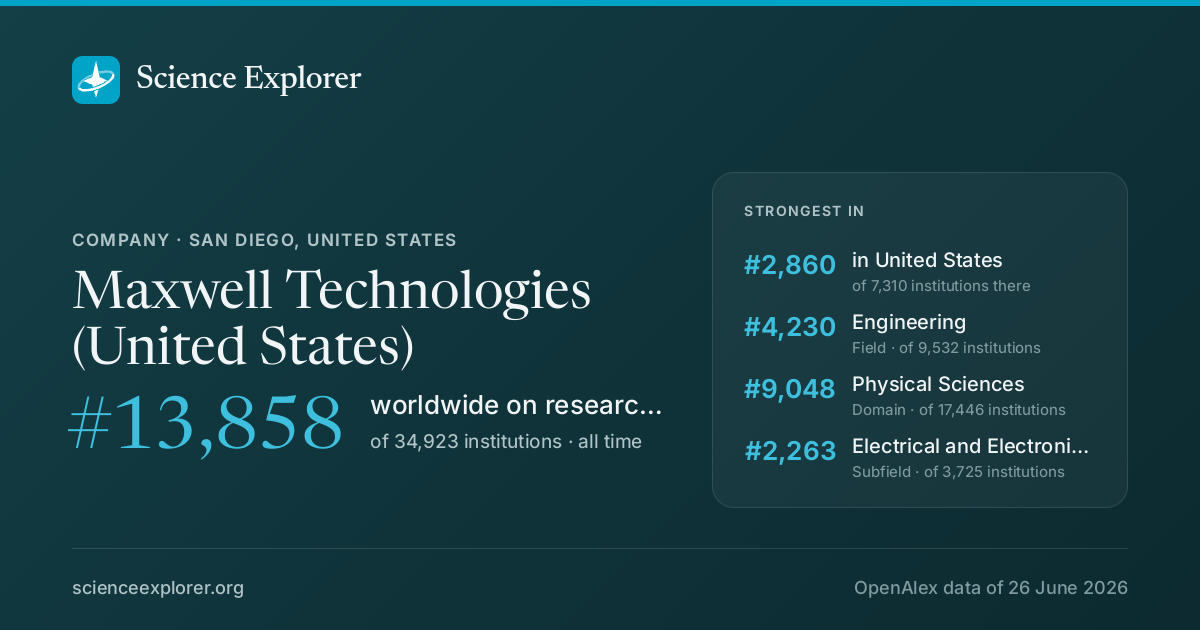
Maxwell Technologies (United States) on Science Explorer

A card with Maxwell Technologies (United States)'s standing and the fields it leads in, for a post or a slide. A link to this page previews as the same card.

Download the card

1200 × 630 PNG, sized for social posts, drawn from the latest snapshot.

Badges for a website1Each links back here and updates with every snapshot

Research measures only: rankings here say nothing about teaching, admissions or student experience. Comparable institutions and collaboration partners have tabs of their own, above.

Discussion

Ask a question or share a note about Maxwell Technologies (United States). Posts are plain text and can be reported.