Messerschmitt-Bölkow-Blohm (Germany)
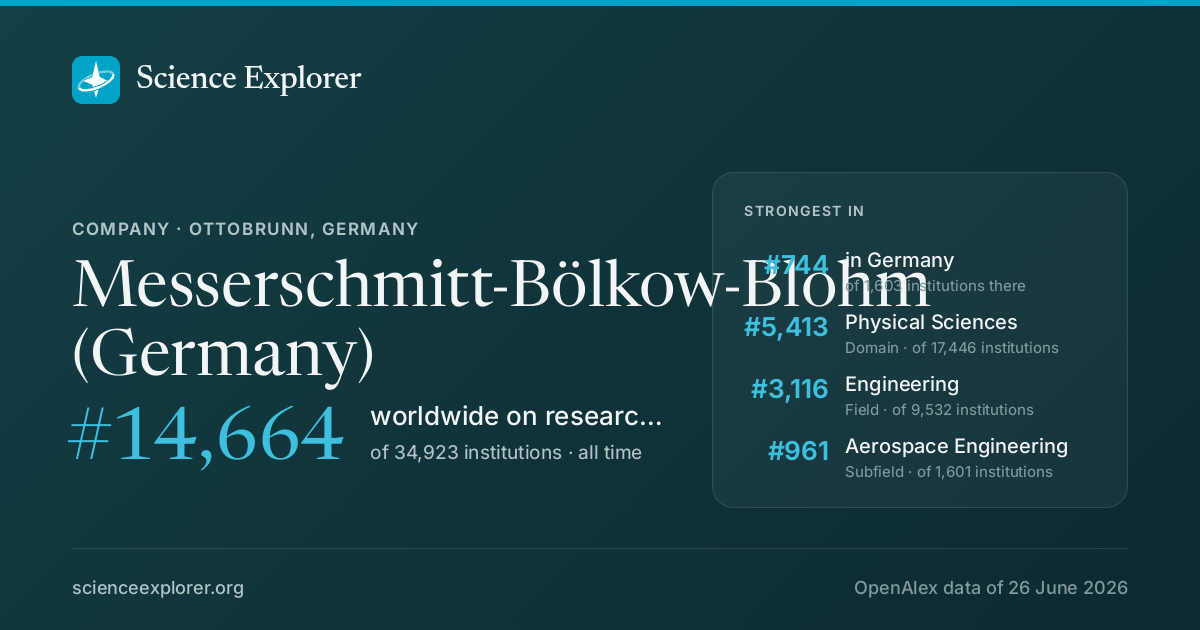
In research, Messerschmitt-Bölkow-Blohm (Germany) stands highest in Physical Sciences (#5,413 of 17,446 worldwide), Engineering (#3,116 of 9,532 worldwide) and Aerospace Engineering (#961 of 1,601 worldwide), over all time.
- World rank, all time
- #14,664 of 34,923
- Rank in Germany
- #744 of 1,603
- Research works
- 673 ▼ 3% vs 2018-21
- Citations
- 6.2k 9.1 per fractional work
- Top-10% rate
- 8.3% all institutions 10.0%
- vs its own fields
- 0.90× 1.00× is exactly expected
- Open access
- 3% world 40%
- International
- 6% world 18%
What is Messerschmitt-Bölkow-Blohm (Germany) known for in research?
The fields where it stands highest, over all time, ranked among every institution above the floor in each field.
| Field | World rank | Where that sits | Top-10% rate | Works |
|---|---|---|---|---|
| Physical SciencesDomain | #5,413 of 17,446 | 5.6% | 617 | |
| EngineeringField | #3,116 of 9,532 | 5.6% | 435 | |
| Aerospace EngineeringSubfield | #961 of 1,601 | 6.6% | 146 |
Each strip is that field's whole ranked pool, with the notch where Messerschmitt-Bölkow-Blohm (Germany) sits in it, in the colour of the band that rank falls in. The track under the rate is the rate itself: it carries no average mark, because the average differs by field (from about 6% in Dentistry to 21% in Economics).
Which fields of science does Messerschmitt-Bölkow-Blohm (Germany) work in?
In all years, 92% of research at Messerschmitt-Bölkow-Blohm (Germany) is in Physical Sciences, 4% in Social Sciences. Its largest fields are Engineering (65%), Physics and Astronomy (7%), Materials Science (7%). It does 2.2× the world's share of Physical Sciences.
Each ring splits the one inside it: the four domains of science, their fields, their subfields. Size is fractional works in all years. Every slice is a page; the interactive view zooms down to single topics and colours each by how much more of it this institution does than the world.
Its 4 domains and 22 fields, with their numbers
- Physical Sciences61791.6%
- Engineering43564.5%
- Physics and Astronomy507.5%
- Materials Science446.6%
- Computer Science304.4%
- Environmental Science172.5%
- Mathematics162.4%
- Earth and Planetary Sciences111.6%
- Energy71.0%
- Chemical Engineering60.8%
- Chemistry30.4%
- Social Sciences274.0%
- Health Sciences233.3%
- Medicine203.0%
- Health Professions20.3%
- Veterinary10.1%
- Life Sciences71.1%
Field profile
Location quotient across every field it publishes in: outside the ring is more than an institution of this size would be expected to publish, inside it is less.
Rings at 0.5×, 1× and 2×. Widest outward: Veterinary, 11.6×. Every wedge is a field page.
All 10 fields, with their numbers
- Veterinary11.61×0 works
- Energy11.44×0 works
- Engineering3.66×2 works
- Chemical Engineering2.51×0 works
- Physics and Astronomy1.77×0 works
- Environmental Science1.59×0 works
- Biochemistry, Genetics and Molecular Biology1.28×0 works
- Materials Science1.13×0 works
- Computer Science1.01×0 works
- Agricultural and Biological Sciences0.33×0 works
Who are the top researchers at Messerschmitt-Bölkow-Blohm (Germany)?
Ranked on the quality score, T. Halldórsson, John Langerholc and Albrecht Eberle lead among researchers whose main affiliation is Messerschmitt-Bölkow-Blohm (Germany).
- 1
T. Halldórsson
 Germany · #1,724,071 worldwide
656 citations · 23 works
- 2
John Langerholc
Germany · #2,430,021 worldwide
613 citations · 27 works
- 3
Albrecht Eberle
Germany · #2,738,703 worldwide
185 citations · 22 works
- 4
Roland Felkai
Germany · #2,803,577 worldwide
29 citations · 70 works
- 5
Ludwig Bölkow
Germany · #3,159,209 worldwide
14 citations · 25 works
- 6
Marcus Oliver Held
Germany · #3,169,628 worldwide
339 citations · 44 works
- 7
Artfried Weihe
Germany · #3,191,163 worldwide
15 citations · 16 works
- 8
Helmut Groß
Germany · #3,273,735 worldwide
10 citations · 17 works
- 9
Eveline Gottzein
Germany · #3,297,194 worldwide
247 citations · 35 works
- 10
Joachim Szodruch
Germany · #3,420,389 worldwide
420 citations · 38 works
Which keywords describe research at Messerschmitt-Bölkow-Blohm (Germany)?
By fractional works in all years, weighted toward what it does more of than the world: Vibration Analysis, Thermal Analysis, Adaptive Mesh Refinement, CubeSat, High-Order Schemes, small satellite, Solar Cells and Thermal Management.
- Photon Counting
- Emissions
- Fault Diagnosis
- Boundary Layer Transition
- Structural Analysis
- Turbulent Flows
- Engineering
- Materials Science
- Vortex Dynamics
- Cryogenic Storage
- Control Systems
- Large-Eddy Simulation
- Hybrid Rocket Propulsion
- Mechanical Properties
- Turbulence Modeling
- Radial Basis Functions
- Solar Cells
- High-Order Schemes
- Adaptive Mesh Refinement
- Renewable Energy
- Vibration Analysis
- Thermal Analysis
- CubeSat
- small satellite
- Thermal Management
- Shock-Wave Interactions
- Combustion Instabilities
- Heat Transfer
- Regression Rate Behavior
- Flight Control
- Fluid Dynamics
- Liquefied Natural Gas (LNG)
- Metal Nanoparticles
- Mathematical Modeling
- Parameter Estimation
- Renewable Energy Integration
- Turbine Technology
- Particle Image Velocimetry
- Unmanned Aerial Vehicles
- Optimal Control
Size is fractional works in all years in the topics tagged with each word; colour is the word's share of this institution's work against its share of the world's. The 40 words are chosen for being large and distinctive. Each links to the topic it comes from most.
All 40 words, with their numbers
- Vibration Analysis25▲ 12×6 topics
- Renewable Energy25▲ 3.7×12 topics
- Thermal Analysis23▲ 23×6 topics
- Adaptive Mesh Refinement21▲ 35×2 topics
- CubeSat21▲ 129×1 topic
- High-Order Schemes21▲ 35×2 topics
- small satellite21▲ 129×1 topic
- Solar Cells20▲ 9.7×6 topics
- Thermal Management20▲ 10×7 topics
- Radial Basis Functions20▲ 30×2 topics
- Shock-Wave Interactions19▲ 51×1 topic
- Turbulence Modeling19▲ 51×1 topic
- Combustion Instabilities19▲ 37×2 topics
- Mechanical Properties19▲ 2.9×22 topics
- Heat Transfer18▲ 5.4×14 topics
- Hybrid Rocket Propulsion18▲ 100×1 topic
- Regression Rate Behavior18▲ 100×1 topic
- Large-Eddy Simulation18▲ 11×5 topics
- Flight Control18▲ 86×2 topics
- Control Systems18▲ 10×7 topics
- Fluid Dynamics17▲ 17×5 topics
- Cryogenic Storage16▲ 65×1 topic
- Liquefied Natural Gas (LNG)16▲ 65×1 topic
- Vortex Dynamics15▲ 13×4 topics
- Metal Nanoparticles14▲ 14×3 topics
- Materials Science14▲ 26×3 topics
- Mathematical Modeling14▲ 19×2 topics
- Engineering14▲ 22×2 topics
- Parameter Estimation14▲ 16×4 topics
- Turbulent Flows14▲ 16×2 topics
- Renewable Energy Integration14▲ 8.0×2 topics
- Structural Analysis14▲ 13×4 topics
- Turbine Technology14▲ 49×1 topic
- Boundary Layer Transition14▲ 21×1 topic
- Particle Image Velocimetry14▲ 21×1 topic
- Fault Diagnosis12▲ 8.1×3 topics
- Unmanned Aerial Vehicles12▲ 17×3 topics
- Emissions12▲ 9.0×3 topics
- Optimal Control12▲ 23×2 topics
- Photon Counting12▲ 23×3 topics
Which research topics does Messerschmitt-Bölkow-Blohm (Germany) publish most on?
By volume in 2022-now: Space Satellite Systems and Control, Physics and Engineering Research Articles, solar cell performance optimization and Photovoltaic System Optimization Techniques.
Area is fractional works; colour is the subfield each topic belongs to.
- 1 Space Satellite Systems and Control Aerospace Engineering 0 works
- 2 Physics and Engineering Research Articles Computational Mechanics 0 works
- 3 solar cell performance optimization Electrical and Electronic Engineering 0 works
- 4 Photovoltaic System Optimization Techniques Renewable Energy, Sustainability and the Environment 0 works
- 5 Flexible and Reconfigurable Manufacturing Systems Industrial and Manufacturing Engineering 0 works
- 6 Satellite Communication Systems Aerospace Engineering 0 works
- 7 Spacecraft Dynamics and Control Aerospace Engineering 0 works
- 8 Explainable Artificial Intelligence (XAI) Artificial Intelligence 0 works
- 9 Photovoltaic Systems and Sustainability Environmental Engineering 0 works
- 10 Spacecraft Design and Technology Aerospace Engineering 0 works
How open and international is its research?
Against the world's own shares: the tick on each track. Both are shares of its output, so they sit on one scale and can be read against each other as well as against the world.
World: 40% of research is openly available.
World: 18% is written across borders.
How has Messerschmitt-Bölkow-Blohm (Germany)'s research output changed?
Output in 2022-2025 was 3% lower than in 2018-2021.
The same series as a ribbon: one cell per year, darker for more. The line above answers how much; this answers when.
Its share of all research
Growing output can still be a shrinking share: all of science grows. This is Messerschmitt-Bölkow-Blohm (Germany) as a percentage of every work published that year, 0.000010% in 2024.
Fractional works of Messerschmitt-Bölkow-Blohm (Germany) over all fractional works that year. How the balance of science has shifted.
Other research institutions in Ottobrunn
Share Messerschmitt-Bölkow-Blohm (Germany)'s ranking
Badges for a website1Each links back here and updates with every snapshot

Research measures only: rankings here say nothing about teaching, admissions or student experience. Comparable institutions and collaboration partners have tabs of their own, above.
Discussion
Ask a question or share a note about Messerschmitt-Bölkow-Blohm (Germany). Keep it to the research: no personal attacks, advertising or links. Any reader can report a post, which collapses it for everyone until it is opened.