Middlesex University

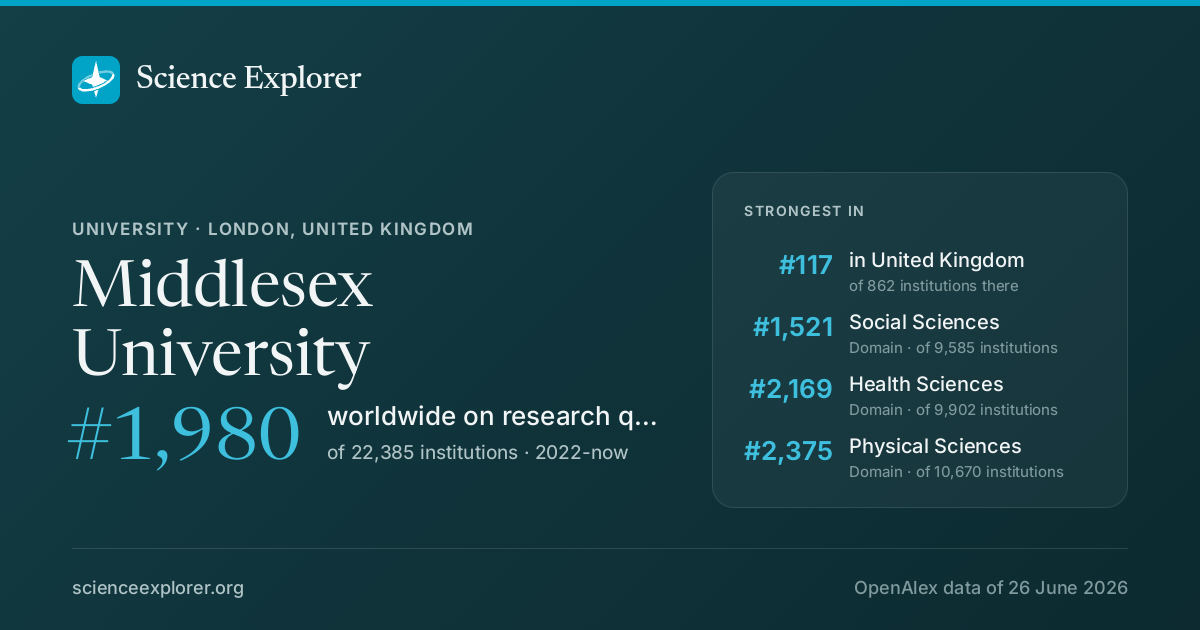
In research, Middlesex University stands highest in Social Sciences (#1,521 of 9,585 worldwide), Health Sciences (#2,169 of 9,902 worldwide) and Physical Sciences (#2,375 of 10,670 worldwide), 2022-now. Relative to its size it is most specialised in Orthopedics and Sports Medicine, Organizational Behavior and Human Resource Management and Management of Technology and Innovation (Orthopedics and Sports Medicine is 10.2× its share of world research).
- World rank, 2022-now
- #1,980 of 22,385 · #3,684 all time
- Rank in United Kingdom
- #117 of 862
- Research works
- 10k ▼ 28% vs 2018-21
- Citations
- 254k 24.3 per fractional work
- Top-10% rate
- 13.1% all institutions 10.0%
- vs its own fields
- 1.19× 1.00× is exactly expected
- Open access
- 25% world 40%
- International
- 21% world 18%
What is Middlesex University known for in research?
The fields where it stands highest, 2022-now, ranked among every institution above the floor in each field.
| Field | World rank | Where that sits | Top-10% rate | Works | All time |
|---|---|---|---|---|---|
| Social SciencesDomain | #1,521 of 9,585 | 13.4% | 597 | #2093 | |
| Health SciencesDomain | #2,169 of 9,902 | 15.6% | 200 | #6312 | |
| Physical SciencesDomain | #2,375 of 10,670 | 12.5% | 274 | #7778 | |
| MedicineField | #2,362 of 8,541 | 17.3% | 156 | #6009 | |
| Social SciencesField | #1,674 of 5,988 | 14.3% | 265 | #2320 | |
| Business, Management and AccountingField | #816 of 2,581 | 11.1% | 127 | #1399 | |
| Sociology and Political ScienceSubfield | #940 of 2,526 | 15.8% | 114 | #1805 | |
| Computer ScienceField | #1,764 of 4,417 | 11.6% | 110 | #2304 | |
| PsychologyField | #1,083 of 2,121 | 13.9% | 91 | #1809 | |
| EngineeringField | #3,283 of 5,901 | 11.4% | 100 | #5289 |
Each strip is that field's whole ranked pool, with the notch where Middlesex University sits in it, in the colour of the band that rank falls in. The track under the rate is the rate itself: it carries no average mark, because the average differs by field (from about 6% in Dentistry to 21% in Economics).
Which of those standings moved
The same fields on both windows: where it stood over the whole record, and where it stands in 2022-now. The distance is the story, and it is the one thing the two rank columns above cannot show.
- Social Sciences#2,093 #1,521
- Health Sciences#6,312 #2,169
- Physical Sciences#7,778 #2,375
- Medicine#6,009 #2,362
- Social Sciences#2,320 #1,674
- Business, Management and Accounting#1,399 #816
- Sociology and Political Science#1,805 #940
- Computer Science#2,304 #1,764
- Psychology#1,809 #1,083
- Engineering#5,289 #3,283
A dot further right is a better standing. Fields it was not ranked in over the whole record are left out.
Which fields of science does Middlesex University work in?
In 2022-now, 53% of research at Middlesex University is in Social Sciences, 24% in Physical Sciences. Its largest fields are Social Sciences (23%), Medicine (14%), Business, Management and Accounting (12%). It does 2.1× the world's share of Social Sciences.
Each ring splits the one inside it: the four domains of science, their fields, their subfields. Size is fractional works in 2022-now. Every slice is a page; the interactive view zooms down to single topics and colours each by how much more of it this institution does than the world.
Its 4 domains and 25 fields, with their numbers
- Social Sciences66452.9%
- Social Sciences29023.1%
- Business, Management and Accounting14711.7%
- Psychology1008.0%
- Arts and Humanities594.7%
- Economics, Econometrics and Finance423.3%
- Decision Sciences262.1%
- Physical Sciences30023.9%
- Computer Science1189.4%
- Engineering1118.9%
- Environmental Science403.2%
- Mathematics110.8%
- Physics and Astronomy50.4%
- Earth and Planetary Sciences50.4%
- Energy30.3%
- Chemistry30.2%
- Materials Science30.2%
- Chemical Engineering10.0%
- Health Sciences22117.6%
- Medicine17513.9%
- Health Professions413.3%
- Nursing40.3%
- Dentistry10.1%
- Life Sciences695.5%
What does Middlesex University specialise in?
Where its research is concentrated relative to its size: Orthopedics and Sports Medicine takes 10.2× the share of its output that it takes of world research.
- Orthopedics and Sports MedicineSubfield · 32.8 works10×
- Organizational Behavior and Human Resource ManagementSubfield · 40.6 works6.8×
- Management of Technology and InnovationSubfield · 20.6 works5.4×
Location quotient, a volume reading rather than an impact one. It surfaces small, lopsided specialities.
Field profile
Location quotient across every field it publishes in: outside the ring is more than an institution of this size would be expected to publish, inside it is less.
Rings at 0.5×, 1× and 2×. Widest outward: Business, Management and Accounting, 3.6×. Every wedge is a field page.
All 25 fields, with their numbers
- Business, Management and Accounting3.64×147 works
- Psychology2.61×100 works
- Decision Sciences2.12×26 works
- Social Sciences1.83×290 works
- Arts and Humanities1.64×59 works
- Economics, Econometrics and Finance1.56×42 works
- Health Professions1.25×41 works
- Computer Science1.21×118 works
- Neuroscience1.19×24 works
- Pharmacology, Toxicology and Pharmaceutics0.90×4 works
- Mathematics0.72×11 works
- Medicine0.72×175 works
- Environmental Science0.64×40 works
- Engineering0.59×112 works
- Nursing0.59×4 works
- Biochemistry, Genetics and Molecular Biology0.37×25 works
- Immunology and Microbiology0.31×4 works
- Energy0.29×3 works
- Earth and Planetary Sciences0.27×5 works
- Agricultural and Biological Sciences0.22×13 works
- Physics and Astronomy0.19×5 works
- Chemistry0.15×3 works
- Dentistry0.14×1 works
- Chemical Engineering0.13×1 works
- Materials Science0.06×3 works
- Business, Management and Accounting 3.6×
- Psychology 2.6×
- Decision Sciences 2.1×
- Social Sciences 1.8×
- Arts and Humanities 1.6×
- Economics, Econometrics and Finance 1.6×
- Health Professions 1.2×
- Computer Science 1.2×
- Neuroscience 1.2×
- Pharmacology, Toxicology and Pharmaceutics 0.9×
- Mathematics 0.7×
- Medicine 0.7×
- Environmental Science 0.6×
- Engineering 0.6×
- Nursing 0.6×
- Biochemistry, Genetics and Molecular Biology 0.4×
- Immunology and Microbiology 0.3×
- Energy 0.3×
- Earth and Planetary Sciences 0.3×
- Agricultural and Biological Sciences 0.2×
- Physics and Astronomy 0.2×
- Chemistry 0.1×
- Dentistry 0.1×
- Chemical Engineering 0.1×
- Materials Science 0.1×
Who are the top researchers at Middlesex University?
Ranked on the quality score, Valerio Capraro, Mariachiara Di Cesare and Charles Dennis lead among researchers whose main affiliation is Middlesex University.
- 1
Valerio Capraro
 United Kingdom · #11,603 worldwide
12k citations · 260 works
- 2
Mariachiara Di Cesare
United Kingdom · #47,965 worldwide
32k citations · 135 works
- 3
Charles Dennis
United Kingdom · #80,772 worldwide
8.6k citations · 255 works
- 4
Pantea Foroudi
United Kingdom · #100,373 worldwide
8.7k citations · 335 works
- 5
Eléonore Kofman
United Kingdom · #191,837 worldwide
7.9k citations · 235 works
- 6
Xin‐She Yang
United Kingdom · #225,049 worldwide
69k citations · 628 works
- 7
Dimitrios Stylidis
United Kingdom · #240,211 worldwide
4.2k citations · 70 works
- 8
Constantinos‐Vasilios Priporas
United Kingdom · #247,153 worldwide
4k citations · 113 works
- 9
Xiaochun Cheng
United Kingdom · #317,032 worldwide
6.5k citations · 317 works
- 10
Jędrzej George Frynas
United Kingdom · #356,558 worldwide
8.8k citations · 85 works
Which keywords describe research at Middlesex University?
By fractional works in 2022-now, weighted toward what it does more of than the world: Digital Transformation, Big Data, Artificial Intelligence, Mental Health, Sustainability, Leadership, Internet of Things and Customer Relationship Management.
- Muscle Injuries
- Athletic Training
- Mobile Health
- Value Chains
- Strategic Marketing
- Generation Management
- Socio-Technical Systems
- Physiological Demands
- Investment Decisions
- Injury Prevention
- Performance Analysis
- Employee Engagement
- Organizational Change
- Social Capital
- Leadership
- Healthcare
- Digital Transformation
- Big Data
- Deep Learning
- Artificial Intelligence
- Sustainability
- Mental Health
- Epidemiology
- Globalization
- Internet of Things
- Education
- Risk Factors
- Customer Relationship Management
- Smart Cities
- Governance
- High-Intensity Interval Training
- Resistance Training
- Urban Development
- Training Load
- Agility
- Customer Experience
- Digital Capital
- Privacy Concerns
- Business Models
- Citizen Participation
Size is fractional works in 2022-now in the topics tagged with each word; colour is the word's share of this institution's work against its share of the world's. The 40 words are chosen for being large and distinctive. Each links to the topic it comes from most.
All 40 words, with their numbers
- Sustainability56▲ 1.84×51 topics
- Artificial Intelligence49▲ 2.8×32 topics
- Mental Health47▲ 2.6×36 topics
- Deep Learning46◆ 1.07×63 topics
- Epidemiology45◆ 0.91×74 topics
- Big Data45▲ 3.7×22 topics
- Globalization43▲ 1.76×61 topics
- Digital Transformation40▲ 5.9×14 topics
- Internet of Things38▲ 3.6×17 topics
- Healthcare37▲ 2.6×19 topics
- Education36▲ 1.66×46 topics
- Leadership32▲ 5.2×15 topics
- Risk Factors30▲ 2.1×27 topics
- Social Capital27▲ 4.2×15 topics
- Customer Relationship Management24▲ 14×2 topics
- Organizational Change23▲ 24×6 topics
- Smart Cities22▲ 6.6×6 topics
- Employee Engagement21▲ 9.3×4 topics
- Governance20▲ 5.0×12 topics
- Performance Analysis20▲ 7.8×4 topics
- High-Intensity Interval Training20▲ 15×2 topics
- Injury Prevention20▲ 13×5 topics
- Resistance Training19▲ 17×2 topics
- Investment Decisions19▲ 12×3 topics
- Urban Development19▲ 4.3×8 topics
- Physiological Demands19▲ 23×1 topic
- Training Load19▲ 23×1 topic
- Socio-Technical Systems19▲ 60×2 topics
- Agility18▲ 101×1 topic
- Generation Management18▲ 101×1 topic
- Customer Experience17▲ 8.4×4 topics
- Strategic Marketing16▲ 59×2 topics
- Digital Capital16▲ 72×1 topic
- Value Chains16▲ 72×1 topic
- Privacy Concerns15▲ 15×3 topics
- Mobile Health15▲ 8.1×3 topics
- Business Models14▲ 15×3 topics
- Athletic Training13▲ 12×2 topics
- Citizen Participation13▲ 9.2×2 topics
- Muscle Injuries13▲ 16×1 topic
Which research topics does Middlesex University publish most on?
By volume in 2022-now: Sports Performance and Training, Corporate Management and Leadership, Corporate Governance and Management and Sports injuries and prevention.
Area is fractional works; colour is the subfield each topic belongs to.
- 1 Sports Performance and Training Orthopedics and Sports Medicine 19 works
- 2 Corporate Management and Leadership Organizational Behavior and Human Resource Management 18 works
- 3 Corporate Governance and Management Strategy and Management 16 works
- 4 Sports injuries and prevention Orthopedics and Sports Medicine 13 works
- 5 Smart Cities and Technologies Media Technology 13 works
- 6 Digital Innovation in Industries Management of Technology and Innovation 11 works
- 7 Digital Marketing and Social Media Sociology and Political Science 9 works
- 8 Sports Science and Education History and Philosophy of Science 8 works
- 9 Blockchain Technology Applications and Security Information Systems 7 works
- 10 IoT and Edge/Fog Computing Computer Networks and Communications 7 works
How open and international is its research?
Against the world's own shares: the tick on each track. Both are shares of its output, so they sit on one scale and can be read against each other as well as against the world.
World: 40% of research is openly available.
World: 18% is written across borders.
How has Middlesex University's research output changed?
Output in 2022-2025 was 28% lower than in 2018-2021.
The same series as a ribbon: one cell per year, darker for more. The line above answers how much; this answers when.
Its share of all research
Growing output can still be a shrinking share: all of science grows. This is Middlesex University as a percentage of every work published that year, 0.0055% in 2024.
Fractional works of Middlesex University over all fractional works that year. How the balance of science has shifted.
How much of it reaches the world top 10%
Year by year, against all institutions in the same year.
Of each year's output, the share that reached the world's 10% most cited for its field and year. Peak 19.0% in 2022.
Other research institutions in London
- University College London
- Imperial College London
- King's College London
- Queen Mary University of London
- London School of Economics and Political Science
- University of London
- Barts Health NHS Trust
- Brunel University of London








Share Middlesex University's ranking
Badges for a website1Each links back here and updates with every snapshot

Research measures only: rankings here say nothing about teaching, admissions or student experience. Comparable institutions and collaboration partners have tabs of their own, above.
Discussion
Ask a question or share a note about Middlesex University. Posts are plain text and can be reported.