Science Explorer Back to mapMap
Discussion
University · Columbia · United States

Midlands Technical College

World rank, all time
#31,316
of 34,923
Rank in United States
#6,623
of 7,310
Research works
141
▲ 6% vs 2018-21
Citations
1.5k
10.3 per fractional work
Top-10% rate
6.7%
all institutions 10.0%
vs its own fields
0.90×
1.00× is exactly expected
Open access
32%
world 40%
International
7%
world 18%

Which fields of science does Midlands Technical College work in?

In 2022-now, 80% of research at Midlands Technical College is in Health Sciences, 8% in Social Sciences. Its largest fields are Medicine (73%), Health Professions (5%), Engineering (4%). It does 2.9× the world's share of Health Sciences.

Health Sciences: 35 fractional works · 79.5% of its workMedicine: 32 fractional works · 73.3% of its workSurgery: 10 fractional works · 23.7% of its workPulmonary and Respiratory Medicine: 3 fractional works · 6.0% of its workEpidemiology: 2 fractional works · 5.0% of its workCardiology and Cardiovascular Medicine: 2 fractional works · 5.0% of its workGenetics: 1 fractional works · 3.2% of its workPublic Health, Environmental and Occupational Health: 1 fractional works · 3.2% of its workOncology: 1 fractional works · 2.3% of its workPhysiology: 1 fractional works · 2.3% of its workEmergency Medicine: 1 fractional works · 2.2% of its workPharmacology: 1 fractional works · 2.1% of its workInfectious Diseases: 1 fractional works · 1.9% of its workNeurology: 1 fractional works · 1.8% of its workCritical Care and Intensive Care Medicine: 1 fractional works · 1.5% of its workRheumatology: 1 fractional works · 1.5% of its workRehabilitation: 1 fractional works · 1.4% of its workNephrology: 1 fractional works · 1.3% of its workOrthopedics and Sports Medicine: 1 fractional works · 1.3% of its workEndocrinology, Diabetes and Metabolism: 1 fractional works · 1.2% of its workDermatology: 0 fractional works · 1.0% of its workPsychiatry and Mental health: 0 fractional works · 1.0% of its workPathology and Forensic Medicine: 0 fractional works · 0.9% of its workPediatrics, Perinatology and Child Health: 0 fractional works · 0.8% of its workHepatology: 0 fractional works · 0.8% of its workGastroenterology: 0 fractional works · 0.5% of its workRadiology, Nuclear Medicine and Imaging: 0 fractional works · 0.4% of its workOphthalmology: 0 fractional works · 0.4% of its workReproductive Medicine: 0 fractional works · 0.3% of its workSmaller subfields together: 0 fractional works · 0.5% of its workHealth Professions: 2 fractional works · 4.7% of its workGeneral Health Professions: 1 fractional works · 1.8% of its workHealth Information Management: 1 fractional works · 1.2% of its workPharmacy: 0 fractional works · 1.0% of its workEmergency Medical Services: 0 fractional works · 0.4% of its workOccupational Therapy: 0 fractional works · 0.3% of its workVeterinary: 0 fractional works · 0.8% of its workSmall Animals: 0 fractional works · 0.8% of its workDentistry: 0 fractional works · 0.6% of its workOral Surgery: 0 fractional works · 0.5% of its workSmaller subfields together: 0 fractional works · 0.1% of its workNursing: 0 fractional works · 0.2% of its workSocial Sciences: 4 fractional works · 8.4% of its workSocial Sciences: 2 fractional works · 4.1% of its workSociology and Political Science: 0 fractional works · 0.9% of its workDemography: 0 fractional works · 0.8% of its workTransportation: 0 fractional works · 0.6% of its workPolitical Science and International Relations: 0 fractional works · 0.5% of its workCommunication: 0 fractional works · 0.4% of its workGender Studies: 0 fractional works · 0.4% of its workLinguistics and Language: 0 fractional works · 0.4% of its workSmaller subfields together: 0 fractional works · 0.2% of its workPsychology: 1 fractional works · 1.8% of its workClinical Psychology: 0 fractional works · 0.9% of its workExperimental and Cognitive Psychology: 0 fractional works · 0.4% of its workSocial Psychology: 0 fractional works · 0.3% of its workSmaller subfields together: 0 fractional works · 0.2% of its workBusiness, Management and Accounting: 0 fractional works · 1.0% of its workAccounting: 0 fractional works · 0.4% of its workManagement Information Systems: 0 fractional works · 0.4% of its workOrganizational Behavior and Human Resource Management: 0 fractional works · 0.3% of its workArts and Humanities: 0 fractional works · 0.8% of its workLiterature and Literary Theory: 0 fractional works · 0.8% of its workSmaller subfields together: 0 fractional works · 0.1% of its workDecision Sciences: 0 fractional works · 0.4% of its workInformation Systems and Management: 0 fractional works · 0.4% of its workSmaller subfields together: 0 fractional works · 0.0% of its workEconomics, Econometrics and Finance: 0 fractional works · 0.3% of its workEconomics and Econometrics: 0 fractional works · 0.3% of its workPhysical Sciences: 3 fractional works · 6.3% of its workEngineering: 2 fractional works · 4.2% of its workBiomedical Engineering: 1 fractional works · 2.9% of its workCivil and Structural Engineering: 0 fractional works · 0.4% of its workMechanical Engineering: 0 fractional works · 0.4% of its workSafety, Risk, Reliability and Quality: 0 fractional works · 0.4% of its workSmaller subfields together: 0 fractional works · 0.1% of its workComputer Science: 0 fractional works · 1.1% of its workArtificial Intelligence: 0 fractional works · 0.8% of its workComputer Networks and Communications: 0 fractional works · 0.4% of its workEarth and Planetary Sciences: 0 fractional works · 0.4% of its workEarth-Surface Processes: 0 fractional works · 0.4% of its workChemistry: 0 fractional works · 0.2% of its workMaterials Science: 0 fractional works · 0.2% of its workPhysics and Astronomy: 0 fractional works · 0.2% of its workMathematics: 0 fractional works · 0.1% of its workLife Sciences: 3 fractional works · 5.8% of its workBiochemistry, Genetics and Molecular Biology: 1 fractional works · 3.0% of its workMolecular Biology: 1 fractional works · 1.8% of its workGenetics: 0 fractional works · 0.4% of its workCell Biology: 0 fractional works · 0.3% of its workSmaller subfields together: 0 fractional works · 0.5% of its workImmunology and Microbiology: 1 fractional works · 1.4% of its workApplied Microbiology and Biotechnology: 0 fractional works · 0.9% of its workSmaller subfields together: 0 fractional works · 0.5% of its workPharmacology, Toxicology and Pharmaceutics: 0 fractional works · 0.8% of its workPharmacology: 0 fractional works · 0.8% of its workNeuroscience: 0 fractional works · 0.6% of its workCellular and Molecular Neuroscience: 0 fractional works · 0.4% of its workCognitive Neuroscience: 0 fractional works · 0.3% of its workALL ITS WORKMidlandsTechnical College44fractional works, 2022-now
Life Sciences6%Physical Sciences6%Health Sciences80%Social Sciences8%

Each ring splits the one inside it: the four domains of science, their fields, their subfields. Size is fractional works in 2022-now. Every slice is a page; the interactive view zooms down to single topics and colours each by how much more of it this institution does than the world.

Its 4 domains and 22 fields, with their numbers
    1. Medicine3273.3%
    2. Health Professions24.7%
    3. Veterinary00.8%
    4. Dentistry00.6%
    5. Nursing00.2%
    1. Social Sciences24.1%
    2. Psychology11.8%
    3. Business, Management and Accounting01.0%
    4. Arts and Humanities00.8%
    5. Decision Sciences00.4%
    6. Economics, Econometrics and Finance00.3%
    1. Engineering24.2%
    2. Computer Science01.1%
    3. Earth and Planetary Sciences00.4%
    4. Chemistry00.2%
    5. Materials Science00.2%
    6. Physics and Astronomy00.2%
    7. Mathematics00.1%
    1. Biochemistry, Genetics and Molecular Biology13.0%
    2. Immunology and Microbiology11.4%
    3. Pharmacology, Toxicology and Pharmaceutics00.8%
    4. Neuroscience00.6%
All of science, and how each field's share has moved since 1950: the Science domain explorer

What does Midlands Technical College specialise in?

Where its research is concentrated relative to its size: Medicine takes 3.8× the share of its output that it takes of world research.

  1. MedicineField · 31.9 works3.8×
← less than its size predicts1×more →

Location quotient, a volume reading rather than an impact one. It surfaces small, lopsided specialities.

Field profile

Location quotient across every field it publishes in: outside the ring is more than an institution of this size would be expected to publish, inside it is less.

Biochemistry, Genetics and Molecular Biology: 0.56× its world share, 1 worksBiochemistry, Geneti…Immunology and Microbiology: 1.35× its world share, 1 worksImmunology and Micro…Neuroscience: 0.39× its world share, 0 worksNeurosciencePharmacology, Toxicology and Pharmaceutics: 2.17× its world share, 0 worksPharmacology, Toxico…Chemistry: 0.10× its world share, 0 worksChemistryComputer Science: 0.15× its world share, 0 worksComputer ScienceEarth and Planetary Sciences: 0.24× its world share, 0 worksEarth and Planetary …Engineering: 0.28× its world share, 2 worksEngineeringMaterials Science: 0.04× its world share, 0 worksMaterials ScienceMathematics: 0.07× its world share, 0 worksMathematicsPhysics and Astronomy: 0.07× its world share, 0 worksPhysics and AstronomyDentistry: 1.31× its world share, 0 worksDentistryHealth Professions: 1.77× its world share, 2 worksHealth ProfessionsMedicine: 3.81× its world share, 32 worksMedicineNursing: 0.39× its world share, 0 worksNursingVeterinary: 5.63× its world share, 0 worksVeterinaryArts and Humanities: 0.29× its world share, 0 worksArts and HumanitiesBusiness, Management and Accounting: 0.32× its world share, 0 worksBusiness, Management…Decision Sciences: 0.45× its world share, 0 worksDecision SciencesEconomics, Econometrics and Finance: 0.12× its world share, 0 worksEconomics, Econometr…Psychology: 0.58× its world share, 1 worksPsychologySocial Sciences: 0.32× its world share, 2 worksSocial Sciences1×world share
more than its size predictsabout as predictedless

Rings at 0.5×, 1× and 2×. Widest outward: Veterinary, 5.6×. Every wedge is a field page.

All 22 fields, with their numbers
  1. Veterinary5.63×0 works
  2. Medicine3.81×32 works
  3. Pharmacology, Toxicology and Pharmaceutics2.17×0 works
  4. Health Professions1.77×2 works
  5. Immunology and Microbiology1.35×1 works
  6. Dentistry1.31×0 works
  7. Psychology0.58×1 works
  8. Biochemistry, Genetics and Molecular Biology0.56×1 works
  9. Decision Sciences0.45×0 works
  10. Neuroscience0.39×0 works
  11. Nursing0.39×0 works
  12. Business, Management and Accounting0.32×0 works
  13. Social Sciences0.32×2 works
  14. Arts and Humanities0.29×0 works
  15. Engineering0.28×2 works
  16. Earth and Planetary Sciences0.24×0 works
  17. Computer Science0.15×0 works
  18. Economics, Econometrics and Finance0.12×0 works
  19. Chemistry0.10×0 works
  20. Mathematics0.07×0 works
  21. Physics and Astronomy0.07×0 works
  22. Materials Science0.04×0 works

Who are the top researchers at Midlands Technical College?

Ranked on the quality score, Janice L. Jake, Thomas P. Gross and Dianne C. Luce lead among researchers whose main affiliation is Midlands Technical College.

  1. 1 Janice L. Jake United States · #549,813 worldwide 1.4k citations · 19 works
  2. 2 Thomas P. Gross United States · #1,555,788 worldwide 6.9k citations · 195 works
  3. 3 Dianne C. Luce United States · #1,656,921 worldwide 297 citations · 32 works
  4. 4 Thomas M. Jones United States · #2,074,036 worldwide 777 citations · 15 works
  5. 5 Dani Gaillard-Campbell United States · #4,984,504 worldwide 160 citations · 19 works
All ranked researchers at Midlands Technical College

What are the most cited papers from Midlands Technical College?

The most cited paper from Midlands Technical College is "IWGDF/IDSA guidelines on the diagnosis and treatment of diabetes‐related foot infections (IWGDF/IDSA 2023)" (Éric Senneville, Zaina Albalawi, Suzanne A. V. van Asten et al., 2023), with 331 citations. Next come "Making a minimalist approach to codeswitching work: Adding the Matrix Language" (240) and "WHO global research priorities for antimicrobial resistance in human health" (217).

Most cited papers
#PaperReleasedCitations
1 IWGDF/IDSA guidelines on the diagnosis and treatment of diabetes‐related foot infections (IWGDF/IDSA 2023) Éric Senneville, Zaina Albalawi, Suzanne A. V. van Asten et al. · Diabetes/Metabolism Research and Reviews Open access Oct 2023 331
2 Making a minimalist approach to codeswitching work: Adding the Matrix Language Janice L. Jake, Carol Myers‐Scotton, Steven Gross · Bilingualism Language and Cognition Apr 2002 240
3 WHO global research priorities for antimicrobial resistance in human health Silvia Bertagnolio et al. · The Lancet Microbe Open access284 authors 13 Aug 2024 217
4 Using concept maps to assess student learning in the science classroom: Must different methods compete? Diana C. Rice, Joseph Michael Ryan, Sara M. Samson · Journal of Research in Science Teaching Dec 1998 172
5 Revisiting the 4-M model: Codeswitching and morpheme election at the abstract level Carol Myers‐Scotton, Janice L. Jake · International Journal of Bilingualism 9 Feb 2016 123
All 60 most cited papers, with filters and sorting

Which keywords describe research at Midlands Technical College?

By fractional works in 2022-now, weighted toward what it does more of than the world: Epidemiology, Complications, Revision Surgery, Total Hip Replacement, Mortality, Rehabilitation, Hip Arthroplasty and Wear Particles.

▲ more of its work than of the world's◆ about the world's share▼ less than the world's

Size is fractional works in 2022-now in the topics tagged with each word; colour is the word's share of this institution's work against its share of the world's. The 34 words are chosen for being large and distinctive. Each links to the topic it comes from most.

All 34 words, with their numbers
  1. Epidemiology6▲ 3.7×27 topics
  2. Complications3▲ 15×8 topics
  3. Revision Surgery3▲ 58×2 topics
  4. Total Hip Replacement3▲ 58×2 topics
  5. Mortality3▲ 11×7 topics
  6. Rehabilitation2▲ 12×3 topics
  7. Hip Arthroplasty2▲ 78×1 topic
  8. Surgery2▲ 13×6 topics
  9. Wear Particles2▲ 78×1 topic
  10. Global Burden2▲ 7.0×6 topics
  11. Functional Recovery2▲ 25×2 topics
  12. Surgical Management2▲ 9.1×4 topics
  13. Biomechanics2▲ 11×3 topics
  14. Patient Satisfaction2▲ 11×6 topics
  15. Risk Factors2▲ 3.1×8 topics
  16. Management1▲ 4.1×10 topics
  17. Antibiotic Prophylaxis1▲ 36×3 topics
  18. Arthroplasty1▲ 31×2 topics
  19. Elderly Patients1▲ 18×1 topic
  20. Health-related Quality of Life1▲ 13×2 topics
  21. Hip Fracture1▲ 81×1 topic
  22. Chronic Pain1▲ 13×3 topics
  23. Clinical Trials1▲ 4.2×7 topics
  24. Outcomes1▲ 33×1 topic
  25. Percutaneous Coronary Intervention1▲ 20×3 topics
  26. Periprosthetic Joint Infection1▲ 69×1 topic
  27. Prosthetic Joint Infections1▲ 69×1 topic
  28. Sickle-cell Disease1▲ 68×1 topic
  29. Thalassemia1▲ 68×1 topic
  30. Total Knee Replacement1▲ 40×1 topic
  31. Obesity1▲ 3.1×4 topics
  32. Public Health1▲ 1.76×6 topics
  33. Treatment1▲ 2.1×7 topics
  34. Inflammation1◆ 1.11×6 topics

Which research topics does Midlands Technical College publish most on?

By volume in 2022-now: Orthopaedic implants and arthroplasty, Hip and Femur Fractures, Orthopedic Infections and Treatments and Total Knee Arthroplasty Outcomes.

  1. 1 Orthopaedic implants and arthroplasty Surgery 2 works
  2. 2 Hip and Femur Fractures Surgery 1 works
  3. 3 Orthopedic Infections and Treatments Surgery 1 works
  4. 4 Total Knee Arthroplasty Outcomes Surgery 1 works
  5. 5 Hemoglobinopathies and Related Disorders Genetics 1 works
  6. 6 Lower Extremity Biomechanics and Pathologies Biomedical Engineering 1 works
  7. 7 Shoulder Injury and Treatment Surgery 1 works
  8. 8 Congenital Heart Disease Studies Epidemiology 0 works
  9. 9 Vascular Procedures and Complications Pulmonary and Respiratory Medicine 0 works
  10. 10 Takotsubo Cardiomyopathy and Associated Phenomena Cardiology and Cardiovascular Medicine 0 works

How open and international is its research?

Against the world's own shares: the tick on each track. Both are shares of its output, so they sit on one scale and can be read against each other as well as against the world.

openly available32.2%not open67.8%

World: 40% of research is openly available.

with international co-authors7.2%domestic only92.8%

World: 18% is written across borders.

How has Midlands Technical College's research output changed?

Output in 2022-2025 was 6% higher than in 2018-2021.

still counting1990200020102020
grewheldshrank

The same series as a ribbon: one cell per year, darker for more. The line above answers how much; this answers when.

Its share of all research

Growing output can still be a shrinking share: all of science grows. This is Midlands Technical College as a percentage of every work published that year, 0.000088% in 2024.

still counting0.00020%0.00040%0.00060%Midlands Technical College0.00029% in 202519801990200020102020

Fractional works of Midlands Technical College over all fractional works that year. How the balance of science has shifted.

Other research institutions in Columbia

All research institutions in Columbia

Share Midlands Technical College's ranking
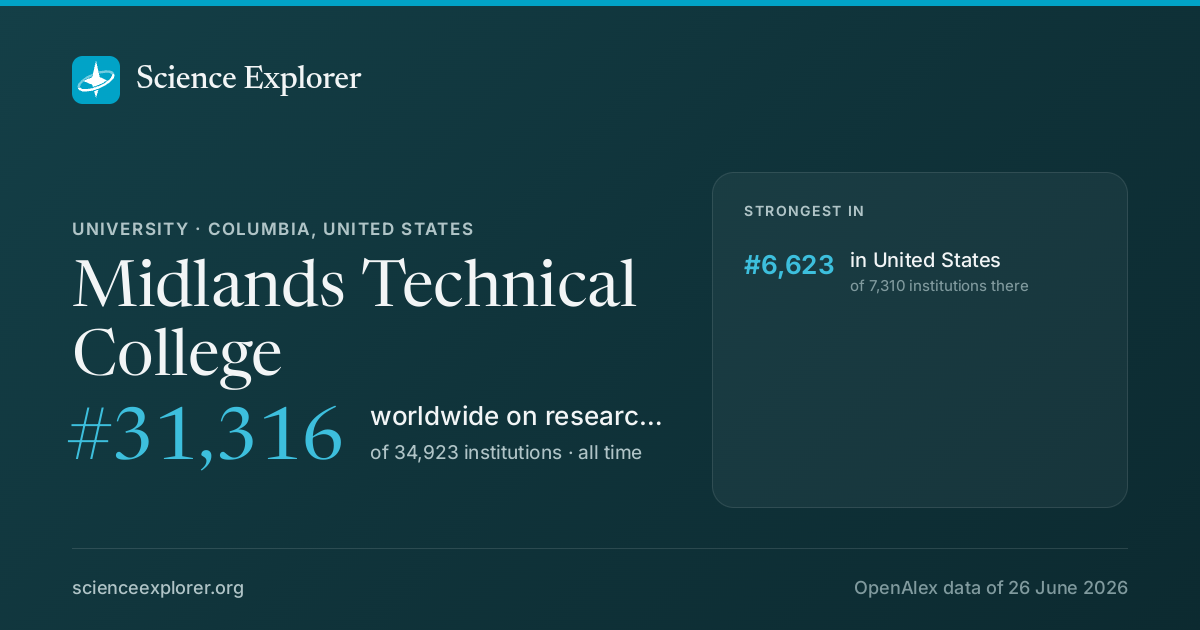
Midlands Technical College on Science Explorer

A card with Midlands Technical College's standing and the fields it leads in, for a post or a slide. A link to this page previews as the same card.

Download the card

1200 × 630 PNG, sized for social posts, drawn from the latest snapshot.

Badges for a website1Each links back here and updates with every snapshot

Research measures only: rankings here say nothing about teaching, admissions or student experience. Comparable institutions and collaboration partners have tabs of their own, above.

Discussion

Ask a question or share a note about Midlands Technical College. Keep it to the research: no personal attacks, advertising or links. Any reader can report a post, which collapses it for everyone until it is opened.
