Neurological Surgery
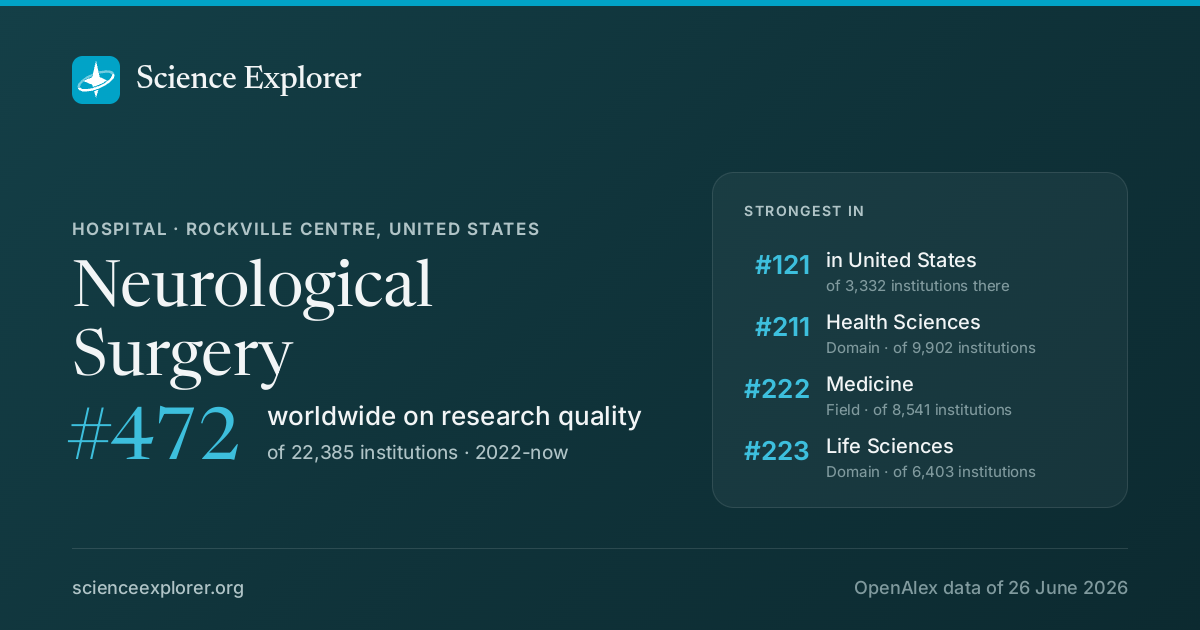
In research, Neurological Surgery stands highest in Health Sciences (#211 of 9,902 worldwide), Medicine (#222 of 8,541 worldwide) and Life Sciences (#223 of 6,403 worldwide), 2022-now. Relative to its size it is most specialised in Neurology, Genetics and Cellular and Molecular Neuroscience (Neurology is 25.4× its share of world research).
- World rank, 2022-now
- #472 of 22,385 · #495 all time
- Rank in United States
- #121 of 3,332
- Research works
- 18k ◆ 1% vs 2018-21
- Citations
- 695k 39.4 per fractional work
- Top-10% rate
- 13.0% all institutions 10.0%
- vs its own fields
- 1.24× 1.00× is exactly expected
- Open access
- 37% world 40%
- International
- 18% world 18%
What is Neurological Surgery known for in research?
The fields where it stands highest, 2022-now, ranked among every institution above the floor in each field.
| Field | World rank | Where that sits | Top-10% rate | Works | All time |
|---|---|---|---|---|---|
| Health SciencesDomain | #211 of 9,902 | 12.7% | 2,127 | #229 | |
| MedicineField | #222 of 8,541 | 12.8% | 2,074 | #247 | |
| Life SciencesDomain | #223 of 6,403 | 14.1% | 504 | #285 | |
| SurgerySubfield | #76 of 1,532 | 13.6% | 429 | #91 | |
| NeuroscienceField | #55 of 1,092 | 13.2% | 280 | #76 | |
| NeurologySubfield | #26 of 405 | 12.3% | 416 | #27 | |
| Biochemistry, Genetics and Molecular BiologyField | #285 of 2,964 | 15.3% | 181 | #361 | |
| Cognitive NeuroscienceSubfield | #53 of 543 | 16.6% | 81 | #45 | |
| Pathology and Forensic MedicineSubfield | #38 of 339 | 12.4% | 139 | #45 | |
| EpidemiologySubfield | #132 of 927 | 12.6% | 181 | #145 |
Each strip is that field's whole ranked pool, with the notch where Neurological Surgery sits in it, in the colour of the band that rank falls in. The track under the rate is the rate itself: it carries no average mark, because the average differs by field (from about 6% in Dentistry to 21% in Economics).
Which of those standings moved
The same fields on both windows: where it stood over the whole record, and where it stands in 2022-now. The distance is the story, and it is the one thing the two rank columns above cannot show.
- Health Sciences#229 #211
- Medicine#247 #222
- Life Sciences#285 #223
- Surgery#91 #76
- Neuroscience#76 #55
- Neurology#27 #26
- Biochemistry, Genetics and Molecular Biology#361 #285
- Cognitive Neuroscience#45 #53
- Pathology and Forensic Medicine#45 #38
- Epidemiology#145 #132
A dot further right is a better standing. Fields it was not ranked in over the whole record are left out.
Which fields of science does Neurological Surgery work in?
In 2022-now, 75% of research at Neurological Surgery is in Health Sciences, 18% in Life Sciences. Its largest fields are Medicine (73%), Neuroscience (10%), Biochemistry, Genetics and Molecular Biology (6%). It does 3.2× the world's share of Health Sciences.
Each ring splits the one inside it: the four domains of science, their fields, their subfields. Size is fractional works in 2022-now. Every slice is a page; the interactive view zooms down to single topics and colours each by how much more of it this institution does than the world.
Its 4 domains and 26 fields, with their numbers
- Health Sciences2,34275.2%
- Medicine2,28173.2%
- Health Professions481.5%
- Dentistry90.3%
- Nursing30.1%
- Veterinary10.0%
- Life Sciences56218.0%
- Physical Sciences1304.2%
- Engineering732.3%
- Computer Science220.7%
- Materials Science110.4%
- Physics and Astronomy90.3%
- Mathematics60.2%
- Environmental Science50.2%
- Chemistry30.1%
- Chemical Engineering00.0%
- Earth and Planetary Sciences00.0%
- Energy00.0%
- Social Sciences802.6%
What does Neurological Surgery specialise in?
Where its research is concentrated relative to its size: Neurology takes 25.4× the share of its output that it takes of world research.
- NeurologySubfield · 453.5 works25×
- GeneticsSubfield · 137.5 works16×
- Cellular and Molecular NeuroscienceSubfield · 114.4 works12×
- Pathology and Forensic MedicineSubfield · 154.1 works9.5×
- NeurologySubfield · 71.0 works8.2×
- OtorhinolaryngologySubfield · 23.7 works7.6×
- SurgerySubfield · 475.3 works6.5×
Location quotient, a volume reading rather than an impact one. It surfaces small, lopsided specialities.
Field profile
Location quotient across every field it publishes in: outside the ring is more than an institution of this size would be expected to publish, inside it is less.
Rings at 0.5×, 1× and 2×. Widest outward: Neuroscience, 6.2×. Every wedge is a field page.
All 26 fields, with their numbers
- Neuroscience6.20×313 works
- Medicine3.81×2,281 works
- Immunology and Microbiology1.23×38 works
- Biochemistry, Genetics and Molecular Biology1.21×200 works
- Dentistry0.59×9 works
- Health Professions0.58×48 works
- Pharmacology, Toxicology and Pharmaceutics0.40×4 works
- Veterinary0.34×2 works
- Psychology0.33×31 works
- Nursing0.19×3 works
- Decision Sciences0.19×6 works
- Engineering0.16×73 works
- Mathematics0.16×6 works
- Physics and Astronomy0.13×9 works
- Economics, Econometrics and Finance0.11×8 works
- Materials Science0.10×11 works
- Computer Science0.09×22 works
- Chemistry0.07×3 works
- Social Sciences0.07×28 works
- Chemical Engineering0.05×0 works
- Arts and Humanities0.04×4 works
- Agricultural and Biological Sciences0.03×5 works
- Environmental Science0.03×5 works
- Business, Management and Accounting0.03×3 works
- Earth and Planetary Sciences0.01×0 works
- Energy0.01×0 works
- Neuroscience 6.2×
- Medicine 3.8×
- Immunology and Microbiology 1.2×
- Biochemistry, Genetics and Molecular Biology 1.2×
- Dentistry 0.6×
- Health Professions 0.6×
- Pharmacology, Toxicology and Pharmaceutics 0.4×
- Veterinary 0.3×
- Psychology 0.3×
- Nursing 0.2×
- Decision Sciences 0.2×
- Engineering 0.2×
- Mathematics 0.2×
- Physics and Astronomy 0.1×
- Economics, Econometrics and Finance 0.1×
- Materials Science 0.1×
- Computer Science 0.1×
- Chemistry 0.1×
- Social Sciences 0.1×
- Chemical Engineering 0.1×
- Arts and Humanities 0.0×
- Agricultural and Biological Sciences 0.0×
- Environmental Science 0.0×
- Business, Management and Accounting 0.0×
- Earth and Planetary Sciences 0.0×
- Energy 0.0×
Who are the top researchers at Neurological Surgery?
Ranked on the quality score, Charles David James, Sanjay S. Dhall and Randall M. Chesnut lead among researchers whose main affiliation is Neurological Surgery.
- 1
Charles David James
 United States · #14,838 worldwide
39k citations · 394 works
- 2
Sanjay S. Dhall
United States · #41,646 worldwide
9.5k citations · 207 works
- 3
Randall M. Chesnut
United States · #51,604 worldwide
32k citations · 295 works
- 4
David O. Okonkwo
United States · #68,633 worldwide
29k citations · 650 works
- 5
Allen K. Sills
United States · #74,587 worldwide
19k citations · 159 works
- 6
Ava M. Puccio
United States · #91,883 worldwide
13k citations · 286 works
- 7
Dario J. Englot
United States · #92,951 worldwide
11k citations · 302 works
- 8
Rune Aaslid
United States · #109,316 worldwide
14k citations · 91 works
- 9
M. Ross Bullock
United States · #111,583 worldwide
9.1k citations · 124 works
- 10
Christopher J. Madden
United States · #116,208 worldwide
13k citations · 228 works
Which keywords describe research at Neurological Surgery?
By fractional works in 2022-now, weighted toward what it does more of than the world: Radiosurgery, Surgical Management, Immunotherapy, Epidemiology, Neurological Disorders, Radiotherapy, Prognostic Factors and Genetic Mutations.
- Pedicle Screw Fixation
- Intracranial Aneurysms
- Clinical Management
- Prognosis
- Intervertebral Disc
- Biomechanics
- Spinal Surgery
- Surgical Treatment
- Cerebrospinal Fluid Leaks
- Histological Classification
- Genomic Analysis
- Temozolomide
- Spinal Fusion
- Endoscopic Surgery
- Endovascular Treatment
- Degenerative Disc Disease
- Inflammation
- Radiotherapy
- Immunotherapy
- Radiosurgery
- Epidemiology
- Surgical Management
- Neurological Disorders
- Prognostic Factors
- Genetic Mutations
- Neuroprotection
- Neuroinflammation
- Molecular Classification
- Glioblastoma
- DNA Methylation
- Clinical Outcomes
- Meningiomas
- Low Back Pain
- Pathophysiology
- Intracranial Pressure
- Hydrocephalus
- Lumbar Disc Degeneration
- Hemodynamics
- Aneurysmal Subarachnoid Hemorrhage
- Anticoagulant Therapy
Size is fractional works in 2022-now in the topics tagged with each word; colour is the word's share of this institution's work against its share of the world's. The 40 words are chosen for being large and distinctive. Each links to the topic it comes from most.
All 40 words, with their numbers
- Epidemiology345▲ 2.8×10⁸ topics
- Radiosurgery238▲ 82×4 topics
- Surgical Management222▲ 17×19 topics
- Immunotherapy212▲ 9.4×18 topics
- Neurological Disorders177▲ 10.0×20 topics
- Radiotherapy165▲ 13×13 topics
- Prognostic Factors164▲ 12×14 topics
- Inflammation150▲ 2.3×72 topics
- Genetic Mutations144▲ 11×21 topics
- Degenerative Disc Disease143▲ 48×2 topics
- Neuroprotection139▲ 13×14 topics
- Endovascular Treatment139▲ 78×2 topics
- Neuroinflammation138▲ 15×6 topics
- Endoscopic Surgery138▲ 46×3 topics
- Molecular Classification136▲ 29×4 topics
- Spinal Fusion132▲ 44×2 topics
- Glioblastoma124▲ 59×1 topic
- Temozolomide124▲ 59×1 topic
- DNA Methylation119▲ 34×3 topics
- Genomic Analysis119▲ 15×10 topics
- Clinical Outcomes118▲ 18×5 topics
- Histological Classification112▲ 118×1 topic
- Meningiomas112▲ 118×1 topic
- Cerebrospinal Fluid Leaks110▲ 71×2 topics
- Low Back Pain102▲ 19×4 topics
- Surgical Treatment97▲ 16×6 topics
- Pathophysiology95▲ 10×11 topics
- Spinal Surgery89▲ 37×2 topics
- Intracranial Pressure88▲ 41×2 topics
- Biomechanics88▲ 9.2×10 topics
- Hydrocephalus88▲ 61×2 topics
- Intervertebral Disc86▲ 42×1 topic
- Lumbar Disc Degeneration86▲ 42×1 topic
- Prognosis86▲ 8.3×9 topics
- Hemodynamics80▲ 48×2 topics
- Clinical Management79▲ 15×8 topics
- Aneurysmal Subarachnoid Hemorrhage79▲ 72×1 topic
- Intracranial Aneurysms79▲ 72×1 topic
- Anticoagulant Therapy78▲ 20×4 topics
- Pedicle Screw Fixation76▲ 64×1 topic
Which research topics does Neurological Surgery publish most on?
By volume in 2022-now: Glioma Diagnosis and Treatment, Meningioma and schwannoma management, Spine and Intervertebral Disc Pathology and Intracranial Aneurysms: Treatment and Complications.
Area is fractional works; colour is the subfield each topic belongs to.
- 1 Glioma Diagnosis and Treatment Genetics 124 works
- 2 Meningioma and schwannoma management Epidemiology 112 works
- 3 Spine and Intervertebral Disc Pathology Pathology and Forensic Medicine 86 works
- 4 Intracranial Aneurysms: Treatment and Complications Neurology 79 works
- 5 Spinal Fractures and Fixation Techniques Surgery 76 works
- 6 Head and Neck Surgical Oncology Surgery 71 works
- 7 Traumatic Brain Injury and Neurovascular Disturbances Neurology 67 works
- 8 Vascular Malformations Diagnosis and Treatment Neurology 60 works
- 9 Cerebrospinal fluid and hydrocephalus Cellular and Molecular Neuroscience 59 works
- 10 Cervical and Thoracic Myelopathy Surgery 57 works
How open and international is its research?
Against the world's own shares: the tick on each track. Both are shares of its output, so they sit on one scale and can be read against each other as well as against the world.
World: 40% of research is openly available.
World: 18% is written across borders.
How has Neurological Surgery's research output changed?
Output in 2022-2025 was 1% lower than in 2018-2021.
The same series as a ribbon: one cell per year, darker for more. The line above answers how much; this answers when.
Its share of all research
Growing output can still be a shrinking share: all of science grows. This is Neurological Surgery as a percentage of every work published that year, 0.013% in 2024.
Fractional works of Neurological Surgery over all fractional works that year. How the balance of science has shifted.
How much of it reaches the world top 10%
Year by year, against all institutions in the same year.
Of each year's output, the share that reached the world's 10% most cited for its field and year. Peak 21.6% in 2013.
Other research institutions in Rockville Centre
Compare Neurological Surgery with
- vs Chan Zuckerberg Initiative (United States)
- vs
 Indian Institute of Technology Kharagpur
- vs
 University of Trieste
- vs
 Hokkaido University
- vs George Washington University
- vs Oregon State University
Share Neurological Surgery's ranking



Research measures only: rankings here say nothing about teaching, admissions or student experience. Comparable institutions and collaboration partners have tabs of their own, above.
Discussion
Ask a question or share a note about Neurological Surgery. Posts are plain text and can be reported.