Science Explorer Back to mapMap
University · Swindon · United Kingdom

New College

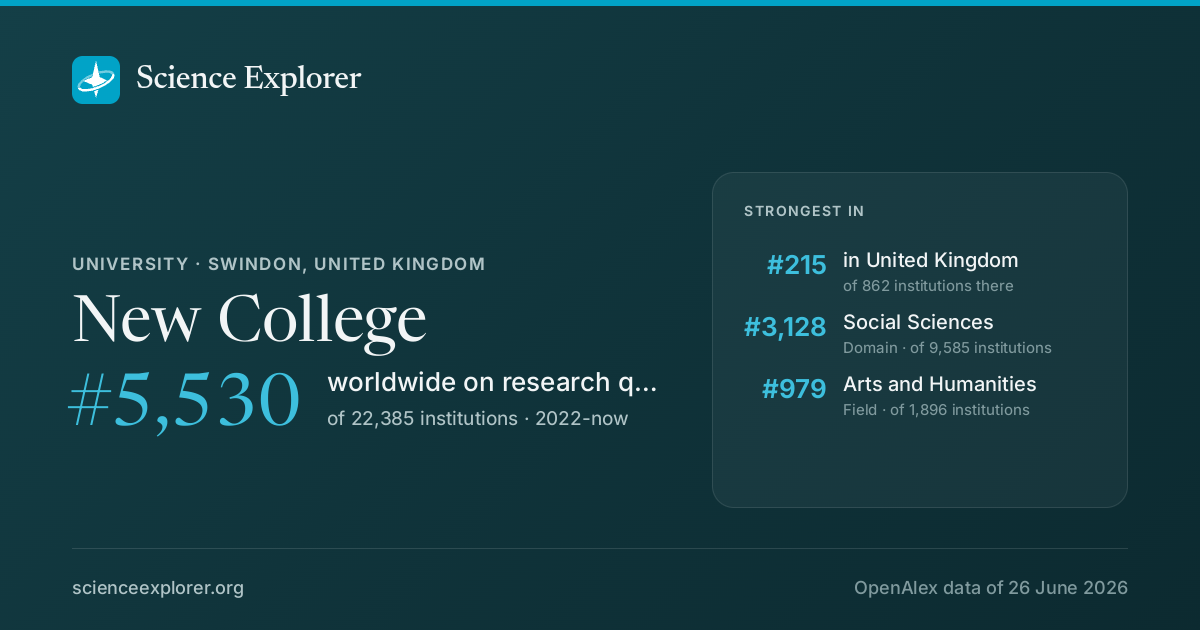
In research, New College stands highest in Social Sciences (#3,128 of 9,585 worldwide), Arts and Humanities (#979 of 1,896 worldwide) and Social Sciences (#3,484 of 5,988 worldwide), 2022-now. Relative to its size it is most specialised in Arts and Humanities (Arts and Humanities is 9.2× its share of world research).

World rank, 2022-now
#5,530
of 22,385 · #2,362 all time
Rank in United Kingdom
#215
of 862
Research works
3.1k
◆ 1% vs 2018-21
Citations
48k
15.8 per fractional work
Top-10% rate
12.5%
all institutions 10.0%
vs its own fields
1.10×
1.00× is exactly expected
Open access
19%
world 40%
International
13%
world 18%

What is New College known for in research?

The fields where it stands highest, 2022-now, ranked among every institution above the floor in each field.

FieldWorld rankWhere that sitsTop-10% rateWorksAll time
Social SciencesDomain #3,128 of 9,585 12.8%159 #1140
Arts and HumanitiesField #979 of 1,896 11.3%61 #457
Social SciencesField #3,484 of 5,988 11.6%69 #1061

Each strip is that field's whole ranked pool, with the notch where New College sits in it, in the colour of the band that rank falls in. The track under the rate is the rate itself: it carries no average mark, because the average differs by field (from about 6% in Dentistry to 21% in Economics).

Which of those standings moved

The same fields on both windows: where it stood over the whole record, and where it stands in 2022-now. The distance is the story, and it is the one thing the two rank columns above cannot show.

  1. Social Sciences#1,140 #3,128
  2. Arts and Humanities#457 #979
  3. Social Sciences#1,061 #3,484
all time2022-now, better2022-now, worse

A dot further right is a better standing. Fields it was not ranked in over the whole record are left out.

Which fields of science does New College work in?

In 2022-now, 71% of research at New College is in Social Sciences, 21% in Physical Sciences. Its largest fields are Social Sciences (30%), Arts and Humanities (27%), Economics, Econometrics and Finance (7%). It does 2.8× the world's share of Social Sciences.

Social Sciences: 194 fractional works · 70.7% of its workSocial Sciences: 82 fractional works · 29.9% of its workSociology and Political Science: 26 fractional works · 9.4% of its workPolitical Science and International Relations: 25 fractional works · 9.3% of its workAnthropology: 10 fractional works · 3.6% of its workEducation: 7 fractional works · 2.4% of its workLaw: 4 fractional works · 1.3% of its workDemography: 2 fractional works · 0.6% of its workCultural Studies: 1 fractional works · 0.5% of its workSafety Research: 1 fractional works · 0.5% of its workGender Studies: 1 fractional works · 0.3% of its workHuman Factors and Ergonomics: 1 fractional works · 0.3% of its workHealth: 1 fractional works · 0.3% of its workGeography, Planning and Development: 1 fractional works · 0.2% of its workLinguistics and Language: 1 fractional works · 0.2% of its workPublic Administration: 1 fractional works · 0.2% of its workSmaller subfields together: 2 fractional works · 0.8% of its workArts and Humanities: 73 fractional works · 26.7% of its workHistory: 18 fractional works · 6.6% of its workPhilosophy: 16 fractional works · 5.7% of its workLiterature and Literary Theory: 8 fractional works · 3.0% of its workReligious studies: 6 fractional works · 2.2% of its workHistory and Philosophy of Science: 6 fractional works · 2.1% of its workArcheology: 5 fractional works · 1.7% of its workLanguage and Linguistics: 4 fractional works · 1.5% of its workClassics: 3 fractional works · 1.2% of its workMuseology: 3 fractional works · 1.1% of its workMusic: 3 fractional works · 1.1% of its workVisual Arts and Performing Arts: 1 fractional works · 0.5% of its workEconomics, Econometrics and Finance: 19 fractional works · 6.9% of its workEconomics and Econometrics: 15 fractional works · 5.6% of its workFinance: 3 fractional works · 0.9% of its workGeneral Economics, Econometrics and Finance: 1 fractional works · 0.4% of its workBusiness, Management and Accounting: 10 fractional works · 3.7% of its workStrategy and Management: 3 fractional works · 1.1% of its workAccounting: 2 fractional works · 0.6% of its workManagement Information Systems: 2 fractional works · 0.6% of its workOrganizational Behavior and Human Resource Management: 1 fractional works · 0.5% of its workMarketing: 1 fractional works · 0.5% of its workBusiness and International Management: 1 fractional works · 0.3% of its workSmaller subfields together: 0 fractional works · 0.1% of its workPsychology: 6 fractional works · 2.1% of its workExperimental and Cognitive Psychology: 2 fractional works · 0.8% of its workSocial Psychology: 2 fractional works · 0.7% of its workClinical Psychology: 1 fractional works · 0.4% of its workSmaller subfields together: 0 fractional works · 0.2% of its workDecision Sciences: 4 fractional works · 1.4% of its workManagement Science and Operations Research: 3 fractional works · 1.1% of its workSmaller subfields together: 1 fractional works · 0.3% of its workPhysical Sciences: 58 fractional works · 21.2% of its workComputer Science: 15 fractional works · 5.3% of its workArtificial Intelligence: 5 fractional works · 1.8% of its workInformation Systems: 4 fractional works · 1.4% of its workComputational Theory and Mathematics: 3 fractional works · 1.0% of its workComputer Vision and Pattern Recognition: 1 fractional works · 0.4% of its workComputer Networks and Communications: 1 fractional works · 0.3% of its workSignal Processing: 1 fractional works · 0.2% of its workSmaller subfields together: 0 fractional works · 0.2% of its workEngineering: 11 fractional works · 4.2% of its workElectrical and Electronic Engineering: 3 fractional works · 1.1% of its workIndustrial and Manufacturing Engineering: 2 fractional works · 0.7% of its workBiomedical Engineering: 1 fractional works · 0.5% of its workBuilding and Construction: 1 fractional works · 0.5% of its workComputational Mechanics: 1 fractional works · 0.3% of its workMechanical Engineering: 1 fractional works · 0.2% of its workAutomotive Engineering: 1 fractional works · 0.2% of its workSmaller subfields together: 1 fractional works · 0.5% of its workPhysics and Astronomy: 10 fractional works · 3.7% of its workNuclear and High Energy Physics: 4 fractional works · 1.5% of its workAstronomy and Astrophysics: 3 fractional works · 1.0% of its workAtomic and Molecular Physics, and Optics: 1 fractional works · 0.5% of its workStatistical and Nonlinear Physics: 1 fractional works · 0.4% of its workCondensed Matter Physics: 1 fractional works · 0.3% of its workSmaller subfields together: 0 fractional works · 0.0% of its workMathematics: 6 fractional works · 2.1% of its workStatistics and Probability: 1 fractional works · 0.5% of its workGeometry and Topology: 1 fractional works · 0.4% of its workDiscrete Mathematics and Combinatorics: 1 fractional works · 0.3% of its workAlgebra and Number Theory: 1 fractional works · 0.2% of its workSmaller subfields together: 2 fractional works · 0.6% of its workEnvironmental Science: 5 fractional works · 2.0% of its workGlobal and Planetary Change: 2 fractional works · 0.6% of its workManagement, Monitoring, Policy and Law: 1 fractional works · 0.4% of its workEcology: 1 fractional works · 0.2% of its workWater Science and Technology: 1 fractional works · 0.2% of its workSmaller subfields together: 1 fractional works · 0.5% of its workEarth and Planetary Sciences: 3 fractional works · 1.2% of its workEarth-Surface Processes: 1 fractional works · 0.4% of its workGeochemistry and Petrology: 1 fractional works · 0.2% of its workGeophysics: 1 fractional works · 0.2% of its workSmaller subfields together: 1 fractional works · 0.3% of its workEnergy: 3 fractional works · 1.0% of its workRenewable Energy, Sustainability and the Environment: 3 fractional works · 0.9% of its workSmaller subfields together: 0 fractional works · 0.1% of its workChemistry: 3 fractional works · 1.0% of its workOrganic Chemistry: 2 fractional works · 0.6% of its workSmaller subfields together: 1 fractional works · 0.3% of its workMaterials Science: 2 fractional works · 0.7% of its workMaterials Chemistry: 1 fractional works · 0.5% of its workElectronic, Optical and Magnetic Materials: 1 fractional works · 0.2% of its workSmaller subfields together: 0 fractional works · 0.0% of its workChemical Engineering: 0 fractional works · 0.1% of its workHealth Sciences: 12 fractional works · 4.5% of its workMedicine: 9 fractional works · 3.2% of its workPhysiology: 1 fractional works · 0.4% of its workDermatology: 1 fractional works · 0.4% of its workPublic Health, Environmental and Occupational Health: 1 fractional works · 0.3% of its workPediatrics, Perinatology and Child Health: 1 fractional works · 0.3% of its workEpidemiology: 1 fractional works · 0.2% of its workSmaller subfields together: 4 fractional works · 1.5% of its workHealth Professions: 3 fractional works · 0.9% of its workGeneral Health Professions: 2 fractional works · 0.8% of its workSmaller subfields together: 0 fractional works · 0.1% of its workNursing: 1 fractional works · 0.3% of its workNutrition and Dietetics: 1 fractional works · 0.2% of its workSmaller subfields together: 0 fractional works · 0.0% of its workVeterinary: 0 fractional works · 0.0% of its workLife Sciences: 10 fractional works · 3.6% of its workAgricultural and Biological Sciences: 5 fractional works · 1.8% of its workSoil Science: 1 fractional works · 0.5% of its workGeneral Agricultural and Biological Sciences: 1 fractional works · 0.5% of its workPlant Science: 1 fractional works · 0.4% of its workSmaller subfields together: 1 fractional works · 0.4% of its workBiochemistry, Genetics and Molecular Biology: 3 fractional works · 0.9% of its workMolecular Biology: 1 fractional works · 0.5% of its workGenetics: 1 fractional works · 0.2% of its workSmaller subfields together: 1 fractional works · 0.2% of its workNeuroscience: 2 fractional works · 0.7% of its workCognitive Neuroscience: 2 fractional works · 0.7% of its workSmaller subfields together: 0 fractional works · 0.1% of its workPharmacology, Toxicology and Pharmaceutics: 0 fractional works · 0.2% of its workImmunology and Microbiology: 0 fractional works · 0.0% of its workALL ITS WORKNew College274fractional works, 2022-now
Life Sciences4%Physical Sciences21%Health Sciences4%Social Sciences71%

Each ring splits the one inside it: the four domains of science, their fields, their subfields. Size is fractional works in 2022-now. Every slice is a page; the interactive view zooms down to single topics and colours each by how much more of it this institution does than the world.

Its 4 domains and 25 fields, with their numbers
    1. Social Sciences8229.9%
    2. Arts and Humanities7326.7%
    3. Economics, Econometrics and Finance196.9%
    4. Business, Management and Accounting103.7%
    5. Psychology62.1%
    6. Decision Sciences41.4%
    1. Computer Science155.3%
    2. Engineering114.2%
    3. Physics and Astronomy103.7%
    4. Mathematics62.1%
    5. Environmental Science52.0%
    6. Earth and Planetary Sciences31.2%
    7. Energy31.0%
    8. Chemistry31.0%
    9. Materials Science20.7%
    10. Chemical Engineering00.1%
    1. Medicine93.2%
    2. Health Professions30.9%
    3. Nursing10.3%
    4. Veterinary00.0%
    1. Agricultural and Biological Sciences51.8%
    2. Biochemistry, Genetics and Molecular Biology30.9%
    3. Neuroscience20.7%
    4. Pharmacology, Toxicology and Pharmaceutics00.2%
    5. Immunology and Microbiology00.0%
All of science, and how each field's share has moved since 1950: the Science domain explorer

What does New College specialise in?

Where its research is concentrated relative to its size: Arts and Humanities takes 9.2× the share of its output that it takes of world research.

  1. Arts and HumanitiesField · 73.3 works9.2×
← less than its size predicts1×more →

Location quotient, a volume reading rather than an impact one. It surfaces small, lopsided specialities.

Field profile

Location quotient across every field it publishes in: outside the ring is more than an institution of this size would be expected to publish, inside it is less.

Agricultural and Biological Sciences: 0.38× its world share, 5 worksAgricultural and Bio…Biochemistry, Genetics and Molecular Biology: 0.17× its world share, 2 worksBiochemistry, Geneti…Immunology and Microbiology: 0.02× its world share, 0 worksImmunology and Micro…Neuroscience: 0.46× its world share, 2 worksNeurosciencePharmacology, Toxicology and Pharmaceutics: 0.46× its world share, 0 worksPharmacology, Toxico…Chemical Engineering: 0.35× its world share, 0 worksChemical EngineeringChemistry: 0.61× its world share, 3 worksChemistryComputer Science: 0.69× its world share, 15 worksComputer ScienceEarth and Planetary Sciences: 0.75× its world share, 3 worksEarth and Planetary …Energy: 1.08× its world share, 3 worksEnergyEngineering: 0.28× its world share, 12 worksEngineeringEnvironmental Science: 0.40× its world share, 6 worksEnvironmental ScienceMaterials Science: 0.21× its world share, 2 worksMaterials ScienceMathematics: 1.77× its world share, 6 worksMathematicsPhysics and Astronomy: 1.65× its world share, 10 worksPhysics and AstronomyHealth Professions: 0.36× its world share, 3 worksHealth ProfessionsMedicine: 0.17× its world share, 9 worksMedicineNursing: 0.55× its world share, 1 worksNursingVeterinary: 0.30× its world share, 0 worksVeterinaryArts and Humanities: 9.25× its world share, 73 worksArts and HumanitiesBusiness, Management and Accounting: 1.15× its world share, 10 worksBusiness, Management…Decision Sciences: 1.46× its world share, 4 worksDecision SciencesEconomics, Econometrics and Finance: 3.25× its world share, 19 worksEconomics, Econometr…Psychology: 0.67× its world share, 6 worksPsychologySocial Sciences: 2.36× its world share, 82 worksSocial Sciences1×world share
more than its size predictsabout as predictedless

Rings at 0.5×, 1× and 2×. Widest outward: Arts and Humanities, 9.2×. Every wedge is a field page.

All 25 fields, with their numbers
  1. Arts and Humanities9.25×73 works
  2. Economics, Econometrics and Finance3.25×19 works
  3. Social Sciences2.36×82 works
  4. Mathematics1.77×6 works
  5. Physics and Astronomy1.65×10 works
  6. Decision Sciences1.46×4 works
  7. Business, Management and Accounting1.15×10 works
  8. Energy1.08×3 works
  9. Earth and Planetary Sciences0.75×3 works
  10. Computer Science0.69×15 works
  11. Psychology0.67×6 works
  12. Chemistry0.61×3 works
  13. Nursing0.55×1 works
  14. Neuroscience0.46×2 works
  15. Pharmacology, Toxicology and Pharmaceutics0.46×0 works
  16. Environmental Science0.40×6 works
  17. Agricultural and Biological Sciences0.38×5 works
  18. Health Professions0.36×3 works
  19. Chemical Engineering0.35×0 works
  20. Veterinary0.30×0 works
  21. Engineering0.28×12 works
  22. Materials Science0.21×2 works
  23. Biochemistry, Genetics and Molecular Biology0.17×2 works
  24. Medicine0.17×9 works
  25. Immunology and Microbiology0.02×0 works

Who are the top researchers at New College?

Ranked on the quality score, George Law Cawkwell, John L. Mackie and G. E. M. de Ste. Croix lead among researchers whose main affiliation is New College.

  1. 1 George Law Cawkwell United Kingdom · #158,065 worldwide 1.8k citations · 122 works
  2. 2 John L. Mackie United Kingdom · #159,380 worldwide 11k citations · 112 works
  3. 3 G. E. M. de Ste. Croix United Kingdom · #184,155 worldwide 2.6k citations · 58 works
  4. 4 Pierre Chaplais United Kingdom · #392,998 worldwide 579 citations · 48 works
  5. 5 A. Andrewes United Kingdom · #423,614 worldwide 1.3k citations · 49 works
  6. 6 Dieter R. Helm United Kingdom · #573,343 worldwide 3.8k citations · 232 works
  7. 7 Mark Griffith United Kingdom · #575,866 worldwide 2.4k citations · 147 works
  8. 8 Ted Tapper United Kingdom · #699,360 worldwide 1.2k citations · 147 works
  9. 9 Alan Ryan United Kingdom · #709,863 worldwide 2.9k citations · 288 works
  10. 10 Noah Carl United Kingdom · #750,139 worldwide 828 citations · 72 works
All ranked researchers at New College

What are the most cited papers from New College?

The most cited paper from New College is "The global obesity pandemic: shaped by global drivers and local environments" (Boyd Anthony Swinburn, Gary Sacks, Kevin D. Hall et al., 2011), with 4,949 citations. Next come "Health and economic burden of the projected obesity trends in the USA and the UK" (2,746) and "Dissecting the cycle: a methodological investigation" (1,531).

Most cited papers
#PaperReleasedCitations
1 The global obesity pandemic: shaped by global drivers and local environments Boyd Anthony Swinburn, Gary Sacks, Kevin D. Hall et al. · The Lancet Open access Aug 2011 4,949
2 Health and economic burden of the projected obesity trends in the USA and the UK Y Claire Wang, Klim McPherson, Timothy Marsh et al. · The Lancet Aug 2011 2,746
3 Dissecting the cycle: a methodological investigation Don Harding, Adrian Pagan · Journal of Monetary Economics Mar 2002 1,531
4 The Parkinson's Disease Questionnaire (PDQ-39): development and validation of a Parkinson's disease summary index score Crispin Jenkinson, Ray Fitzpatrick, Viv Peto et al. · Age and Ageing 1997 1,364
5 Child and adolescent obesity: part of a bigger picture Tim Lobstein, Rachel Jackson‐Leach, Marj Moodie et al. · The Lancet Open access 18 Feb 2015 1,306
All 60 most cited papers, with filters and sorting

Which keywords describe research at New College?

By fractional works in 2022-now, weighted toward what it does more of than the world: Globalization, Nationalism, History, Religion, Colonialism, Empire, Philosophy and Social History.

▲ more of its work than of the world's◆ about the world's share▼ less than the world's

Size is fractional works in 2022-now in the topics tagged with each word; colour is the word's share of this institution's work against its share of the world's. The 40 words are chosen for being large and distinctive. Each links to the topic it comes from most.

All 40 words, with their numbers
  1. Globalization20▲ 3.7×40 topics
  2. History13▲ 6.8×16 topics
  3. Nationalism12▲ 10×17 topics
  4. Religion12▲ 9.2×18 topics
  5. Colonialism12▲ 8.9×17 topics
  6. Empire10▲ 44×5 topics
  7. Philosophy10▲ 8.5×17 topics
  8. Economic Growth10▲ 4.3×18 topics
  9. Ethics9▲ 6.8×21 topics
  10. Literature9▲ 6.1×13 topics
  11. Cultural Identity9▲ 6.5×10 topics
  12. Social History9▲ 40×7 topics
  13. Identity9▲ 4.3×21 topics
  14. Gender8▲ 5.7×15 topics
  15. National Identity7▲ 23×5 topics
  16. Human Rights7▲ 2.6×18 topics
  17. Social Justice7▲ 4.3×13 topics
  18. Inequality7▲ 11×5 topics
  19. Health6▲ 6.0×7 topics
  20. Culture6▲ 4.5×9 topics
  21. Feminism6▲ 7.8×9 topics
  22. Late Antiquity6▲ 43×2 topics
  23. Cultural Studies6▲ 5.7×10 topics
  24. Cultural History6▲ 17×8 topics
  25. Trade6▲ 26×3 topics
  26. Europe5▲ 33×2 topics
  27. Society5▲ 10×6 topics
  28. Central Asia5▲ 27×4 topics
  29. Height5▲ 94×1 topic
  30. Wages5▲ 94×1 topic
  31. Cosmopolitanism5▲ 16×5 topics
  32. Perception5▲ 24×3 topics
  33. Demography4▲ 36×2 topics
  34. International Relations4▲ 6.7×8 topics
  35. Soviet Union4▲ 29×3 topics
  36. Ancient Rome4▲ 48×1 topic
  37. Archaeology4▲ 12×7 topics
  38. Cultural Politics4▲ 23×3 topics
  39. Greek Literature4▲ 48×1 topic
  40. Truth4▲ 46×2 topics

Which research topics does New College publish most on?

By volume in 2022-now: Historical Economic and Social Studies, Classical Antiquity Studies, Scottish History and National Identity and Historical Art and Culture Studies.

  1. 1 Historical Economic and Social Studies Economics and Econometrics 5 works
  2. 2 Classical Antiquity Studies Anthropology 4 works
  3. 3 Scottish History and National Identity History 4 works
  4. 4 Historical Art and Culture Studies Museology 3 works
  5. 5 Historical Architecture and Urbanism History 3 works
  6. 6 Soviet and Russian History Political Science and International Relations 3 works
  7. 7 Medieval Literature and History Classics 2 works
  8. 8 Islamic Studies and History Political Science and International Relations 2 works
  9. 9 Epistemology, Ethics, and Metaphysics Philosophy 2 works
  10. 10 Christian Theology and Mission Religious studies 2 works

How open and international is its research?

Against the world's own shares: the tick on each track. Both are shares of its output, so they sit on one scale and can be read against each other as well as against the world.

openly available18.7%not open81.3%

World: 40% of research is openly available.

with international co-authors12.8%domestic only87.2%

World: 18% is written across borders.

How has New College's research output changed?

Output in 2022-2025 was 1% higher than in 2018-2021.

still counting1990200020102020
grewheldshrank

The same series as a ribbon: one cell per year, darker for more. The line above answers how much; this answers when.

Its share of all research

Growing output can still be a shrinking share: all of science grows. This is New College as a percentage of every work published that year, 0.0011% in 2024.

still counting0.010%0.020%New College0.0013% in 202519801990200020102020

Fractional works of New College over all fractional works that year. How the balance of science has shifted.

How much of it reaches the world top 10%

Year by year, against all institutions in the same year.

still counting20%40%New College11.3% in 2025all institutions10.0% in 2025200020102020

Of each year's output, the share that reached the world's 10% most cited for its field and year. Peak 31.5% in 2014.

Other research institutions in Swindon

All research institutions in Swindon

Share New College's ranking

New College on Science Explorer

A card with New College's standing and the fields it leads in, for a post or a slide. A link to this page previews as the same card.

Download the card

1200 × 630 PNG, sized for social posts, drawn from the latest snapshot.

Badges for a website1Each links back here and updates with every snapshot

Research measures only: rankings here say nothing about teaching, admissions or student experience. Comparable institutions and collaboration partners have tabs of their own, above.

Discussion

Ask a question or share a note about New College. Posts are plain text and can be reported.