
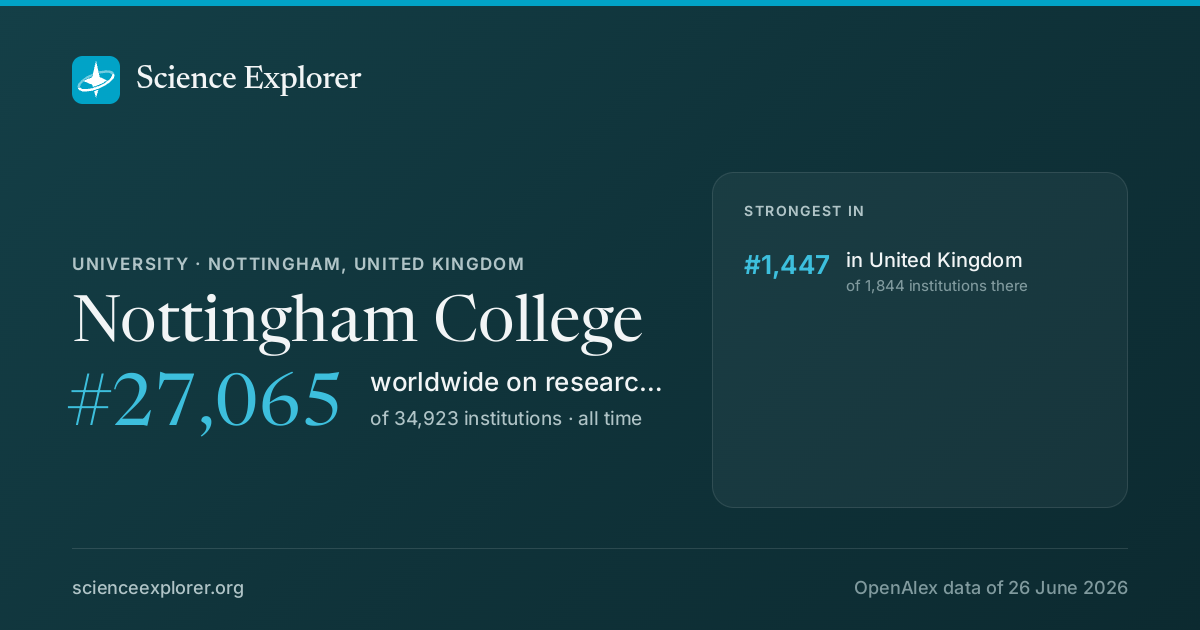
- World rank, all time
- #27,065 of 34,923
- Rank in United Kingdom
- #1,447 of 1,844
- Research works
- 125 ▼ 4% vs 2018-21
- Citations
- 1.7k 13.7 per fractional work
- Top-10% rate
- 19.4% all institutions 10.0%
- vs its own fields
- 0.97× 1.00× is exactly expected
- Open access
- 29% world 40%
- International
- 20% world 18%
Which fields of science does Nottingham College work in?
In all years, 42% of research at Nottingham College is in Physical Sciences, 29% in Social Sciences. Its largest fields are Engineering (17%), Social Sciences (14%), Biochemistry, Genetics and Molecular Biology (7%). It does 1.3× the world's share of Social Sciences.
Each ring splits the one inside it: the four domains of science, their fields, their subfields. Size is fractional works in all years. Every slice is a page; the interactive view zooms down to single topics and colours each by how much more of it this institution does than the world.
Its 4 domains and 25 fields, with their numbers
- Physical Sciences5241.7%
- Engineering2116.8%
- Computer Science97.0%
- Mathematics75.5%
- Earth and Planetary Sciences53.7%
- Materials Science43.3%
- Physics and Astronomy21.9%
- Environmental Science21.7%
- Chemistry11.1%
- Chemical Engineering10.5%
- Energy00.3%
- Social Sciences3628.7%
- Life Sciences1914.9%
- Health Sciences1814.7%
- Medicine97.3%
- Veterinary64.8%
- Health Professions21.9%
- Nursing10.7%
Field profile
Location quotient across every field it publishes in: outside the ring is more than an institution of this size would be expected to publish, inside it is less.
Rings at 0.5×, 1× and 2×. Widest outward: Veterinary, 68.5×. Every wedge is a field page.
All 23 fields, with their numbers
- Veterinary68.49×1 works
- Earth and Planetary Sciences5.52×1 works
- Business, Management and Accounting4.36×2 works
- Immunology and Microbiology3.60×0 works
- Chemical Engineering3.56×0 works
- Pharmacology, Toxicology and Pharmaceutics3.54×0 works
- Biochemistry, Genetics and Molecular Biology2.67×2 works
- Nursing2.12×0 works
- Economics, Econometrics and Finance1.46×0 works
- Decision Sciences1.44×0 works
- Mathematics1.36×0 works
- Health Professions1.26×0 works
- Materials Science1.05×0 works
- Chemistry0.79×0 works
- Agricultural and Biological Sciences0.61×0 works
- Neuroscience0.61×0 works
- Engineering0.56×1 works
- Physics and Astronomy0.56×0 works
- Environmental Science0.52×0 works
- Medicine0.43×1 works
- Computer Science0.36×0 works
- Social Sciences0.35×1 works
- Psychology0.16×0 works
- Veterinary 68.5×
- Earth and Planetary Sciences 5.5×
- Business, Management and Accounting 4.4×
- Immunology and Microbiology 3.6×
- Chemical Engineering 3.6×
- Pharmacology, Toxicology and Pharmaceutics 3.5×
- Biochemistry, Genetics and Molecular Biology 2.7×
- Nursing 2.1×
- Economics, Econometrics and Finance 1.5×
- Decision Sciences 1.4×
- Mathematics 1.4×
- Health Professions 1.3×
- Materials Science 1.1×
- Chemistry 0.8×
- Agricultural and Biological Sciences 0.6×
- Neuroscience 0.6×
- Engineering 0.6×
- Physics and Astronomy 0.6×
- Environmental Science 0.5×
- Medicine 0.4×
- Computer Science 0.4×
- Social Sciences 0.3×
- Psychology 0.2×
Who are the top researchers at Nottingham College?
Ranked on the quality score, Frank Granger, Edwin Henry Barton and Henry J. S. Sand lead among researchers whose main affiliation is Nottingham College.
- 1
Frank Granger
 United Kingdom · #2,091,710 worldwide
126 citations · 84 works
- 2
Edwin Henry Barton
United Kingdom · #2,151,638 worldwide
138 citations · 60 works
- 3
Henry J. S. Sand
United Kingdom · #2,197,546 worldwide
1k citations · 54 works
- 4
S. R. Trotman
United Kingdom · #2,426,118 worldwide
55 citations · 33 works
- 5
H. T. H. Piaggio
United Kingdom · #2,440,474 worldwide
1.4k citations · 134 works
- 6
Heinrich Mutschmann
United Kingdom · #2,495,395 worldwide
83 citations · 35 works
- 7
WM. H. GEORGE
United Kingdom · #2,524,775 worldwide
80 citations · 27 works
- 8
Ernest Weekley
United Kingdom · #2,615,230 worldwide
202 citations · 70 works
- 9
P. E. Shaw
United Kingdom · #2,664,513 worldwide
469 citations · 40 works
- 10
R. M. Caven
United Kingdom · #2,674,451 worldwide
1 citations · 20 works
Which keywords describe research at Nottingham College?
By fractional works in all years, weighted toward what it does more of than the world: Civil Engineering, Construction, Bridge Engineering, Structural Health Monitoring, Sustainable Development, Geometry, Hyperbolic and Teacher Professional Development.
- Visual Culture
- Error Compensation
- Arts Education
- Genomic Characterization
- Zoonotic Transmission
- Cultural Competence
- Host-Pathogen Interactions
- Academic Achievement
- Reflective Practice
- Religious Education
- Virulence Factors
- Equine Health
- Teacher Knowledge
- Mathematics Education
- Matrix Computations
- Educational Technology
- Hyperbolic
- Structural Health Monitoring
- Construction
- Sustainable Development
- Epidemiology
- Civil Engineering
- Bridge Engineering
- Geometry
- Teacher Professional Development
- Education
- Numerical Linear Algebra
- Pedagogical Content Knowledge
- Electronic Structure
- Social Justice
- Welfare Assessment
- Lifelong Learning
- Teacher Training
- Burnout
- Machine Tools
- Educational Assessment
- Diversity
- Schools
- Dimensional Metrology
- Magnetic Properties
Size is fractional works in all years in the topics tagged with each word; colour is the word's share of this institution's work against its share of the world's. The 40 words are chosen for being large and distinctive. Each links to the topic it comes from most.
All 40 words, with their numbers
- Epidemiology6▲ 1.27×27 topics
- Sustainable Development6▲ 4.2×5 topics
- Civil Engineering5▲ 64×2 topics
- Construction5▲ 38×2 topics
- Bridge Engineering5▲ 231×1 topic
- Structural Health Monitoring5▲ 38×1 topic
- Geometry4▲ 111×1 topic
- Hyperbolic4▲ 111×1 topic
- Teacher Professional Development4▲ 30×3 topics
- Educational Technology4▲ 4.3×2 topics
- Education4▲ 2.1×15 topics
- Matrix Computations4▲ 62×1 topic
- Numerical Linear Algebra4▲ 62×1 topic
- Mathematics Education3▲ 47×2 topics
- Pedagogical Content Knowledge3▲ 100×1 topic
- Teacher Knowledge3▲ 87×1 topic
- Electronic Structure2▲ 8.9×5 topics
- Equine Health2▲ 96×1 topic
- Social Justice2▲ 3.6×2 topics
- Virulence Factors2▲ 9.3×5 topics
- Welfare Assessment2▲ 96×1 topic
- Religious Education2▲ 19×2 topics
- Lifelong Learning2▲ 9.7×5 topics
- Reflective Practice2▲ 8.4×6 topics
- Teacher Training2▲ 3.7×5 topics
- Academic Achievement2▲ 9.9×3 topics
- Burnout2▲ 15×2 topics
- Host-Pathogen Interactions2▲ 14×2 topics
- Machine Tools2▲ 17×2 topics
- Cultural Competence2▲ 10×2 topics
- Educational Assessment2▲ 22×1 topic
- Zoonotic Transmission2▲ 12×2 topics
- Diversity1▲ 6.4×1 topic
- Genomic Characterization1▲ 7.3×2 topics
- Schools1▲ 68×1 topic
- Arts Education1▲ 98×1 topic
- Dimensional Metrology1▲ 31×1 topic
- Error Compensation1▲ 31×1 topic
- Magnetic Properties1▲ 11×2 topics
- Visual Culture1▲ 18×1 topic
Which research topics does Nottingham College publish most on?
By volume in 2022-now: Veterinary Medicine and Surgery, Business Strategy and Innovation, Veterinary Equine Medical Research and Human-Animal Interaction Studies.
Area is fractional works; colour is the subfield each topic belongs to.
- 1 Veterinary Medicine and Surgery Small Animals 0 works
- 2 Business Strategy and Innovation Strategy and Management 0 works
- 3 Veterinary Equine Medical Research Equine 0 works
- 4 Human-Animal Interaction Studies Genetics 0 works
- 5 Arctic and Antarctic ice dynamics Atmospheric Science 0 works
- 6 Conflict of Laws and Jurisdiction Political Science and International Relations 0 works
- 7 Cryospheric studies and observations Atmospheric Science 0 works
- 8 Climate change and permafrost Atmospheric Science 0 works
- 9 Innovation and Knowledge Management Strategy and Management 0 works
- 10 Prion Diseases and Protein Misfolding Molecular Biology 0 works
How open and international is its research?
Against the world's own shares: the tick on each track. Both are shares of its output, so they sit on one scale and can be read against each other as well as against the world.
World: 40% of research is openly available.
World: 18% is written across borders.
How has Nottingham College's research output changed?
Output in 2022-2025 was 4% lower than in 2018-2021.
The same series as a ribbon: one cell per year, darker for more. The line above answers how much; this answers when.
Its share of all research
Growing output can still be a shrinking share: all of science grows. This is Nottingham College as a percentage of every work published that year, 0.000035% in 2024.
Fractional works of Nottingham College over all fractional works that year. How the balance of science has shifted.
Other research institutions in Nottingham
- University of Nottingham
- Nottingham Trent University
- Nottingham University Hospitals NHS Trust
- British Geological Survey
- Nottinghamshire Healthcare NHS Foundation Trust
- Quotient Clinical (United Kingdom)
- Institute of Mental Health
- Luxfer Group (United Kingdom)
Share Nottingham College's ranking
Badges for a website1Each links back here and updates with every snapshot

Research measures only: rankings here say nothing about teaching, admissions or student experience. Comparable institutions and collaboration partners have tabs of their own, above.
Discussion
Ask a question or share a note about Nottingham College. Posts are plain text and can be reported.