Science Explorer Back to mapMap
Discussion
Government institution · Istanbul · ??

Orient-Institut Istanbul

World rank, all time
#13,708
of 34,923
Rank in ??
#147
of 615
Research works
309
▼ 64% vs 2018-21
Citations
3.2k
10.4 per fractional work
Top-10% rate
3.2%
all institutions 10.0%
vs its own fields
0.98×
1.00× is exactly expected
Open access
49%
world 40%
International
15%
world 18%

Which fields of science does Orient-Institut Istanbul work in?

In 2022-now, 60% of research at Orient-Institut Istanbul is in Social Sciences, 23% in Health Sciences. Its largest fields are Arts and Humanities (20%), Medicine (19%), Social Sciences (19%). It does 2.1× the world's share of Social Sciences.

Social Sciences: 20 fractional works · 60.4% of its workArts and Humanities: 7 fractional works · 20.4% of its workMuseology: 2 fractional works · 4.7% of its workMusic: 2 fractional works · 4.4% of its workLiterature and Literary Theory: 1 fractional works · 2.1% of its workReligious studies: 1 fractional works · 2.0% of its workHistory: 1 fractional works · 1.9% of its workLanguage and Linguistics: 1 fractional works · 1.8% of its workArcheology: 0 fractional works · 1.5% of its workVisual Arts and Performing Arts: 0 fractional works · 1.0% of its workPhilosophy: 0 fractional works · 0.6% of its workHistory and Philosophy of Science: 0 fractional works · 0.3% of its workSocial Sciences: 6 fractional works · 18.8% of its workPolitical Science and International Relations: 2 fractional works · 7.3% of its workSociology and Political Science: 1 fractional works · 4.1% of its workCultural Studies: 1 fractional works · 2.6% of its workGender Studies: 1 fractional works · 2.3% of its workEducation: 1 fractional works · 1.7% of its workPublic Administration: 0 fractional works · 0.5% of its workGeography, Planning and Development: 0 fractional works · 0.2% of its workEconomics, Econometrics and Finance: 3 fractional works · 9.1% of its workEconomics and Econometrics: 2 fractional works · 6.9% of its workFinance: 0 fractional works · 1.5% of its workGeneral Economics, Econometrics and Finance: 0 fractional works · 0.7% of its workPsychology: 2 fractional works · 6.9% of its workSocial Psychology: 1 fractional works · 3.8% of its workClinical Psychology: 1 fractional works · 2.8% of its workDevelopmental and Educational Psychology: 0 fractional works · 0.2% of its workBusiness, Management and Accounting: 2 fractional works · 4.8% of its workOrganizational Behavior and Human Resource Management: 1 fractional works · 2.2% of its workAccounting: 0 fractional works · 1.5% of its workManagement of Technology and Innovation: 0 fractional works · 0.7% of its workStrategy and Management: 0 fractional works · 0.3% of its workDecision Sciences: 0 fractional works · 0.5% of its workManagement Science and Operations Research: 0 fractional works · 0.5% of its workHealth Sciences: 8 fractional works · 22.8% of its workMedicine: 6 fractional works · 19.1% of its workSurgery: 1 fractional works · 3.6% of its workCardiology and Cardiovascular Medicine: 1 fractional works · 3.5% of its workOncology: 1 fractional works · 2.5% of its workInfectious Diseases: 1 fractional works · 2.0% of its workEpidemiology: 1 fractional works · 1.5% of its workPublic Health, Environmental and Occupational Health: 0 fractional works · 1.2% of its workRheumatology: 0 fractional works · 1.0% of its workOphthalmology: 0 fractional works · 0.7% of its workPhysiology: 0 fractional works · 0.7% of its workGastroenterology: 0 fractional works · 0.6% of its workPulmonary and Respiratory Medicine: 0 fractional works · 0.6% of its workPsychiatry and Mental health: 0 fractional works · 0.5% of its workUrology: 0 fractional works · 0.5% of its workCritical Care and Intensive Care Medicine: 0 fractional works · 0.2% of its workSmaller subfields together: 0 fractional works · 0.2% of its workHealth Professions: 1 fractional works · 2.4% of its workGeneral Health Professions: 0 fractional works · 1.0% of its workEmergency Medical Services: 0 fractional works · 0.5% of its workRadiological and Ultrasound Technology: 0 fractional works · 0.5% of its workSpeech and Hearing: 0 fractional works · 0.4% of its workNursing: 0 fractional works · 1.3% of its workNutrition and Dietetics: 0 fractional works · 0.8% of its workResearch and Theory: 0 fractional works · 0.5% of its workPhysical Sciences: 3 fractional works · 9.8% of its workEngineering: 1 fractional works · 3.8% of its workBiomedical Engineering: 1 fractional works · 2.8% of its workAutomotive Engineering: 0 fractional works · 0.5% of its workMechanical Engineering: 0 fractional works · 0.5% of its workComputer Science: 1 fractional works · 3.0% of its workArtificial Intelligence: 1 fractional works · 1.6% of its workComputer Vision and Pattern Recognition: 0 fractional works · 0.7% of its workHuman-Computer Interaction: 0 fractional works · 0.7% of its workMathematics: 0 fractional works · 1.0% of its workStatistics and Probability: 0 fractional works · 1.0% of its workEnergy: 0 fractional works · 0.7% of its workGeneral Energy: 0 fractional works · 0.7% of its workEnvironmental Science: 0 fractional works · 0.6% of its workGlobal and Planetary Change: 0 fractional works · 0.5% of its workSmaller subfields together: 0 fractional works · 0.1% of its workEarth and Planetary Sciences: 0 fractional works · 0.5% of its workPaleontology: 0 fractional works · 0.5% of its workChemistry: 0 fractional works · 0.2% of its workLife Sciences: 2 fractional works · 7.0% of its workNeuroscience: 1 fractional works · 3.1% of its workCognitive Neuroscience: 1 fractional works · 2.7% of its workSensory Systems: 0 fractional works · 0.3% of its workBiochemistry, Genetics and Molecular Biology: 1 fractional works · 3.0% of its workMolecular Biology: 1 fractional works · 1.7% of its workClinical Biochemistry: 0 fractional works · 0.5% of its workGenetics: 0 fractional works · 0.5% of its workBiotechnology: 0 fractional works · 0.3% of its workAgricultural and Biological Sciences: 0 fractional works · 1.0% of its workFood Science: 0 fractional works · 0.3% of its workAquatic Science: 0 fractional works · 0.3% of its workSmaller subfields together: 0 fractional works · 0.4% of its workALL ITS WORKOrient-InstitutIstanbul34fractional works, 2022-now
Life Sciences7%Physical Sciences10%Health Sciences23%Social Sciences60%

Each ring splits the one inside it: the four domains of science, their fields, their subfields. Size is fractional works in 2022-now. Every slice is a page; the interactive view zooms down to single topics and colours each by how much more of it this institution does than the world.

Its 4 domains and 19 fields, with their numbers
    1. Arts and Humanities720.4%
    2. Social Sciences618.8%
    3. Economics, Econometrics and Finance39.1%
    4. Psychology26.9%
    5. Business, Management and Accounting24.8%
    6. Decision Sciences00.5%
    1. Medicine619.1%
    2. Health Professions12.4%
    3. Nursing01.3%
    1. Engineering13.8%
    2. Computer Science13.0%
    3. Mathematics01.0%
    4. Energy00.7%
    5. Environmental Science00.6%
    6. Earth and Planetary Sciences00.5%
    7. Chemistry00.2%
    1. Neuroscience13.1%
    2. Biochemistry, Genetics and Molecular Biology13.0%
    3. Agricultural and Biological Sciences01.0%
All of science, and how each field's share has moved since 1950: the Science domain explorer

Field profile

Location quotient across every field it publishes in: outside the ring is more than an institution of this size would be expected to publish, inside it is less.

Agricultural and Biological Sciences: 0.20× its world share, 0 worksAgricultural and Bio…Biochemistry, Genetics and Molecular Biology: 0.56× its world share, 1 worksBiochemistry, Geneti…Neuroscience: 1.88× its world share, 1 worksNeuroscienceChemistry: 0.10× its world share, 0 worksChemistryComputer Science: 0.39× its world share, 1 worksComputer ScienceEarth and Planetary Sciences: 0.30× its world share, 0 worksEarth and Planetary …Energy: 0.81× its world share, 0 worksEnergyEngineering: 0.25× its world share, 1 worksEngineeringEnvironmental Science: 0.13× its world share, 0 worksEnvironmental ScienceMathematics: 0.84× its world share, 0 worksMathematicsHealth Professions: 0.91× its world share, 1 worksHealth ProfessionsMedicine: 0.99× its world share, 6 worksMedicineNursing: 2.69× its world share, 0 worksNursingArts and Humanities: 7.05× its world share, 7 worksArts and HumanitiesBusiness, Management and Accounting: 1.48× its world share, 2 worksBusiness, Management…Decision Sciences: 0.51× its world share, 0 worksDecision SciencesEconomics, Econometrics and Finance: 4.27× its world share, 3 worksEconomics, Econometr…Psychology: 2.26× its world share, 2 worksPsychologySocial Sciences: 1.49× its world share, 6 worksSocial Sciences1×world share
more than its size predictsabout as predictedless

Rings at 0.5×, 1× and 2×. Widest outward: Arts and Humanities, 7.0×. Every wedge is a field page.

All 19 fields, with their numbers
  1. Arts and Humanities7.05×7 works
  2. Economics, Econometrics and Finance4.27×3 works
  3. Nursing2.69×0 works
  4. Psychology2.26×2 works
  5. Neuroscience1.88×1 works
  6. Social Sciences1.49×6 works
  7. Business, Management and Accounting1.48×2 works
  8. Medicine0.99×6 works
  9. Health Professions0.91×1 works
  10. Mathematics0.84×0 works
  11. Energy0.81×0 works
  12. Biochemistry, Genetics and Molecular Biology0.56×1 works
  13. Decision Sciences0.51×0 works
  14. Computer Science0.39×1 works
  15. Earth and Planetary Sciences0.30×0 works
  16. Engineering0.25×1 works
  17. Agricultural and Biological Sciences0.20×0 works
  18. Environmental Science0.13×0 works
  19. Chemistry0.10×0 works

Who are the top researchers at Orient-Institut Istanbul?

Ranked on the quality score, Barbara Pusch, Quincke and Judith I. Haug lead among researchers whose main affiliation is Orient-Institut Istanbul.

  1. 1 Barbara Pusch #2,751,551 worldwide 238 citations · 46 works
  2. 2 Quincke #2,896,159 worldwide 3 citations · 16 works
  3. 3 Judith I. Haug #3,402,012 worldwide 12 citations · 17 works
  4. 4 Melike Şahinol #3,471,387 worldwide 123 citations · 62 works
  5. 5 Constantin Regel #3,848,277 worldwide 22 citations · 23 works
  6. 6 Giacomo Saban #4,465,137 worldwide 12 citations · 18 works
  7. 7 Jan Keetman #4,927,420 worldwide 50 citations · 30 works
  8. 8 Nusret Ekin #5,223,610 worldwide 23 citations · 31 works
All ranked researchers at Orient-Institut Istanbul

What are the most cited papers from Orient-Institut Istanbul?

The most cited paper from Orient-Institut Istanbul is "The electrical modulus and other dielectric properties by the impedance spectroscopy of LaCrO 3 and LaCr 0.90 Ir 0.10 O 3 perovskites" (mustafa coskun, Ozgur Murat Polat, Fatih Mehmet Coşkun et al., 2018), with 275 citations. Next come "Shining a light on an adaptable photoinitiator: advances in photopolymerizations initiated by thioxanthones" (226) and "Trends in aptamer selection methods and applications" (198).

Most cited papers
#PaperReleasedCitations
1 The electrical modulus and other dielectric properties by the impedance spectroscopy of LaCrO 3 and LaCr 0.90 Ir 0.10 O 3 perovskites mustafa coskun, Ozgur Murat Polat, Fatih Mehmet Coşkun et al. · RSC Advances Open access 2018 275
2 Shining a light on an adaptable photoinitiator: advances in photopolymerizations initiated by thioxanthones Sajjad Dadashi‐Silab, Cansu Aydoğan, Yusuf Yağcı · Polymer Chemistry 2015 226
3 Trends in aptamer selection methods and applications Meral Yüce, Naimat Ullah, Hikmet Budak · The Analyst 2015 198
4 Grapefruit-derived extracellular vesicles as a promising cell-free therapeutic tool for wound healing Yağız Savcı, Oğuz Kaan Kırbaş, Batuhan Turhan Bozkurt et al. · Food & Function 2021 189
5 How to make nanobiosensors: surface modification and characterisation of nanomaterials for biosensing applications Meral Yüce, Hasan Kurt · RSC Advances Open access 2017 177
All 61 most cited papers, with filters and sorting

Which keywords describe research at Orient-Institut Istanbul?

By fractional works in 2022-now, weighted toward what it does more of than the world: Cultural Heritage, Public Policy, Neoliberalism, Pandemic, Job Satisfaction, Nationalism, Ottoman Empire and Culture.

▲ more of its work than of the world's◆ about the world's share▼ less than the world's

Size is fractional works in 2022-now in the topics tagged with each word; colour is the word's share of this institution's work against its share of the world's. The 35 words are chosen for being large and distinctive. Each links to the topic it comes from most.

All 35 words, with their numbers
  1. Cultural Heritage3▲ 16×5 topics
  2. Globalization2▲ 3.1×7 topics
  3. Mental Health2▲ 3.9×5 topics
  4. Pandemic2▲ 5.2×3 topics
  5. Public Policy2▲ 11×3 topics
  6. Neoliberalism2▲ 13×3 topics
  7. Epidemiology2◆ 1.09×8 topics
  8. COVID-191▲ 3.1×3 topics
  9. Culture1▲ 8.0×4 topics
  10. Job Satisfaction1▲ 9.7×5 topics
  11. Nationalism1▲ 9.4×3 topics
  12. Ottoman Empire1▲ 59×3 topics
  13. Education1▲ 2.3×3 topics
  14. Healthcare1▲ 3.4×3 topics
  15. Digital Transformation1▲ 6.4×2 topics
  16. Ethical Issues1▲ 33×4 topics
  17. Feminism1▲ 12×4 topics
  18. Folklore1▲ 68×1 topic
  19. Inflammation1▲ 1.74×4 topics
  20. Turkish Culture1▲ 110×1 topic
  21. Coping Strategies1▲ 12×3 topics
  22. Ethnomusicology1▲ 80×2 topics
  23. Gender politics1▲ 83×2 topics
  24. Social Justice1▲ 5.2×4 topics
  25. Thrombosis1▲ 12×2 topics
  26. Aspirin1▲ 139×1 topic
  27. Cancer1▲ 2.2×3 topics
  28. Clopidogrel1▲ 139×1 topic
  29. Cultural Exchange1▲ 23×2 topics
  30. Economic Growth1▲ 3.6×1 topic
  31. Financial Markets1▲ 24×1 topic
  32. Innovation1▲ 3.0×4 topics
  33. Military Expenditure1▲ 367×1 topic
  34. Sufism1▲ 64×2 topics
  35. business impact1▲ 33×1 topic

Which research topics does Orient-Institut Istanbul publish most on?

By volume in 2022-now: Cultural and Sociopolitical Studies, Defense, Military, and Policy Studies, COVID-19 Pandemic Impacts and Antiplatelet Therapy and Cardiovascular Diseases.

  1. 1 Cultural and Sociopolitical Studies Museology 1 works
  2. 2 Defense, Military, and Policy Studies Economics and Econometrics 1 works
  3. 3 COVID-19 Pandemic Impacts Economics and Econometrics 1 works
  4. 4 Antiplatelet Therapy and Cardiovascular Diseases Cardiology and Cardiovascular Medicine 1 works
  5. 5 Neuroethics, Human Enhancement, Biomedical Innovations Cognitive Neuroscience 1 works
  6. 6 Turkey's Politics and Society Political Science and International Relations 1 works
  7. 7 Families in Therapy and Culture Social Psychology 1 works
  8. 8 Islamic Thought and Society Studies Religious studies 1 works
  9. 9 History and Cultural Heritage Cultural Studies 1 works
  10. 10 Diverse Musicological Studies Music 1 works

How open and international is its research?

Against the world's own shares: the tick on each track. Both are shares of its output, so they sit on one scale and can be read against each other as well as against the world.

openly available49.4%not open50.6%

World: 40% of research is openly available.

with international co-authors15.2%domestic only84.8%

World: 18% is written across borders.

How has Orient-Institut Istanbul's research output changed?

Output in 2022-2025 was 64% lower than in 2018-2021.

still counting1990200020102020
grewheldshrank

The same series as a ribbon: one cell per year, darker for more. The line above answers how much; this answers when.

Its share of all research

Growing output can still be a shrinking share: all of science grows. This is Orient-Institut Istanbul as a percentage of every work published that year, 0.000065% in 2024.

still counting0.00050%0.0010%0.0015%Orient-Institut Istanbul0.000040% in 202519801990200020102020

Fractional works of Orient-Institut Istanbul over all fractional works that year. How the balance of science has shifted.

How much of it reaches the world top 10%

Year by year, against all institutions in the same year.

5%10%15%all institutions10.0% in 2020Orient-Institut Istanbul7.2% in 20202020

Of each year's output, the share that reached the world's 10% most cited for its field and year. Peak 10.2% in 2016.

Other research institutions in Istanbul

All research institutions in Istanbul

Share Orient-Institut Istanbul's ranking
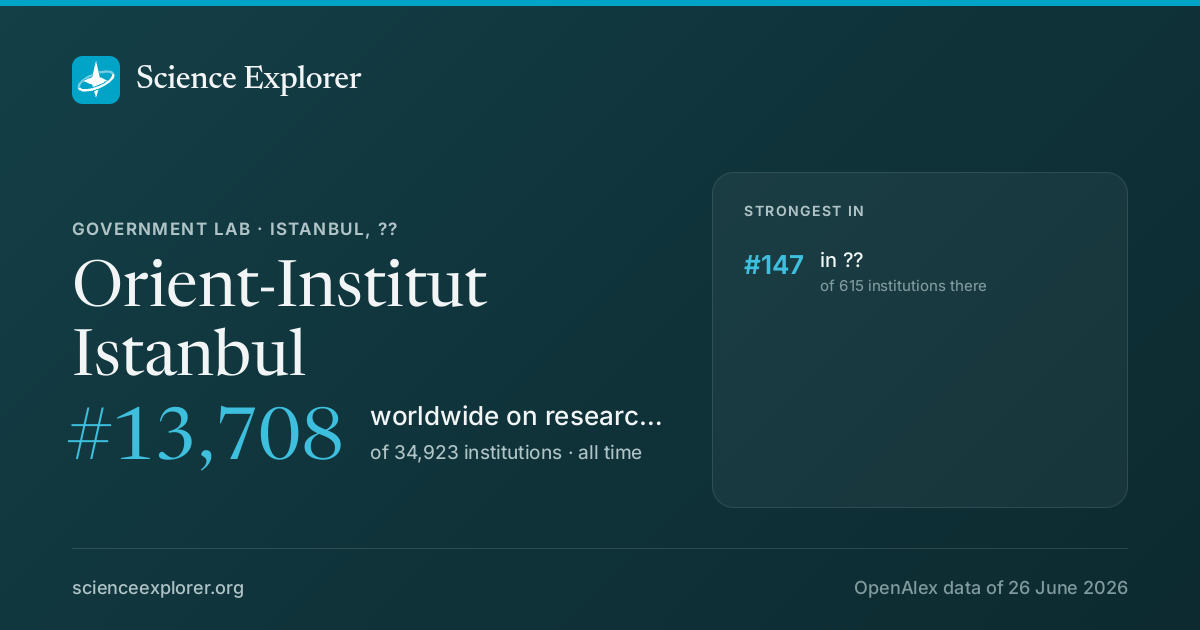
Orient-Institut Istanbul on Science Explorer

A card with Orient-Institut Istanbul's standing and the fields it leads in, for a post or a slide. A link to this page previews as the same card.

Download the card

1200 × 630 PNG, sized for social posts, drawn from the latest snapshot.

Badges for a website1Each links back here and updates with every snapshot

Research measures only: rankings here say nothing about teaching, admissions or student experience. Comparable institutions and collaboration partners have tabs of their own, above.

Discussion

Ask a question or share a note about Orient-Institut Istanbul. Keep it to the research: no personal attacks, advertising or links. Any reader can report a post, which collapses it for everyone until it is opened.