Science Explorer Back to mapMap
Discussion
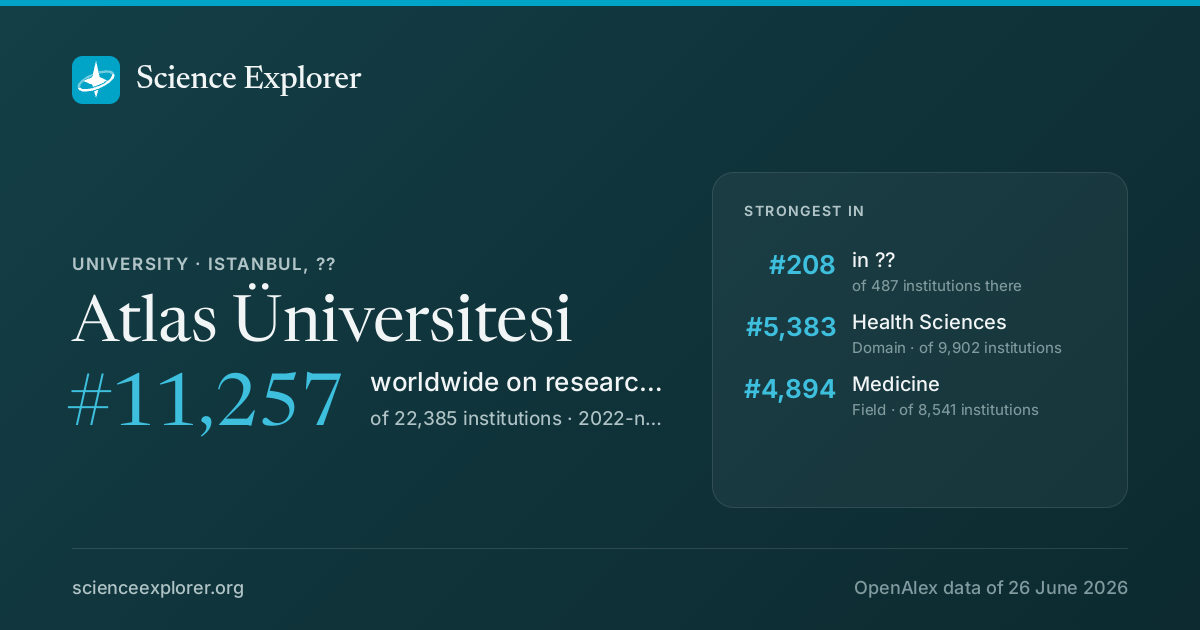
University · Istanbul · ??

Atlas Üniversitesi

In research, Atlas Üniversitesi stands highest in Health Sciences (#5,383 of 9,902 worldwide) and Medicine (#4,894 of 8,541 worldwide), 2022-now.

World rank, 2022-now
#11,257
of 22,385 · #22,677 all time
Rank in ??
#208
of 487
Research works
277
▲ 498% vs 2018-21
Citations
753
2.7 per fractional work
Top-10% rate
5.8%
all institutions 10.0%
vs its own fields
0.87×
1.00× is exactly expected
Open access
82%
world 40%
International
12%
world 18%

What is Atlas Üniversitesi known for in research?

The fields where it stands highest, 2022-now, ranked among every institution above the floor in each field.

FieldWorld rankWhere that sitsTop-10% rateWorksAll time
Health SciencesDomain #5,383 of 9,902 4.1%120 #11948
MedicineField #4,894 of 8,541 3.5%99 #10518

Each strip is that field's whole ranked pool, with the notch where Atlas Üniversitesi sits in it, in the colour of the band that rank falls in. The track under the rate is the rate itself: it carries no average mark, because the average differs by field (from about 6% in Dentistry to 21% in Economics).

Which fields of science does Atlas Üniversitesi work in?

In 2022-now, 55% of research at Atlas Üniversitesi is in Health Sciences, 20% in Social Sciences. Its largest fields are Medicine (45%), Social Sciences (7%), Health Professions (6%). It does 2.3× the world's share of Health Sciences.

Health Sciences: 133 fractional works · 55.1% of its workMedicine: 109 fractional works · 45.2% of its workSurgery: 16 fractional works · 6.8% of its workEpidemiology: 8 fractional works · 3.5% of its workPhysiology: 8 fractional works · 3.3% of its workPulmonary and Respiratory Medicine: 7 fractional works · 3.0% of its workOncology: 6 fractional works · 2.5% of its workPublic Health, Environmental and Occupational Health: 6 fractional works · 2.5% of its workCardiology and Cardiovascular Medicine: 6 fractional works · 2.3% of its workNeurology: 5 fractional works · 2.2% of its workPathology and Forensic Medicine: 5 fractional works · 2.0% of its workPsychiatry and Mental health: 4 fractional works · 1.8% of its workEndocrinology, Diabetes and Metabolism: 4 fractional works · 1.7% of its workPediatrics, Perinatology and Child Health: 3 fractional works · 1.3% of its workComplementary and alternative medicine: 3 fractional works · 1.2% of its workRheumatology: 3 fractional works · 1.1% of its workRehabilitation: 3 fractional works · 1.1% of its workRadiology, Nuclear Medicine and Imaging: 2 fractional works · 1.0% of its workInfectious Diseases: 2 fractional works · 1.0% of its workObstetrics and Gynecology: 2 fractional works · 0.9% of its workPharmacology: 2 fractional works · 0.8% of its workOrthopedics and Sports Medicine: 2 fractional works · 0.7% of its workReproductive Medicine: 2 fractional works · 0.6% of its workUrology: 1 fractional works · 0.5% of its workEmergency Medicine: 1 fractional works · 0.5% of its workGastroenterology: 1 fractional works · 0.4% of its workDermatology: 1 fractional works · 0.4% of its workAnesthesiology and Pain Medicine: 1 fractional works · 0.3% of its workGenetics: 1 fractional works · 0.3% of its workCritical Care and Intensive Care Medicine: 1 fractional works · 0.3% of its workGeriatrics and Gerontology: 1 fractional works · 0.2% of its workSmaller subfields together: 2 fractional works · 0.9% of its workHealth Professions: 15 fractional works · 6.4% of its workGeneral Health Professions: 6 fractional works · 2.5% of its workSpeech and Hearing: 2 fractional works · 0.8% of its workRadiological and Ultrasound Technology: 1 fractional works · 0.6% of its workEmergency Medical Services: 1 fractional works · 0.6% of its workOccupational Therapy: 1 fractional works · 0.4% of its workComplementary and Manual Therapy: 1 fractional works · 0.4% of its workPharmacy: 1 fractional works · 0.4% of its workPhysical Therapy, Sports Therapy and Rehabilitation: 1 fractional works · 0.3% of its workHealth Information Management: 1 fractional works · 0.2% of its workSmaller subfields together: 0 fractional works · 0.1% of its workDentistry: 5 fractional works · 2.0% of its workOral Surgery: 1 fractional works · 0.6% of its workGeneral Dentistry: 1 fractional works · 0.5% of its workPeriodontics: 1 fractional works · 0.5% of its workOrthodontics: 1 fractional works · 0.4% of its workNursing: 3 fractional works · 1.3% of its workNutrition and Dietetics: 2 fractional works · 0.8% of its workIssues, ethics and legal aspects: 1 fractional works · 0.3% of its workSmaller subfields together: 1 fractional works · 0.2% of its workVeterinary: 0 fractional works · 0.2% of its workSmall Animals: 0 fractional works · 0.2% of its workSocial Sciences: 49 fractional works · 20.5% of its workSocial Sciences: 17 fractional works · 7.3% of its workSociology and Political Science: 6 fractional works · 2.7% of its workEducation: 4 fractional works · 1.5% of its workGender Studies: 2 fractional works · 0.8% of its workHealth: 1 fractional works · 0.5% of its workPolitical Science and International Relations: 1 fractional works · 0.5% of its workCultural Studies: 1 fractional works · 0.4% of its workUrban Studies: 1 fractional works · 0.4% of its workSmaller subfields together: 1 fractional works · 0.3% of its workPsychology: 14 fractional works · 5.8% of its workClinical Psychology: 6 fractional works · 2.4% of its workSocial Psychology: 5 fractional works · 1.9% of its workExperimental and Cognitive Psychology: 1 fractional works · 0.6% of its workDevelopmental and Educational Psychology: 1 fractional works · 0.5% of its workApplied Psychology: 1 fractional works · 0.3% of its workSmaller subfields together: 0 fractional works · 0.1% of its workArts and Humanities: 13 fractional works · 5.4% of its workMuseology: 2 fractional works · 1.0% of its workLiterature and Literary Theory: 2 fractional works · 1.0% of its workLanguage and Linguistics: 2 fractional works · 0.9% of its workPhilosophy: 1 fractional works · 0.5% of its workVisual Arts and Performing Arts: 1 fractional works · 0.4% of its workArcheology: 1 fractional works · 0.4% of its workConservation: 1 fractional works · 0.4% of its workMusic: 1 fractional works · 0.3% of its workGeneral Arts and Humanities: 0 fractional works · 0.2% of its workSmaller subfields together: 1 fractional works · 0.3% of its workEconomics, Econometrics and Finance: 3 fractional works · 1.3% of its workEconomics and Econometrics: 2 fractional works · 1.0% of its workSmaller subfields together: 1 fractional works · 0.3% of its workBusiness, Management and Accounting: 1 fractional works · 0.6% of its workDecision Sciences: 0 fractional works · 0.2% of its workPhysical Sciences: 34 fractional works · 14.1% of its workComputer Science: 13 fractional works · 5.4% of its workArtificial Intelligence: 5 fractional works · 1.9% of its workInformation Systems: 3 fractional works · 1.3% of its workComputer Networks and Communications: 2 fractional works · 0.8% of its workComputer Vision and Pattern Recognition: 2 fractional works · 0.8% of its workSignal Processing: 1 fractional works · 0.3% of its workSmaller subfields together: 1 fractional works · 0.3% of its workEngineering: 13 fractional works · 5.2% of its workElectrical and Electronic Engineering: 3 fractional works · 1.3% of its workBiomedical Engineering: 2 fractional works · 1.0% of its workIndustrial and Manufacturing Engineering: 2 fractional works · 0.7% of its workMechanical Engineering: 1 fractional works · 0.5% of its workBuilding and Construction: 1 fractional works · 0.4% of its workAerospace Engineering: 1 fractional works · 0.3% of its workControl and Systems Engineering: 1 fractional works · 0.2% of its workSmaller subfields together: 2 fractional works · 0.7% of its workMathematics: 2 fractional works · 0.9% of its workApplied Mathematics: 0 fractional works · 0.2% of its workSmaller subfields together: 2 fractional works · 0.7% of its workEnvironmental Science: 2 fractional works · 0.8% of its workGlobal and Planetary Change: 1 fractional works · 0.3% of its workHealth, Toxicology and Mutagenesis: 1 fractional works · 0.3% of its workSmaller subfields together: 0 fractional works · 0.1% of its workMaterials Science: 2 fractional works · 0.6% of its workMaterials Chemistry: 1 fractional works · 0.2% of its workBiomaterials: 1 fractional works · 0.2% of its workSmaller subfields together: 0 fractional works · 0.2% of its workChemistry: 1 fractional works · 0.4% of its workEarth and Planetary Sciences: 1 fractional works · 0.2% of its workEnergy: 1 fractional works · 0.2% of its workPhysics and Astronomy: 0 fractional works · 0.1% of its workLife Sciences: 25 fractional works · 10.4% of its workBiochemistry, Genetics and Molecular Biology: 13 fractional works · 5.4% of its workMolecular Biology: 6 fractional works · 2.7% of its workCell Biology: 2 fractional works · 0.7% of its workCancer Research: 1 fractional works · 0.6% of its workGenetics: 1 fractional works · 0.5% of its workClinical Biochemistry: 1 fractional works · 0.4% of its workBiophysics: 1 fractional works · 0.2% of its workSmaller subfields together: 1 fractional works · 0.4% of its workNeuroscience: 7 fractional works · 2.8% of its workCognitive Neuroscience: 2 fractional works · 0.9% of its workNeurology: 1 fractional works · 0.6% of its workCellular and Molecular Neuroscience: 1 fractional works · 0.5% of its workEndocrine and Autonomic Systems: 1 fractional works · 0.3% of its workSensory Systems: 0 fractional works · 0.2% of its workSmaller subfields together: 1 fractional works · 0.2% of its workImmunology and Microbiology: 3 fractional works · 1.1% of its workImmunology: 2 fractional works · 0.8% of its workMicrobiology: 1 fractional works · 0.3% of its workSmaller subfields together: 0 fractional works · 0.0% of its workAgricultural and Biological Sciences: 2 fractional works · 0.9% of its workFood Science: 1 fractional works · 0.4% of its workSmaller subfields together: 1 fractional works · 0.4% of its workPharmacology, Toxicology and Pharmaceutics: 0 fractional works · 0.2% of its workALL ITS WORKAtlasÜniversitesi241fractional works, 2022-now
Life Sciences10%Physical Sciences14%Health Sciences55%Social Sciences20%

Each ring splits the one inside it: the four domains of science, their fields, their subfields. Size is fractional works in 2022-now. Every slice is a page; the interactive view zooms down to single topics and colours each by how much more of it this institution does than the world.

Its 4 domains and 26 fields, with their numbers
    1. Medicine10945.2%
    2. Health Professions156.4%
    3. Dentistry52.0%
    4. Nursing31.3%
    5. Veterinary00.2%
    1. Social Sciences177.3%
    2. Psychology145.8%
    3. Arts and Humanities135.4%
    4. Economics, Econometrics and Finance31.3%
    5. Business, Management and Accounting10.6%
    6. Decision Sciences00.2%
    1. Computer Science135.4%
    2. Engineering135.2%
    3. Mathematics20.9%
    4. Environmental Science20.8%
    5. Materials Science20.6%
    6. Chemistry10.4%
    7. Earth and Planetary Sciences10.2%
    8. Energy10.2%
    9. Physics and Astronomy00.1%
    10. Chemical Engineering00.0%
    1. Biochemistry, Genetics and Molecular Biology135.4%
    2. Neuroscience72.8%
    3. Immunology and Microbiology31.1%
    4. Agricultural and Biological Sciences20.9%
    5. Pharmacology, Toxicology and Pharmaceutics00.2%
All of science, and how each field's share has moved since 1950: the Science domain explorer

Field profile

Location quotient across every field it publishes in: outside the ring is more than an institution of this size would be expected to publish, inside it is less.

Agricultural and Biological Sciences: 0.18× its world share, 2 worksAgricultural and Bio…Biochemistry, Genetics and Molecular Biology: 1.02× its world share, 13 worksBiochemistry, Geneti…Immunology and Microbiology: 1.12× its world share, 3 worksImmunology and Micro…Neuroscience: 1.70× its world share, 7 worksNeurosciencePharmacology, Toxicology and Pharmaceutics: 0.59× its world share, 0 worksPharmacology, Toxico…Chemical Engineering: 0.05× its world share, 0 worksChemical EngineeringChemistry: 0.25× its world share, 1 worksChemistryComputer Science: 0.70× its world share, 13 worksComputer ScienceEarth and Planetary Sciences: 0.15× its world share, 1 worksEarth and Planetary …Energy: 0.24× its world share, 0 worksEnergyEngineering: 0.35× its world share, 12 worksEngineeringEnvironmental Science: 0.17× its world share, 2 worksEnvironmental ScienceMaterials Science: 0.19× its world share, 2 worksMaterials ScienceMathematics: 0.80× its world share, 2 worksMathematicsPhysics and Astronomy: 0.06× its world share, 0 worksPhysics and AstronomyDentistry: 4.04× its world share, 5 worksDentistryHealth Professions: 2.43× its world share, 15 worksHealth ProfessionsMedicine: 2.35× its world share, 109 worksMedicineNursing: 2.74× its world share, 3 worksNursingVeterinary: 1.53× its world share, 0 worksVeterinaryArts and Humanities: 1.86× its world share, 13 worksArts and HumanitiesBusiness, Management and Accounting: 0.18× its world share, 1 worksBusiness, Management…Decision Sciences: 0.19× its world share, 0 worksDecision SciencesEconomics, Econometrics and Finance: 0.59× its world share, 3 worksEconomics, Econometr…Psychology: 1.91× its world share, 14 worksPsychologySocial Sciences: 0.57× its world share, 18 worksSocial Sciences1×world share
more than its size predictsabout as predictedless

Rings at 0.5×, 1× and 2×. Widest outward: Dentistry, 4.0×. Every wedge is a field page.

All 26 fields, with their numbers
  1. Dentistry4.04×5 works
  2. Nursing2.74×3 works
  3. Health Professions2.43×15 works
  4. Medicine2.35×109 works
  5. Psychology1.91×14 works
  6. Arts and Humanities1.86×13 works
  7. Neuroscience1.70×7 works
  8. Veterinary1.53×0 works
  9. Immunology and Microbiology1.12×3 works
  10. Biochemistry, Genetics and Molecular Biology1.02×13 works
  11. Mathematics0.80×2 works
  12. Computer Science0.70×13 works
  13. Pharmacology, Toxicology and Pharmaceutics0.59×0 works
  14. Economics, Econometrics and Finance0.59×3 works
  15. Social Sciences0.57×18 works
  16. Engineering0.35×12 works
  17. Chemistry0.25×1 works
  18. Energy0.24×0 works
  19. Materials Science0.19×2 works
  20. Decision Sciences0.19×0 works
  21. Agricultural and Biological Sciences0.18×2 works
  22. Business, Management and Accounting0.18×1 works
  23. Environmental Science0.17×2 works
  24. Earth and Planetary Sciences0.15×1 works
  25. Physics and Astronomy0.06×0 works
  26. Chemical Engineering0.05×0 works

Who are the top researchers at Atlas Üniversitesi?

Ranked on the quality score, Hafize Uzun, Leman Kutlu and Yusuf Elgörmüş lead among researchers whose main affiliation is Atlas Üniversitesi.

  1. 1 Hafize Uzun #4,025,841 worldwide 45 citations · 16 works
  2. 2 Leman Kutlu #4,052,303 worldwide 197 citations · 30 works
  3. 3 Yusuf Elgörmüş #4,156,921 worldwide 212 citations · 23 works
  4. 4 Aybüke Ersin #4,322,869 worldwide 54 citations · 24 works
  5. 5 Şeyma Dümür #4,675,807 worldwide 215 citations · 51 works
  6. 6 Demet Aygün #4,702,247 worldwide 29 citations · 22 works
  7. 7 Müveddet Emel Alphan #5,120,945 worldwide 20 citations · 35 works
  8. 8 Sema Ketenci #5,287,579 worldwide 136 citations · 32 works
  9. 9 Dilek Baykal #5,412,948 worldwide 151 citations · 44 works
  10. 10 Zeki Doğan #5,518,010 worldwide 130 citations · 32 works
All ranked researchers at Atlas Üniversitesi

What are the most cited papers from Atlas Üniversitesi?

The most cited paper from Atlas Üniversitesi is "A new service composition method in the cloud‐based Internet of things environment using a grey wolf optimization algorithm and MapReduce framework" (Asrin Vakili, Hamza Mohammed Ridha Al‐Khafaji, Mehdi Darbandi et al., 2024), with 125 citations. Next come "Comprehensive survey of artificial intelligence techniques and strategies for climate change mitigation" (120) and "Targeting Metabolic Diseases: The Role of Nutraceuticals in Modulating Oxidative Stress and Inflammation" (111).

Most cited papers
#PaperReleasedCitations
1 A new service composition method in the cloud‐based Internet of things environment using a grey wolf optimization algorithm and MapReduce framework Asrin Vakili, Hamza Mohammed Ridha Al‐Khafaji, Mehdi Darbandi et al. · Concurrency and Computation Practice and Experience 16 May 2024 125
2 Comprehensive survey of artificial intelligence techniques and strategies for climate change mitigation Zahra Mohtasham‐Amiri, Arash Heidari, Nima Jafari Navimipour · Energy 29 Aug 2024 120
3 Targeting Metabolic Diseases: The Role of Nutraceuticals in Modulating Oxidative Stress and Inflammation Aida Dama, Kleva Shpati, Patricia Daliu et al. · Nutrients Open access 10 Feb 2024 111
4 The applications of nature‐inspired algorithms in Internet of Things‐based healthcare service: A systematic literature review Zahra Mohtasham‐Amiri, Arash Heidari, Mohammad Hossein Zavvar et al. · Transactions on Emerging Telecommunications Technologies Review 21 May 2024 105
5 Assessment of reliability and availability of wireless sensor networks in industrial applications by considering permanent faults Arash Heidari, Zahra Mohtasham‐Amiri, Mohammad Ali Jabraeil Jamali et al. · Concurrency and Computation Practice and Experience Open access 4 Oct 2024 97
All 62 most cited papers, with filters and sorting

Which keywords describe research at Atlas Üniversitesi?

By fractional works in 2022-now, weighted toward what it does more of than the world: Inflammation, Epidemiology, Quality of Life, Metabolic Syndrome, Obesity, Cardiovascular Disease, Insulin Resistance and Self-Efficacy.

▲ more of its work than of the world's◆ about the world's share▼ less than the world's

Size is fractional works in 2022-now in the topics tagged with each word; colour is the word's share of this institution's work against its share of the world's. The 40 words are chosen for being large and distinctive. Each links to the topic it comes from most.

All 40 words, with their numbers
  1. Epidemiology20▲ 2.1×70 topics
  2. Inflammation18▲ 3.5×62 topics
  3. Quality of Life12▲ 3.3×37 topics
  4. Cardiovascular Disease9▲ 3.2×25 topics
  5. Metabolic Syndrome8▲ 4.3×17 topics
  6. Obesity8▲ 4.3×20 topics
  7. Mental Health7▲ 1.99×17 topics
  8. Cancer7▲ 2.1×29 topics
  9. Risk Factors6▲ 2.4×22 topics
  10. COVID-196▲ 1.96×14 topics
  11. Treatment6▲ 2.1×24 topics
  12. Neurological Disorders6▲ 4.3×12 topics
  13. Cultural Heritage6▲ 4.5×10 topics
  14. Insulin Resistance6▲ 5.3×9 topics
  15. Social Support6▲ 4.3×10 topics
  16. Depression5▲ 2.5×15 topics
  17. Management5▲ 2.6×16 topics
  18. Diabetes5▲ 4.0×14 topics
  19. Diagnosis5▲ 2.1×15 topics
  20. Self-Efficacy5▲ 7.5×6 topics
  21. Rehabilitation4▲ 4.6×10 topics
  22. Clinical Trials4▲ 2.7×11 topics
  23. Global Burden4▲ 3.3×8 topics
  24. Thrombosis4▲ 5.9×6 topics
  25. Pain Management4▲ 6.8×8 topics
  26. Psychological Factors4▲ 7.4×6 topics
  27. Anxiety4▲ 3.1×9 topics
  28. Low Back Pain4▲ 8.5×3 topics
  29. Metastasis3▲ 4.0×7 topics
  30. Pathophysiology3▲ 4.7×8 topics
  31. Weight Loss3▲ 8.5×4 topics
  32. Ethnography3▲ 7.4×2 topics
  33. Atherosclerosis3▲ 4.4×9 topics
  34. Diagnostic Criteria3▲ 5.4×8 topics
  35. Elderly3▲ 5.2×5 topics
  36. Nursing Students3▲ 29×2 topics
  37. Chronic Pain3▲ 5.2×4 topics
  38. Health Locus of Control3▲ 36×1 topic
  39. Health-Promoting Behaviors3▲ 36×1 topic
  40. Autism Spectrum Disorders2▲ 10×2 topics

Which research topics does Atlas Üniversitesi publish most on?

By volume in 2022-now: Health and Wellbeing Research, Cultural and Sociopolitical Studies, Inflammatory Biomarkers in Disease Prognosis and Blockchain Technology Applications and Security.

  1. 1 Health and Wellbeing Research General Health Professions 3 works
  2. 2 Cultural and Sociopolitical Studies Museology 2 works
  3. 3 Inflammatory Biomarkers in Disease Prognosis Oncology 2 works
  4. 4 Blockchain Technology Applications and Security Information Systems 2 works
  5. 5 Diet and metabolism studies Physiology 2 works
  6. 6 Gender Studies and Social Issues Gender Studies 2 works
  7. 7 COVID-19 and Mental Health Clinical Psychology 2 works
  8. 8 COVID-19 Clinical Research Studies Infectious Diseases 2 works
  9. 9 Child Nutrition and Feeding Issues Psychiatry and Mental health 2 works
  10. 10 Nutrition and Health in Aging Physiology 2 works

How open and international is its research?

Against the world's own shares: the tick on each track. Both are shares of its output, so they sit on one scale and can be read against each other as well as against the world.

openly available82.3%not open17.7%

World: 40% of research is openly available.

with international co-authors12.3%domestic only87.7%

World: 18% is written across borders.

How has Atlas Üniversitesi's research output changed?

Output in 2022-2025 was 498% higher than in 2018-2021.

still counting20202025
grewheldshrank

The same series as a ribbon: one cell per year, darker for more. The line above answers how much; this answers when.

Other research institutions in Istanbul

All research institutions in Istanbul

Share Atlas Üniversitesi's ranking

Atlas Üniversitesi on Science Explorer

A card with Atlas Üniversitesi's standing and the fields it leads in, for a post or a slide. A link to this page previews as the same card.

Download the card

1200 × 630 PNG, sized for social posts, drawn from the latest snapshot.

Badges for a website1Each links back here and updates with every snapshot

Research measures only: rankings here say nothing about teaching, admissions or student experience. Comparable institutions and collaboration partners have tabs of their own, above.

Discussion

Ask a question or share a note about Atlas Üniversitesi. Keep it to the research: no personal attacks, advertising or links. Any reader can report a post, which collapses it for everyone until it is opened.