Science Explorer Back to mapMap
Discussion
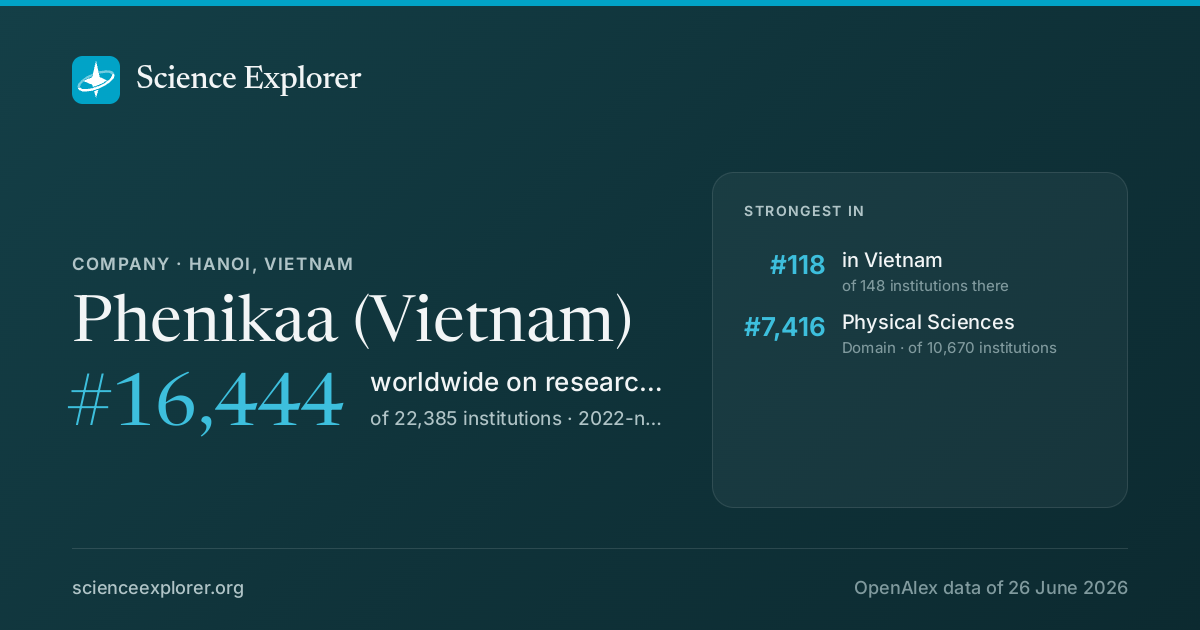
Company · Hanoi · Vietnam

Phenikaa (Vietnam)

In research, Phenikaa (Vietnam) stands highest in Physical Sciences (#7,416 of 10,670 worldwide), 2022-now.

World rank, 2022-now
#16,444
of 22,385 · #24,160 all time
Rank in Vietnam
#118
of 148
Research works
228
◆ 1% vs 2018-21
Citations
3.6k
15.7 per fractional work
Top-10% rate
6.3%
all institutions 10.0%
vs its own fields
0.98×
1.00× is exactly expected
Open access
43%
world 40%
International
29%
world 18%

What is Phenikaa (Vietnam) known for in research?

The fields where it stands highest, 2022-now, ranked among every institution above the floor in each field.

FieldWorld rankWhere that sitsTop-10% rateWorksAll time
Physical SciencesDomain #7,416 of 10,670 6.5%87 #11193

Each strip is that field's whole ranked pool, with the notch where Phenikaa (Vietnam) sits in it, in the colour of the band that rank falls in. The track under the rate is the rate itself: it carries no average mark, because the average differs by field (from about 6% in Dentistry to 21% in Economics).

Which fields of science does Phenikaa (Vietnam) work in?

In 2022-now, 81% of research at Phenikaa (Vietnam) is in Physical Sciences, 7% in Health Sciences. Its largest fields are Engineering (45%), Materials Science (14%), Computer Science (10%). It does 2.0× the world's share of Physical Sciences.

Physical Sciences: 95 fractional works · 81.1% of its workEngineering: 52 fractional works · 44.6% of its workElectrical and Electronic Engineering: 9 fractional works · 8.1% of its workCivil and Structural Engineering: 9 fractional works · 7.4% of its workBiomedical Engineering: 6 fractional works · 5.3% of its workMechanical Engineering: 6 fractional works · 4.8% of its workMechanics of Materials: 5 fractional works · 4.1% of its workComputational Mechanics: 5 fractional works · 3.9% of its workControl and Systems Engineering: 3 fractional works · 2.6% of its workAerospace Engineering: 3 fractional works · 2.6% of its workAutomotive Engineering: 2 fractional works · 2.0% of its workIndustrial and Manufacturing Engineering: 2 fractional works · 1.3% of its workOcean Engineering: 1 fractional works · 0.7% of its workBuilding and Construction: 1 fractional works · 0.7% of its workSafety, Risk, Reliability and Quality: 1 fractional works · 0.7% of its workMedia Technology: 0 fractional works · 0.4% of its workMaterials Science: 16 fractional works · 13.6% of its workMaterials Chemistry: 11 fractional works · 9.5% of its workPolymers and Plastics: 2 fractional works · 1.3% of its workElectronic, Optical and Magnetic Materials: 1 fractional works · 0.8% of its workSurfaces, Coatings and Films: 1 fractional works · 0.8% of its workCeramics and Composites: 1 fractional works · 0.5% of its workBiomaterials: 1 fractional works · 0.5% of its workSmaller subfields together: 0 fractional works · 0.2% of its workComputer Science: 11 fractional works · 9.7% of its workArtificial Intelligence: 4 fractional works · 3.5% of its workComputer Vision and Pattern Recognition: 4 fractional works · 3.3% of its workComputer Networks and Communications: 2 fractional works · 1.5% of its workInformation Systems: 1 fractional works · 0.6% of its workComputational Theory and Mathematics: 0 fractional works · 0.3% of its workSignal Processing: 0 fractional works · 0.3% of its workSmaller subfields together: 0 fractional works · 0.2% of its workEnvironmental Science: 6 fractional works · 5.1% of its workEcology: 3 fractional works · 2.4% of its workManagement, Monitoring, Policy and Law: 1 fractional works · 0.7% of its workPollution: 1 fractional works · 0.5% of its workEnvironmental Engineering: 1 fractional works · 0.4% of its workWater Science and Technology: 0 fractional works · 0.3% of its workIndustrial and Manufacturing Engineering: 0 fractional works · 0.3% of its workGlobal and Planetary Change: 0 fractional works · 0.3% of its workSmaller subfields together: 0 fractional works · 0.1% of its workEnergy: 3 fractional works · 2.3% of its workRenewable Energy, Sustainability and the Environment: 3 fractional works · 2.2% of its workSmaller subfields together: 0 fractional works · 0.1% of its workPhysics and Astronomy: 2 fractional works · 2.1% of its workAtomic and Molecular Physics, and Optics: 1 fractional works · 0.8% of its workRadiation: 1 fractional works · 0.5% of its workCondensed Matter Physics: 0 fractional works · 0.4% of its workStatistical and Nonlinear Physics: 0 fractional works · 0.2% of its workSmaller subfields together: 0 fractional works · 0.2% of its workChemistry: 2 fractional works · 1.9% of its workElectrochemistry: 1 fractional works · 0.8% of its workOrganic Chemistry: 1 fractional works · 0.6% of its workSpectroscopy: 0 fractional works · 0.3% of its workInorganic Chemistry: 0 fractional works · 0.3% of its workChemical Engineering: 2 fractional works · 1.4% of its workBioengineering: 1 fractional works · 0.6% of its workCatalysis: 1 fractional works · 0.5% of its workFluid Flow and Transfer Processes: 0 fractional works · 0.3% of its workEarth and Planetary Sciences: 0 fractional works · 0.4% of its workMathematics: 0 fractional works · 0.1% of its workHealth Sciences: 8 fractional works · 6.9% of its workMedicine: 7 fractional works · 6.1% of its workPulmonary and Respiratory Medicine: 1 fractional works · 1.0% of its workSurgery: 1 fractional works · 0.8% of its workComplementary and alternative medicine: 1 fractional works · 0.5% of its workCardiology and Cardiovascular Medicine: 1 fractional works · 0.5% of its workInfectious Diseases: 1 fractional works · 0.5% of its workEpidemiology: 0 fractional works · 0.4% of its workPharmacology: 0 fractional works · 0.4% of its workRadiology, Nuclear Medicine and Imaging: 0 fractional works · 0.3% of its workOncology: 0 fractional works · 0.2% of its workPhysiology: 0 fractional works · 0.2% of its workSmaller subfields together: 1 fractional works · 1.1% of its workNursing: 0 fractional works · 0.4% of its workNutrition and Dietetics: 0 fractional works · 0.4% of its workHealth Professions: 0 fractional works · 0.2% of its workRadiological and Ultrasound Technology: 0 fractional works · 0.2% of its workDentistry: 0 fractional works · 0.2% of its workSocial Sciences: 8 fractional works · 6.8% of its workBusiness, Management and Accounting: 3 fractional works · 2.2% of its workStrategy and Management: 2 fractional works · 1.8% of its workSmaller subfields together: 0 fractional works · 0.4% of its workSocial Sciences: 2 fractional works · 1.6% of its workSociology and Political Science: 1 fractional works · 0.9% of its workSmaller subfields together: 1 fractional works · 0.7% of its workEconomics, Econometrics and Finance: 2 fractional works · 1.5% of its workEconomics and Econometrics: 2 fractional works · 1.4% of its workSmaller subfields together: 0 fractional works · 0.1% of its workDecision Sciences: 1 fractional works · 1.2% of its workManagement Science and Operations Research: 1 fractional works · 0.9% of its workSmaller subfields together: 0 fractional works · 0.3% of its workPsychology: 0 fractional works · 0.4% of its workExperimental and Cognitive Psychology: 0 fractional works · 0.2% of its workSmaller subfields together: 0 fractional works · 0.1% of its workLife Sciences: 6 fractional works · 5.2% of its workBiochemistry, Genetics and Molecular Biology: 3 fractional works · 2.4% of its workMolecular Biology: 2 fractional works · 1.6% of its workSmaller subfields together: 1 fractional works · 0.8% of its workAgricultural and Biological Sciences: 2 fractional works · 1.7% of its workPlant Science: 1 fractional works · 0.6% of its workEcology, Evolution, Behavior and Systematics: 0 fractional works · 0.4% of its workFood Science: 0 fractional works · 0.2% of its workSmaller subfields together: 1 fractional works · 0.5% of its workPharmacology, Toxicology and Pharmaceutics: 1 fractional works · 0.5% of its workPharmacology: 1 fractional works · 0.5% of its workImmunology and Microbiology: 0 fractional works · 0.4% of its workImmunology: 0 fractional works · 0.4% of its workNeuroscience: 0 fractional works · 0.3% of its workNeurology: 0 fractional works · 0.3% of its workALL ITS WORKPhenikaa(Vietnam)117fractional works, 2022-now
Life Sciences5%Physical Sciences81%Health Sciences7%Social Sciences7%

Each ring splits the one inside it: the four domains of science, their fields, their subfields. Size is fractional works in 2022-now. Every slice is a page; the interactive view zooms down to single topics and colours each by how much more of it this institution does than the world.

Its 4 domains and 24 fields, with their numbers
    1. Engineering5244.6%
    2. Materials Science1613.6%
    3. Computer Science119.7%
    4. Environmental Science65.1%
    5. Energy32.3%
    6. Physics and Astronomy22.1%
    7. Chemistry21.9%
    8. Chemical Engineering21.4%
    9. Earth and Planetary Sciences00.4%
    10. Mathematics00.1%
    1. Medicine76.1%
    2. Nursing00.4%
    3. Health Professions00.2%
    4. Dentistry00.2%
    1. Business, Management and Accounting32.2%
    2. Social Sciences21.6%
    3. Economics, Econometrics and Finance21.5%
    4. Decision Sciences11.2%
    5. Psychology00.4%
    1. Biochemistry, Genetics and Molecular Biology32.4%
    2. Agricultural and Biological Sciences21.7%
    3. Pharmacology, Toxicology and Pharmaceutics10.5%
    4. Immunology and Microbiology00.4%
    5. Neuroscience00.3%
All of science, and how each field's share has moved since 1950: the Science domain explorer

Field profile

Location quotient across every field it publishes in: outside the ring is more than an institution of this size would be expected to publish, inside it is less.

Agricultural and Biological Sciences: 0.36× its world share, 2 worksAgricultural and Bio…Biochemistry, Genetics and Molecular Biology: 0.44× its world share, 3 worksBiochemistry, Geneti…Immunology and Microbiology: 0.35× its world share, 0 worksImmunology and Micro…Neuroscience: 0.19× its world share, 0 worksNeurosciencePharmacology, Toxicology and Pharmaceutics: 1.34× its world share, 1 worksPharmacology, Toxico…Chemical Engineering: 4.01× its world share, 2 worksChemical EngineeringChemistry: 1.23× its world share, 2 worksChemistryComputer Science: 1.24× its world share, 11 worksComputer ScienceEarth and Planetary Sciences: 0.24× its world share, 0 worksEarth and Planetary …Energy: 2.46× its world share, 3 worksEnergyEngineering: 2.97× its world share, 52 worksEngineeringEnvironmental Science: 1.02× its world share, 6 worksEnvironmental ScienceMaterials Science: 3.90× its world share, 16 worksMaterials ScienceMathematics: 0.09× its world share, 0 worksMathematicsPhysics and Astronomy: 0.94× its world share, 2 worksPhysics and AstronomyDentistry: 0.41× its world share, 0 worksDentistryHealth Professions: 0.09× its world share, 0 worksHealth ProfessionsMedicine: 0.32× its world share, 7 worksMedicineNursing: 0.74× its world share, 0 worksNursingBusiness, Management and Accounting: 0.67× its world share, 2 worksBusiness, Management…Decision Sciences: 1.20× its world share, 1 worksDecision SciencesEconomics, Econometrics and Finance: 0.69× its world share, 2 worksEconomics, Econometr…Psychology: 0.12× its world share, 0 worksPsychologySocial Sciences: 0.13× its world share, 2 worksSocial Sciences1×world share
more than its size predictsabout as predictedless

Rings at 0.5×, 1× and 2×. Widest outward: Chemical Engineering, 4.0×. Every wedge is a field page.

All 24 fields, with their numbers
  1. Chemical Engineering4.01×2 works
  2. Materials Science3.90×16 works
  3. Engineering2.97×52 works
  4. Energy2.46×3 works
  5. Pharmacology, Toxicology and Pharmaceutics1.34×1 works
  6. Computer Science1.24×11 works
  7. Chemistry1.23×2 works
  8. Decision Sciences1.20×1 works
  9. Environmental Science1.02×6 works
  10. Physics and Astronomy0.94×2 works
  11. Nursing0.74×0 works
  12. Economics, Econometrics and Finance0.69×2 works
  13. Business, Management and Accounting0.67×2 works
  14. Biochemistry, Genetics and Molecular Biology0.44×3 works
  15. Dentistry0.41×0 works
  16. Agricultural and Biological Sciences0.36×2 works
  17. Immunology and Microbiology0.35×0 works
  18. Medicine0.32×7 works
  19. Earth and Planetary Sciences0.24×0 works
  20. Neuroscience0.19×0 works
  21. Social Sciences0.13×2 works
  22. Psychology0.12×0 works
  23. Mathematics0.09×0 works
  24. Health Professions0.09×0 works

What are the most cited papers from Phenikaa (Vietnam)?

The most cited paper from Phenikaa (Vietnam) is "Federated Learning in Mobile Edge Networks: A Comprehensive Survey" (Wei Yang Bryan Lim, Nguyen Cong Luong, Dinh Thai Hoang et al., 2020), with 2,561 citations. Next come "Recent advances and challenges for solar-driven water evaporation system toward applications" (504) and "Antimicrobial peptides – Advances in development of therapeutic applications" (260).

Most cited papers
#PaperReleasedCitations
1 Federated Learning in Mobile Edge Networks: A Comprehensive Survey Wei Yang Bryan Lim, Nguyen Cong Luong, Dinh Thai Hoang et al. · IEEE Communications Surveys & Tutorials 2020 2,561
2 Recent advances and challenges for solar-driven water evaporation system toward applications Van‐Duong Dao, Ngoc Hung Vu, Sining Yun · Nano Energy 27 Nov 2019 504
3 Antimicrobial peptides – Advances in development of therapeutic applications Huy Xuan Luong, Trương Thanh Tùng, Tuan Hiep Tran · Life Sciences Open access 12 Sep 2020 260
4 1-Ethyl 3-methylimidazolium thiocyanate ionic liquid as corrosion inhibitor of API 5L X52 steel in H2SO4 and HCl media Mónica Corrales-Luna, Tu Le Manh, Mario Romero-Romo et al. · Corrosion Science 28 Mar 2019 199
5 One-step fabrication of SnO2 porous nanofiber gas sensors for sub-ppm H2S detection Phan Hong Phuoc, Chu Manh Hung, Nguyễn Văn Toàn et al. · Sensors and Actuators A Physical 9 Nov 2019 181
All 60 most cited papers, with filters and sorting

Which keywords describe research at Phenikaa (Vietnam)?

By fractional works in 2022-now, weighted toward what it does more of than the world: Nanostructures, Surface Tension, Mechanical Properties, Composite Materials, Fuzzy Mathematics, Set Pair Analysis, Risk Assessment and Tool Wear.

▲ more of its work than of the world's◆ about the world's share▼ less than the world's

Size is fractional works in 2022-now in the topics tagged with each word; colour is the word's share of this institution's work against its share of the world's. The 40 words are chosen for being large and distinctive. Each links to the topic it comes from most.

All 40 words, with their numbers
  1. Deep Learning6▲ 1.47×22 topics
  2. Nanostructures5▲ 10×7 topics
  3. Mechanical Properties4▲ 3.7×16 topics
  4. Biomedical Applications4▲ 2.7×11 topics
  5. Nanomaterials4▲ 3.0×8 topics
  6. Nanocomposites4▲ 3.8×10 topics
  7. Risk Assessment4▲ 4.5×4 topics
  8. Nanoparticles3▲ 2.3×13 topics
  9. Neural Networks3▲ 1.88×10 topics
  10. Graphene3▲ 3.9×8 topics
  11. Composite Materials3▲ 12×5 topics
  12. Surface Tension3▲ 49×3 topics
  13. Fuzzy Mathematics3▲ 117×1 topic
  14. Set Pair Analysis3▲ 117×1 topic
  15. Synthesis3▲ 6.3×6 topics
  16. Fluid Dynamics3▲ 16×2 topics
  17. Tool Wear3▲ 18×3 topics
  18. Multiphase Flow3▲ 27×3 topics
  19. Surface Roughness2▲ 16×3 topics
  20. Level Set Method2▲ 45×2 topics
  21. Visible Light2▲ 8.5×3 topics
  22. Drop Impact2▲ 72×1 topic
  23. Nanocrystals2▲ 7.1×4 topics
  24. Spray Cooling2▲ 72×1 topic
  25. Buckling Behavior2▲ 25×2 topics
  26. Semiconductors2▲ 6.1×3 topics
  27. Efficiency2▲ 5.6×4 topics
  28. Finite Element Method2▲ 18×3 topics
  29. Vibration Analysis2▲ 6.4×5 topics
  30. Water Splitting2▲ 4.6×3 topics
  31. Semiconductor2▲ 5.0×5 topics
  32. Solar Cells2▲ 8.0×5 topics
  33. Size-Dependent Behavior2▲ 55×2 topics
  34. Thin Films2▲ 7.4×4 topics
  35. Autonomous Vehicles2▲ 6.7×3 topics
  36. Nanoscale Materials2▲ 30×2 topics
  37. Characterization2▲ 9.4×3 topics
  38. Infrastructure2▲ 11×2 topics
  39. Machining2▲ 23×1 topic
  40. Wave Propagation2▲ 12×3 topics

Which research topics does Phenikaa (Vietnam) publish most on?

By volume in 2022-now: Research studies in Vietnam, Fluid Dynamics and Heat Transfer, Advanced machining processes and optimization and Geodetic Measurements and Engineering Structures.

  1. 1 Research studies in Vietnam Ecology 3 works
  2. 2 Fluid Dynamics and Heat Transfer Computational Mechanics 2 works
  3. 3 Advanced machining processes and optimization Mechanical Engineering 2 works
  4. 4 Geodetic Measurements and Engineering Structures Civil and Structural Engineering 1 works
  5. 5 Composite Structure Analysis and Optimization Mechanics of Materials 1 works
  6. 6 Nonlocal and gradient elasticity in micro/nano structures Materials Chemistry 1 works
  7. 7 Copper-based nanomaterials and applications Materials Chemistry 1 works
  8. 8 Innovative Microfluidic and Catalytic Techniques Innovation Biomedical Engineering 1 works
  9. 9 Advanced Photocatalysis Techniques Renewable Energy, Sustainability and the Environment 1 works
  10. 10 Electrochemical Analysis and Applications Electrochemistry 1 works

How open and international is its research?

Against the world's own shares: the tick on each track. Both are shares of its output, so they sit on one scale and can be read against each other as well as against the world.

openly available42.7%not open57.3%

World: 40% of research is openly available.

with international co-authors29.0%domestic only71.0%

World: 18% is written across borders.

How has Phenikaa (Vietnam)'s research output changed?

Output in 2022-2025 was 1% higher than in 2018-2021.

still counting200020102020
grewheldshrank

The same series as a ribbon: one cell per year, darker for more. The line above answers how much; this answers when.

Its share of all research

Growing output can still be a shrinking share: all of science grows. This is Phenikaa (Vietnam) as a percentage of every work published that year, 0.00045% in 2024.

still counting0.00025%0.00050%0.00075%Phenikaa (Vietnam)0.00049% in 2025200020102020

Fractional works of Phenikaa (Vietnam) over all fractional works that year. How the balance of science has shifted.

How much of it reaches the world top 10%

Year by year, against all institutions in the same year.

still counting5%10%15%all institutions10.0% in 2025Phenikaa (Vietnam)4.8% in 20252020

Of each year's output, the share that reached the world's 10% most cited for its field and year. Peak 12.9% in 2020.

Other research institutions in Hanoi

All research institutions in Hanoi

Share Phenikaa (Vietnam)'s ranking

Phenikaa (Vietnam) on Science Explorer

A card with Phenikaa (Vietnam)'s standing and the fields it leads in, for a post or a slide. A link to this page previews as the same card.

Download the card

1200 × 630 PNG, sized for social posts, drawn from the latest snapshot.

Badges for a website1Each links back here and updates with every snapshot

Research measures only: rankings here say nothing about teaching, admissions or student experience. Comparable institutions and collaboration partners have tabs of their own, above.

Discussion

Ask a question or share a note about Phenikaa (Vietnam). Posts are plain text and can be reported.