Phillips 66 (United States)
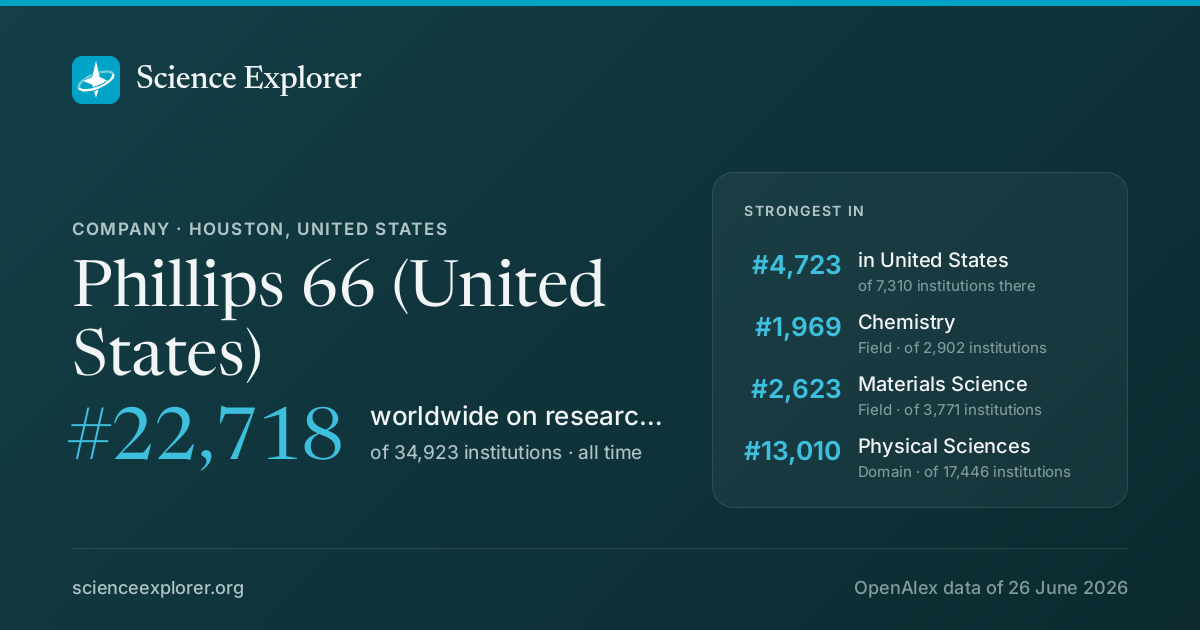
In research, Phillips 66 (United States) stands highest in Chemistry (#1,969 of 2,902 worldwide), Materials Science (#2,623 of 3,771 worldwide) and Physical Sciences (#13,010 of 17,446 worldwide), over all time.
- World rank, all time
- #22,718 of 34,923
- Rank in United States
- #4,723 of 7,310
- Research works
- 1k ▲ 4% vs 2018-21
- Citations
- 23k 22.7 per fractional work
- Top-10% rate
- 4.3% all institutions 10.0%
- vs its own fields
- 0.91× 1.00× is exactly expected
- Open access
- 6% world 40%
- International
- 6% world 18%
What is Phillips 66 (United States) known for in research?
The fields where it stands highest, over all time, ranked among every institution above the floor in each field.
| Field | World rank | Where that sits | Top-10% rate | Works |
|---|---|---|---|---|
| ChemistryField | #1,969 of 2,902 | 13.8% | 196 | |
| Materials ScienceField | #2,623 of 3,771 | 11.9% | 186 | |
| Physical SciencesDomain | #13,010 of 17,446 | 10.5% | 906 | |
| EngineeringField | #7,615 of 9,532 | 9.2% | 290 |
Each strip is that field's whole ranked pool, with the notch where Phillips 66 (United States) sits in it, in the colour of the band that rank falls in. The track under the rate is the rate itself: it carries no average mark, because the average differs by field (from about 6% in Dentistry to 21% in Economics).
Which fields of science does Phillips 66 (United States) work in?
In 2022-now, 87% of research at Phillips 66 (United States) is in Physical Sciences, 7% in Social Sciences. Its largest fields are Engineering (50%), Materials Science (17%), Chemistry (7%). It does 2.0× the world's share of Physical Sciences.
Each ring splits the one inside it: the four domains of science, their fields, their subfields. Size is fractional works in 2022-now. Every slice is a page; the interactive view zooms down to single topics and colours each by how much more of it this institution does than the world.
Its 4 domains and 20 fields, with their numbers
- Physical Sciences3786.8%
- Engineering2149.5%
- Materials Science717.4%
- Chemistry37.0%
- Chemical Engineering24.6%
- Energy12.9%
- Earth and Planetary Sciences12.0%
- Environmental Science11.8%
- Computer Science01.0%
- Mathematics00.3%
- Physics and Astronomy00.3%
- Social Sciences37.3%
- Social Sciences24.6%
- Arts and Humanities11.3%
- Psychology00.7%
- Economics, Econometrics and Finance00.5%
- Decision Sciences00.4%
- Health Sciences13.5%
- Medicine12.3%
- Health Professions00.7%
- Dentistry00.6%
- Life Sciences12.4%
Field profile
Location quotient across every field it publishes in: outside the ring is more than an institution of this size would be expected to publish, inside it is less.
Rings at 0.5×, 1× and 2×. Widest outward: Chemical Engineering, 13.2×. Every wedge is a field page.
All 20 fields, with their numbers
- Chemical Engineering13.15×2 works
- Materials Science4.98×7 works
- Chemistry4.45×3 works
- Engineering3.30×21 works
- Energy3.15×1 works
- Earth and Planetary Sciences1.30×1 works
- Dentistry1.22×0 works
- Arts and Humanities0.43×0 works
- Decision Sciences0.41×0 works
- Biochemistry, Genetics and Molecular Biology0.38×1 works
- Environmental Science0.36×1 works
- Social Sciences0.36×2 works
- Health Professions0.25×0 works
- Mathematics0.22×0 works
- Economics, Econometrics and Finance0.22×0 works
- Psychology0.22×0 works
- Computer Science0.13×0 works
- Physics and Astronomy0.12×0 works
- Medicine0.12×1 works
- Agricultural and Biological Sciences0.07×0 works
- Chemical Engineering 13.2×
- Materials Science 5.0×
- Chemistry 4.5×
- Engineering 3.3×
- Energy 3.1×
- Earth and Planetary Sciences 1.3×
- Dentistry 1.2×
- Arts and Humanities 0.4×
- Decision Sciences 0.4×
- Biochemistry, Genetics and Molecular Biology 0.4×
- Environmental Science 0.4×
- Social Sciences 0.4×
- Health Professions 0.2×
- Mathematics 0.2×
- Economics, Econometrics and Finance 0.2×
- Psychology 0.2×
- Computer Science 0.1×
- Physics and Astronomy 0.1×
- Medicine 0.1×
- Agricultural and Biological Sciences 0.1×
Who are the top researchers at Phillips 66 (United States)?
Ranked on the quality score, Max P. McDaniel, Gerard Kraus and Ann G. Osborn lead among researchers whose main affiliation is Phillips 66 (United States).
- 1
Max P. McDaniel
 United States · #1,472,599 worldwide
3.6k citations · 83 works
- 2
Gerard Kraus
United States · #1,720,972 worldwide
3.5k citations · 80 works
- 3
Ann G. Osborn
United States · #1,841,139 worldwide
1.7k citations · 97 works
- 4
Jay Janzen
United States · #1,995,687 worldwide
1.4k citations · 29 works
- 5
Eric T. Hsieh
United States · #2,137,954 worldwide
1.7k citations · 36 works
- 6
Darryl R. Fahey
United States · #2,255,844 worldwide
1.6k citations · 55 works
- 7
James C. Randall
United States · #2,376,679 worldwide
2.4k citations · 53 works
- 8
T. T. P. Cheung
United States · #2,400,245 worldwide
1.5k citations · 52 works
- 9
K. W. Rollmann
United States · #2,638,121 worldwide
713 citations · 26 works
- 10
Grant C. Bailey
United States · #3,028,502 worldwide
712 citations · 15 works
Which keywords describe research at Phillips 66 (United States)?
By fractional works in 2022-now, weighted toward what it does more of than the world: Catalysis, Pipeline, Finite Element Analysis, Heterogeneous Catalysis, Pitting Corrosion, Dehydrogenation, Numerical Simulation and Material Characterization.
- Materials
- Development Policies
- Fracture Toughness Testing
- Economic Growth
- Risk Analysis
- Oxidative
- Design Optimization
- Optimization
- Natural Gas
- Non-Destructive Evaluation
- Microstructure
- Eddy Current Testing
- Corrosion
- Numerical Simulation
- Heterogeneous Catalysis
- Finite Element Analysis
- Machine Learning
- Catalysis
- Pipeline
- Mechanical Properties
- Dehydrogenation
- Pitting Corrosion
- Material Characterization
- Failure Analysis
- Nanoparticles
- Fluid Dynamics
- Neural Networks
- Renewable Energy
- Metal Oxides
- Reliability Assessment
- Structural Analysis
- Fatigue Crack Closure
- Coal Industry
- Foreign Aid
- Oxidative Desulphurisation
Size is fractional works in 2022-now in the topics tagged with each word; colour is the word's share of this institution's work against its share of the world's. The 35 words are chosen for being large and distinctive. Each links to the topic it comes from most.
All 35 words, with their numbers
- Catalysis4▲ 13×8 topics
- Machine Learning3▲ 2.1×6 topics
- Pipeline2▲ 55×3 topics
- Finite Element Analysis2▲ 22×2 topics
- Mechanical Properties2▲ 4.7×4 topics
- Heterogeneous Catalysis2▲ 22×3 topics
- Dehydrogenation2▲ 63×2 topics
- Numerical Simulation2▲ 14×3 topics
- Pitting Corrosion2▲ 79×2 topics
- Corrosion2▲ 30×2 topics
- Material Characterization2▲ 32×2 topics
- Eddy Current Testing2▲ 89×1 topic
- Failure Analysis2▲ 39×3 topics
- Microstructure2▲ 6.8×3 topics
- Nanoparticles2▲ 2.8×4 topics
- Non-Destructive Evaluation2▲ 89×1 topic
- Fluid Dynamics1▲ 24×2 topics
- Natural Gas1▲ 36×2 topics
- Neural Networks1▲ 2.0×2 topics
- Optimization1▲ 7.0×4 topics
- Renewable Energy1▲ 2.2×5 topics
- Design Optimization1▲ 80×1 topic
- Metal Oxides1▲ 25×1 topic
- Oxidative1▲ 77×1 topic
- Reliability Assessment1▲ 68×1 topic
- Risk Analysis1▲ 29×1 topic
- Structural Analysis1▲ 33×1 topic
- Economic Growth1▲ 3.3×3 topics
- Fatigue Crack Closure1▲ 89×1 topic
- Fracture Toughness Testing1▲ 89×1 topic
- Coal Industry1▲ 310×1 topic
- Development Policies1▲ 72×1 topic
- Foreign Aid1▲ 72×1 topic
- Materials1▲ 10×2 topics
- Oxidative Desulphurisation1▲ 310×1 topic
Which research topics does Phillips 66 (United States) publish most on?
By volume in 2022-now: Non-Destructive Testing Techniques, Engineering Applied Research, Catalysis and Oxidation Reactions and Structural Integrity and Reliability Analysis.
Area is fractional works; colour is the subfield each topic belongs to.
- 1 Non-Destructive Testing Techniques Mechanical Engineering 2 works
- 2 Engineering Applied Research Civil and Structural Engineering 1 works
- 3 Catalysis and Oxidation Reactions Catalysis 1 works
- 4 Structural Integrity and Reliability Analysis Mechanical Engineering 1 works
- 5 Fatigue and fracture mechanics Mechanics of Materials 1 works
- 6 International Development and Aid Development 1 works
- 7 Coal and Coke Industries Research Fuel Technology 1 works
- 8 Engineering Structural Analysis Methods Mechanical Engineering 1 works
- 9 Water Systems and Optimization Civil and Structural Engineering 1 works
- 10 Geotechnical Engineering and Underground Structures Civil and Structural Engineering 1 works
How open and international is its research?
Against the world's own shares: the tick on each track. Both are shares of its output, so they sit on one scale and can be read against each other as well as against the world.
World: 40% of research is openly available.
World: 18% is written across borders.
How has Phillips 66 (United States)'s research output changed?
Output in 2022-2025 was 4% higher than in 2018-2021.
The same series as a ribbon: one cell per year, darker for more. The line above answers how much; this answers when.
Its share of all research
Growing output can still be a shrinking share: all of science grows. This is Phillips 66 (United States) as a percentage of every work published that year, 0.00020% in 2024.
Fractional works of Phillips 66 (United States) over all fractional works that year. How the balance of science has shifted.
Other research institutions in Houston
- Baylor College of Medicine
- The University of Texas MD Anderson Cancer Center
- University of Houston
- Rice University
- The University of Texas Health Science Center at Houston
- Houston Methodist
- Texas Medical Center
- Baker Hughes (United States)
Share Phillips 66 (United States)'s ranking
Badges for a website1Each links back here and updates with every snapshot

Research measures only: rankings here say nothing about teaching, admissions or student experience. Comparable institutions and collaboration partners have tabs of their own, above.
Discussion
Ask a question or share a note about Phillips 66 (United States). Keep it to the research: no personal attacks, advertising or links. Any reader can report a post, which collapses it for everyone until it is opened.