Science Explorer Back to mapMap
Discussion
Nonprofit · Santa Monica · United States

Prostate Cancer Foundation

World rank, all time
#28,325
of 34,923
Rank in United States
#5,942
of 7,310
Research works
172
▼ 18% vs 2018-21
Citations
3.2k
18.9 per fractional work
Top-10% rate
8.1%
all institutions 10.0%
vs its own fields
0.98×
1.00× is exactly expected
Open access
35%
world 40%
International
17%
world 18%

Which fields of science does Prostate Cancer Foundation work in?

In 2022-now, 70% of research at Prostate Cancer Foundation is in Health Sciences, 13% in Life Sciences. Its largest fields are Medicine (62%), Biochemistry, Genetics and Molecular Biology (11%), Health Professions (8%). It does 2.4× the world's share of Health Sciences.

Health Sciences: 20 fractional works · 70.1% of its workMedicine: 17 fractional works · 61.6% of its workPulmonary and Respiratory Medicine: 9 fractional works · 31.1% of its workOncology: 2 fractional works · 8.5% of its workPublic Health, Environmental and Occupational Health: 1 fractional works · 3.4% of its workRadiology, Nuclear Medicine and Imaging: 1 fractional works · 3.3% of its workEpidemiology: 1 fractional works · 2.4% of its workSurgery: 1 fractional works · 2.4% of its workRheumatology: 0 fractional works · 1.7% of its workUrology: 0 fractional works · 1.7% of its workReproductive Medicine: 0 fractional works · 1.4% of its workPsychiatry and Mental health: 0 fractional works · 1.0% of its workEndocrinology, Diabetes and Metabolism: 0 fractional works · 0.9% of its workDermatology: 0 fractional works · 0.6% of its workGeriatrics and Gerontology: 0 fractional works · 0.6% of its workPhysiology: 0 fractional works · 0.4% of its workFamily Practice: 0 fractional works · 0.4% of its workGenetics: 0 fractional works · 0.4% of its workGastroenterology: 0 fractional works · 0.3% of its workHematology: 0 fractional works · 0.3% of its workInfectious Diseases: 0 fractional works · 0.3% of its workObstetrics and Gynecology: 0 fractional works · 0.3% of its workSmaller subfields together: 0 fractional works · 0.4% of its workHealth Professions: 2 fractional works · 7.8% of its workGeneral Health Professions: 1 fractional works · 5.4% of its workRadiological and Ultrasound Technology: 0 fractional works · 0.8% of its workHealth Information Management: 0 fractional works · 0.7% of its workPharmacy: 0 fractional works · 0.6% of its workSpeech and Hearing: 0 fractional works · 0.4% of its workNursing: 0 fractional works · 0.6% of its workResearch and Theory: 0 fractional works · 0.6% of its workLife Sciences: 4 fractional works · 13.1% of its workBiochemistry, Genetics and Molecular Biology: 3 fractional works · 11.2% of its workMolecular Biology: 2 fractional works · 6.4% of its workCancer Research: 1 fractional works · 3.9% of its workGenetics: 0 fractional works · 0.9% of its workAgricultural and Biological Sciences: 0 fractional works · 1.5% of its workForestry: 0 fractional works · 0.9% of its workPlant Science: 0 fractional works · 0.4% of its workSmaller subfields together: 0 fractional works · 0.2% of its workImmunology and Microbiology: 0 fractional works · 0.4% of its workImmunology: 0 fractional works · 0.4% of its workSocial Sciences: 3 fractional works · 12.2% of its workSocial Sciences: 2 fractional works · 7.5% of its workPolitical Science and International Relations: 1 fractional works · 2.3% of its workHealth: 0 fractional works · 1.7% of its workCultural Studies: 0 fractional works · 1.4% of its workSociology and Political Science: 0 fractional works · 1.2% of its workEducation: 0 fractional works · 0.6% of its workGender Studies: 0 fractional works · 0.4% of its workEconomics, Econometrics and Finance: 0 fractional works · 1.7% of its workEconomics and Econometrics: 0 fractional works · 1.7% of its workArts and Humanities: 0 fractional works · 1.4% of its workLiterature and Literary Theory: 0 fractional works · 0.6% of its workPhilosophy: 0 fractional works · 0.6% of its workSmaller subfields together: 0 fractional works · 0.1% of its workBusiness, Management and Accounting: 0 fractional works · 1.2% of its workOrganizational Behavior and Human Resource Management: 0 fractional works · 1.2% of its workDecision Sciences: 0 fractional works · 0.3% of its workInformation Systems and Management: 0 fractional works · 0.3% of its workPsychology: 0 fractional works · 0.2% of its workPhysical Sciences: 1 fractional works · 4.6% of its workEngineering: 0 fractional works · 1.4% of its workBiomedical Engineering: 0 fractional works · 0.9% of its workAutomotive Engineering: 0 fractional works · 0.2% of its workSmaller subfields together: 0 fractional works · 0.2% of its workComputer Science: 0 fractional works · 0.9% of its workComputational Theory and Mathematics: 0 fractional works · 0.4% of its workComputer Vision and Pattern Recognition: 0 fractional works · 0.3% of its workArtificial Intelligence: 0 fractional works · 0.2% of its workSmaller subfields together: 0 fractional works · 0.0% of its workEnvironmental Science: 0 fractional works · 0.9% of its workEnvironmental Engineering: 0 fractional works · 0.5% of its workManagement, Monitoring, Policy and Law: 0 fractional works · 0.3% of its workSmaller subfields together: 0 fractional works · 0.1% of its workPhysics and Astronomy: 0 fractional works · 0.8% of its workRadiation: 0 fractional works · 0.8% of its workMathematics: 0 fractional works · 0.4% of its workStatistics and Probability: 0 fractional works · 0.4% of its workChemistry: 0 fractional works · 0.1% of its workALL ITS WORKProstate CancerFoundation28fractional works, 2022-now
Life Sciences13%Physical Sciences5%Health Sciences70%Social Sciences12%

Each ring splits the one inside it: the four domains of science, their fields, their subfields. Size is fractional works in 2022-now. Every slice is a page; the interactive view zooms down to single topics and colours each by how much more of it this institution does than the world.

Its 4 domains and 18 fields, with their numbers
    1. Medicine1761.6%
    2. Health Professions27.8%
    3. Nursing00.6%
    1. Biochemistry, Genetics and Molecular Biology311.2%
    2. Agricultural and Biological Sciences01.5%
    3. Immunology and Microbiology00.4%
    1. Social Sciences27.5%
    2. Economics, Econometrics and Finance01.7%
    3. Arts and Humanities01.4%
    4. Business, Management and Accounting01.2%
    5. Decision Sciences00.3%
    6. Psychology00.2%
    1. Engineering01.4%
    2. Computer Science00.9%
    3. Environmental Science00.9%
    4. Physics and Astronomy00.8%
    5. Mathematics00.4%
    6. Chemistry00.1%
All of science, and how each field's share has moved since 1950: the Science domain explorer

Field profile

Location quotient across every field it publishes in: outside the ring is more than an institution of this size would be expected to publish, inside it is less.

Agricultural and Biological Sciences: 0.31× its world share, 0 worksAgricultural and Bio…Biochemistry, Genetics and Molecular Biology: 2.10× its world share, 3 worksBiochemistry, Geneti…Immunology and Microbiology: 0.42× its world share, 0 worksImmunology and Micro…Chemistry: 0.08× its world share, 0 worksChemistryComputer Science: 0.12× its world share, 0 worksComputer ScienceEngineering: 0.09× its world share, 0 worksEngineeringEnvironmental Science: 0.19× its world share, 0 worksEnvironmental ScienceMathematics: 0.38× its world share, 0 worksMathematicsPhysics and Astronomy: 0.37× its world share, 0 worksPhysics and AstronomyHealth Professions: 2.97× its world share, 2 worksHealth ProfessionsMedicine: 3.20× its world share, 17 worksMedicineNursing: 1.22× its world share, 0 worksNursingArts and Humanities: 0.47× its world share, 0 worksArts and HumanitiesBusiness, Management and Accounting: 0.37× its world share, 0 worksBusiness, Management…Decision Sciences: 0.31× its world share, 0 worksDecision SciencesEconomics, Econometrics and Finance: 0.78× its world share, 0 worksEconomics, Econometr…Psychology: 0.07× its world share, 0 worksPsychologySocial Sciences: 0.60× its world share, 2 worksSocial Sciences1×world share
more than its size predictsabout as predictedless

Rings at 0.5×, 1× and 2×. Widest outward: Medicine, 3.2×. Every wedge is a field page.

All 18 fields, with their numbers
  1. Medicine3.20×17 works
  2. Health Professions2.97×2 works
  3. Biochemistry, Genetics and Molecular Biology2.10×3 works
  4. Nursing1.22×0 works
  5. Economics, Econometrics and Finance0.78×0 works
  6. Social Sciences0.60×2 works
  7. Arts and Humanities0.47×0 works
  8. Immunology and Microbiology0.42×0 works
  9. Mathematics0.38×0 works
  10. Physics and Astronomy0.37×0 works
  11. Business, Management and Accounting0.37×0 works
  12. Agricultural and Biological Sciences0.31×0 works
  13. Decision Sciences0.31×0 works
  14. Environmental Science0.19×0 works
  15. Computer Science0.12×0 works
  16. Engineering0.09×0 works
  17. Chemistry0.08×0 works
  18. Psychology0.07×0 works

Who are the top researchers at Prostate Cancer Foundation?

Ranked on the quality score, Howard R. Soule, Brian Joseph Moran and Andrea K. Miyahira lead among researchers whose main affiliation is Prostate Cancer Foundation.

  1. 1 Howard R. Soule United States · #180,705 worldwide 7.1k citations · 141 works
  2. 2 Brian Joseph Moran United States · #551,233 worldwide 13k citations · 281 works
  3. 3 Andrea K. Miyahira United States · #1,980,106 worldwide 1.1k citations · 51 works
  4. 4 Stephen Bruce Strum United States · #2,144,539 worldwide 2.6k citations · 67 works
  5. 5 Michelle H. Braccioforte United States · #3,096,068 worldwide 1.1k citations · 93 works
All ranked researchers at Prostate Cancer Foundation

What are the most cited papers from Prostate Cancer Foundation?

The most cited paper from Prostate Cancer Foundation is "The genomic complexity of primary human prostate cancer" (Michael F. Berger et al., 2011), with 1,267 citations. Next come "The Lancet Commission on prostate cancer: planning for the surge in cases" (723) and "Management of Patients with Advanced Prostate Cancer: The Report of the Advanced Prostate Cancer Consensus Conference APCCC 2017" (644).

Most cited papers
#PaperReleasedCitations
1 The genomic complexity of primary human prostate cancer Michael F. Berger et al. · Nature Open access Feb 2011 1,267
2 The Lancet Commission on prostate cancer: planning for the surge in cases Nicholas David James et al. · The Lancet Open access Apr 2024 723
3 Management of Patients with Advanced Prostate Cancer: The Report of the Advanced Prostate Cancer Consensus Conference APCCC 2017 Silke Gillessen et al. · European Urology Open access 24 Jun 2017 644
4 Tracking the clonal origin of lethal prostate cancer Michael C. Haffner, Timothy L. Mosbruger, David Esopi et al. · Journal of Clinical Investigation Open access 25 Oct 2013 513
5 Multi-institutional analysis of long-term outcome for stages T1–T2 prostate cancer treated with permanent seed implantation Michael J. Zeléfsky, Deborah Ann Kuban, Larry B. Levy et al. · International Journal of Radiation Oncology*Biology*Physics 3 Nov 2006 468
All 60 most cited papers, with filters and sorting

Which keywords describe research at Prostate Cancer Foundation?

By fractional works in 2022-now, weighted toward what it does more of than the world: Prostate Cancer, Biomarkers, Clinical Trials, Immunotherapy, Hormone Therapy, Clinical Guidelines, Genetic Mutations and Genomic Profiling.

▲ more of its work than of the world's◆ about the world's share▼ less than the world's

Size is fractional works in 2022-now in the topics tagged with each word; colour is the word's share of this institution's work against its share of the world's. The 15 words are chosen for being large and distinctive. Each links to the topic it comes from most.

All 15 words, with their numbers
  1. Prostate Cancer8▲ 217×4 topics
  2. Biomarkers5▲ 27×6 topics
  3. Clinical Trials5▲ 26×5 topics
  4. Immunotherapy4▲ 21×5 topics
  5. Clinical Guidelines4▲ 51×3 topics
  6. Hormone Therapy4▲ 179×3 topics
  7. Genetic Mutations4▲ 34×2 topics
  8. Genomic Profiling4▲ 141×2 topics
  9. Androgen Receptor4▲ 196×1 topic
  10. Genetic Variants4▲ 81×3 topics
  11. Metastatic Prostate Cancer4▲ 351×1 topic
  12. Radiation Therapy4▲ 106×1 topic
  13. Screening4▲ 147×1 topic
  14. Cancer2▲ 5.2×12 topics
  15. Quality of Life2▲ 4.8×9 topics

Which research topics does Prostate Cancer Foundation publish most on?

By volume in 2022-now: Prostate Cancer Treatment and Research, Prostate Cancer Diagnosis and Treatment, Cancer survivorship and care and International Relations in Latin America.

  1. 1 Prostate Cancer Treatment and Research Pulmonary and Respiratory Medicine 4 works
  2. 2 Prostate Cancer Diagnosis and Treatment Pulmonary and Respiratory Medicine 4 works
  3. 3 Cancer survivorship and care Oncology 1 works
  4. 4 International Relations in Latin America Political Science and International Relations 1 works
  5. 5 Mental Health and Patient Involvement General Health Professions 1 works
  6. 6 Cancer Genomics and Diagnostics Cancer Research 0 works
  7. 7 Global Cancer Incidence and Screening Oncology 0 works
  8. 8 Single-cell and spatial transcriptomics Molecular Biology 0 works
  9. 9 Cancer, Lipids, and Metabolism Cancer Research 0 works
  10. 10 Ethics in Clinical Research Public Health, Environmental and Occupational Health 0 works

How open and international is its research?

Against the world's own shares: the tick on each track. Both are shares of its output, so they sit on one scale and can be read against each other as well as against the world.

openly available35.0%not open65.0%

World: 40% of research is openly available.

with international co-authors17.1%domestic only82.9%

World: 18% is written across borders.

How has Prostate Cancer Foundation's research output changed?

Output in 2022-2025 was 18% lower than in 2018-2021.

still counting1990200020102020
grewheldshrank

The same series as a ribbon: one cell per year, darker for more. The line above answers how much; this answers when.

Its share of all research

Growing output can still be a shrinking share: all of science grows. This is Prostate Cancer Foundation as a percentage of every work published that year, 0.00012% in 2024.

still counting0.00020%0.00040%0.00060%Prostate Cancer Foundation0.000072% in 202519801990200020102020

Fractional works of Prostate Cancer Foundation over all fractional works that year. How the balance of science has shifted.

Other research institutions in Santa Monica

All research institutions in Santa Monica

Share Prostate Cancer Foundation's ranking
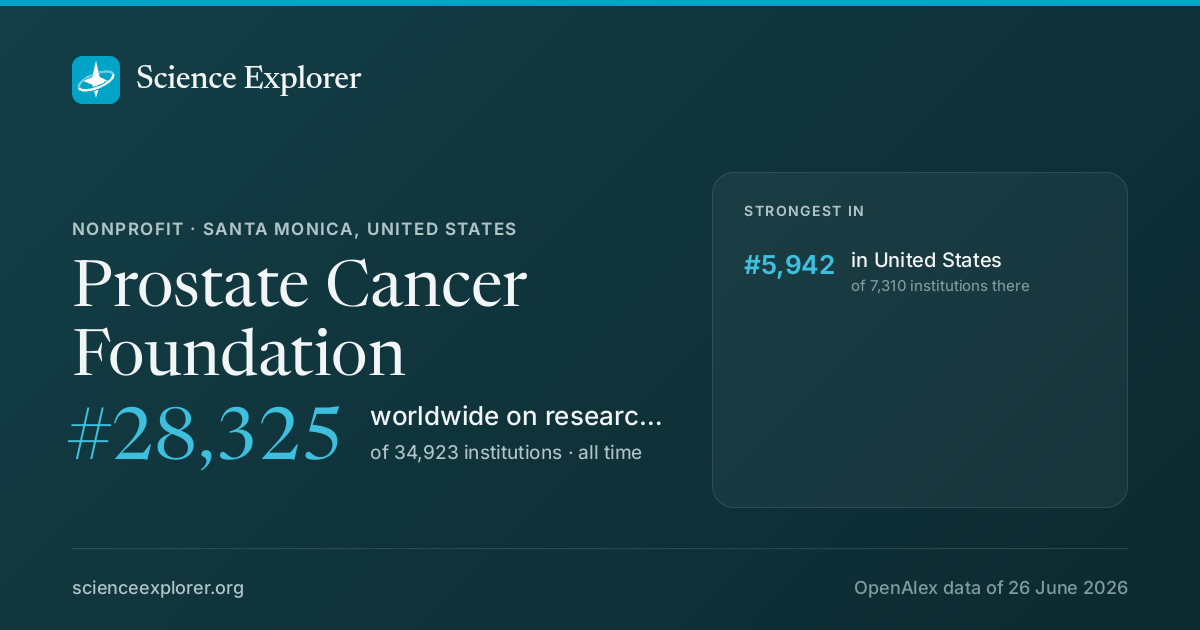
Prostate Cancer Foundation on Science Explorer

A card with Prostate Cancer Foundation's standing and the fields it leads in, for a post or a slide. A link to this page previews as the same card.

Download the card

1200 × 630 PNG, sized for social posts, drawn from the latest snapshot.

Badges for a website1Each links back here and updates with every snapshot

Research measures only: rankings here say nothing about teaching, admissions or student experience. Comparable institutions and collaboration partners have tabs of their own, above.

Discussion

Ask a question or share a note about Prostate Cancer Foundation. Keep it to the research: no personal attacks, advertising or links. Any reader can report a post, which collapses it for everyone until it is opened.