Science Explorer Back to mapMap
Nonprofit · London · United Kingdom

Public Works

In research, Public Works stands highest in Health Sciences (#7,044 of 16,688 worldwide), Medicine (#6,516 of 14,558 worldwide) and Social Sciences (#7,903 of 14,833 worldwide), over all time.

World rank, 2022-now
#13,348
of 22,385 · #7,897 all time
Rank in United Kingdom
#452
of 862
Research works
946
▼ 7% vs 2018-21
Citations
11k
11.8 per fractional work
Top-10% rate
7.7%
all institutions 10.0%
vs its own fields
0.90×
1.00× is exactly expected
Open access
40%
world 40%
International
59%
world 18%

What is Public Works known for in research?

The fields where it stands highest, over all time, ranked among every institution above the floor in each field.

FieldWorld rankWhere that sitsTop-10% rateWorks
Health SciencesDomain #7,044 of 16,688 9.4%172
MedicineField #6,516 of 14,558 9.5%148
Social SciencesDomain #7,903 of 14,833 8.7%230
Social SciencesField #5,411 of 9,330 8.1%134
Physical SciencesDomain #11,406 of 17,446 4.9%503
Environmental ScienceField #4,662 of 5,407 5.7%135
EngineeringField #8,304 of 9,532 4.6%223

Each strip is that field's whole ranked pool, with the notch where Public Works sits in it, in the colour of the band that rank falls in. The track under the rate is the rate itself: it carries no average mark, because the average differs by field (from about 6% in Dentistry to 21% in Economics).

Which fields of science does Public Works work in?

In 2022-now, 48% of research at Public Works is in Physical Sciences, 36% in Social Sciences. Its largest fields are Engineering (26%), Social Sciences (20%), Environmental Science (13%). It does 1.4× the world's share of Social Sciences.

Physical Sciences: 66 fractional works · 48.2% of its workEngineering: 35 fractional works · 25.5% of its workCivil and Structural Engineering: 16 fractional works · 11.5% of its workMechanical Engineering: 6 fractional works · 4.4% of its workBuilding and Construction: 4 fractional works · 2.6% of its workSafety, Risk, Reliability and Quality: 3 fractional works · 2.5% of its workOcean Engineering: 2 fractional works · 1.5% of its workBiomedical Engineering: 1 fractional works · 0.7% of its workMechanics of Materials: 1 fractional works · 0.5% of its workElectrical and Electronic Engineering: 1 fractional works · 0.5% of its workIndustrial and Manufacturing Engineering: 1 fractional works · 0.4% of its workAerospace Engineering: 0 fractional works · 0.2% of its workComputational Mechanics: 0 fractional works · 0.2% of its workSmaller subfields together: 0 fractional works · 0.4% of its workEnvironmental Science: 17 fractional works · 12.6% of its workManagement, Monitoring, Policy and Law: 4 fractional works · 3.2% of its workGlobal and Planetary Change: 3 fractional works · 2.2% of its workWater Science and Technology: 3 fractional works · 1.9% of its workEnvironmental Engineering: 2 fractional works · 1.7% of its workEcology: 2 fractional works · 1.5% of its workPollution: 1 fractional works · 0.6% of its workNature and Landscape Conservation: 1 fractional works · 0.5% of its workIndustrial and Manufacturing Engineering: 1 fractional works · 0.4% of its workHealth, Toxicology and Mutagenesis: 0 fractional works · 0.3% of its workEnvironmental Chemistry: 0 fractional works · 0.2% of its workComputer Science: 6 fractional works · 4.4% of its workInformation Systems: 4 fractional works · 3.2% of its workArtificial Intelligence: 1 fractional works · 0.5% of its workComputer Networks and Communications: 0 fractional works · 0.3% of its workSmaller subfields together: 0 fractional works · 0.3% of its workEarth and Planetary Sciences: 4 fractional works · 2.8% of its workAtmospheric Science: 2 fractional works · 1.1% of its workGeology: 1 fractional works · 0.7% of its workGeochemistry and Petrology: 1 fractional works · 0.4% of its workGeophysics: 0 fractional works · 0.2% of its workOceanography: 0 fractional works · 0.2% of its workSmaller subfields together: 0 fractional works · 0.0% of its workEnergy: 2 fractional works · 1.5% of its workRenewable Energy, Sustainability and the Environment: 2 fractional works · 1.2% of its workEnergy Engineering and Power Technology: 0 fractional works · 0.2% of its workMaterials Science: 1 fractional works · 0.8% of its workPolymers and Plastics: 0 fractional works · 0.3% of its workMaterials Chemistry: 0 fractional works · 0.3% of its workBiomaterials: 0 fractional works · 0.2% of its workSmaller subfields together: 0 fractional works · 0.0% of its workChemistry: 0 fractional works · 0.3% of its workPhysical and Theoretical Chemistry: 0 fractional works · 0.2% of its workSmaller subfields together: 0 fractional works · 0.0% of its workMathematics: 0 fractional works · 0.2% of its workModeling and Simulation: 0 fractional works · 0.2% of its workPhysics and Astronomy: 0 fractional works · 0.1% of its workChemical Engineering: 0 fractional works · 0.0% of its workSocial Sciences: 50 fractional works · 36.2% of its workSocial Sciences: 27 fractional works · 19.7% of its workEducation: 6 fractional works · 4.2% of its workPolitical Science and International Relations: 6 fractional works · 4.0% of its workSociology and Political Science: 5 fractional works · 3.9% of its workLaw: 2 fractional works · 1.2% of its workGender Studies: 2 fractional works · 1.1% of its workAnthropology: 1 fractional works · 1.0% of its workUrban Studies: 1 fractional works · 0.9% of its workTransportation: 1 fractional works · 0.8% of its workPublic Administration: 1 fractional works · 0.5% of its workDemography: 1 fractional works · 0.4% of its workCommunication: 1 fractional works · 0.4% of its workGeneral Social Sciences: 1 fractional works · 0.4% of its workDevelopment: 0 fractional works · 0.2% of its workHealth: 0 fractional works · 0.2% of its workSafety Research: 0 fractional works · 0.2% of its workBusiness, Management and Accounting: 7 fractional works · 5.4% of its workOrganizational Behavior and Human Resource Management: 2 fractional works · 1.7% of its workStrategy and Management: 2 fractional works · 1.4% of its workAccounting: 1 fractional works · 1.0% of its workManagement Information Systems: 1 fractional works · 0.7% of its workManagement of Technology and Innovation: 1 fractional works · 0.6% of its workArts and Humanities: 6 fractional works · 4.5% of its workHistory and Philosophy of Science: 2 fractional works · 1.2% of its workPhilosophy: 2 fractional works · 1.1% of its workArcheology: 1 fractional works · 0.8% of its workLiterature and Literary Theory: 1 fractional works · 0.5% of its workVisual Arts and Performing Arts: 0 fractional works · 0.3% of its workConservation: 0 fractional works · 0.3% of its workSmaller subfields together: 0 fractional works · 0.3% of its workDecision Sciences: 4 fractional works · 2.5% of its workManagement Science and Operations Research: 3 fractional works · 2.0% of its workInformation Systems and Management: 1 fractional works · 0.6% of its workSmaller subfields together: 0 fractional works · 0.0% of its workPsychology: 3 fractional works · 2.2% of its workClinical Psychology: 2 fractional works · 1.3% of its workSocial Psychology: 1 fractional works · 0.7% of its workSmaller subfields together: 0 fractional works · 0.2% of its workEconomics, Econometrics and Finance: 3 fractional works · 1.9% of its workGeneral Economics, Econometrics and Finance: 1 fractional works · 0.8% of its workEconomics and Econometrics: 1 fractional works · 0.7% of its workFinance: 0 fractional works · 0.4% of its workHealth Sciences: 17 fractional works · 12.2% of its workMedicine: 12 fractional works · 8.6% of its workPublic Health, Environmental and Occupational Health: 2 fractional works · 1.3% of its workSurgery: 2 fractional works · 1.3% of its workCardiology and Cardiovascular Medicine: 1 fractional works · 0.7% of its workPulmonary and Respiratory Medicine: 1 fractional works · 0.6% of its workEpidemiology: 1 fractional works · 0.5% of its workPediatrics, Perinatology and Child Health: 1 fractional works · 0.5% of its workPhysiology: 1 fractional works · 0.4% of its workOncology: 1 fractional works · 0.4% of its workEmergency Medicine: 0 fractional works · 0.3% of its workPsychiatry and Mental health: 0 fractional works · 0.3% of its workOrthopedics and Sports Medicine: 0 fractional works · 0.2% of its workPathology and Forensic Medicine: 0 fractional works · 0.2% of its workHematology: 0 fractional works · 0.2% of its workInfectious Diseases: 0 fractional works · 0.2% of its workSmaller subfields together: 2 fractional works · 1.3% of its workHealth Professions: 4 fractional works · 2.9% of its workGeneral Health Professions: 1 fractional works · 1.1% of its workRadiological and Ultrasound Technology: 1 fractional works · 0.8% of its workSpeech and Hearing: 1 fractional works · 0.6% of its workOccupational Therapy: 0 fractional works · 0.2% of its workSmaller subfields together: 0 fractional works · 0.2% of its workNursing: 1 fractional works · 0.4% of its workNutrition and Dietetics: 1 fractional works · 0.4% of its workDentistry: 0 fractional works · 0.3% of its workPeriodontics: 0 fractional works · 0.2% of its workSmaller subfields together: 0 fractional works · 0.0% of its workLife Sciences: 5 fractional works · 3.4% of its workAgricultural and Biological Sciences: 2 fractional works · 1.7% of its workGeneral Agricultural and Biological Sciences: 1 fractional works · 0.4% of its workEcology, Evolution, Behavior and Systematics: 1 fractional works · 0.4% of its workSoil Science: 0 fractional works · 0.3% of its workForestry: 0 fractional works · 0.3% of its workPlant Science: 0 fractional works · 0.2% of its workBiochemistry, Genetics and Molecular Biology: 2 fractional works · 1.3% of its workGenetics: 1 fractional works · 0.6% of its workMolecular Biology: 1 fractional works · 0.5% of its workSmaller subfields together: 0 fractional works · 0.3% of its workImmunology and Microbiology: 0 fractional works · 0.3% of its workParasitology: 0 fractional works · 0.2% of its workSmaller subfields together: 0 fractional works · 0.1% of its workNeuroscience: 0 fractional works · 0.1% of its workALL ITS WORKPublic Works138fractional works, 2022-now
Life Sciences3%Physical Sciences48%Health Sciences12%Social Sciences36%

Each ring splits the one inside it: the four domains of science, their fields, their subfields. Size is fractional works in 2022-now. Every slice is a page; the interactive view zooms down to single topics and colours each by how much more of it this institution does than the world.

Its 4 domains and 24 fields, with their numbers
    1. Engineering3525.5%
    2. Environmental Science1712.6%
    3. Computer Science64.4%
    4. Earth and Planetary Sciences42.8%
    5. Energy21.5%
    6. Materials Science10.8%
    7. Chemistry00.3%
    8. Mathematics00.2%
    9. Physics and Astronomy00.1%
    10. Chemical Engineering00.0%
    1. Social Sciences2719.7%
    2. Business, Management and Accounting75.4%
    3. Arts and Humanities64.5%
    4. Decision Sciences42.5%
    5. Psychology32.2%
    6. Economics, Econometrics and Finance31.9%
    1. Medicine128.6%
    2. Health Professions42.9%
    3. Nursing10.4%
    4. Dentistry00.3%
    1. Agricultural and Biological Sciences21.7%
    2. Biochemistry, Genetics and Molecular Biology21.3%
    3. Immunology and Microbiology00.3%
    4. Neuroscience00.1%
All of science, and how each field's share has moved since 1950: the Science domain explorer

Field profile

Location quotient across every field it publishes in: outside the ring is more than an institution of this size would be expected to publish, inside it is less.

Agricultural and Biological Sciences: 0.37× its world share, 2 worksAgricultural and Bio…Biochemistry, Genetics and Molecular Biology: 0.24× its world share, 2 worksBiochemistry, Geneti…Immunology and Microbiology: 0.29× its world share, 0 worksImmunology and Micro…Neuroscience: 0.06× its world share, 0 worksNeuroscienceChemical Engineering: 0.10× its world share, 0 worksChemical EngineeringChemistry: 0.18× its world share, 0 worksChemistryComputer Science: 0.56× its world share, 6 worksComputer ScienceEarth and Planetary Sciences: 1.76× its world share, 4 worksEarth and Planetary …Energy: 1.61× its world share, 2 worksEnergyEngineering: 1.70× its world share, 35 worksEngineeringEnvironmental Science: 2.53× its world share, 17 worksEnvironmental ScienceMaterials Science: 0.24× its world share, 1 worksMaterials ScienceMathematics: 0.17× its world share, 0 worksMathematicsPhysics and Astronomy: 0.05× its world share, 0 worksPhysics and AstronomyDentistry: 0.58× its world share, 0 worksDentistryHealth Professions: 1.10× its world share, 4 worksHealth ProfessionsMedicine: 0.45× its world share, 12 worksMedicineNursing: 0.84× its world share, 1 worksNursingArts and Humanities: 1.57× its world share, 6 worksArts and HumanitiesBusiness, Management and Accounting: 1.67× its world share, 7 worksBusiness, Management…Decision Sciences: 2.63× its world share, 4 worksDecision SciencesEconomics, Econometrics and Finance: 0.89× its world share, 3 worksEconomics, Econometr…Psychology: 0.72× its world share, 3 worksPsychologySocial Sciences: 1.55× its world share, 27 worksSocial Sciences1×world share
more than its size predictsabout as predictedless

Rings at 0.5×, 1× and 2×. Widest outward: Decision Sciences, 2.6×. Every wedge is a field page.

All 24 fields, with their numbers
  1. Decision Sciences2.63×4 works
  2. Environmental Science2.53×17 works
  3. Earth and Planetary Sciences1.76×4 works
  4. Engineering1.70×35 works
  5. Business, Management and Accounting1.67×7 works
  6. Energy1.61×2 works
  7. Arts and Humanities1.57×6 works
  8. Social Sciences1.55×27 works
  9. Health Professions1.10×4 works
  10. Economics, Econometrics and Finance0.89×3 works
  11. Nursing0.84×1 works
  12. Psychology0.72×3 works
  13. Dentistry0.58×0 works
  14. Computer Science0.56×6 works
  15. Medicine0.45×12 works
  16. Agricultural and Biological Sciences0.37×2 works
  17. Immunology and Microbiology0.29×0 works
  18. Biochemistry, Genetics and Molecular Biology0.24×2 works
  19. Materials Science0.24×1 works
  20. Chemistry0.18×0 works
  21. Mathematics0.17×0 works
  22. Chemical Engineering0.10×0 works
  23. Neuroscience0.06×0 works
  24. Physics and Astronomy0.05×0 works

Who are the top researchers at Public Works?

Ranked on the quality score, Syed Azizul Haq, Ivan M. Nelidov and Jeff Kieffer lead among researchers whose main affiliation is Public Works.

  1. 1 Syed Azizul Haq United Kingdom · #2,918,087 worldwide 17 citations · 43 works
  2. 2 Ivan M. Nelidov United Kingdom · #2,981,181 worldwide 6 citations · 30 works
  3. 3 Jeff Kieffer United Kingdom · #3,720,255 worldwide 30 citations · 15 works
  4. 4 Arthur E. Gorman United Kingdom · #3,856,631 worldwide 87 citations · 49 works
  5. 5 John R. Schmidt United Kingdom · #4,389,048 worldwide 6 citations · 15 works
  6. 6 William C. Pisano United Kingdom · #4,474,067 worldwide 178 citations · 28 works
  7. 7 E. G. Pryor United Kingdom · #4,625,648 worldwide 96 citations · 15 works
  8. 8 Edward J. Schmeltz United Kingdom · #5,016,827 worldwide 17 citations · 15 works
  9. 9 Angus D. Gordon United Kingdom · #5,265,035 worldwide 164 citations · 32 works
  10. 10 M Siffert United Kingdom · #5,649,765 worldwide 14 citations · 28 works
All ranked researchers at Public Works

What are the most cited papers from Public Works?

The most cited paper from Public Works is "Comparative lipoquinone analysis of influent sewage and activated sludge by high-performance liquid chromatography and photodiode array detection." (Akira Hiraishi, Yôko Ueda, Junko Ishihara et al., 1996), with 783 citations. Next come "Synthetic Storm Pattern for Drainage Design" (486) and "Comparison of car ownership models" (282).

Most cited papers
#PaperReleasedCitations
1 Comparative lipoquinone analysis of influent sewage and activated sludge by high-performance liquid chromatography and photodiode array detection. Akira Hiraishi, Yôko Ueda, Junko Ishihara et al. · The Journal of General and Applied Microbiology Open access 1996 783
2 Synthetic Storm Pattern for Drainage Design Clint J. Keifer, Henry Hsien Chu · Journal of the Hydraulics Division Aug 1957 486
3 Comparison of car ownership models Gerard de Jong, James N. Fox, Andrew Daly et al. · Transport Reviews Jul 2004 282
4 State of the Art Study on Aging of Asphalt Mixtures and Use of Antioxidant Additives Okan Şirin, Dalim Kumar Paul, Emad Kassem · Advances in Civil Engineering Open access 2018 227
5 Salinity tolerance of the Mediterranean seagrass Posidonia oceanica: recommendations to minimize the impact of brine discharges from desalination plants José Luis Sánchez‐Lizaso, Javier Romero, Juanma Ruiz et al. · Desalination Open access 21 Jan 2008 200
All 60 most cited papers, with filters and sorting

Which keywords describe research at Public Works?

By fractional works in 2022-now, weighted toward what it does more of than the world: Climate Change, Sustainability, Risk Management, Supply Chain Management, Remote Sensing, Philosophy, Sustainable Development and RFID Technology.

▲ more of its work than of the world's◆ about the world's share▼ less than the world's

Size is fractional works in 2022-now in the topics tagged with each word; colour is the word's share of this institution's work against its share of the world's. The 40 words are chosen for being large and distinctive. Each links to the topic it comes from most.

All 40 words, with their numbers
  1. Climate Change9▲ 2.5×26 topics
  2. Sustainability8▲ 2.5×22 topics
  3. Sustainable Development6▲ 2.7×14 topics
  4. Remote Sensing6▲ 3.3×14 topics
  5. Supply Chain Management5▲ 4.2×10 topics
  6. Risk Management5▲ 7.1×6 topics
  7. Environmental Impact4▲ 1.91×19 topics
  8. Education4▲ 1.84×15 topics
  9. Innovation4▲ 2.9×10 topics
  10. Healthcare4▲ 2.5×12 topics
  11. Renewable Energy4▲ 1.93×16 topics
  12. Philosophy4▲ 6.3×7 topics
  13. RFID Technology3▲ 14×2 topics
  14. History3▲ 3.5×6 topics
  15. Internet of Things3▲ 2.7×9 topics
  16. IoT3▲ 5.7×5 topics
  17. Community Participation3▲ 6.0×6 topics
  18. Soil Properties3▲ 12×3 topics
  19. Information Technology3▲ 4.3×8 topics
  20. Hydrological Modeling3▲ 8.3×3 topics
  21. Leadership3▲ 4.1×7 topics
  22. Spatial Analysis3▲ 21×2 topics
  23. Construction Projects3▲ 43×2 topics
  24. Driver Behavior3▲ 24×2 topics
  25. Geotechnical Engineering3▲ 28×4 topics
  26. Injury Severity3▲ 24×2 topics
  27. Risk Perception3▲ 7.0×3 topics
  28. Road Safety3▲ 47×1 topic
  29. Smart Cities3▲ 7.1×4 topics
  30. Traffic Accidents3▲ 42×1 topic
  31. Urbanization2▲ 4.5×4 topics
  32. Water Resources2▲ 7.5×4 topics
  33. Cloud Computing2▲ 6.0×3 topics
  34. Stakeholder Analysis2▲ 24×2 topics
  35. Accident Detection2▲ 74×1 topic
  36. Lateritic Soils2▲ 33×1 topic
  37. Road Construction2▲ 33×1 topic
  38. Smart Vehicle Safety2▲ 74×1 topic
  39. Cost Overruns2▲ 36×1 topic
  40. Project Success2▲ 36×1 topic

Which research topics does Public Works publish most on?

By volume in 2022-now: Traffic and Road Safety, Geotechnical and construction materials studies, Internet of Things and AI and IoT and GPS-based Vehicle Safety Systems.

  1. 1 Traffic and Road Safety Safety, Risk, Reliability and Quality 3 works
  2. 2 Geotechnical and construction materials studies Civil and Structural Engineering 2 works
  3. 3 Internet of Things and AI Information Systems 2 works
  4. 4 IoT and GPS-based Vehicle Safety Systems Mechanical Engineering 2 works
  5. 5 Construction Project Management and Performance Management Science and Operations Research 2 works
  6. 6 Water resources management and optimization Ocean Engineering 2 works
  7. 7 BIM and Construction Integration Building and Construction 1 works
  8. 8 Flood Risk Assessment and Management Global and Planetary Change 1 works
  9. 9 Structural Health Monitoring Techniques Civil and Structural Engineering 1 works
  10. 10 History of Science and Medicine History and Philosophy of Science 1 works

How open and international is its research?

Against the world's own shares: the tick on each track. Both are shares of its output, so they sit on one scale and can be read against each other as well as against the world.

openly available39.7%not open60.3%

World: 40% of research is openly available.

with international co-authors58.8%domestic only41.2%

World: 18% is written across borders.

How has Public Works's research output changed?

Output in 2022-2025 was 7% lower than in 2018-2021.

still counting1990200020102020
grewheldshrank

The same series as a ribbon: one cell per year, darker for more. The line above answers how much; this answers when.

Its share of all research

Growing output can still be a shrinking share: all of science grows. This is Public Works as a percentage of every work published that year, 0.00049% in 2024.

still counting0.0020%0.0040%0.0060%Public Works0.00072% in 202519801990200020102020

Fractional works of Public Works over all fractional works that year. How the balance of science has shifted.

How much of it reaches the world top 10%

Year by year, against all institutions in the same year.

still counting5%10%15%all institutions10.0% in 2025Public Works7.9% in 202520102020

Of each year's output, the share that reached the world's 10% most cited for its field and year. Peak 10.1% in 2014.

Other research institutions in London

All research institutions in London

Share Public Works's ranking
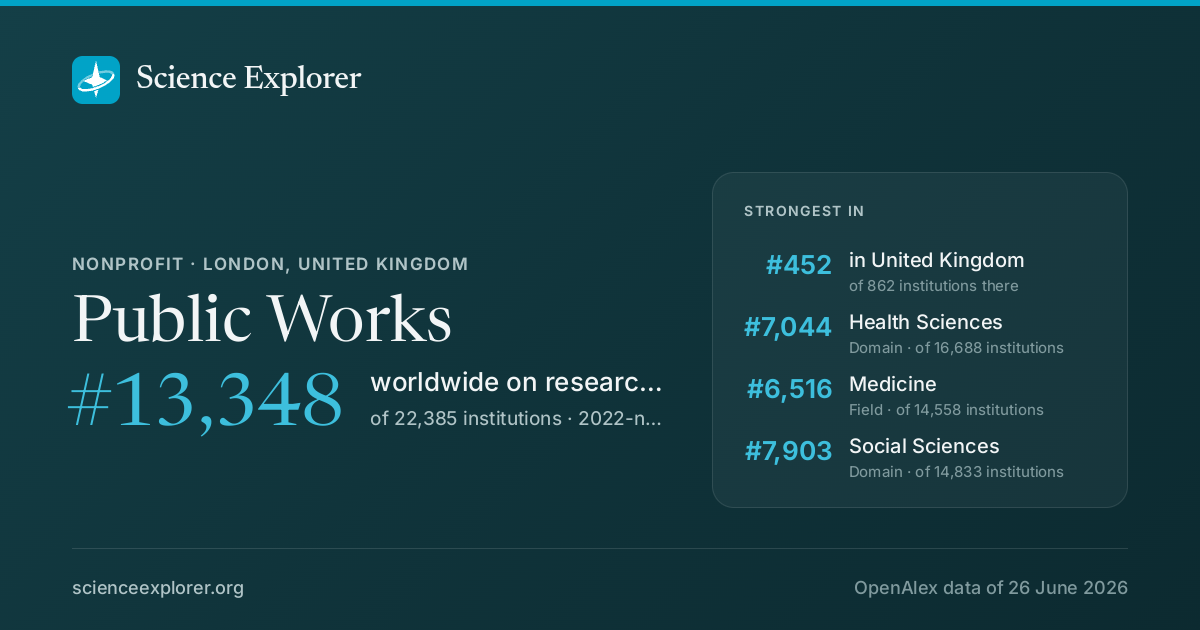
Public Works on Science Explorer

A card with Public Works's standing and the fields it leads in, for a post or a slide. A link to this page previews as the same card.

Download the card

1200 × 630 PNG, sized for social posts, drawn from the latest snapshot.

Badges for a website1Each links back here and updates with every snapshot

Research measures only: rankings here say nothing about teaching, admissions or student experience. Comparable institutions and collaboration partners have tabs of their own, above.

Discussion

Ask a question or share a note about Public Works. Keep it to the research: no personal attacks, advertising or links. Any reader can report a post, which collapses it for everyone until it is opened.