Quaternary Research Association
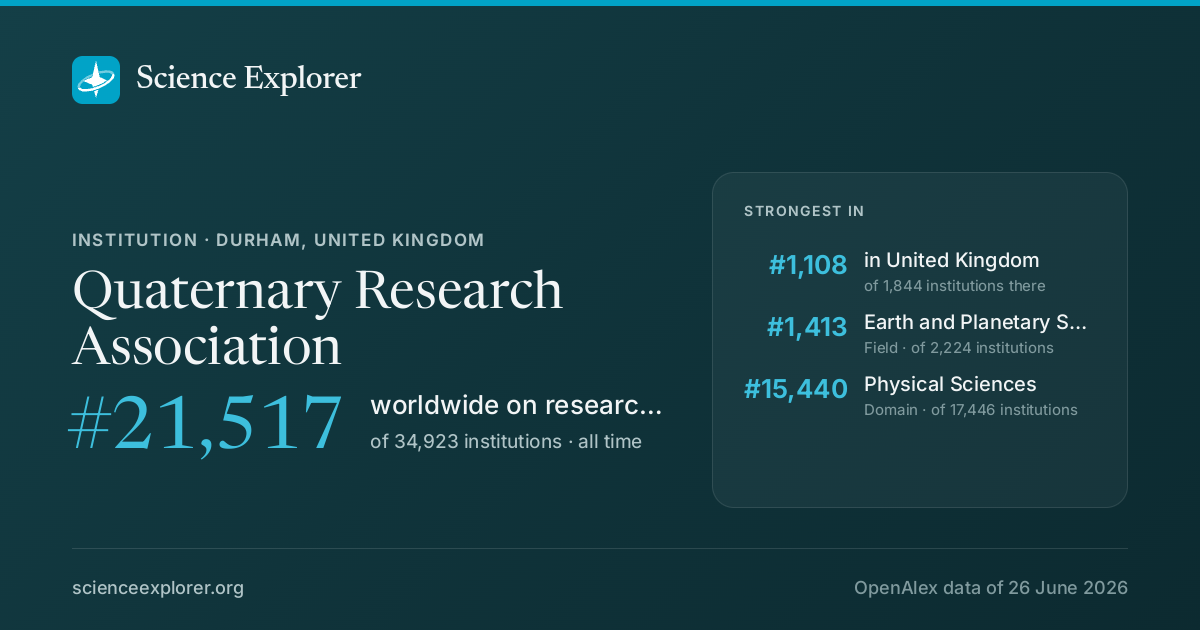
In research, Quaternary Research Association stands highest in Earth and Planetary Sciences (#1,413 of 2,224 worldwide) and Physical Sciences (#15,440 of 17,446 worldwide), over all time.
- World rank, all time
- #21,517 of 34,923
- Rank in United Kingdom
- #1,108 of 1,844
- Research works
- 483 ▼ 43% vs 2018-21
- Citations
- 23k 48.5 per fractional work
- Top-10% rate
- 9.5% all institutions 10.0%
- vs its own fields
- 1.11× 1.00× is exactly expected
- Open access
- 26% world 40%
- International
- 32% world 18%
What is Quaternary Research Association known for in research?
The fields where it stands highest, over all time, ranked among every institution above the floor in each field.
| Field | World rank | Where that sits | Top-10% rate | Works |
|---|---|---|---|---|
| Earth and Planetary SciencesField | #1,413 of 2,224 | 17.7% | 198 | |
| Physical SciencesDomain | #15,440 of 17,446 | 16.0% | 321 |
Each strip is that field's whole ranked pool, with the notch where Quaternary Research Association sits in it, in the colour of the band that rank falls in. The track under the rate is the rate itself: it carries no average mark, because the average differs by field (from about 6% in Dentistry to 21% in Economics).
Which fields of science does Quaternary Research Association work in?
In all years, 66% of research at Quaternary Research Association is in Physical Sciences, 21% in Social Sciences. Its largest fields are Earth and Planetary Sciences (41%), Environmental Science (15%), Social Sciences (11%). It does 1.6× the world's share of Physical Sciences.
Each ring splits the one inside it: the four domains of science, their fields, their subfields. Size is fractional works in all years. Every slice is a page; the interactive view zooms down to single topics and colours each by how much more of it this institution does than the world.
Its 4 domains and 24 fields, with their numbers
- Physical Sciences32166.4%
- Earth and Planetary Sciences19841.0%
- Environmental Science7415.4%
- Engineering163.2%
- Physics and Astronomy153.1%
- Computer Science91.9%
- Materials Science40.9%
- Chemistry30.5%
- Energy10.2%
- Mathematics00.1%
- Chemical Engineering00.0%
- Social Sciences10221.1%
- Social Sciences5110.7%
- Arts and Humanities387.8%
- Economics, Econometrics and Finance40.9%
- Psychology40.8%
- Business, Management and Accounting30.6%
- Decision Sciences20.4%
- Life Sciences469.4%
- Health Sciences153.0%
- Medicine81.7%
- Health Professions51.1%
- Nursing10.2%
- Veterinary00.0%
Field profile
Location quotient across every field it publishes in: outside the ring is more than an institution of this size would be expected to publish, inside it is less.
Rings at 0.5×, 1× and 2×. Widest outward: Earth and Planetary Sciences, 13.2×. Every wedge is a field page.
All 16 fields, with their numbers
- Earth and Planetary Sciences13.24×4 works
- Psychology2.54×2 works
- Environmental Science2.25×2 works
- Neuroscience2.23×1 works
- Economics, Econometrics and Finance1.99×1 works
- Arts and Humanities1.55×1 works
- Social Sciences1.48×4 works
- Chemistry1.09×0 works
- Medicine0.56×2 works
- Agricultural and Biological Sciences0.53×0 works
- Computer Science0.46×1 works
- Engineering0.44×1 works
- Physics and Astronomy0.42×0 works
- Health Professions0.32×0 works
- Biochemistry, Genetics and Molecular Biology0.31×0 works
- Materials Science0.16×0 works
- Earth and Planetary Sciences 13.2×
- Psychology 2.5×
- Environmental Science 2.2×
- Neuroscience 2.2×
- Economics, Econometrics and Finance 2.0×
- Arts and Humanities 1.6×
- Social Sciences 1.5×
- Chemistry 1.1×
- Medicine 0.6×
- Agricultural and Biological Sciences 0.5×
- Computer Science 0.5×
- Engineering 0.4×
- Physics and Astronomy 0.4×
- Health Professions 0.3×
- Biochemistry, Genetics and Molecular Biology 0.3×
- Materials Science 0.2×
Who are the top researchers at Quaternary Research Association?
Ranked on the quality score, Nick Debenham, Torbjörn Brorsson and Martin Bernhardson lead among researchers whose main affiliation is Quaternary Research Association.
- 1
Nick Debenham
 United Kingdom · #3,707,560 worldwide
466 citations · 29 works
- 2
Torbjörn Brorsson
United Kingdom · #4,677,346 worldwide
50 citations · 37 works
- 3
Martin Bernhardson
United Kingdom · #4,834,252 worldwide
193 citations · 19 works
- 4
William H. Waldren
United Kingdom · #5,773,186 worldwide
254 citations · 32 works
Which keywords describe research at Quaternary Research Association?
By fractional works in all years, weighted toward what it does more of than the world: Climate Change, Holocene, Sea Level, Paleoclimatology, Solar Influence, Glacial Cycles, Monsoon Dynamics and Biodiversity.
- paleoceanography
- Global Warming
- Arctic
- Flora
- Methane Emissions
- Stable Isotopes
- Scandinavia
- Religion
- Cultural Exchange
- Sequence Stratigraphy
- Hydrology
- Conservation
- Invasive Species
- Archaeology
- Agricultural Origins
- Hominin Genetics
- Biodiversity
- Glacial Cycles
- Paleoclimatology
- Holocene
- Climate Change
- Sea Level
- Solar Influence
- Monsoon Dynamics
- Sedimentation
- Paleolithic Archaeology
- Radiocarbon Dating
- Tectonics
- Remote Sensing
- Biogeography
- Fluvial Systems
- Mediterranean
- Ecology
- Medieval
- Viking Age
- Trophic Position
- Vegetation
- Vascular Plants
- Ecosystem Resilience
- Black Sea
Size is fractional works in all years in the topics tagged with each word; colour is the word's share of this institution's work against its share of the world's. The 40 words are chosen for being large and distinctive. Each links to the topic it comes from most.
All 40 words, with their numbers
- Climate Change164▲ 13×55 topics
- Holocene101▲ 128×3 topics
- Sea Level97▲ 142×2 topics
- Paleoclimatology94▲ 154×2 topics
- Solar Influence88▲ 152×2 topics
- Glacial Cycles87▲ 166×1 topic
- Monsoon Dynamics87▲ 166×1 topic
- Biodiversity30▲ 8.1×15 topics
- Sedimentation26▲ 72×2 topics
- Hominin Genetics25▲ 196×1 topic
- Paleolithic Archaeology25▲ 196×1 topic
- Agricultural Origins24▲ 141×1 topic
- Radiocarbon Dating24▲ 141×1 topic
- Archaeology23▲ 32×9 topics
- Tectonics22▲ 28×3 topics
- Invasive Species22▲ 8.0×12 topics
- Remote Sensing22▲ 4.1×21 topics
- Conservation20▲ 8.8×11 topics
- Biogeography20▲ 12×11 topics
- Hydrology17▲ 31×3 topics
- Fluvial Systems17▲ 79×1 topic
- Sequence Stratigraphy17▲ 79×1 topic
- Mediterranean15▲ 30×5 topics
- Cultural Exchange15▲ 23×5 topics
- Ecology15▲ 15×4 topics
- Religion14▲ 5.1×5 topics
- Medieval13▲ 54×2 topics
- Scandinavia13▲ 137×1 topic
- Viking Age13▲ 137×1 topic
- Stable Isotopes13▲ 62×1 topic
- Trophic Position13▲ 62×1 topic
- Methane Emissions13▲ 50×2 topics
- Vegetation12▲ 25×2 topics
- Flora12▲ 47×1 topic
- Vascular Plants12▲ 47×1 topic
- Arctic11▲ 22×4 topics
- Ecosystem Resilience11▲ 14×5 topics
- Global Warming10▲ 6.0×8 topics
- Black Sea10▲ 55×1 topic
- paleoceanography10▲ 62×1 topic
Which research topics does Quaternary Research Association publish most on?
By volume in 2022-now: Pleistocene-Era Hominins and Archaeology, Geology and Paleoclimatology Research, Diverse Scientific and Economic Studies and Geological formations and processes.
Area is fractional works; colour is the subfield each topic belongs to.
- 1 Pleistocene-Era Hominins and Archaeology Anthropology 1 works
- 2 Geology and Paleoclimatology Research Atmospheric Science 1 works
- 3 Diverse Scientific and Economic Studies Economics and Econometrics 1 works
- 4 Geological formations and processes Earth-Surface Processes 0 works
- 5 Landslides and related hazards Management, Monitoring, Policy and Law 0 works
- 6 Legal Cases and Commentary Reproductive Medicine 0 works
- 7 Archaeology and ancient environmental studies Paleontology 0 works
- 8 Psychological Testing and Assessment Applied Psychology 0 works
- 9 Soil Geostatistics and Mapping Environmental Engineering 0 works
- 10 Mining and Gasification Technologies Mechanical Engineering 0 works
How open and international is its research?
Against the world's own shares: the tick on each track. Both are shares of its output, so they sit on one scale and can be read against each other as well as against the world.
World: 40% of research is openly available.
World: 18% is written across borders.
How has Quaternary Research Association's research output changed?
Output in 2022-2025 was 43% lower than in 2018-2021.
The same series as a ribbon: one cell per year, darker for more. The line above answers how much; this answers when.
Its share of all research
Growing output can still be a shrinking share: all of science grows. This is Quaternary Research Association as a percentage of every work published that year, 0.000068% in 2024.
Fractional works of Quaternary Research Association over all fractional works that year. How the balance of science has shifted.
Other research institutions in Durham
- Durham University
- Geospatial Research (United Kingdom)
- Durham County Council
- Lanchester Road Hospital
- New College Durham
- Northumbrian Water Group (United Kingdom)
- High Force Research (United Kingdom)
- British Society for Middle Eastern Studies


Share Quaternary Research Association's ranking
Badges for a website1Each links back here and updates with every snapshot

Research measures only: rankings here say nothing about teaching, admissions or student experience. Comparable institutions and collaboration partners have tabs of their own, above.
Discussion
Ask a question or share a note about Quaternary Research Association. Posts are plain text and can be reported.