Rolls-Royce (United States)

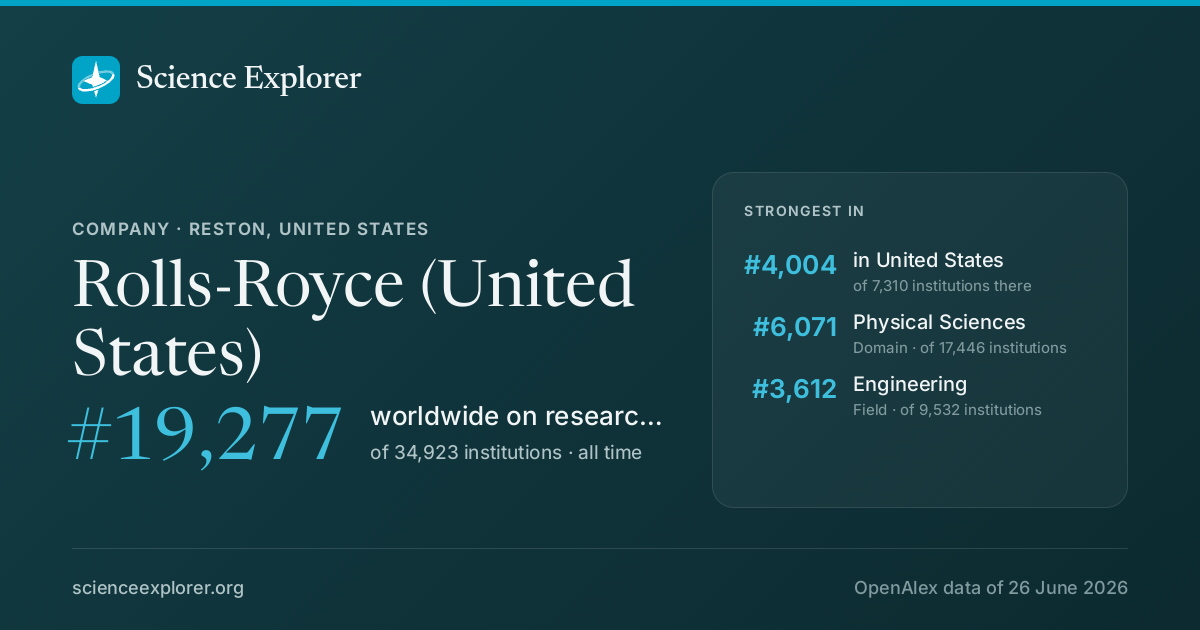
In research, Rolls-Royce (United States) stands highest in Physical Sciences (#6,071 of 17,446 worldwide) and Engineering (#3,612 of 9,532 worldwide), over all time.
- World rank, all time
- #19,277 of 34,923
- Rank in United States
- #4,004 of 7,310
- Research works
- 439 ▼ 18% vs 2018-21
- Citations
- 6.4k 14.5 per fractional work
- Top-10% rate
- 5.3% all institutions 10.0%
- vs its own fields
- 0.86× 1.00× is exactly expected
- Open access
- 19% world 40%
- International
- 24% world 18%
What is Rolls-Royce (United States) known for in research?
The fields where it stands highest, over all time, ranked among every institution above the floor in each field.
| Field | World rank | Where that sits | Top-10% rate | Works |
|---|---|---|---|---|
| Physical SciencesDomain | #6,071 of 17,446 | 8.0% | 385 | |
| EngineeringField | #3,612 of 9,532 | 8.2% | 290 |
Each strip is that field's whole ranked pool, with the notch where Rolls-Royce (United States) sits in it, in the colour of the band that rank falls in. The track under the rate is the rate itself: it carries no average mark, because the average differs by field (from about 6% in Dentistry to 21% in Economics).
Which fields of science does Rolls-Royce (United States) work in?
In 2022-now, 85% of research at Rolls-Royce (United States) is in Physical Sciences, 10% in Social Sciences. Its largest fields are Engineering (58%), Materials Science (11%), Computer Science (6%). It does 2.0× the world's share of Physical Sciences.
Each ring splits the one inside it: the four domains of science, their fields, their subfields. Size is fractional works in 2022-now. Every slice is a page; the interactive view zooms down to single topics and colours each by how much more of it this institution does than the world.
Its 4 domains and 20 fields, with their numbers
- Physical Sciences4584.9%
- Engineering3157.6%
- Materials Science611.4%
- Computer Science36.2%
- Environmental Science34.8%
- Chemical Engineering12.7%
- Earth and Planetary Sciences11.3%
- Energy00.5%
- Mathematics00.3%
- Social Sciences59.8%
- Health Sciences23.1%
- Medicine12.1%
- Health Professions00.7%
- Dentistry00.3%
- Life Sciences12.2%
Field profile
Location quotient across every field it publishes in: outside the ring is more than an institution of this size would be expected to publish, inside it is less.
Rings at 0.5×, 1× and 2×. Widest outward: Chemical Engineering, 7.6×. Every wedge is a field page.
All 20 fields, with their numbers
- Chemical Engineering7.58×1 works
- Decision Sciences4.00×2 works
- Engineering3.84×31 works
- Materials Science3.28×6 works
- Environmental Science0.96×3 works
- Computer Science0.80×3 works
- Earth and Planetary Sciences0.80×1 works
- Business, Management and Accounting0.70×1 works
- Dentistry0.64×0 works
- Energy0.57×0 works
- Economics, Econometrics and Finance0.44×0 works
- Agricultural and Biological Sciences0.39×1 works
- Mathematics0.26×0 works
- Health Professions0.26×0 works
- Social Sciences0.18×1 works
- Arts and Humanities0.16×0 works
- Medicine0.11×1 works
- Neuroscience0.10×0 works
- Immunology and Microbiology0.05×0 works
- Biochemistry, Genetics and Molecular Biology0.03×0 works
- Chemical Engineering 7.6×
- Decision Sciences 4.0×
- Engineering 3.8×
- Materials Science 3.3×
- Environmental Science 1.0×
- Computer Science 0.8×
- Earth and Planetary Sciences 0.8×
- Business, Management and Accounting 0.7×
- Dentistry 0.6×
- Energy 0.6×
- Economics, Econometrics and Finance 0.4×
- Agricultural and Biological Sciences 0.4×
- Mathematics 0.3×
- Health Professions 0.3×
- Social Sciences 0.2×
- Arts and Humanities 0.2×
- Medicine 0.1×
- Neuroscience 0.1×
- Immunology and Microbiology 0.1×
- Biochemistry, Genetics and Molecular Biology 0.0×
Who are the top researchers at Rolls-Royce (United States)?
Ranked on the quality score, Adam L. Chamberlain, Steven R. Wellborn and Michael G. Glavicic lead among researchers whose main affiliation is Rolls-Royce (United States).
- 1
Adam L. Chamberlain
 United States · #604,000 worldwide
2.1k citations · 29 works
- 2
Steven R. Wellborn
United States · #1,060,839 worldwide
767 citations · 23 works
- 3
Michael G. Glavicic
United States · #1,163,175 worldwide
1.5k citations · 55 works
- 4
Medha Sree Anand
United States · #1,604,303 worldwide
1k citations · 70 works
- 5
Ann Bolcavage
United States · #1,715,000 worldwide
687 citations · 17 works
- 6
Randolph C. Helmink
United States · #2,071,670 worldwide
670 citations · 36 works
- 7
Ted R. Ohrn
United States · #2,331,761 worldwide
342 citations · 15 works
- 8
R. J. G. Norton
United States · #2,788,034 worldwide
298 citations · 21 works
- 9
John F. Matlik
United States · #3,162,062 worldwide
208 citations · 23 works
- 10
A. B. Thakker
United States · #3,232,103 worldwide
205 citations · 17 works
Which keywords describe research at Rolls-Royce (United States)?
By fractional works in 2022-now, weighted toward what it does more of than the world: Heat Transfer, Large-Eddy Simulation, Multiphase Flow, Chemical Kinetics, Gas Turbine Engines, Microstructural Evolution, Composite Materials and Ceramic Materials.
- Fracture Toughness Testing
- Numerical Simulation
- Soot Formation
- Corrosion
- Turbulent Flames
- Particle Flow
- High-Temperature Applications
- Combustion Instabilities
- Particles
- Gas-Solid Flow
- Turbine
- Film Cooling
- Thermal Conductivity
- Cold Spray Deposition
- Sintering
- CFD Simulation
- Ceramic Materials
- Microstructural Evolution
- Chemical Kinetics
- Large-Eddy Simulation
- Heat Transfer
- Multiphase Flow
- Gas Turbine Engines
- Composite Materials
- Mechanical Properties
- Emissions
- Spark Plasma Sintering
- Thermal Barrier Coatings
- Two-Phase Flow
- Oxidation Resistance
- Combustion
- Material Properties
- Turbulence
- Cyclone Separator
- Nanocrystalline Ceramics
- Premixed Combustion
- Risk Assessment
- Internal Combustion Engines
- Surface Roughness
- Fatigue Crack Closure
Size is fractional works in 2022-now in the topics tagged with each word; colour is the word's share of this institution's work against its share of the world's. The 40 words are chosen for being large and distinctive. Each links to the topic it comes from most.
All 40 words, with their numbers
- Heat Transfer6▲ 21×7 topics
- Large-Eddy Simulation5▲ 49×4 topics
- Multiphase Flow4▲ 84×2 topics
- Chemical Kinetics3▲ 65×2 topics
- Gas Turbine Engines3▲ 107×2 topics
- Microstructural Evolution3▲ 35×3 topics
- Composite Materials3▲ 24×3 topics
- Ceramic Materials3▲ 52×2 topics
- Mechanical Properties3▲ 5.0×8 topics
- CFD Simulation2▲ 40×2 topics
- Emissions2▲ 23×4 topics
- Sintering2▲ 35×2 topics
- Spark Plasma Sintering2▲ 45×2 topics
- Cold Spray Deposition2▲ 101×1 topic
- Thermal Barrier Coatings2▲ 101×1 topic
- Thermal Conductivity2▲ 26×2 topics
- Two-Phase Flow2▲ 56×2 topics
- Film Cooling2▲ 257×1 topic
- Oxidation Resistance2▲ 38×3 topics
- Turbine2▲ 257×1 topic
- Combustion2▲ 61×2 topics
- Gas-Solid Flow2▲ 110×2 topics
- Material Properties2▲ 39×2 topics
- Particles2▲ 186×1 topic
- Turbulence2▲ 41×1 topic
- Combustion Instabilities2▲ 59×2 topics
- Cyclone Separator2▲ 230×1 topic
- High-Temperature Applications2▲ 72×1 topic
- Nanocrystalline Ceramics2▲ 72×1 topic
- Particle Flow2▲ 230×1 topic
- Premixed Combustion2▲ 83×1 topic
- Turbulent Flames2▲ 83×1 topic
- Risk Assessment2▲ 4.7×4 topics
- Corrosion1▲ 22×4 topics
- Internal Combustion Engines1▲ 59×1 topic
- Soot Formation1▲ 59×1 topic
- Surface Roughness1▲ 19×4 topics
- Numerical Simulation1▲ 8.6×6 topics
- Fatigue Crack Closure1▲ 70×1 topic
- Fracture Toughness Testing1▲ 70×1 topic
Which research topics does Rolls-Royce (United States) publish most on?
By volume in 2022-now: High-Temperature Coating Behaviors, Turbomachinery Performance and Optimization, Particle Dynamics in Fluid Flows and Cyclone Separators and Fluid Dynamics.
Area is fractional works; colour is the subfield each topic belongs to.
- 1 High-Temperature Coating Behaviors Aerospace Engineering 2 works
- 2 Turbomachinery Performance and Optimization Aerospace Engineering 2 works
- 3 Particle Dynamics in Fluid Flows Ocean Engineering 2 works
- 4 Cyclone Separators and Fluid Dynamics Computational Mechanics 2 works
- 5 Advanced ceramic materials synthesis Ceramics and Composites 2 works
- 6 Combustion and flame dynamics Computational Mechanics 2 works
- 7 Advanced Combustion Engine Technologies Fluid Flow and Transfer Processes 1 works
- 8 Fatigue and fracture mechanics Mechanics of Materials 1 works
- 9 Probabilistic and Robust Engineering Design Statistics, Probability and Uncertainty 1 works
- 10 Vehicle emissions and performance Automotive Engineering 1 works
How open and international is its research?
Against the world's own shares: the tick on each track. Both are shares of its output, so they sit on one scale and can be read against each other as well as against the world.
World: 40% of research is openly available.
World: 18% is written across borders.
How has Rolls-Royce (United States)'s research output changed?
Output in 2022-2025 was 18% lower than in 2018-2021.
The same series as a ribbon: one cell per year, darker for more. The line above answers how much; this answers when.
Its share of all research
Growing output can still be a shrinking share: all of science grows. This is Rolls-Royce (United States) as a percentage of every work published that year, 0.00017% in 2024.
Fractional works of Rolls-Royce (United States) over all fractional works that year. How the balance of science has shifted.
Other research institutions in Reston
- United States Geological Survey
- American Institute of Aeronautics and Astronautics
- American Society of Civil Engineers
- Leidos (United States)
- American College of Radiology
- Society of Health and Physical Educators
- Entertainment Industries Council
- Information Management Consultants (United States)

Share Rolls-Royce (United States)'s ranking
Badges for a website1Each links back here and updates with every snapshot

Research measures only: rankings here say nothing about teaching, admissions or student experience. Comparable institutions and collaboration partners have tabs of their own, above.
Discussion
Ask a question or share a note about Rolls-Royce (United States). Posts are plain text and can be reported.