Sanden (Japan)
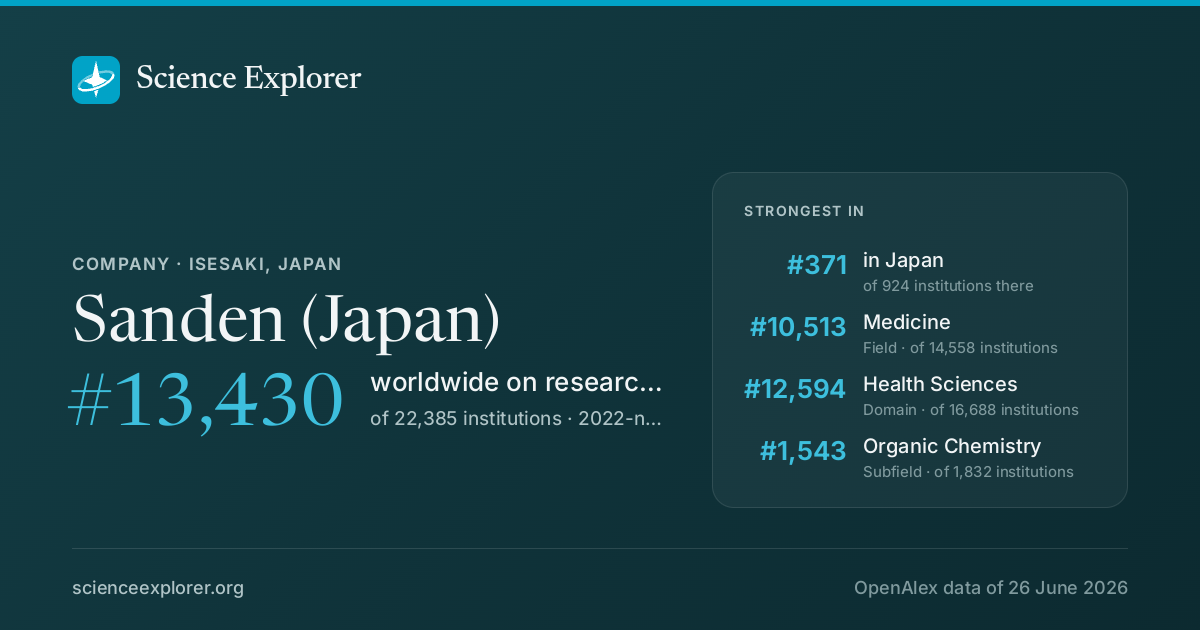
In research, Sanden (Japan) stands highest in Medicine (#10,513 of 14,558 worldwide), Health Sciences (#12,594 of 16,688 worldwide) and Organic Chemistry (#1,543 of 1,832 worldwide), over all time.
- World rank, 2022-now
- #13,430 of 22,385 · #18,729 all time
- Rank in Japan
- #371 of 924
- Research works
- 2.2k ▲ 37% vs 2018-21
- Citations
- 56k 25.4 per fractional work
- Top-10% rate
- 6.3% all institutions 10.0%
- vs its own fields
- 0.95× 1.00× is exactly expected
- Open access
- 20% world 40%
- International
- 23% world 18%
What is Sanden (Japan) known for in research?
The fields where it stands highest, over all time, ranked among every institution above the floor in each field.
| Field | World rank | Where that sits | Top-10% rate | Works |
|---|---|---|---|---|
| MedicineField | #10,513 of 14,558 | 10.2% | 633 | |
| Health SciencesDomain | #12,594 of 16,688 | 9.9% | 703 | |
| Organic ChemistrySubfield | #1,543 of 1,832 | 12.7% | 220 | |
| ChemistryField | #2,458 of 2,902 | 11.8% | 318 | |
| Biochemistry, Genetics and Molecular BiologyField | #4,938 of 5,801 | 13.1% | 356 | |
| Molecular BiologySubfield | #3,199 of 3,729 | 13.5% | 252 | |
| Life SciencesDomain | #9,646 of 11,023 | 12.2% | 709 | |
| Agricultural and Biological SciencesField | #4,905 of 5,126 | 12.0% | 120 | |
| Physical SciencesDomain | #17,274 of 17,446 | 8.5% | 637 | |
| EngineeringField | #9,465 of 9,532 | 4.7% | 177 |
Each strip is that field's whole ranked pool, with the notch where Sanden (Japan) sits in it, in the colour of the band that rank falls in. The track under the rate is the rate itself: it carries no average mark, because the average differs by field (from about 6% in Dentistry to 21% in Economics).
Which fields of science does Sanden (Japan) work in?
In 2022-now, 37% of research at Sanden (Japan) is in Physical Sciences, 29% in Health Sciences. Its largest fields are Medicine (26%), Engineering (22%), Computer Science (6%).
Each ring splits the one inside it: the four domains of science, their fields, their subfields. Size is fractional works in 2022-now. Every slice is a page; the interactive view zooms down to single topics and colours each by how much more of it this institution does than the world.
Its 4 domains and 26 fields, with their numbers
- Physical Sciences4736.7%
- Engineering2821.9%
- Computer Science86.5%
- Environmental Science54.2%
- Materials Science21.2%
- Mathematics10.9%
- Earth and Planetary Sciences10.8%
- Physics and Astronomy10.8%
- Chemistry00.2%
- Energy00.2%
- Chemical Engineering00.1%
- Health Sciences3729.3%
- Medicine3225.6%
- Health Professions43.3%
- Nursing00.2%
- Veterinary00.1%
- Dentistry00.1%
- Social Sciences2519.7%
- Life Sciences1814.3%
Field profile
Location quotient across every field it publishes in: outside the ring is more than an institution of this size would be expected to publish, inside it is less.
Rings at 0.5×, 1× and 2×. Widest outward: Pharmacology, Toxicology and Pharmaceutics, 3.9×. Every wedge is a field page.
All 26 fields, with their numbers
- Pharmacology, Toxicology and Pharmaceutics3.94×2 works
- Immunology and Microbiology3.45×4 works
- Economics, Econometrics and Finance1.65×4 works
- Engineering1.46×28 works
- Arts and Humanities1.43×5 works
- Decision Sciences1.41×2 works
- Medicine1.33×32 works
- Health Professions1.25×4 works
- Psychology1.19×5 works
- Neuroscience1.09×2 works
- Veterinary0.97×0 works
- Computer Science0.84×8 works
- Environmental Science0.84×5 works
- Agricultural and Biological Sciences0.76×5 works
- Mathematics0.76×1 works
- Biochemistry, Genetics and Molecular Biology0.75×5 works
- Earth and Planetary Sciences0.54×1 works
- Nursing0.45×0 works
- Social Sciences0.45×7 works
- Business, Management and Accounting0.43×2 works
- Materials Science0.35×2 works
- Physics and Astronomy0.34×1 works
- Chemical Engineering0.19×0 works
- Energy0.19×0 works
- Chemistry0.14×0 works
- Dentistry0.14×0 works
- Pharmacology, Toxicology and Pharmaceutics 3.9×
- Immunology and Microbiology 3.5×
- Economics, Econometrics and Finance 1.6×
- Engineering 1.5×
- Arts and Humanities 1.4×
- Decision Sciences 1.4×
- Medicine 1.3×
- Health Professions 1.2×
- Psychology 1.2×
- Neuroscience 1.1×
- Veterinary 1.0×
- Computer Science 0.8×
- Environmental Science 0.8×
- Agricultural and Biological Sciences 0.8×
- Mathematics 0.8×
- Biochemistry, Genetics and Molecular Biology 0.8×
- Earth and Planetary Sciences 0.5×
- Nursing 0.5×
- Social Sciences 0.5×
- Business, Management and Accounting 0.4×
- Materials Science 0.3×
- Physics and Astronomy 0.3×
- Chemical Engineering 0.2×
- Energy 0.2×
- Chemistry 0.1×
- Dentistry 0.1×
Who are the top researchers at Sanden (Japan)?
Ranked on the quality score, Wayne S. Skinner, Ursula Bretz and B. P. Richardson lead among researchers whose main affiliation is Sanden (Japan).
- 1
Wayne S. Skinner
 Japan · #3,149,110 worldwide
1.1k citations · 25 works
- 2
Ursula Bretz
Japan · #3,561,279 worldwide
2.1k citations · 26 works
- 3
B. P. Richardson
Japan · #3,609,614 worldwide
3.6k citations · 46 works
- 4
H. P. Siǵǵ
Japan · #3,714,350 worldwide
1.5k citations · 35 works
- 5
Alfred André Hofmann
Japan · #4,043,008 worldwide
3.7k citations · 112 works
- 6
Alfred Frey
Japan · #4,181,223 worldwide
2.1k citations · 81 works
- 7
Roland Maurice Wenger
Japan · #4,263,264 worldwide
3.1k citations · 72 works
- 8
Gideon Shapiro
Japan · #4,264,066 worldwide
2.2k citations · 84 works
- 9
H. Stähelin
Japan · #4,573,504 worldwide
3.5k citations · 42 works
- 10
Emilio del Pozo
Japan · #4,642,558 worldwide
1.5k citations · 43 works
Which keywords describe research at Sanden (Japan)?
By fractional works in 2022-now, weighted toward what it does more of than the world: Parallel Computing, Epidemiology, Thermal Management, Monoclonal Antibodies, Endoscopic Resection, Distributed Storage, Network Coding and Biopharmaceuticals.
- Thermal Analysis
- Electromagnetic Compatibility
- Cost-effectiveness Analysis
- Ejectors
- Esophageal Carcinoma
- Thermodynamic Analysis
- Chronic Disease Management
- Neoadjuvant Therapy
- Fault Tolerance
- Economic Evaluation
- Clinical Outcomes
- Bioanalytical Methods
- Power Electronics
- Nanoelectronics
- CMOS Technology
- Immunogenicity
- Network Coding
- Monoclonal Antibodies
- Endoscopic Resection
- Parallel Computing
- Epidemiology
- Thermal Management
- Energy Efficiency
- Distributed Storage
- Biopharmaceuticals
- Meta-Analysis
- Chemotherapy
- Genetics
- Surgery
- Biosimilars
- Induction Motors
- Gastric Cancer
- Heart Failure
- Chemoradiation
- Preoperative Chemoradiotherapy
- Barrett's Esophagus
- High-Temperature Electronics
- Refrigerants
- EMI
- Health Utility Measures
Size is fractional works in 2022-now in the topics tagged with each word; colour is the word's share of this institution's work against its share of the world's. The 40 words are chosen for being large and distinctive. Each links to the topic it comes from most.
All 40 words, with their numbers
- Epidemiology8▲ 1.68×30 topics
- Parallel Computing4▲ 27×2 topics
- Thermal Management3▲ 8.2×4 topics
- Endoscopic Resection3▲ 26×2 topics
- Energy Efficiency3▲ 2.9×6 topics
- Monoclonal Antibodies3▲ 29×3 topics
- Distributed Storage3▲ 92×1 topic
- Network Coding3▲ 55×1 topic
- Biopharmaceuticals3▲ 45×2 topics
- Immunogenicity3▲ 54×2 topics
- Meta-Analysis3▲ 4.0×5 topics
- CMOS Technology3▲ 29×3 topics
- Chemotherapy3▲ 3.2×10 topics
- Nanoelectronics3▲ 28×2 topics
- Genetics3▲ 3.1×6 topics
- Power Electronics3▲ 6.8×4 topics
- Surgery2▲ 5.8×5 topics
- Bioanalytical Methods2▲ 95×1 topic
- Biosimilars2▲ 95×1 topic
- Clinical Outcomes2▲ 8.8×2 topics
- Induction Motors2▲ 43×2 topics
- Economic Evaluation2▲ 15×2 topics
- Gastric Cancer2▲ 16×2 topics
- Fault Tolerance2▲ 11×2 topics
- Heart Failure2▲ 3.9×6 topics
- Neoadjuvant Therapy2▲ 7.2×4 topics
- Chemoradiation2▲ 25×2 topics
- Chronic Disease Management2▲ 8.3×4 topics
- Preoperative Chemoradiotherapy2▲ 20×2 topics
- Thermodynamic Analysis2▲ 25×2 topics
- Barrett's Esophagus2▲ 36×1 topic
- Esophageal Carcinoma2▲ 36×1 topic
- High-Temperature Electronics2▲ 23×2 topics
- Ejectors2▲ 45×1 topic
- Refrigerants2▲ 45×1 topic
- Cost-effectiveness Analysis2▲ 16×1 topic
- EMI2▲ 67×1 topic
- Electromagnetic Compatibility2▲ 67×1 topic
- Health Utility Measures2▲ 16×1 topic
- Thermal Analysis2▲ 9.9×3 topics
Which research topics does Sanden (Japan) publish most on?
By volume in 2022-now: Advanced Data Storage Technologies, Biosimilars and Bioanalytical Methods, Esophageal Cancer Research and Treatment and Refrigeration and Air Conditioning Technologies.
Area is fractional works; colour is the subfield each topic belongs to.
- 1 Advanced Data Storage Technologies Computer Networks and Communications 3 works
- 2 Biosimilars and Bioanalytical Methods Immunology 2 works
- 3 Esophageal Cancer Research and Treatment Surgery 2 works
- 4 Refrigeration and Air Conditioning Technologies Mechanical Engineering 2 works
- 5 Electromagnetic Compatibility and Noise Suppression Electrical and Electronic Engineering 2 works
- 6 Health Systems, Economic Evaluations, Quality of Life Economics and Econometrics 2 works
- 7 3D IC and TSV technologies Electrical and Electronic Engineering 2 works
- 8 Health Literacy and Information Accessibility General Health Professions 2 works
- 9 Radiation Effects in Electronics Electrical and Electronic Engineering 2 works
- 10 Semiconductor materials and devices Electrical and Electronic Engineering 1 works
How open and international is its research?
Against the world's own shares: the tick on each track. Both are shares of its output, so they sit on one scale and can be read against each other as well as against the world.
World: 40% of research is openly available.
World: 18% is written across borders.
How has Sanden (Japan)'s research output changed?
Output in 2022-2025 was 37% higher than in 2018-2021.
The same series as a ribbon: one cell per year, darker for more. The line above answers how much; this answers when.
Its share of all research
Growing output can still be a shrinking share: all of science grows. This is Sanden (Japan) as a percentage of every work published that year, 0.00056% in 2024.
Fractional works of Sanden (Japan) over all fractional works that year. How the balance of science has shifted.
How much of it reaches the world top 10%
Year by year, against all institutions in the same year.
Of each year's output, the share that reached the world's 10% most cited for its field and year. Peak 14.1% in 1991.
Other research institutions in Isesaki
- Institute of Brain and Blood Vessels
- Isesaki Fukushima Hospital
- Jobu University
- Gunma Prefectural Isesaki Koyokotogakko
Share Sanden (Japan)'s ranking
Badges for a website1Each links back here and updates with every snapshot

Research measures only: rankings here say nothing about teaching, admissions or student experience. Comparable institutions and collaboration partners have tabs of their own, above.
Discussion
Ask a question or share a note about Sanden (Japan). Keep it to the research: no personal attacks, advertising or links. Any reader can report a post, which collapses it for everyone until it is opened.