Science Explorer Back to mapMap
Discussion
Government institution · Edinburgh · United Kingdom

Scottish Government

In research, Scottish Government stands highest in Health Sciences (#6,110 of 16,688 worldwide), Social Sciences (#8,210 of 14,833 worldwide) and Physical Sciences (#10,330 of 17,446 worldwide), over all time.

World rank, 2022-now
#16,225
of 22,385 · #7,514 all time
Rank in United Kingdom
#556
of 862
Research works
481
▲ 16% vs 2018-21
Citations
9.5k
19.7 per fractional work
Top-10% rate
7.5%
all institutions 10.0%
vs its own fields
1.01×
1.00× is exactly expected
Open access
34%
world 40%
International
17%
world 18%

What is Scottish Government known for in research?

The fields where it stands highest, over all time, ranked among every institution above the floor in each field.

FieldWorld rankWhere that sitsTop-10% rateWorks
Health SciencesDomain #6,110 of 16,688 8.8%148
Social SciencesDomain #8,210 of 14,833 6.8%147
Physical SciencesDomain #10,330 of 17,446 11.4%124

Each strip is that field's whole ranked pool, with the notch where Scottish Government sits in it, in the colour of the band that rank falls in. The track under the rate is the rate itself: it carries no average mark, because the average differs by field (from about 6% in Dentistry to 21% in Economics).

Which fields of science does Scottish Government work in?

In 2022-now, 31% of research at Scottish Government is in Social Sciences, 29% in Health Sciences. Its largest fields are Environmental Science (21%), Medicine (19%), Social Sciences (15%).

Social Sciences: 22 fractional works · 30.6% of its workSocial Sciences: 11 fractional works · 14.6% of its workSociology and Political Science: 5 fractional works · 7.0% of its workEducation: 2 fractional works · 2.8% of its workPolitical Science and International Relations: 1 fractional works · 1.1% of its workHealth: 1 fractional works · 1.1% of its workGender Studies: 0 fractional works · 0.7% of its workCommunication: 0 fractional works · 0.6% of its workGeography, Planning and Development: 0 fractional works · 0.4% of its workUrban Studies: 0 fractional works · 0.3% of its workSafety Research: 0 fractional works · 0.2% of its workSmaller subfields together: 0 fractional works · 0.3% of its workPsychology: 5 fractional works · 6.6% of its workSocial Psychology: 3 fractional works · 3.6% of its workClinical Psychology: 1 fractional works · 1.9% of its workDevelopmental and Educational Psychology: 0 fractional works · 0.7% of its workApplied Psychology: 0 fractional works · 0.3% of its workSmaller subfields together: 0 fractional works · 0.1% of its workDecision Sciences: 2 fractional works · 3.1% of its workManagement Science and Operations Research: 2 fractional works · 2.7% of its workInformation Systems and Management: 0 fractional works · 0.4% of its workArts and Humanities: 2 fractional works · 2.7% of its workConservation: 0 fractional works · 0.5% of its workHistory and Philosophy of Science: 0 fractional works · 0.4% of its workMuseology: 0 fractional works · 0.4% of its workPhilosophy: 0 fractional works · 0.3% of its workHistory: 0 fractional works · 0.3% of its workLiterature and Literary Theory: 0 fractional works · 0.3% of its workArcheology: 0 fractional works · 0.2% of its workSmaller subfields together: 0 fractional works · 0.2% of its workEconomics, Econometrics and Finance: 2 fractional works · 2.3% of its workEconomics and Econometrics: 2 fractional works · 2.3% of its workBusiness, Management and Accounting: 1 fractional works · 1.3% of its workOrganizational Behavior and Human Resource Management: 1 fractional works · 1.0% of its workSmaller subfields together: 0 fractional works · 0.3% of its workHealth Sciences: 21 fractional works · 28.7% of its workMedicine: 14 fractional works · 19.3% of its workPublic Health, Environmental and Occupational Health: 4 fractional works · 5.4% of its workPediatrics, Perinatology and Child Health: 2 fractional works · 2.6% of its workPhysiology: 2 fractional works · 2.0% of its workEpidemiology: 1 fractional works · 1.7% of its workGeriatrics and Gerontology: 1 fractional works · 1.6% of its workInfectious Diseases: 1 fractional works · 1.0% of its workFamily Practice: 1 fractional works · 0.7% of its workPsychiatry and Mental health: 1 fractional works · 0.7% of its workReproductive Medicine: 0 fractional works · 0.7% of its workPulmonary and Respiratory Medicine: 0 fractional works · 0.6% of its workSurgery: 0 fractional works · 0.4% of its workOncology: 0 fractional works · 0.4% of its workRadiology, Nuclear Medicine and Imaging: 0 fractional works · 0.3% of its workOrthopedics and Sports Medicine: 0 fractional works · 0.2% of its workEmergency Medicine: 0 fractional works · 0.2% of its workSmaller subfields together: 0 fractional works · 0.7% of its workHealth Professions: 6 fractional works · 8.4% of its workGeneral Health Professions: 4 fractional works · 6.1% of its workHealth Information Management: 1 fractional works · 0.9% of its workEmergency Medical Services: 0 fractional works · 0.6% of its workComplementary and Manual Therapy: 0 fractional works · 0.3% of its workSpeech and Hearing: 0 fractional works · 0.2% of its workSmaller subfields together: 0 fractional works · 0.3% of its workDentistry: 0 fractional works · 0.4% of its workOral Surgery: 0 fractional works · 0.2% of its workOrthodontics: 0 fractional works · 0.2% of its workNursing: 0 fractional works · 0.4% of its workNutrition and Dietetics: 0 fractional works · 0.2% of its workSmaller subfields together: 0 fractional works · 0.1% of its workVeterinary: 0 fractional works · 0.2% of its workSmall Animals: 0 fractional works · 0.2% of its workPhysical Sciences: 21 fractional works · 28.7% of its workEnvironmental Science: 16 fractional works · 21.3% of its workGlobal and Planetary Change: 5 fractional works · 6.6% of its workEcology: 3 fractional works · 4.5% of its workNature and Landscape Conservation: 2 fractional works · 3.0% of its workHealth, Toxicology and Mutagenesis: 1 fractional works · 2.0% of its workManagement, Monitoring, Policy and Law: 1 fractional works · 1.5% of its workWater Science and Technology: 1 fractional works · 1.0% of its workEnvironmental Chemistry: 1 fractional works · 0.8% of its workPollution: 1 fractional works · 0.7% of its workIndustrial and Manufacturing Engineering: 0 fractional works · 0.6% of its workEnvironmental Engineering: 0 fractional works · 0.4% of its workEcological Modeling: 0 fractional works · 0.2% of its workEarth and Planetary Sciences: 3 fractional works · 3.9% of its workOceanography: 2 fractional works · 3.2% of its workAtmospheric Science: 0 fractional works · 0.4% of its workPaleontology: 0 fractional works · 0.2% of its workSmaller subfields together: 0 fractional works · 0.1% of its workComputer Science: 1 fractional works · 1.8% of its workInformation Systems: 0 fractional works · 0.6% of its workComputer Networks and Communications: 0 fractional works · 0.4% of its workComputer Science Applications: 0 fractional works · 0.4% of its workComputational Theory and Mathematics: 0 fractional works · 0.2% of its workEngineering: 1 fractional works · 1.0% of its workMedia Technology: 0 fractional works · 0.4% of its workMechanics of Materials: 0 fractional works · 0.2% of its workSmaller subfields together: 0 fractional works · 0.4% of its workMathematics: 0 fractional works · 0.7% of its workStatistics and Probability: 0 fractional works · 0.6% of its workSmaller subfields together: 0 fractional works · 0.1% of its workLife Sciences: 9 fractional works · 12.0% of its workAgricultural and Biological Sciences: 6 fractional works · 7.7% of its workGeneral Agricultural and Biological Sciences: 2 fractional works · 2.9% of its workPlant Science: 2 fractional works · 2.5% of its workEcology, Evolution, Behavior and Systematics: 1 fractional works · 0.9% of its workFood Science: 1 fractional works · 0.7% of its workInsect Science: 0 fractional works · 0.3% of its workAquatic Science: 0 fractional works · 0.3% of its workSmaller subfields together: 0 fractional works · 0.1% of its workBiochemistry, Genetics and Molecular Biology: 2 fractional works · 3.3% of its workMolecular Biology: 1 fractional works · 1.1% of its workPhysiology: 0 fractional works · 0.6% of its workEndocrinology: 0 fractional works · 0.4% of its workGenetics: 0 fractional works · 0.4% of its workDevelopmental Biology: 0 fractional works · 0.3% of its workSmaller subfields together: 0 fractional works · 0.4% of its workImmunology and Microbiology: 1 fractional works · 0.7% of its workParasitology: 0 fractional works · 0.3% of its workApplied Microbiology and Biotechnology: 0 fractional works · 0.2% of its workVirology: 0 fractional works · 0.2% of its workNeuroscience: 0 fractional works · 0.1% of its workPharmacology, Toxicology and Pharmaceutics: 0 fractional works · 0.1% of its workALL ITS WORKScottishGovernment74fractional works, 2022-now
Life Sciences12%Physical Sciences29%Health Sciences29%Social Sciences31%

Each ring splits the one inside it: the four domains of science, their fields, their subfields. Size is fractional works in 2022-now. Every slice is a page; the interactive view zooms down to single topics and colours each by how much more of it this institution does than the world.

Its 4 domains and 21 fields, with their numbers
    1. Social Sciences1114.6%
    2. Psychology56.6%
    3. Decision Sciences23.1%
    4. Arts and Humanities22.7%
    5. Economics, Econometrics and Finance22.3%
    6. Business, Management and Accounting11.3%
    1. Medicine1419.3%
    2. Health Professions68.4%
    3. Dentistry00.4%
    4. Nursing00.4%
    5. Veterinary00.2%
    1. Environmental Science1621.3%
    2. Earth and Planetary Sciences33.9%
    3. Computer Science11.8%
    4. Engineering11.0%
    5. Mathematics00.7%
    1. Agricultural and Biological Sciences67.7%
    2. Biochemistry, Genetics and Molecular Biology23.3%
    3. Immunology and Microbiology10.7%
    4. Neuroscience00.1%
    5. Pharmacology, Toxicology and Pharmaceutics00.1%
All of science, and how each field's share has moved since 1950: the Science domain explorer

Field profile

Location quotient across every field it publishes in: outside the ring is more than an institution of this size would be expected to publish, inside it is less.

Agricultural and Biological Sciences: 1.62× its world share, 6 worksAgricultural and Bio…Biochemistry, Genetics and Molecular Biology: 0.62× its world share, 2 worksBiochemistry, Geneti…Immunology and Microbiology: 0.74× its world share, 0 worksImmunology and Micro…Neuroscience: 0.07× its world share, 0 worksNeurosciencePharmacology, Toxicology and Pharmaceutics: 0.32× its world share, 0 worksPharmacology, Toxico…Computer Science: 0.23× its world share, 1 worksComputer ScienceEarth and Planetary Sciences: 2.48× its world share, 3 worksEarth and Planetary …Engineering: 0.07× its world share, 1 worksEngineeringEnvironmental Science: 4.29× its world share, 16 worksEnvironmental ScienceMathematics: 0.55× its world share, 0 worksMathematicsDentistry: 0.93× its world share, 0 worksDentistryHealth Professions: 3.18× its world share, 6 worksHealth ProfessionsMedicine: 1.01× its world share, 14 worksMedicineNursing: 0.73× its world share, 0 worksNursingVeterinary: 1.50× its world share, 0 worksVeterinaryArts and Humanities: 0.93× its world share, 2 worksArts and HumanitiesBusiness, Management and Accounting: 0.40× its world share, 1 worksBusiness, Management…Decision Sciences: 3.25× its world share, 2 worksDecision SciencesEconomics, Econometrics and Finance: 1.08× its world share, 2 worksEconomics, Econometr…Psychology: 2.16× its world share, 5 worksPsychologySocial Sciences: 1.15× its world share, 11 worksSocial Sciences1×world share
more than its size predictsabout as predictedless

Rings at 0.5×, 1× and 2×. Widest outward: Environmental Science, 4.3×. Every wedge is a field page.

All 21 fields, with their numbers
  1. Environmental Science4.29×16 works
  2. Decision Sciences3.25×2 works
  3. Health Professions3.18×6 works
  4. Earth and Planetary Sciences2.48×3 works
  5. Psychology2.16×5 works
  6. Agricultural and Biological Sciences1.62×6 works
  7. Veterinary1.50×0 works
  8. Social Sciences1.15×11 works
  9. Economics, Econometrics and Finance1.08×2 works
  10. Medicine1.01×14 works
  11. Dentistry0.93×0 works
  12. Arts and Humanities0.93×2 works
  13. Immunology and Microbiology0.74×0 works
  14. Nursing0.73×0 works
  15. Biochemistry, Genetics and Molecular Biology0.62×2 works
  16. Mathematics0.55×0 works
  17. Business, Management and Accounting0.40×1 works
  18. Pharmacology, Toxicology and Pharmaceutics0.32×0 works
  19. Computer Science0.23×1 works
  20. Neuroscience0.07×0 works
  21. Engineering0.07×1 works

Who are the top researchers at Scottish Government?

Ranked on the quality score, Alpana Mair, Margaret MacLeod and Alpana Rajesh Mair lead among researchers whose main affiliation is Scottish Government.

  1. 1 Alpana Mair United Kingdom · #510,738 worldwide 1.1k citations · 32 works
  2. 2 Margaret MacLeod United Kingdom · #717,929 worldwide 853 citations · 19 works
  3. 3 Alpana Rajesh Mair United Kingdom · #775,846 worldwide 1.2k citations · 46 works
  4. 4 Albert King United Kingdom · #1,168,372 worldwide 758 citations · 28 works
  5. 5 Jennifer McIntosh United Kingdom · #1,316,824 worldwide 682 citations · 30 works
  6. 6 Catherine Calderwood United Kingdom · #1,360,973 worldwide 980 citations · 31 works
  7. 7 Faye L. Jackson United Kingdom · #2,084,014 worldwide 468 citations · 21 works
  8. 8 John Claudius Loudon United Kingdom · #2,566,996 worldwide 412 citations · 130 works
  9. 9 Andrea Pavličková United Kingdom · #3,088,487 worldwide 242 citations · 30 works
  10. 10 Brian Wilson United Kingdom · #3,342,475 worldwide 99 citations · 27 works
All ranked researchers at Scottish Government

What are the most cited papers from Scottish Government?

The most cited paper from Scottish Government is "The social dimension of sustainable development: Defining urban social sustainability" (Nicola Dempsey, Glen Bramley, Sinéad Power et al., 2009), with 1,915 citations. Next come "Using natural experiments to evaluate population health interventions: new Medical Research Council guidance" (942) and "Video consultations for covid-19" (936).

Most cited papers
#PaperReleasedCitations
1 The social dimension of sustainable development: Defining urban social sustainability Nicola Dempsey, Glen Bramley, Sinéad Power et al. · Sustainable Development 26 May 2009 1,915
2 Using natural experiments to evaluate population health interventions: new Medical Research Council guidance Peter Craig, Cyrus Cooper, David Gunnell et al. · Journal of Epidemiology & Community Health Open access 10 May 2012 942
3 Video consultations for covid-19 Trisha Greenhalgh, Joe Wherton, Sara Elizabeth Shaw et al. · BMJ Open access 12 Mar 2020 936
4 Morbidity and mortality in homeless individuals, prisoners, sex workers, and individuals with substance use disorders in high-income countries: a systematic review and meta-analysis Robert W Aldridge, Alistair Story, Stephen W. Hwang et al. · The Lancet ReviewOpen access 12 Nov 2017 928
5 Consensus statement for perioperative care in total hip replacement and total knee replacement surgery: Enhanced Recovery After Surgery (ERAS ® ) Society recommendations Thomas William Wainwright, Mike Gill, David A. McDonald et al. · Acta Orthopaedica Open access 30 Oct 2019 810
All 60 most cited papers, with filters and sorting

Which keywords describe research at Scottish Government?

By fractional works in 2022-now, weighted toward what it does more of than the world: Climate Change, Fisheries Sustainability, Public Health, Trophic Cascades, Ecosystem Management, Marine Fisheries, Mental Health and Gender Identity.

▲ more of its work than of the world's◆ about the world's share▼ less than the world's

Size is fractional works in 2022-now in the topics tagged with each word; colour is the word's share of this institution's work against its share of the world's. The 40 words are chosen for being large and distinctive. Each links to the topic it comes from most.

All 40 words, with their numbers
  1. Climate Change13▲ 6.6×24 topics
  2. Public Health6▲ 5.1×19 topics
  3. Fisheries Sustainability5▲ 83×2 topics
  4. Mental Health4▲ 3.8×14 topics
  5. Sustainability4▲ 2.1×10 topics
  6. Trophic Cascades3▲ 50×2 topics
  7. Ecosystem Management3▲ 75×1 topic
  8. Marine Fisheries3▲ 109×1 topic
  9. Quality of Life3▲ 2.9×11 topics
  10. Gender Identity2▲ 32×3 topics
  11. Invasive Species2▲ 8.1×6 topics
  12. Population Dynamics2▲ 13×6 topics
  13. Rural Development2▲ 9.7×2 topics
  14. Physical Activity2▲ 6.4×6 topics
  15. Primary Care2▲ 8.4×8 topics
  16. Social Innovation2▲ 19×2 topics
  17. Agricultural Change2▲ 196×1 topic
  18. Biodiversity2▲ 3.7×8 topics
  19. Community Empowerment2▲ 4.0×2 topics
  20. Freshwater Biodiversity2▲ 46×2 topics
  21. International Relations2▲ 12×3 topics
  22. Neo-Endogenous Development2▲ 196×1 topic
  23. Conservation Challenges2▲ 59×1 topic
  24. Flow Regulation2▲ 59×1 topic
  25. Ecosystem Services2▲ 6.7×6 topics
  26. Arctic2▲ 21×2 topics
  27. Global Warming2▲ 5.3×6 topics
  28. Nationalism2▲ 5.1×4 topics
  29. Chronic Disease Management2▲ 11×4 topics
  30. Exercise2▲ 17×2 topics
  31. Health Benefits2▲ 6.2×1 topic
  32. Health Inequalities2▲ 17×2 topics
  33. Ocean Acidification2▲ 27×3 topics
  34. Sedentary Behavior2▲ 46×1 topic
  35. Cost-effectiveness Analysis1▲ 24×1 topic
  36. Governance1▲ 6.0×1 topic
  37. Health Utility Measures1▲ 24×1 topic
  38. Shipping1▲ 40×1 topic
  39. Positive Psychology1▲ 23×2 topics
  40. Stakeholder Engagement1▲ 19×2 topics

Which research topics does Scottish Government publish most on?

By volume in 2022-now: Marine and fisheries research, Rural development and sustainability, Fish Ecology and Management Studies and Physical Activity and Health.

  1. 1 Marine and fisheries research Global and Planetary Change 3 works
  2. 2 Rural development and sustainability General Agricultural and Biological Sciences 2 works
  3. 3 Fish Ecology and Management Studies Nature and Landscape Conservation 2 works
  4. 4 Physical Activity and Health Physiology 2 works
  5. 5 Arctic and Russian Policy Studies Sociology and Political Science 1 works
  6. 6 Health Systems, Economic Evaluations, Quality of Life Economics and Econometrics 1 works
  7. 7 demographic modeling and climate adaptation Management Science and Operations Research 1 works
  8. 8 Zoonotic diseases and public health Public Health, Environmental and Occupational Health 1 works
  9. 9 Pharmaceutical Practices and Patient Outcomes Geriatrics and Gerontology 1 works
  10. 10 Irish and British Studies Sociology and Political Science 1 works

How open and international is its research?

Against the world's own shares: the tick on each track. Both are shares of its output, so they sit on one scale and can be read against each other as well as against the world.

openly available33.7%not open66.3%

World: 40% of research is openly available.

with international co-authors17.0%domestic only83.0%

World: 18% is written across borders.

How has Scottish Government's research output changed?

Output in 2022-2025 was 16% higher than in 2018-2021.

still counting1990200020102020
grewheldshrank

The same series as a ribbon: one cell per year, darker for more. The line above answers how much; this answers when.

Its share of all research

Growing output can still be a shrinking share: all of science grows. This is Scottish Government as a percentage of every work published that year, 0.00028% in 2024.

still counting0.0010%0.0020%0.0030%Scottish Government0.00034% in 202519801990200020102020

Fractional works of Scottish Government over all fractional works that year. How the balance of science has shifted.

Other research institutions in Edinburgh

All research institutions in Edinburgh

Share Scottish Government's ranking
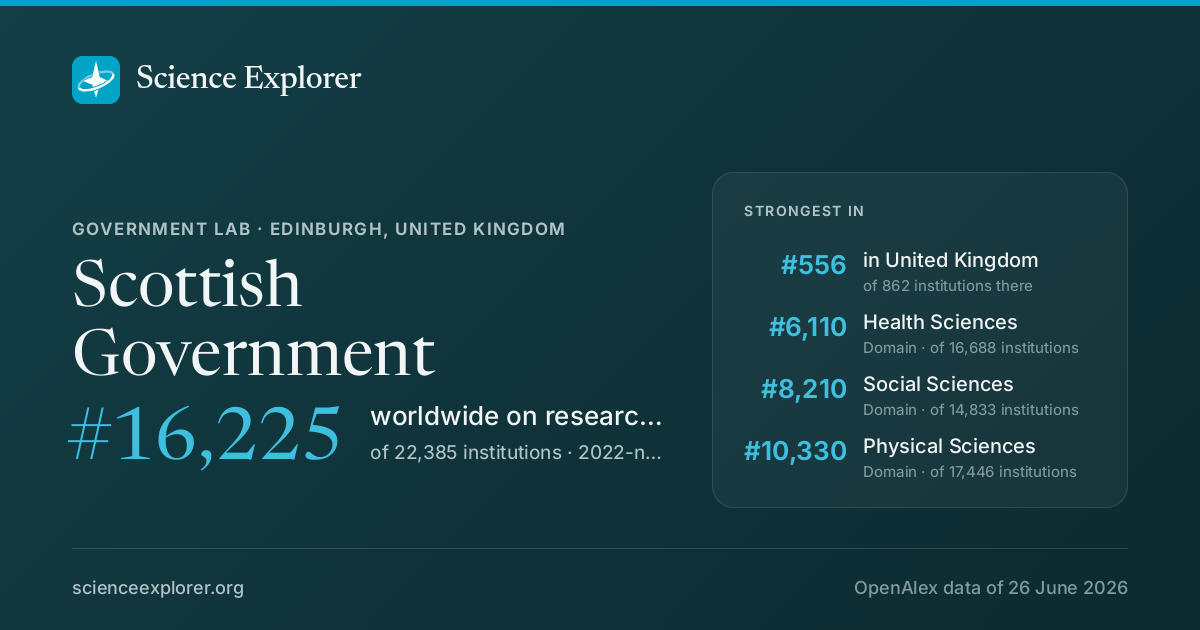
Scottish Government on Science Explorer

A card with Scottish Government's standing and the fields it leads in, for a post or a slide. A link to this page previews as the same card.

Download the card

1200 × 630 PNG, sized for social posts, drawn from the latest snapshot.

Badges for a website1Each links back here and updates with every snapshot

Research measures only: rankings here say nothing about teaching, admissions or student experience. Comparable institutions and collaboration partners have tabs of their own, above.

Discussion

Ask a question or share a note about Scottish Government. Posts are plain text and can be reported.