Science Explorer Back to mapMap
Discussion
Company · Gyōda · Japan

Showa Corporation

In research, Showa Corporation stands highest in Physical Sciences (#14,758 of 17,446 worldwide) and Engineering (#8,156 of 9,532 worldwide), over all time.

World rank, all time
#29,222
of 34,923
Rank in Japan
#1,244
of 1,923
Research works
502
▼ 40% vs 2018-21
Citations
4k
7.9 per fractional work
Top-10% rate
5.4%
all institutions 10.0%
vs its own fields
0.78×
1.00× is exactly expected
Open access
47%
world 40%
International
11%
world 18%

What is Showa Corporation known for in research?

The fields where it stands highest, over all time, ranked among every institution above the floor in each field.

FieldWorld rankWhere that sitsTop-10% rateWorks
Physical SciencesDomain #14,758 of 17,446 4.3%447
EngineeringField #8,156 of 9,532 4.9%241

Each strip is that field's whole ranked pool, with the notch where Showa Corporation sits in it, in the colour of the band that rank falls in. The track under the rate is the rate itself: it carries no average mark, because the average differs by field (from about 6% in Dentistry to 21% in Economics).

Which fields of science does Showa Corporation work in?

In 2022-now, 53% of research at Showa Corporation is in Physical Sciences, 26% in Health Sciences. Its largest fields are Engineering (28%), Medicine (23%), Environmental Science (10%). It does 1.3× the world's share of Physical Sciences.

Physical Sciences: 13 fractional works · 53.3% of its workEngineering: 7 fractional works · 27.9% of its workBiomedical Engineering: 2 fractional works · 8.4% of its workCivil and Structural Engineering: 1 fractional works · 5.8% of its workMechanics of Materials: 1 fractional works · 4.2% of its workElectrical and Electronic Engineering: 1 fractional works · 2.8% of its workBuilding and Construction: 0 fractional works · 2.1% of its workMechanical Engineering: 0 fractional works · 1.3% of its workControl and Systems Engineering: 0 fractional works · 0.9% of its workOcean Engineering: 0 fractional works · 0.8% of its workAerospace Engineering: 0 fractional works · 0.7% of its workSafety, Risk, Reliability and Quality: 0 fractional works · 0.7% of its workEnvironmental Science: 2 fractional works · 9.7% of its workManagement, Monitoring, Policy and Law: 1 fractional works · 2.5% of its workNature and Landscape Conservation: 0 fractional works · 1.9% of its workIndustrial and Manufacturing Engineering: 0 fractional works · 1.4% of its workWater Science and Technology: 0 fractional works · 1.4% of its workEnvironmental Engineering: 0 fractional works · 0.9% of its workEcology: 0 fractional works · 0.7% of its workHealth, Toxicology and Mutagenesis: 0 fractional works · 0.7% of its workGlobal and Planetary Change: 0 fractional works · 0.2% of its workComputer Science: 2 fractional works · 6.9% of its workInformation Systems: 1 fractional works · 3.5% of its workComputer Vision and Pattern Recognition: 0 fractional works · 1.5% of its workArtificial Intelligence: 0 fractional works · 1.2% of its workComputer Networks and Communications: 0 fractional works · 0.7% of its workPhysics and Astronomy: 1 fractional works · 2.7% of its workCondensed Matter Physics: 0 fractional works · 1.7% of its workAstronomy and Astrophysics: 0 fractional works · 1.1% of its workMaterials Science: 1 fractional works · 2.6% of its workMaterials Chemistry: 0 fractional works · 1.6% of its workSurfaces, Coatings and Films: 0 fractional works · 1.1% of its workEarth and Planetary Sciences: 0 fractional works · 2.1% of its workGeochemistry and Petrology: 0 fractional works · 1.4% of its workGeophysics: 0 fractional works · 0.7% of its workChemistry: 0 fractional works · 1.3% of its workSpectroscopy: 0 fractional works · 1.1% of its workOrganic Chemistry: 0 fractional works · 0.3% of its workHealth Sciences: 6 fractional works · 25.9% of its workMedicine: 6 fractional works · 23.4% of its workNephrology: 2 fractional works · 7.3% of its workPulmonary and Respiratory Medicine: 1 fractional works · 3.4% of its workHematology: 1 fractional works · 2.5% of its workSurgery: 0 fractional works · 2.1% of its workPathology and Forensic Medicine: 0 fractional works · 1.1% of its workDermatology: 0 fractional works · 1.0% of its workGenetics: 0 fractional works · 0.8% of its workEndocrinology, Diabetes and Metabolism: 0 fractional works · 0.7% of its workGastroenterology: 0 fractional works · 0.7% of its workPhysiology: 0 fractional works · 0.7% of its workBiochemistry: 0 fractional works · 0.5% of its workNeurology: 0 fractional works · 0.5% of its workRheumatology: 0 fractional works · 0.5% of its workCardiology and Cardiovascular Medicine: 0 fractional works · 0.3% of its workEpidemiology: 0 fractional works · 0.3% of its workOtorhinolaryngology: 0 fractional works · 0.3% of its workOrthopedics and Sports Medicine: 0 fractional works · 0.3% of its workSmaller subfields together: 0 fractional works · 0.3% of its workHealth Professions: 1 fractional works · 2.4% of its workGeneral Health Professions: 0 fractional works · 0.7% of its workOccupational Therapy: 0 fractional works · 0.7% of its workSpeech and Hearing: 0 fractional works · 0.7% of its workSmaller subfields together: 0 fractional works · 0.3% of its workNursing: 0 fractional works · 0.1% of its workSocial Sciences: 3 fractional works · 14.1% of its workSocial Sciences: 2 fractional works · 6.4% of its workSociology and Political Science: 1 fractional works · 2.3% of its workTransportation: 1 fractional works · 2.2% of its workPolitical Science and International Relations: 0 fractional works · 0.7% of its workUrban Studies: 0 fractional works · 0.5% of its workEducation: 0 fractional works · 0.3% of its workSafety Research: 0 fractional works · 0.3% of its workArts and Humanities: 1 fractional works · 3.9% of its workLanguage and Linguistics: 0 fractional works · 1.4% of its workHistory: 0 fractional works · 0.7% of its workLiterature and Literary Theory: 0 fractional works · 0.7% of its workPhilosophy: 0 fractional works · 0.7% of its workReligious studies: 0 fractional works · 0.3% of its workBusiness, Management and Accounting: 0 fractional works · 1.4% of its workStrategy and Management: 0 fractional works · 0.7% of its workManagement of Technology and Innovation: 0 fractional works · 0.7% of its workPsychology: 0 fractional works · 1.2% of its workClinical Psychology: 0 fractional works · 0.8% of its workExperimental and Cognitive Psychology: 0 fractional works · 0.3% of its workSmaller subfields together: 0 fractional works · 0.0% of its workDecision Sciences: 0 fractional works · 1.2% of its workStatistics, Probability and Uncertainty: 0 fractional works · 1.2% of its workLife Sciences: 2 fractional works · 6.7% of its workBiochemistry, Genetics and Molecular Biology: 1 fractional works · 2.4% of its workMolecular Biology: 0 fractional works · 1.7% of its workCancer Research: 0 fractional works · 0.7% of its workAgricultural and Biological Sciences: 0 fractional works · 2.1% of its workAnimal Science and Zoology: 0 fractional works · 0.7% of its workFood Science: 0 fractional works · 0.7% of its workPlant Science: 0 fractional works · 0.7% of its workNeuroscience: 0 fractional works · 0.8% of its workCellular and Molecular Neuroscience: 0 fractional works · 0.5% of its workNeurology: 0 fractional works · 0.3% of its workPharmacology, Toxicology and Pharmaceutics: 0 fractional works · 0.7% of its workPharmacology: 0 fractional works · 0.3% of its workToxicology: 0 fractional works · 0.3% of its workSmaller subfields together: 0 fractional works · 0.0% of its workImmunology and Microbiology: 0 fractional works · 0.6% of its workImmunology: 0 fractional works · 0.6% of its workALL ITS WORKShowa Corporation24fractional works, 2022-now
Life Sciences7%Physical Sciences53%Health Sciences26%Social Sciences14%

Each ring splits the one inside it: the four domains of science, their fields, their subfields. Size is fractional works in 2022-now. Every slice is a page; the interactive view zooms down to single topics and colours each by how much more of it this institution does than the world.

Its 4 domains and 20 fields, with their numbers
    1. Engineering727.9%
    2. Environmental Science29.7%
    3. Computer Science26.9%
    4. Physics and Astronomy12.7%
    5. Materials Science12.6%
    6. Earth and Planetary Sciences02.1%
    7. Chemistry01.3%
    1. Medicine623.4%
    2. Health Professions12.4%
    3. Nursing00.1%
    1. Social Sciences26.4%
    2. Arts and Humanities13.9%
    3. Business, Management and Accounting01.4%
    4. Psychology01.2%
    5. Decision Sciences01.2%
    1. Biochemistry, Genetics and Molecular Biology12.4%
    2. Agricultural and Biological Sciences02.1%
    3. Neuroscience00.8%
    4. Pharmacology, Toxicology and Pharmaceutics00.7%
    5. Immunology and Microbiology00.6%
All of science, and how each field's share has moved since 1950: the Science domain explorer

Field profile

Location quotient across every field it publishes in: outside the ring is more than an institution of this size would be expected to publish, inside it is less.

Agricultural and Biological Sciences: 0.45× its world share, 0 worksAgricultural and Bio…Biochemistry, Genetics and Molecular Biology: 0.45× its world share, 1 worksBiochemistry, Geneti…Immunology and Microbiology: 0.63× its world share, 0 worksImmunology and Micro…Neuroscience: 0.51× its world share, 0 worksNeurosciencePharmacology, Toxicology and Pharmaceutics: 2.00× its world share, 0 worksPharmacology, Toxico…Chemistry: 0.83× its world share, 0 worksChemistryComputer Science: 0.90× its world share, 2 worksComputer ScienceEarth and Planetary Sciences: 1.35× its world share, 0 worksEarth and Planetary …Engineering: 1.86× its world share, 7 worksEngineeringEnvironmental Science: 1.96× its world share, 2 worksEnvironmental ScienceMaterials Science: 0.75× its world share, 1 worksMaterials SciencePhysics and Astronomy: 1.22× its world share, 1 worksPhysics and AstronomyHealth Professions: 0.92× its world share, 1 worksHealth ProfessionsMedicine: 1.22× its world share, 6 worksMedicineNursing: 0.21× its world share, 0 worksNursingArts and Humanities: 1.35× its world share, 1 worksArts and HumanitiesBusiness, Management and Accounting: 0.42× its world share, 0 worksBusiness, Management…Decision Sciences: 1.22× its world share, 0 worksDecision SciencesPsychology: 0.40× its world share, 0 worksPsychologySocial Sciences: 0.51× its world share, 2 worksSocial Sciences1×world share
more than its size predictsabout as predictedless

Rings at 0.5×, 1× and 2×. Widest outward: Pharmacology, Toxicology and Pharmaceutics, 2.0×. Every wedge is a field page.

All 20 fields, with their numbers
  1. Pharmacology, Toxicology and Pharmaceutics2.00×0 works
  2. Environmental Science1.96×2 works
  3. Engineering1.86×7 works
  4. Earth and Planetary Sciences1.35×0 works
  5. Arts and Humanities1.35×1 works
  6. Physics and Astronomy1.22×1 works
  7. Medicine1.22×6 works
  8. Decision Sciences1.22×0 works
  9. Health Professions0.92×1 works
  10. Computer Science0.90×2 works
  11. Chemistry0.83×0 works
  12. Materials Science0.75×1 works
  13. Immunology and Microbiology0.63×0 works
  14. Neuroscience0.51×0 works
  15. Social Sciences0.51×2 works
  16. Agricultural and Biological Sciences0.45×0 works
  17. Biochemistry, Genetics and Molecular Biology0.45×1 works
  18. Business, Management and Accounting0.42×0 works
  19. Psychology0.40×0 works
  20. Nursing0.21×0 works

Who are the top researchers at Showa Corporation?

Ranked on the quality score, Masatoshi Enomoto, Ying Li and Yoshimasa Kamisada lead among researchers whose main affiliation is Showa Corporation.

  1. 1 Masatoshi Enomoto Japan · #2,218,229 worldwide 2.1k citations · 70 works
  2. 2 Ying Li Japan · #3,151,462 worldwide 782 citations · 17 works
  3. 3 Yoshimasa Kamisada Japan · #4,137,477 worldwide 196 citations · 18 works
  4. 4 M. Okashita Japan · #4,470,264 worldwide 377 citations · 23 works
  5. 5 T Miura Japan · #4,775,640 worldwide 291 citations · 20 works
  6. 6 N. Ohtani Japan · #4,802,719 worldwide 211 citations · 19 works
  7. 7 M. Aihara Japan · #4,930,894 worldwide 204 citations · 18 works
  8. 8 Kathe Geist Japan · #5,170,247 worldwide 53 citations · 16 works
  9. 9 K Soga Japan · #5,594,963 worldwide 94 citations · 16 works
  10. 10 Kiyohiko Inaba Japan · #5,661,538 worldwide 48 citations · 16 works
All ranked researchers at Showa Corporation

What are the most cited papers from Showa Corporation?

The most cited paper from Showa Corporation is "Microstructural evolution of 6063 aluminum during friction-stir welding" (Yutaka S. Sato, Hiroyuki Kokawa, Masatoshi Enomoto et al., 1999), with 708 citations. Next come "IgA nephropathy" (517) and "Fabrication of long-period fiber gratings by focused irradiation of infrared femtosecond laser pulses" (404).

Most cited papers
#PaperReleasedCitations
1 Microstructural evolution of 6063 aluminum during friction-stir welding Yutaka S. Sato, Hiroyuki Kokawa, Masatoshi Enomoto et al. · Metallurgical and Materials Transactions A Sep 1999 708
2 IgA nephropathy Kar Neng Lai, Sydney C.W. Tang, Francesco Paolo Schena et al. · Nature Reviews Disease Primers Review 11 Feb 2016 517
3 Fabrication of long-period fiber gratings by focused irradiation of infrared femtosecond laser pulses Yuki Kondo, Kentaro Nouchi, Tsuneo Mitsuyu et al. · Optics Letters 15 May 1999 404
4 Nature and origin of the 5-eV band in SiO2 : GeO2 glasses Hideo Hosono, Yoshihiro Abe, Donald L. Kinser et al. · Physical review. B, Condensed matter Nov 1992 342
5 Microtexture in the friction-stir weld of an aluminum alloy Yutaka S. Sato, Hiroyuki Kokawa, K. Ikeda et al. · Metallurgical and Materials Transactions A Apr 2001 300
All 60 most cited papers, with filters and sorting

Which keywords describe research at Showa Corporation?

By fractional works in 2022-now, weighted toward what it does more of than the world: Chronic Kidney Disease, Nanocomposites, Mechanical Properties, Inflammation, Thin Films, Ceramic Materials, Coatings and Nanoindentation.

▲ more of its work than of the world's◆ about the world's share▼ less than the world's

Size is fractional works in 2022-now in the topics tagged with each word; colour is the word's share of this institution's work against its share of the world's. The 8 words are chosen for being large and distinctive. Each links to the topic it comes from most.

All 8 words, with their numbers
  1. Inflammation2▲ 3.4×9 topics
  2. Chronic Kidney Disease2▲ 26×5 topics
  3. Nanocomposites1▲ 7.3×3 topics
  4. Mechanical Properties1▲ 5.8×5 topics
  5. Thin Films1▲ 24×2 topics
  6. Ceramic Materials1▲ 46×2 topics
  7. Coatings1▲ 73×1 topic
  8. Nanoindentation1▲ 76×1 topic

Which research topics does Showa Corporation publish most on?

By volume in 2022-now: Metal and Thin Film Mechanics, Advanced Sensor Technologies Research, Dialysis and Renal Disease Management and Urban and spatial planning.

  1. 1 Metal and Thin Film Mechanics Mechanics of Materials 1 works
  2. 2 Advanced Sensor Technologies Research Biomedical Engineering 1 works
  3. 3 Dialysis and Renal Disease Management Nephrology 1 works
  4. 4 Urban and spatial planning Nature and Landscape Conservation 0 works
  5. 5 Superconducting Materials and Applications Biomedical Engineering 0 works
  6. 6 Physics of Superconductivity and Magnetism Condensed Matter Physics 0 works
  7. 7 Earthquake and Disaster Impact Studies Transportation 0 works
  8. 8 Acoustic Wave Phenomena Research Biomedical Engineering 0 works
  9. 9 Recycling and utilization of industrial and municipal waste in materials production Building and Construction 0 works
  10. 10 Constructed Wetlands for Wastewater Treatment Industrial and Manufacturing Engineering 0 works

How open and international is its research?

Against the world's own shares: the tick on each track. Both are shares of its output, so they sit on one scale and can be read against each other as well as against the world.

openly available47.1%not open52.9%

World: 40% of research is openly available.

with international co-authors11.4%domestic only88.6%

World: 18% is written across borders.

How has Showa Corporation's research output changed?

Output in 2022-2025 was 40% lower than in 2018-2021.

still counting1990200020102020
grewheldshrank

The same series as a ribbon: one cell per year, darker for more. The line above answers how much; this answers when.

Its share of all research

Growing output can still be a shrinking share: all of science grows. This is Showa Corporation as a percentage of every work published that year, 0.000096% in 2024.

still counting0.0010%0.0020%0.0030%Showa Corporation0.00010% in 202519801990200020102020

Fractional works of Showa Corporation over all fractional works that year. How the balance of science has shifted.

Other research institutions in Gyōda

All research institutions in Gyōda

Share Showa Corporation's ranking
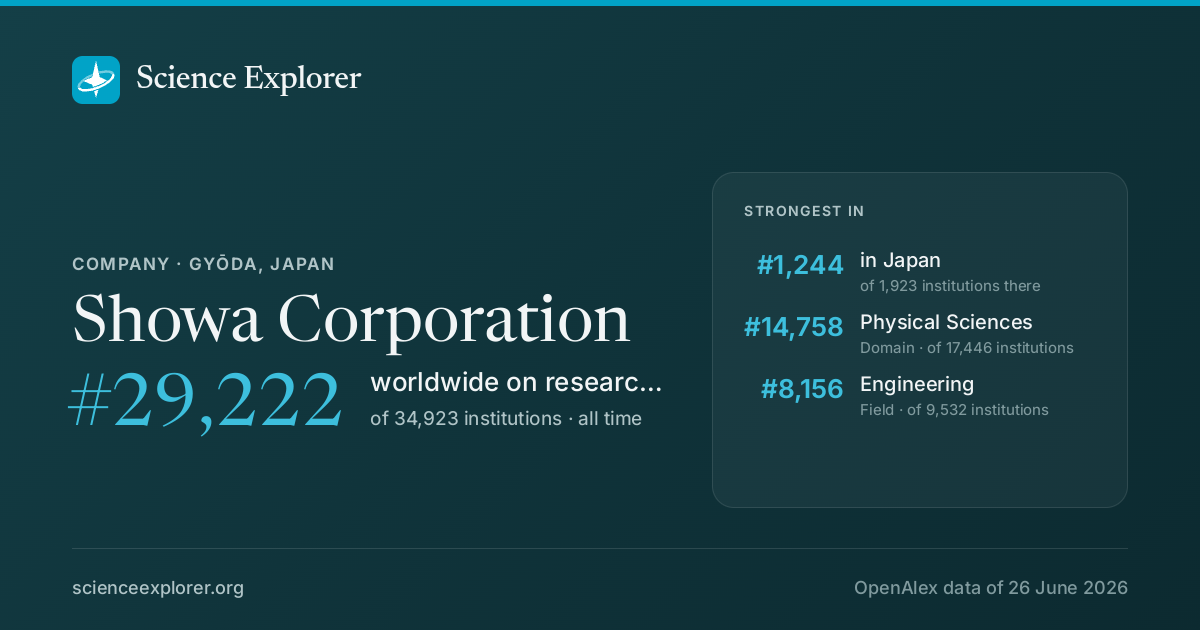
Showa Corporation on Science Explorer

A card with Showa Corporation's standing and the fields it leads in, for a post or a slide. A link to this page previews as the same card.

Download the card

1200 × 630 PNG, sized for social posts, drawn from the latest snapshot.

Badges for a website1Each links back here and updates with every snapshot

Research measures only: rankings here say nothing about teaching, admissions or student experience. Comparable institutions and collaboration partners have tabs of their own, above.

Discussion

Ask a question or share a note about Showa Corporation. Keep it to the research: no personal attacks, advertising or links. Any reader can report a post, which collapses it for everyone until it is opened.
