Textron (United States)

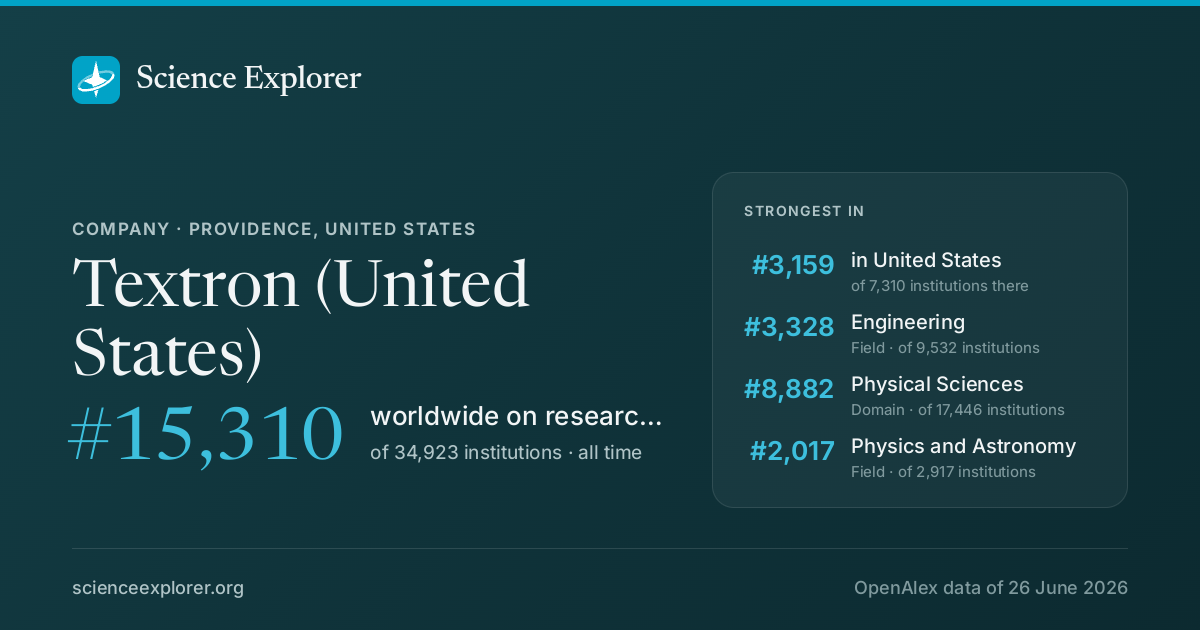
In research, Textron (United States) stands highest in Engineering (#3,328 of 9,532 worldwide), Physical Sciences (#8,882 of 17,446 worldwide) and Physics and Astronomy (#2,017 of 2,917 worldwide), over all time.
- World rank, all time
- #15,310 of 34,923
- Rank in United States
- #3,159 of 7,310
- Research works
- 1.3k ▼ 52% vs 2018-21
- Citations
- 21k 15.9 per fractional work
- Top-10% rate
- 7.4% all institutions 10.0%
- vs its own fields
- 0.86× 1.00× is exactly expected
- Open access
- 12% world 40%
- International
- 2% world 18%
What is Textron (United States) known for in research?
The fields where it stands highest, over all time, ranked among every institution above the floor in each field.
| Field | World rank | Where that sits | Top-10% rate | Works |
|---|---|---|---|---|
| EngineeringField | #3,328 of 9,532 | 8.0% | 714 | |
| Physical SciencesDomain | #8,882 of 17,446 | 7.6% | 1,232 | |
| Physics and AstronomyField | #2,017 of 2,917 | 7.3% | 178 | |
| Aerospace EngineeringSubfield | #1,145 of 1,601 | 6.5% | 165 | |
| Electrical and Electronic EngineeringSubfield | #3,043 of 3,725 | 6.0% | 128 |
Each strip is that field's whole ranked pool, with the notch where Textron (United States) sits in it, in the colour of the band that rank falls in. The track under the rate is the rate itself: it carries no average mark, because the average differs by field (from about 6% in Dentistry to 21% in Economics).
Which fields of science does Textron (United States) work in?
In all years, 92% of research at Textron (United States) is in Physical Sciences, 3% in Life Sciences. Its largest fields are Engineering (53%), Physics and Astronomy (13%), Materials Science (6%). It does 2.2× the world's share of Physical Sciences.
Each ring splits the one inside it: the four domains of science, their fields, their subfields. Size is fractional works in all years. Every slice is a page; the interactive view zooms down to single topics and colours each by how much more of it this institution does than the world.
Its 4 domains and 24 fields, with their numbers
- Physical Sciences1,23291.7%
- Engineering71453.1%
- Physics and Astronomy17813.3%
- Materials Science836.2%
- Earth and Planetary Sciences624.6%
- Mathematics594.4%
- Computer Science443.3%
- Environmental Science403.0%
- Chemistry342.5%
- Energy90.7%
- Chemical Engineering80.6%
- Life Sciences403.0%
- Social Sciences382.8%
- Health Sciences342.5%
- Medicine312.3%
- Health Professions20.1%
- Dentistry00.0%
- Nursing00.0%
Field profile
Location quotient across every field it publishes in: outside the ring is more than an institution of this size would be expected to publish, inside it is less.
Rings at 0.5×, 1× and 2×. Widest outward: Dentistry, 8.2×. Every wedge is a field page.
All 14 fields, with their numbers
- Dentistry8.15×0 works
- Engineering1.68×3 works
- Economics, Econometrics and Finance1.54×0 works
- Business, Management and Accounting1.36×0 works
- Agricultural and Biological Sciences1.34×1 works
- Decision Sciences1.34×0 works
- Health Professions1.25×0 works
- Social Sciences1.22×2 works
- Medicine1.18×2 works
- Environmental Science1.12×1 works
- Computer Science0.76×1 works
- Arts and Humanities0.57×0 works
- Psychology0.22×0 works
- Biochemistry, Genetics and Molecular Biology0.06×0 works
- Dentistry 8.2×
- Engineering 1.7×
- Economics, Econometrics and Finance 1.5×
- Business, Management and Accounting 1.4×
- Agricultural and Biological Sciences 1.3×
- Decision Sciences 1.3×
- Health Professions 1.2×
- Social Sciences 1.2×
- Medicine 1.2×
- Environmental Science 1.1×
- Computer Science 0.8×
- Arts and Humanities 0.6×
- Psychology 0.2×
- Biochemistry, Genetics and Molecular Biology 0.1×
Who are the top researchers at Textron (United States)?
Ranked on the quality score, Nelson H. Kemp, Jerrold M. Yos and T. Vasilos lead among researchers whose main affiliation is Textron (United States).
- 1
Nelson H. Kemp
 United States · #2,254,166 worldwide
967 citations · 35 works
- 2
Jerrold M. Yos
United States · #2,629,490 worldwide
1.7k citations · 22 works
- 3
T. Vasilos
United States · #2,731,633 worldwide
1.9k citations · 82 works
- 4
Frederick R. Riddell
United States · #3,262,818 worldwide
1.7k citations · 29 works
- 5
Charles K. Wilkinson
United States · #3,327,670 worldwide
441 citations · 53 works
- 6
W. L. Bade
United States · #3,443,471 worldwide
720 citations · 22 works
- 7
R. H. Duff
United States · #3,512,318 worldwide
304 citations · 13 works
- 8
Ronald L. Fante
United States · #3,873,710 worldwide
5.4k citations · 208 works
- 9
Mark A. Kovacs
United States · #3,968,799 worldwide
485 citations · 40 works
- 10
BARRY L. REEVES
United States · #3,987,231 worldwide
589 citations · 33 works
Which keywords describe research at Textron (United States)?
By fractional works in all years, weighted toward what it does more of than the world: Heat Transfer, Large-Eddy Simulation, Numerical Methods, Kinetic Theory, Boltzmann Equation, Rarefied Flows, Vortex Dynamics and Turbulent Flows.
- Orbit Determination
- Cryogenic Storage
- Thermodynamic Modeling
- Air Quality
- Multiphase Flow
- Thermal Analysis
- Spectroscopy
- Shock-Wave Interactions
- Laser Oscillation
- Semiconductor Industry
- Plasma Etching
- Numerical Simulation
- Adaptive Mesh Refinement
- Remote Sensing
- Boundary Layer Transition
- Mechanical Properties
- Turbulent Flows
- Rarefied Flows
- Kinetic Theory
- Large-Eddy Simulation
- Heat Transfer
- Numerical Methods
- Boltzmann Equation
- Vortex Dynamics
- Fluid Mechanics
- Frequency Conversion
- Particle Image Velocimetry
- Electric Propulsion
- High-Order Schemes
- Solar Wind
- Radial Basis Functions
- Electric Discharge
- Combustion Instabilities
- Turbulence Modeling
- Thermal Management
- Composite Materials
- Turbulence
- Two-Phase Flow
- Finite Element Method
- Liquefied Natural Gas (LNG)
Size is fractional works in all years in the topics tagged with each word; colour is the word's share of this institution's work against its share of the world's. The 40 words are chosen for being large and distinctive. Each links to the topic it comes from most.
All 40 words, with their numbers
- Heat Transfer81▲ 12×18 topics
- Large-Eddy Simulation62▲ 19×5 topics
- Numerical Methods51▲ 33×5 topics
- Kinetic Theory47▲ 58×2 topics
- Boltzmann Equation45▲ 97×1 topic
- Rarefied Flows45▲ 97×1 topic
- Vortex Dynamics41▲ 18×4 topics
- Turbulent Flows39▲ 22×3 topics
- Fluid Mechanics38▲ 28×2 topics
- Mechanical Properties38▲ 3.0×25 topics
- Frequency Conversion38▲ 28×3 topics
- Boundary Layer Transition38▲ 29×1 topic
- Particle Image Velocimetry38▲ 29×1 topic
- Remote Sensing34▲ 2.3×15 topics
- Electric Propulsion30▲ 38×2 topics
- Adaptive Mesh Refinement27▲ 22×2 topics
- High-Order Schemes27▲ 22×2 topics
- Numerical Simulation27▲ 6.0×10 topics
- Solar Wind26▲ 14×2 topics
- Plasma Etching26▲ 43×1 topic
- Radial Basis Functions26▲ 20×2 topics
- Semiconductor Industry26▲ 43×1 topic
- Electric Discharge26▲ 54×1 topic
- Laser Oscillation26▲ 54×1 topic
- Combustion Instabilities25▲ 25×2 topics
- Shock-Wave Interactions25▲ 34×1 topic
- Turbulence Modeling25▲ 34×1 topic
- Spectroscopy22▲ 5.2×10 topics
- Thermal Management22▲ 5.6×8 topics
- Thermal Analysis21▲ 11×8 topics
- Composite Materials21▲ 6.8×8 topics
- Multiphase Flow21▲ 16×4 topics
- Turbulence20▲ 10×5 topics
- Air Quality20▲ 8.0×5 topics
- Two-Phase Flow18▲ 15×4 topics
- Thermodynamic Modeling18▲ 8.0×3 topics
- Finite Element Method18▲ 10×7 topics
- Cryogenic Storage18▲ 36×1 topic
- Liquefied Natural Gas (LNG)18▲ 36×1 topic
- Orbit Determination17▲ 29×2 topics
Which research topics does Textron (United States) publish most on?
By volume in 2022-now: Underwater Vehicles and Communication Systems, Systems Engineering Methodologies and Applications, Palliative Care and End-of-Life Issues and Water and Wastewater Treatment.
Area is fractional works; colour is the subfield each topic belongs to.
- 1 Underwater Vehicles and Communication Systems Ocean Engineering 1 works
- 2 Systems Engineering Methodologies and Applications Control and Systems Engineering 0 works
- 3 Palliative Care and End-of-Life Issues Public Health, Environmental and Occupational Health 0 works
- 4 Water and Wastewater Treatment Computational Mechanics 0 works
- 5 Retirement, Disability, and Employment Demography 0 works
- 6 Transport and Logistics Innovations Industrial and Manufacturing Engineering 0 works
- 7 Aviation Industry Analysis and Trends General Economics, Econometrics and Finance 0 works
- 8 Service and Product Innovation Marketing 0 works
- 9 Education and Digital Technologies Sociology and Political Science 0 works
- 10 Diverse Scientific Research in Ukraine Global and Planetary Change 0 works
How open and international is its research?
Against the world's own shares: the tick on each track. Both are shares of its output, so they sit on one scale and can be read against each other as well as against the world.
World: 40% of research is openly available.
World: 18% is written across borders.
How has Textron (United States)'s research output changed?
Output in 2022-2025 was 52% lower than in 2018-2021.
The same series as a ribbon: one cell per year, darker for more. The line above answers how much; this answers when.
Its share of all research
Growing output can still be a shrinking share: all of science grows. This is Textron (United States) as a percentage of every work published that year, 0.000032% in 2024.
Fractional works of Textron (United States) over all fractional works that year. How the balance of science has shifted.
Other research institutions in Providence
- Brown University
- Providence College
- Rhode Island College
- University Gastroenterology
- Lifespan
- Healthcentric Advisors
- Rhode Island Department of Health
- Rhode Island School of Design


Share Textron (United States)'s ranking
Badges for a website1Each links back here and updates with every snapshot

Research measures only: rankings here say nothing about teaching, admissions or student experience. Comparable institutions and collaboration partners have tabs of their own, above.
Discussion
Ask a question or share a note about Textron (United States). Posts are plain text and can be reported.