Science Explorer Back to mapMap
University · Providence · United States

Providence College

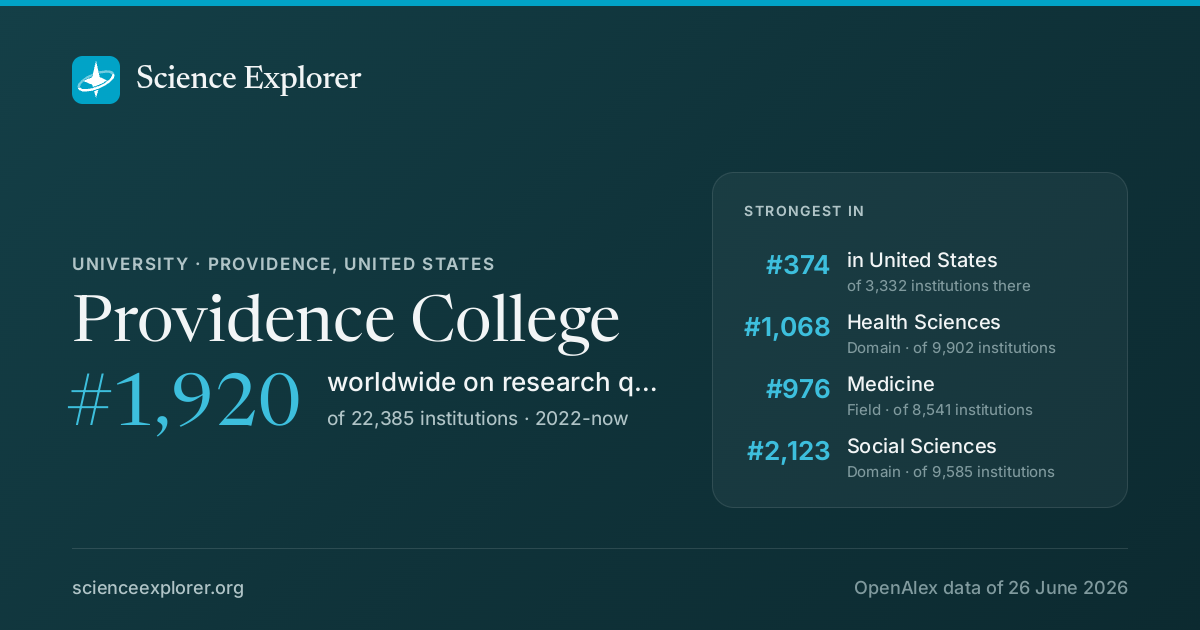
In research, Providence College stands highest in Health Sciences (#1,068 of 9,902 worldwide), Medicine (#976 of 8,541 worldwide) and Social Sciences (#2,123 of 9,585 worldwide), 2022-now. Relative to its size it is most specialised in Music, Philosophy and Experimental and Cognitive Psychology (Music is 15.0× its share of world research).

World rank, 2022-now
#1,920
of 22,385 · #1,187 all time
Rank in United States
#374
of 3,332
Research works
11k
▼ 6% vs 2018-21
Citations
226k
21.1 per fractional work
Top-10% rate
8.9%
all institutions 10.0%
vs its own fields
0.88×
1.00× is exactly expected
Open access
30%
world 40%
International
12%
world 18%

What is Providence College known for in research?

The fields where it stands highest, 2022-now, ranked among every institution above the floor in each field.

FieldWorld rankWhere that sitsTop-10% rateWorksAll time
Health SciencesDomain #1,068 of 9,902 10.1%704 #845
MedicineField #976 of 8,541 10.2%620 #788
Social SciencesDomain #2,123 of 9,585 8.6%552 #942
Social SciencesField #2,093 of 5,988 8.9%226 #1166
Life SciencesDomain #2,432 of 6,403 8.3%180 #1968
Physical SciencesDomain #4,172 of 10,670 9.1%215 #1500
EngineeringField #3,096 of 5,901 10.7%78 #1670
PsychologyField #1,113 of 2,121 7.4%113 #615
Health ProfessionsField #998 of 1,895 9.9%75 #757
Biochemistry, Genetics and Molecular BiologyField #1,659 of 2,964 7.8%86 #1778

Each strip is that field's whole ranked pool, with the notch where Providence College sits in it, in the colour of the band that rank falls in. The track under the rate is the rate itself: it carries no average mark, because the average differs by field (from about 6% in Dentistry to 21% in Economics).

Which of those standings moved

The same fields on both windows: where it stood over the whole record, and where it stands in 2022-now. The distance is the story, and it is the one thing the two rank columns above cannot show.

  1. Health Sciences#845 #1,068
  2. Medicine#788 #976
  3. Social Sciences#942 #2,123
  4. Social Sciences#1,166 #2,093
  5. Life Sciences#1,968 #2,432
  6. Physical Sciences#1,500 #4,172
  7. Engineering#1,670 #3,096
  8. Psychology#615 #1,113
  9. Health Professions#757 #998
  10. Biochemistry, Genetics and Molecular Biology#1,778 #1,659
all time2022-now, better2022-now, worse

A dot further right is a better standing. Fields it was not ranked in over the whole record are left out.

Which fields of science does Providence College work in?

In 2022-now, 40% of research at Providence College is in Health Sciences, 36% in Social Sciences. Its largest fields are Medicine (35%), Social Sciences (14%), Arts and Humanities (9%). It does 1.7× the world's share of Health Sciences.

Health Sciences: 778 fractional works · 40.1% of its workMedicine: 674 fractional works · 34.8% of its workSurgery: 68 fractional works · 3.5% of its workEpidemiology: 62 fractional works · 3.2% of its workPulmonary and Respiratory Medicine: 58 fractional works · 3.0% of its workPublic Health, Environmental and Occupational Health: 54 fractional works · 2.8% of its workOncology: 50 fractional works · 2.6% of its workCardiology and Cardiovascular Medicine: 39 fractional works · 2.0% of its workPhysiology: 33 fractional works · 1.7% of its workPediatrics, Perinatology and Child Health: 24 fractional works · 1.2% of its workInfectious Diseases: 24 fractional works · 1.2% of its workPsychiatry and Mental health: 24 fractional works · 1.2% of its workNeurology: 23 fractional works · 1.2% of its workEndocrinology, Diabetes and Metabolism: 22 fractional works · 1.1% of its workRadiology, Nuclear Medicine and Imaging: 18 fractional works · 0.9% of its workRheumatology: 18 fractional works · 0.9% of its workHematology: 17 fractional works · 0.9% of its workPathology and Forensic Medicine: 17 fractional works · 0.9% of its workReproductive Medicine: 13 fractional works · 0.7% of its workPharmacology: 12 fractional works · 0.6% of its workObstetrics and Gynecology: 11 fractional works · 0.6% of its workGenetics: 11 fractional works · 0.6% of its workNephrology: 9 fractional works · 0.5% of its workEmergency Medicine: 8 fractional works · 0.4% of its workDermatology: 7 fractional works · 0.4% of its workRehabilitation: 7 fractional works · 0.4% of its workGeriatrics and Gerontology: 6 fractional works · 0.3% of its workOphthalmology: 5 fractional works · 0.3% of its workCritical Care and Intensive Care Medicine: 5 fractional works · 0.2% of its workAnesthesiology and Pain Medicine: 4 fractional works · 0.2% of its workSmaller subfields together: 27 fractional works · 1.4% of its workHealth Professions: 91 fractional works · 4.7% of its workGeneral Health Professions: 59 fractional works · 3.1% of its workOccupational Therapy: 6 fractional works · 0.3% of its workSpeech and Hearing: 6 fractional works · 0.3% of its workEmergency Medical Services: 6 fractional works · 0.3% of its workHealth Information Management: 4 fractional works · 0.2% of its workSmaller subfields together: 10 fractional works · 0.5% of its workNursing: 10 fractional works · 0.5% of its workNutrition and Dietetics: 6 fractional works · 0.3% of its workSmaller subfields together: 3 fractional works · 0.2% of its workDentistry: 2 fractional works · 0.1% of its workVeterinary: 1 fractional works · 0.1% of its workSocial Sciences: 695 fractional works · 35.9% of its workSocial Sciences: 271 fractional works · 14.0% of its workSociology and Political Science: 97 fractional works · 5.0% of its workEducation: 40 fractional works · 2.1% of its workPolitical Science and International Relations: 27 fractional works · 1.4% of its workGender Studies: 19 fractional works · 1.0% of its workAnthropology: 16 fractional works · 0.9% of its workHealth: 15 fractional works · 0.8% of its workCultural Studies: 13 fractional works · 0.7% of its workSafety Research: 8 fractional works · 0.4% of its workDemography: 7 fractional works · 0.4% of its workCommunication: 7 fractional works · 0.3% of its workLaw: 5 fractional works · 0.3% of its workLibrary and Information Sciences: 4 fractional works · 0.2% of its workSmaller subfields together: 13 fractional works · 0.7% of its workArts and Humanities: 166 fractional works · 8.6% of its workPhilosophy: 37 fractional works · 1.9% of its workLiterature and Literary Theory: 27 fractional works · 1.4% of its workMusic: 24 fractional works · 1.2% of its workHistory: 17 fractional works · 0.9% of its workVisual Arts and Performing Arts: 13 fractional works · 0.7% of its workReligious studies: 13 fractional works · 0.7% of its workHistory and Philosophy of Science: 10 fractional works · 0.5% of its workArcheology: 8 fractional works · 0.4% of its workClassics: 7 fractional works · 0.4% of its workSmaller subfields together: 10 fractional works · 0.5% of its workPsychology: 148 fractional works · 7.6% of its workClinical Psychology: 57 fractional works · 2.9% of its workExperimental and Cognitive Psychology: 38 fractional works · 1.9% of its workSocial Psychology: 31 fractional works · 1.6% of its workApplied Psychology: 10 fractional works · 0.5% of its workDevelopmental and Educational Psychology: 8 fractional works · 0.4% of its workSmaller subfields together: 4 fractional works · 0.2% of its workEconomics, Econometrics and Finance: 53 fractional works · 2.7% of its workEconomics and Econometrics: 42 fractional works · 2.2% of its workFinance: 9 fractional works · 0.4% of its workSmaller subfields together: 3 fractional works · 0.2% of its workBusiness, Management and Accounting: 47 fractional works · 2.4% of its workAccounting: 12 fractional works · 0.6% of its workStrategy and Management: 10 fractional works · 0.5% of its workOrganizational Behavior and Human Resource Management: 8 fractional works · 0.4% of its workMarketing: 7 fractional works · 0.4% of its workManagement Information Systems: 4 fractional works · 0.2% of its workSmaller subfields together: 5 fractional works · 0.3% of its workDecision Sciences: 10 fractional works · 0.5% of its workManagement Science and Operations Research: 5 fractional works · 0.2% of its workSmaller subfields together: 6 fractional works · 0.3% of its workPhysical Sciences: 254 fractional works · 13.1% of its workEngineering: 86 fractional works · 4.4% of its workElectrical and Electronic Engineering: 34 fractional works · 1.8% of its workBiomedical Engineering: 19 fractional works · 1.0% of its workAerospace Engineering: 5 fractional works · 0.3% of its workMechanical Engineering: 5 fractional works · 0.2% of its workSmaller subfields together: 24 fractional works · 1.2% of its workComputer Science: 55 fractional works · 2.9% of its workArtificial Intelligence: 17 fractional works · 0.9% of its workInformation Systems: 12 fractional works · 0.6% of its workComputer Vision and Pattern Recognition: 8 fractional works · 0.4% of its workComputer Networks and Communications: 5 fractional works · 0.3% of its workComputational Theory and Mathematics: 4 fractional works · 0.2% of its workSmaller subfields together: 9 fractional works · 0.5% of its workEnvironmental Science: 41 fractional works · 2.1% of its workEcology: 13 fractional works · 0.7% of its workHealth, Toxicology and Mutagenesis: 7 fractional works · 0.4% of its workGlobal and Planetary Change: 7 fractional works · 0.3% of its workManagement, Monitoring, Policy and Law: 4 fractional works · 0.2% of its workSmaller subfields together: 10 fractional works · 0.5% of its workPhysics and Astronomy: 21 fractional works · 1.1% of its workAtomic and Molecular Physics, and Optics: 7 fractional works · 0.4% of its workAstronomy and Astrophysics: 5 fractional works · 0.3% of its workSmaller subfields together: 8 fractional works · 0.4% of its workMathematics: 19 fractional works · 1.0% of its workStatistics and Probability: 5 fractional works · 0.3% of its workGeometry and Topology: 4 fractional works · 0.2% of its workSmaller subfields together: 10 fractional works · 0.5% of its workEarth and Planetary Sciences: 11 fractional works · 0.6% of its workOceanography: 5 fractional works · 0.3% of its workSmaller subfields together: 6 fractional works · 0.3% of its workMaterials Science: 9 fractional works · 0.5% of its workMaterials Chemistry: 4 fractional works · 0.2% of its workSmaller subfields together: 5 fractional works · 0.3% of its workChemistry: 7 fractional works · 0.4% of its workEnergy: 3 fractional works · 0.2% of its workChemical Engineering: 2 fractional works · 0.1% of its workLife Sciences: 211 fractional works · 10.9% of its workBiochemistry, Genetics and Molecular Biology: 97 fractional works · 5.0% of its workMolecular Biology: 47 fractional works · 2.4% of its workGenetics: 21 fractional works · 1.1% of its workCancer Research: 13 fractional works · 0.7% of its workCell Biology: 4 fractional works · 0.2% of its workSmaller subfields together: 12 fractional works · 0.6% of its workNeuroscience: 46 fractional works · 2.4% of its workCognitive Neuroscience: 25 fractional works · 1.3% of its workNeurology: 8 fractional works · 0.4% of its workCellular and Molecular Neuroscience: 5 fractional works · 0.3% of its workSmaller subfields together: 7 fractional works · 0.4% of its workAgricultural and Biological Sciences: 32 fractional works · 1.7% of its workPlant Science: 11 fractional works · 0.6% of its workFood Science: 8 fractional works · 0.4% of its workEcology, Evolution, Behavior and Systematics: 4 fractional works · 0.2% of its workSmaller subfields together: 9 fractional works · 0.5% of its workImmunology and Microbiology: 30 fractional works · 1.5% of its workImmunology: 21 fractional works · 1.1% of its workMicrobiology: 4 fractional works · 0.2% of its workSmaller subfields together: 5 fractional works · 0.3% of its workPharmacology, Toxicology and Pharmaceutics: 5 fractional works · 0.3% of its workALL ITS WORKProvidenceCollege1,938fractional works, 2022-now
Life Sciences11%Physical Sciences13%Health Sciences40%Social Sciences36%

Each ring splits the one inside it: the four domains of science, their fields, their subfields. Size is fractional works in 2022-now. Every slice is a page; the interactive view zooms down to single topics and colours each by how much more of it this institution does than the world.

Its 4 domains and 26 fields, with their numbers
    1. Medicine67434.8%
    2. Health Professions914.7%
    3. Nursing100.5%
    4. Dentistry20.1%
    5. Veterinary10.1%
    1. Social Sciences27114.0%
    2. Arts and Humanities1668.6%
    3. Psychology1487.6%
    4. Economics, Econometrics and Finance532.7%
    5. Business, Management and Accounting472.4%
    6. Decision Sciences100.5%
    1. Engineering864.4%
    2. Computer Science552.9%
    3. Environmental Science412.1%
    4. Physics and Astronomy211.1%
    5. Mathematics191.0%
    6. Earth and Planetary Sciences110.6%
    7. Materials Science90.5%
    8. Chemistry70.4%
    9. Energy30.2%
    10. Chemical Engineering20.1%
    1. Biochemistry, Genetics and Molecular Biology975.0%
    2. Neuroscience462.4%
    3. Agricultural and Biological Sciences321.7%
    4. Immunology and Microbiology301.5%
    5. Pharmacology, Toxicology and Pharmaceutics50.3%
All of science, and how each field's share has moved since 1950: the Science domain explorer

What does Providence College specialise in?

Where its research is concentrated relative to its size: Music takes 15.0× the share of its output that it takes of world research.

  1. MusicSubfield · 23.8 works15×
  2. PhilosophySubfield · 36.9 works4.4×
  3. Experimental and Cognitive PsychologySubfield · 37.6 works4.1×
← less than its size predicts1×more →

Location quotient, a volume reading rather than an impact one. It surfaces small, lopsided specialities.

Field profile

Location quotient across every field it publishes in: outside the ring is more than an institution of this size would be expected to publish, inside it is less.

Agricultural and Biological Sciences: 0.35× its world share, 32 worksAgricultural and Bio…Biochemistry, Genetics and Molecular Biology: 0.94× its world share, 98 worksBiochemistry, Geneti…Immunology and Microbiology: 1.53× its world share, 30 worksImmunology and Micro…Neuroscience: 1.45× its world share, 46 worksNeurosciencePharmacology, Toxicology and Pharmaceutics: 0.78× its world share, 5 worksPharmacology, Toxico…Chemical Engineering: 0.24× its world share, 2 worksChemical EngineeringChemistry: 0.23× its world share, 7 worksChemistryComputer Science: 0.37× its world share, 55 worksComputer ScienceEarth and Planetary Sciences: 0.36× its world share, 11 worksEarth and Planetary …Energy: 0.17× its world share, 3 worksEnergyEngineering: 0.30× its world share, 86 worksEngineeringEnvironmental Science: 0.42× its world share, 41 worksEnvironmental ScienceMaterials Science: 0.14× its world share, 10 worksMaterials ScienceMathematics: 0.83× its world share, 19 worksMathematicsPhysics and Astronomy: 0.48× its world share, 21 worksPhysics and AstronomyDentistry: 0.16× its world share, 2 worksDentistryHealth Professions: 1.78× its world share, 91 worksHealth ProfessionsMedicine: 1.81× its world share, 674 worksMedicineNursing: 1.03× its world share, 10 worksNursingVeterinary: 0.47× its world share, 1 worksVeterinaryArts and Humanities: 2.97× its world share, 166 worksArts and HumanitiesBusiness, Management and Accounting: 0.76× its world share, 47 worksBusiness, Management…Decision Sciences: 0.55× its world share, 10 worksDecision SciencesEconomics, Econometrics and Finance: 1.28× its world share, 53 worksEconomics, Econometr…Psychology: 2.50× its world share, 148 worksPsychologySocial Sciences: 1.10× its world share, 271 worksSocial Sciences1×world share
more than its size predictsabout as predictedless

Rings at 0.5×, 1× and 2×. Widest outward: Arts and Humanities, 3.0×. Every wedge is a field page.

All 26 fields, with their numbers
  1. Arts and Humanities2.97×166 works
  2. Psychology2.50×148 works
  3. Medicine1.81×674 works
  4. Health Professions1.78×91 works
  5. Immunology and Microbiology1.53×30 works
  6. Neuroscience1.45×46 works
  7. Economics, Econometrics and Finance1.28×53 works
  8. Social Sciences1.10×271 works
  9. Nursing1.03×10 works
  10. Biochemistry, Genetics and Molecular Biology0.94×98 works
  11. Mathematics0.83×19 works
  12. Pharmacology, Toxicology and Pharmaceutics0.78×5 works
  13. Business, Management and Accounting0.76×47 works
  14. Decision Sciences0.55×10 works
  15. Physics and Astronomy0.48×21 works
  16. Veterinary0.47×1 works
  17. Environmental Science0.42×41 works
  18. Computer Science0.37×55 works
  19. Earth and Planetary Sciences0.36×11 works
  20. Agricultural and Biological Sciences0.35×32 works
  21. Engineering0.30×86 works
  22. Chemical Engineering0.24×2 works
  23. Chemistry0.23×7 works
  24. Energy0.17×3 works
  25. Dentistry0.16×2 works
  26. Materials Science0.14×10 works

Who are the top researchers at Providence College?

Ranked on the quality score, Ty J. Gluckman, Gail Vance Civille and Gary L. Grunkemeier lead among researchers whose main affiliation is Providence College.

  1. 1 Ty J. Gluckman United States · #117,639 worldwide 5.3k citations · 136 works
  2. 2 Gail Vance Civille United States · #295,605 worldwide 8.4k citations · 99 works
  3. 3 Gary L. Grunkemeier United States · #327,973 worldwide 18k citations · 291 works
  4. 4 John H. Hospers United States · #330,686 worldwide 1.3k citations · 95 works
  5. 5 Jason W. Tarpley United States · #340,931 worldwide 4k citations · 70 works
  6. 6 Jacob Abraham United States · #459,174 worldwide 5k citations · 209 works
  7. 7 Astrid McKeown United States · #482,480 worldwide 2.6k citations · 151 works
  8. 8 Leslie P. Cousens United States · #487,727 worldwide 5.1k citations · 51 works
  9. 9 Lisa Rietz Yanase United States · #502,602 worldwide 2.4k citations · 32 works
  10. 10 John H. Costello United States · #509,180 worldwide 5.5k citations · 176 works
All ranked researchers at Providence College

What are the most cited papers from Providence College?

The most cited paper from Providence College is "Transcatheter or Surgical Aortic-Valve Replacement in Intermediate-Risk Patients" (Martin B. Leon et al., 2016), with 5,107 citations. Next come "Surviving Sepsis Campaign: International guidelines for management of severe sepsis and septic shock: 2008" (4,947) and "Meta-Analysis of Quantitative Sleep Parameters From Childhood to Old Age in Healthy Individuals: Developing Normative Sleep Values Across the Human Lifespan" (3,386).

Most cited papers
#PaperReleasedCitations
1 Transcatheter or Surgical Aortic-Valve Replacement in Intermediate-Risk Patients Martin B. Leon et al. · New England Journal of Medicine Open access 2 Apr 2016 5,107
2 Surviving Sepsis Campaign: International guidelines for management of severe sepsis and septic shock: 2008 R. Phillip Dellinger et al. · Intensive Care Medicine Open access 3 Dec 2007 4,947
3 Meta-Analysis of Quantitative Sleep Parameters From Childhood to Old Age in Healthy Individuals: Developing Normative Sleep Values Across the Human Lifespan Maurice Moyses Ohayon, Mary A. Carskadon, Christian Guilleminault et al. · SLEEP ReviewOpen access Oct 2004 3,386
4 The antibody aducanumab reduces Aβ plaques in Alzheimer’s disease Jeff Sevigny et al. · Nature 30 Aug 2016 3,131
5 Maintenance Olaparib in Patients with Newly Diagnosed Advanced Ovarian Cancer Kathleen N. Moore et al. · New England Journal of Medicine Open access 21 Oct 2018 2,927
All 60 most cited papers, with filters and sorting

Which keywords describe research at Providence College?

By fractional works in 2022-now, weighted toward what it does more of than the world: Epidemiology, Mental Health, Identity, Risk Factors, Globalization, Quality of Life, Ethics and Inflammation.

▲ more of its work than of the world's◆ about the world's share▼ less than the world's

Size is fractional works in 2022-now in the topics tagged with each word; colour is the word's share of this institution's work against its share of the world's. The 40 words are chosen for being large and distinctive. Each links to the topic it comes from most.

All 40 words, with their numbers
  1. Epidemiology135▲ 1.75×118 topics
  2. Mental Health65▲ 2.3×37 topics
  3. Globalization64▲ 1.68×63 topics
  4. Inflammation61▲ 1.49×75 topics
  5. Quality of Life54▲ 1.93×47 topics
  6. Public Health52▲ 1.86×47 topics
  7. Risk Factors52▲ 2.4×36 topics
  8. Identity51▲ 3.6×42 topics
  9. Treatment42▲ 1.77×44 topics
  10. Depression40▲ 2.3×22 topics
  11. Ethics37▲ 3.7×34 topics
  12. Gender36▲ 3.4×32 topics
  13. Culture35▲ 3.5×20 topics
  14. Literature35▲ 3.3×31 topics
  15. History34▲ 2.5×31 topics
  16. Cardiovascular Disease32▲ 1.47×33 topics
  17. Social Justice30▲ 2.6×25 topics
  18. Philosophy29▲ 3.3×26 topics
  19. Genetics28▲ 2.0×22 topics
  20. Religion28▲ 3.1×27 topics
  21. Clinical Trials27▲ 2.0×19 topics
  22. Nationalism26▲ 3.0×23 topics
  23. Biomarkers26▲ 1.93×17 topics
  24. Colonialism24▲ 2.6×24 topics
  25. Feminism24▲ 4.2×16 topics
  26. Adolescents23▲ 3.3×8 topics
  27. Anxiety23▲ 2.5×11 topics
  28. Neuroprotection21▲ 3.1×12 topics
  29. Race20▲ 8.7×14 topics
  30. Mortality Risk20▲ 4.2×6 topics
  31. Violence19▲ 6.7×10 topics
  32. Clinical Outcomes19▲ 4.5×6 topics
  33. Health Disparities19▲ 3.7×9 topics
  34. Substance Use Disorders18▲ 12×2 topics
  35. Society17▲ 4.7×12 topics
  36. Cognitive Science17▲ 14×3 topics
  37. Stigma16▲ 5.9×5 topics
  38. Theology15▲ 8.3×4 topics
  39. Music14▲ 14×4 topics
  40. Sound Art14▲ 219×1 topic

Which research topics does Providence College publish most on?

By volume in 2022-now: Sound Studies and Aurality, Acute Ischemic Stroke Management, Multiple Myeloma Research and Treatments and Music History and Culture.

  1. 1 Sound Studies and Aurality Experimental and Cognitive Psychology 14 works
  2. 2 Acute Ischemic Stroke Management Epidemiology 11 works
  3. 3 Multiple Myeloma Research and Treatments Hematology 11 works
  4. 4 Music History and Culture Music 10 works
  5. 5 Opioid Use Disorder Treatment Public Health, Environmental and Occupational Health 10 works
  6. 6 Asthma and respiratory diseases Physiology 9 works
  7. 7 Dementia and Cognitive Impairment Research Psychiatry and Mental health 9 works
  8. 8 Substance Abuse Treatment and Outcomes Epidemiology 8 works
  9. 9 Diverse Musicological Studies Music 8 works
  10. 10 Cerebrovascular and Carotid Artery Diseases Pulmonary and Respiratory Medicine 7 works

How open and international is its research?

Against the world's own shares: the tick on each track. Both are shares of its output, so they sit on one scale and can be read against each other as well as against the world.

openly available29.8%not open70.2%

World: 40% of research is openly available.

with international co-authors12.4%domestic only87.6%

World: 18% is written across borders.

How has Providence College's research output changed?

Output in 2022-2025 was 6% lower than in 2018-2021.

still counting1990200020102020
grewheldshrank

The same series as a ribbon: one cell per year, darker for more. The line above answers how much; this answers when.

Its share of all research

Growing output can still be a shrinking share: all of science grows. This is Providence College as a percentage of every work published that year, 0.0076% in 2024.

still counting0.010%0.020%Providence College0.0057% in 202519801990200020102020

Fractional works of Providence College over all fractional works that year. How the balance of science has shifted.

How much of it reaches the world top 10%

Year by year, against all institutions in the same year.

still counting5%10%15%all institutions10.0% in 2025Providence College9.1% in 2025200020102020

Of each year's output, the share that reached the world's 10% most cited for its field and year. Peak 13.1% in 2010.

Other research institutions in Providence

All research institutions in Providence

Share Providence College's ranking

Providence College on Science Explorer

A card with Providence College's standing and the fields it leads in, for a post or a slide. A link to this page previews as the same card.

Download the card

1200 × 630 PNG, sized for social posts, drawn from the latest snapshot.

Badges for a website1Each links back here and updates with every snapshot

Research measures only: rankings here say nothing about teaching, admissions or student experience. Comparable institutions and collaboration partners have tabs of their own, above.

Discussion

Ask a question or share a note about Providence College. Posts are plain text and can be reported.