Science Explorer Back to mapMap
Discussion
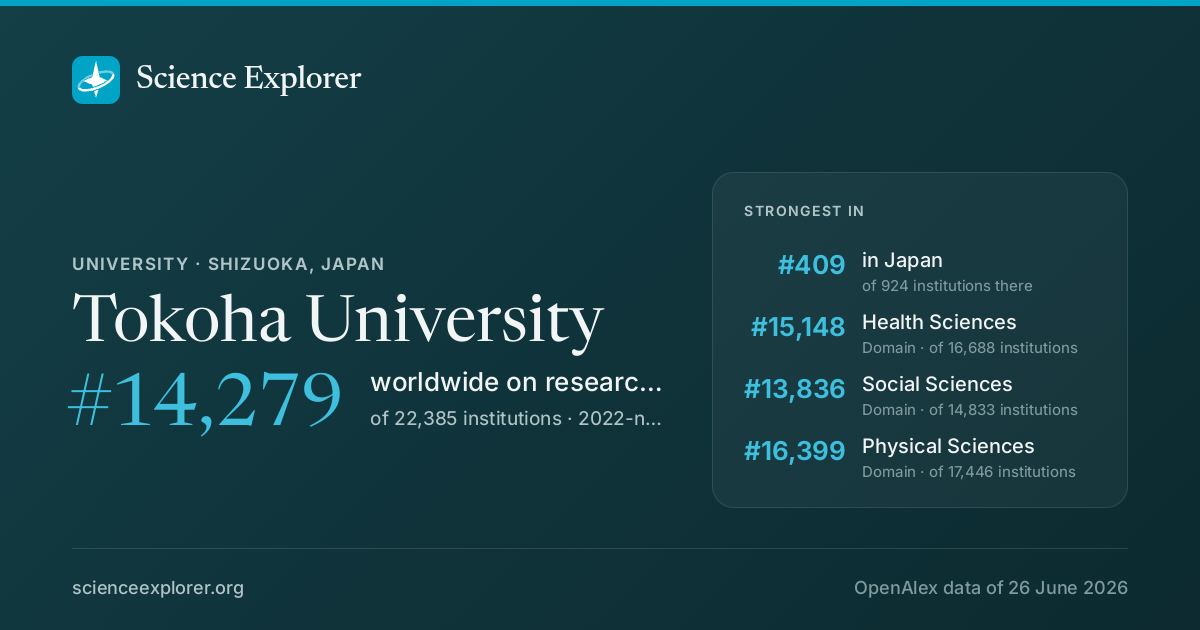
University · Shizuoka · Japan

Tokoha University

In research, Tokoha University stands highest in Health Sciences (#15,148 of 16,688 worldwide), Social Sciences (#13,836 of 14,833 worldwide) and Physical Sciences (#16,399 of 17,446 worldwide), over all time.

World rank, 2022-now
#14,279
of 22,385 · #23,264 all time
Rank in Japan
#409
of 924
Research works
415
▲ 9% vs 2018-21
Citations
1.7k
4.2 per fractional work
Top-10% rate
4.9%
all institutions 10.0%
vs its own fields
0.91×
1.00× is exactly expected
Open access
64%
world 40%
International
10%
world 18%

What is Tokoha University known for in research?

The fields where it stands highest, over all time, ranked among every institution above the floor in each field.

FieldWorld rankWhere that sitsTop-10% rateWorks
Health SciencesDomain #15,148 of 16,688 4.7%127
Social SciencesDomain #13,836 of 14,833 3.0%127
Physical SciencesDomain #16,399 of 17,446 5.1%123

Each strip is that field's whole ranked pool, with the notch where Tokoha University sits in it, in the colour of the band that rank falls in. The track under the rate is the rate itself: it carries no average mark, because the average differs by field (from about 6% in Dentistry to 21% in Economics).

Which fields of science does Tokoha University work in?

In 2022-now, 36% of research at Tokoha University is in Social Sciences, 36% in Health Sciences. Its largest fields are Medicine (30%), Social Sciences (17%), Psychology (9%). It does 1.5× the world's share of Health Sciences.

Social Sciences: 42 fractional works · 36.2% of its workSocial Sciences: 20 fractional works · 17.0% of its workSociology and Political Science: 6 fractional works · 5.5% of its workEducation: 4 fractional works · 3.6% of its workPolitical Science and International Relations: 3 fractional works · 2.3% of its workCultural Studies: 2 fractional works · 1.9% of its workSafety Research: 2 fractional works · 1.4% of its workTransportation: 1 fractional works · 0.8% of its workDemography: 1 fractional works · 0.6% of its workLinguistics and Language: 0 fractional works · 0.4% of its workLaw: 0 fractional works · 0.3% of its workSmaller subfields together: 0 fractional works · 0.4% of its workPsychology: 11 fractional works · 9.1% of its workSocial Psychology: 5 fractional works · 3.9% of its workDevelopmental and Educational Psychology: 4 fractional works · 3.0% of its workClinical Psychology: 1 fractional works · 1.3% of its workExperimental and Cognitive Psychology: 1 fractional works · 0.6% of its workGeneral Psychology: 0 fractional works · 0.2% of its workSmaller subfields together: 0 fractional works · 0.1% of its workEconomics, Econometrics and Finance: 6 fractional works · 4.8% of its workEconomics and Econometrics: 3 fractional works · 3.0% of its workGeneral Economics, Econometrics and Finance: 2 fractional works · 1.4% of its workFinance: 1 fractional works · 0.5% of its workArts and Humanities: 3 fractional works · 2.5% of its workMusic: 1 fractional works · 1.1% of its workHistory: 0 fractional works · 0.4% of its workLanguage and Linguistics: 0 fractional works · 0.3% of its workLiterature and Literary Theory: 0 fractional works · 0.2% of its workSmaller subfields together: 0 fractional works · 0.4% of its workBusiness, Management and Accounting: 2 fractional works · 1.6% of its workStrategy and Management: 1 fractional works · 1.0% of its workMarketing: 0 fractional works · 0.3% of its workManagement of Technology and Innovation: 0 fractional works · 0.2% of its workSmaller subfields together: 0 fractional works · 0.1% of its workDecision Sciences: 1 fractional works · 1.1% of its workManagement Science and Operations Research: 1 fractional works · 0.9% of its workSmaller subfields together: 0 fractional works · 0.2% of its workHealth Sciences: 42 fractional works · 35.8% of its workMedicine: 35 fractional works · 29.9% of its workSurgery: 6 fractional works · 5.4% of its workPhysiology: 4 fractional works · 3.4% of its workOrthopedics and Sports Medicine: 3 fractional works · 2.5% of its workPharmacology: 2 fractional works · 1.9% of its workRheumatology: 2 fractional works · 1.9% of its workPublic Health, Environmental and Occupational Health: 2 fractional works · 1.8% of its workEpidemiology: 2 fractional works · 1.6% of its workPsychiatry and Mental health: 2 fractional works · 1.6% of its workComplementary and alternative medicine: 2 fractional works · 1.5% of its workCardiology and Cardiovascular Medicine: 1 fractional works · 1.2% of its workRehabilitation: 1 fractional works · 1.1% of its workPulmonary and Respiratory Medicine: 1 fractional works · 1.1% of its workPathology and Forensic Medicine: 1 fractional works · 0.7% of its workNeurology: 1 fractional works · 0.6% of its workGeriatrics and Gerontology: 1 fractional works · 0.5% of its workOncology: 1 fractional works · 0.4% of its workObstetrics and Gynecology: 0 fractional works · 0.4% of its workCritical Care and Intensive Care Medicine: 0 fractional works · 0.4% of its workEndocrinology, Diabetes and Metabolism: 0 fractional works · 0.3% of its workBiochemistry: 0 fractional works · 0.3% of its workInfectious Diseases: 0 fractional works · 0.2% of its workOphthalmology: 0 fractional works · 0.2% of its workAnesthesiology and Pain Medicine: 0 fractional works · 0.2% of its workRadiology, Nuclear Medicine and Imaging: 0 fractional works · 0.2% of its workSmaller subfields together: 1 fractional works · 0.5% of its workHealth Professions: 6 fractional works · 4.8% of its workPhysical Therapy, Sports Therapy and Rehabilitation: 3 fractional works · 2.7% of its workGeneral Health Professions: 2 fractional works · 1.5% of its workOccupational Therapy: 0 fractional works · 0.4% of its workSmaller subfields together: 0 fractional works · 0.2% of its workNursing: 1 fractional works · 0.9% of its workNutrition and Dietetics: 1 fractional works · 0.9% of its workVeterinary: 0 fractional works · 0.1% of its workDentistry: 0 fractional works · 0.1% of its workPhysical Sciences: 23 fractional works · 19.8% of its workComputer Science: 9 fractional works · 7.5% of its workInformation Systems: 4 fractional works · 3.1% of its workArtificial Intelligence: 2 fractional works · 1.9% of its workSignal Processing: 1 fractional works · 0.9% of its workComputer Science Applications: 1 fractional works · 0.6% of its workComputer Networks and Communications: 0 fractional works · 0.4% of its workComputer Vision and Pattern Recognition: 0 fractional works · 0.3% of its workSmaller subfields together: 0 fractional works · 0.3% of its workEngineering: 7 fractional works · 6.1% of its workBiomedical Engineering: 2 fractional works · 2.0% of its workMechanical Engineering: 2 fractional works · 1.4% of its workElectrical and Electronic Engineering: 1 fractional works · 0.9% of its workAerospace Engineering: 1 fractional works · 0.8% of its workIndustrial and Manufacturing Engineering: 0 fractional works · 0.4% of its workOcean Engineering: 0 fractional works · 0.2% of its workSmaller subfields together: 0 fractional works · 0.3% of its workEnvironmental Science: 4 fractional works · 3.5% of its workGlobal and Planetary Change: 1 fractional works · 0.8% of its workNature and Landscape Conservation: 1 fractional works · 0.7% of its workEcology: 1 fractional works · 0.5% of its workPollution: 0 fractional works · 0.3% of its workHealth, Toxicology and Mutagenesis: 0 fractional works · 0.3% of its workManagement, Monitoring, Policy and Law: 0 fractional works · 0.2% of its workIndustrial and Manufacturing Engineering: 0 fractional works · 0.2% of its workSmaller subfields together: 1 fractional works · 0.5% of its workEarth and Planetary Sciences: 2 fractional works · 1.5% of its workGeophysics: 1 fractional works · 0.7% of its workAtmospheric Science: 1 fractional works · 0.6% of its workSmaller subfields together: 0 fractional works · 0.3% of its workChemistry: 0 fractional works · 0.4% of its workAnalytical Chemistry: 0 fractional works · 0.2% of its workSmaller subfields together: 0 fractional works · 0.2% of its workMaterials Science: 0 fractional works · 0.3% of its workMaterials Chemistry: 0 fractional works · 0.3% of its workSmaller subfields together: 0 fractional works · 0.1% of its workChemical Engineering: 0 fractional works · 0.1% of its workEnergy: 0 fractional works · 0.1% of its workPhysics and Astronomy: 0 fractional works · 0.1% of its workLife Sciences: 10 fractional works · 8.1% of its workNeuroscience: 4 fractional works · 3.5% of its workCognitive Neuroscience: 3 fractional works · 2.7% of its workDevelopmental Neuroscience: 0 fractional works · 0.3% of its workNeurology: 0 fractional works · 0.3% of its workSmaller subfields together: 0 fractional works · 0.2% of its workBiochemistry, Genetics and Molecular Biology: 3 fractional works · 2.5% of its workMolecular Biology: 2 fractional works · 1.5% of its workGenetics: 1 fractional works · 0.7% of its workSmaller subfields together: 0 fractional works · 0.3% of its workAgricultural and Biological Sciences: 2 fractional works · 1.9% of its workPlant Science: 1 fractional works · 1.0% of its workInsect Science: 0 fractional works · 0.3% of its workSoil Science: 0 fractional works · 0.3% of its workSmaller subfields together: 0 fractional works · 0.3% of its workPharmacology, Toxicology and Pharmaceutics: 0 fractional works · 0.2% of its workImmunology and Microbiology: 0 fractional works · 0.0% of its workALL ITS WORKTokoha University117fractional works, 2022-now
Life Sciences8%Physical Sciences20%Health Sciences36%Social Sciences36%

Each ring splits the one inside it: the four domains of science, their fields, their subfields. Size is fractional works in 2022-now. Every slice is a page; the interactive view zooms down to single topics and colours each by how much more of it this institution does than the world.

Its 4 domains and 25 fields, with their numbers
    1. Social Sciences2017.0%
    2. Psychology119.1%
    3. Economics, Econometrics and Finance64.8%
    4. Arts and Humanities32.5%
    5. Business, Management and Accounting21.6%
    6. Decision Sciences11.1%
    1. Medicine3529.9%
    2. Health Professions64.8%
    3. Nursing10.9%
    4. Veterinary00.1%
    5. Dentistry00.1%
    1. Computer Science97.5%
    2. Engineering76.1%
    3. Environmental Science43.5%
    4. Earth and Planetary Sciences21.5%
    5. Chemistry00.4%
    6. Materials Science00.3%
    7. Chemical Engineering00.1%
    8. Energy00.1%
    9. Physics and Astronomy00.1%
    1. Neuroscience43.5%
    2. Biochemistry, Genetics and Molecular Biology32.5%
    3. Agricultural and Biological Sciences21.9%
    4. Pharmacology, Toxicology and Pharmaceutics00.2%
    5. Immunology and Microbiology00.0%
All of science, and how each field's share has moved since 1950: the Science domain explorer

Field profile

Location quotient across every field it publishes in: outside the ring is more than an institution of this size would be expected to publish, inside it is less.

Agricultural and Biological Sciences: 0.41× its world share, 2 worksAgricultural and Bio…Biochemistry, Genetics and Molecular Biology: 0.47× its world share, 3 worksBiochemistry, Geneti…Immunology and Microbiology: 0.03× its world share, 0 worksImmunology and Micro…Neuroscience: 2.15× its world share, 4 worksNeurosciencePharmacology, Toxicology and Pharmaceutics: 0.43× its world share, 0 worksPharmacology, Toxico…Chemical Engineering: 0.41× its world share, 0 worksChemical EngineeringChemistry: 0.26× its world share, 0 worksChemistryComputer Science: 0.97× its world share, 9 worksComputer ScienceEarth and Planetary Sciences: 0.97× its world share, 2 worksEarth and Planetary …Energy: 0.15× its world share, 0 worksEnergyEngineering: 0.41× its world share, 7 worksEngineeringEnvironmental Science: 0.71× its world share, 4 worksEnvironmental ScienceMaterials Science: 0.09× its world share, 0 worksMaterials SciencePhysics and Astronomy: 0.06× its world share, 0 worksPhysics and AstronomyDentistry: 0.17× its world share, 0 worksDentistryHealth Professions: 1.83× its world share, 6 worksHealth ProfessionsMedicine: 1.56× its world share, 35 worksMedicineNursing: 1.87× its world share, 1 worksNursingVeterinary: 0.87× its world share, 0 worksVeterinaryArts and Humanities: 0.85× its world share, 3 worksArts and HumanitiesBusiness, Management and Accounting: 0.50× its world share, 2 worksBusiness, Management…Decision Sciences: 1.15× its world share, 1 worksDecision SciencesEconomics, Econometrics and Finance: 2.27× its world share, 6 worksEconomics, Econometr…Psychology: 2.99× its world share, 11 worksPsychologySocial Sciences: 1.35× its world share, 20 worksSocial Sciences1×world share
more than its size predictsabout as predictedless

Rings at 0.5×, 1× and 2×. Widest outward: Psychology, 3.0×. Every wedge is a field page.

All 25 fields, with their numbers
  1. Psychology2.99×11 works
  2. Economics, Econometrics and Finance2.27×6 works
  3. Neuroscience2.15×4 works
  4. Nursing1.87×1 works
  5. Health Professions1.83×6 works
  6. Medicine1.56×35 works
  7. Social Sciences1.35×20 works
  8. Decision Sciences1.15×1 works
  9. Computer Science0.97×9 works
  10. Earth and Planetary Sciences0.97×2 works
  11. Veterinary0.87×0 works
  12. Arts and Humanities0.85×3 works
  13. Environmental Science0.71×4 works
  14. Business, Management and Accounting0.50×2 works
  15. Biochemistry, Genetics and Molecular Biology0.47×3 works
  16. Pharmacology, Toxicology and Pharmaceutics0.43×0 works
  17. Agricultural and Biological Sciences0.41×2 works
  18. Chemical Engineering0.41×0 works
  19. Engineering0.41×7 works
  20. Chemistry0.26×0 works
  21. Dentistry0.17×0 works
  22. Energy0.15×0 works
  23. Materials Science0.09×0 works
  24. Physics and Astronomy0.06×0 works
  25. Immunology and Microbiology0.03×0 works

Who are the top researchers at Tokoha University?

Ranked on the quality score, Kazuya Kito, Michitaka Kato and Yasunari Kurita lead among researchers whose main affiliation is Tokoha University.

  1. 1 Kazuya Kito Japan · #2,077,212 worldwide 159 citations · 20 works
  2. 2 Michitaka Kato Japan · #2,119,283 worldwide 904 citations · 71 works
  3. 3 Yasunari Kurita Japan · #2,934,262 worldwide 104 citations · 26 works
  4. 4 Tadahiro Sado Japan · #3,651,755 worldwide 127 citations · 28 works
  5. 5 Toshiya Tsukamoto Japan · #3,664,299 worldwide 166 citations · 23 works
  6. 6 Tetsuya Amano Japan · #4,041,646 worldwide 1.7k citations · 68 works
  7. 7 Masayoshi Ota Japan · #4,619,136 worldwide 39 citations · 19 works
  8. 8 Peter Hourdequin Japan · #4,761,070 worldwide 16 citations · 15 works
  9. 9 Wataru Nakano Japan · #4,911,894 worldwide 278 citations · 69 works
  10. 10 SungHyek Kim Japan · #4,967,337 worldwide 13 citations · 16 works
All ranked researchers at Tokoha University

What are the most cited papers from Tokoha University?

The most cited paper from Tokoha University is "Risk maps for Antarctic krill under projected Southern Ocean acidification" (So Kawaguchi, Akio Ishida, Robert A. King et al., 2013), with 198 citations. Next come "Low-intensity resistance training with blood flow restriction improves vascular endothelial function and peripheral blood circulation in healthy elderly people" (188) and "Effects of ageing on the total number of muscle fibers and motoneurons of the tibialis anterior and soleus muscles in the rat" (109).

Most cited papers
#PaperReleasedCitations
1 Risk maps for Antarctic krill under projected Southern Ocean acidification So Kawaguchi, Akio Ishida, Robert A. King et al. · Nature Climate Change Open access 5 Jul 2013 198
2 Low-intensity resistance training with blood flow restriction improves vascular endothelial function and peripheral blood circulation in healthy elderly people Ryosuke Shimizu, Kazuki Hotta, Shuhei Yamamoto et al. · European Journal of Applied Physiology 28 Jan 2016 188
3 Effects of ageing on the total number of muscle fibers and motoneurons of the tibialis anterior and soleus muscles in the rat Akihiko Ishihara, Hisashi Naitoh, Shigeru Katsuta · Brain Research Dec 1987 109
4 Low Zinc, Copper, and Manganese Intake is Associated with Depression and Anxiety Symptoms in the Japanese Working Population: Findings from the Eating Habit and Well-Being Study Mieko Nakamura, Ayako Miura, Tomomi Nagahata et al. · Nutrients Open access 15 Apr 2019 101
5 New guidelines for management of febrile seizures in Japan Jun Natsume, Shin-ichiro Hamano, Kuniaki Iyoda et al. · Brain and Development Open access 8 Sep 2016 97
All 60 most cited papers, with filters and sorting

Which keywords describe research at Tokoha University?

By fractional works in 2022-now, weighted toward what it does more of than the world: Epidemiology, Gender, Self-Efficacy, International Relations, Political Economy, Refugees, Online Education and Modernization.

▲ more of its work than of the world's◆ about the world's share▼ less than the world's

Size is fractional works in 2022-now in the topics tagged with each word; colour is the word's share of this institution's work against its share of the world's. The 40 words are chosen for being large and distinctive. Each links to the topic it comes from most.

All 40 words, with their numbers
  1. Epidemiology10▲ 2.0×29 topics
  2. Inflammation5▲ 2.1×20 topics
  3. Gender5▲ 7.4×2 topics
  4. History4▲ 4.5×5 topics
  5. Self-Efficacy4▲ 12×2 topics
  6. Human Rights4▲ 2.9×4 topics
  7. International Relations3▲ 12×2 topics
  8. Political Economy3▲ 11×2 topics
  9. Refugees3▲ 22×3 topics
  10. Culture3▲ 5.1×3 topics
  11. Literature3▲ 4.8×3 topics
  12. Online Education3▲ 14×2 topics
  13. Physical Activity3▲ 5.4×7 topics
  14. Modernization3▲ 14×2 topics
  15. Physical Performance3▲ 25×2 topics
  16. Rehabilitation3▲ 6.0×7 topics
  17. Colonialism3▲ 4.8×2 topics
  18. Migration3▲ 6.7×2 topics
  19. Parkinson's Disease3▲ 9.3×4 topics
  20. Virtual Reality3▲ 4.8×3 topics
  21. Global Burden3▲ 4.1×7 topics
  22. Famine2▲ 318×1 topic
  23. North Korea2▲ 318×1 topic
  24. Physical Education2▲ 17×4 topics
  25. Politics2▲ 8.1×2 topics
  26. Psychological Factors2▲ 10×4 topics
  27. Lifelong Learning2▲ 9.8×2 topics
  28. Low Back Pain2▲ 12×3 topics
  29. Elderly2▲ 8.1×3 topics
  30. Muscle Mass2▲ 18×2 topics
  31. Smart Learning2▲ 64×1 topic
  32. COVID-19 Impact2▲ 11×3 topics
  33. Fall Risk2▲ 41×1 topic
  34. Gait Speed2▲ 41×1 topic
  35. Japan2▲ 87×1 topic
  36. Society2▲ 9.7×1 topic
  37. Chronic Pain2▲ 7.7×3 topics
  38. Cognitive Development2▲ 13×2 topics
  39. Neural Mechanisms2▲ 16×2 topics
  40. Disability2▲ 14×2 topics

Which research topics does Tokoha University publish most on?

By volume in 2022-now: Korean Peninsula Historical and Political Studies, Education and Learning Interventions, Balance, Gait, and Falls Prevention and Japanese History and Culture.

  1. 1 Korean Peninsula Historical and Political Studies Sociology and Political Science 2 works
  2. 2 Education and Learning Interventions Information Systems 2 works
  3. 3 Balance, Gait, and Falls Prevention Physical Therapy, Sports Therapy and Rehabilitation 2 works
  4. 4 Japanese History and Culture Cultural Studies 2 works
  5. 5 Energy, Environment, Economic Growth Economics and Econometrics 2 works
  6. 6 Musculoskeletal pain and rehabilitation Pharmacology 2 works
  7. 7 Nutrition and Health in Aging Physiology 2 works
  8. 8 Children's Physical and Motor Development Developmental and Educational Psychology 2 works
  9. 9 Neuroscience and Music Perception Cognitive Neuroscience 2 works
  10. 10 Aviation Industry Analysis and Trends General Economics, Econometrics and Finance 2 works

How open and international is its research?

Against the world's own shares: the tick on each track. Both are shares of its output, so they sit on one scale and can be read against each other as well as against the world.

openly available63.6%not open36.4%

World: 40% of research is openly available.

with international co-authors9.5%domestic only90.5%

World: 18% is written across borders.

How has Tokoha University's research output changed?

Output in 2022-2025 was 9% higher than in 2018-2021.

still counting1990200020102020
grewheldshrank

The same series as a ribbon: one cell per year, darker for more. The line above answers how much; this answers when.

Its share of all research

Growing output can still be a shrinking share: all of science grows. This is Tokoha University as a percentage of every work published that year, 0.00059% in 2024.

still counting0.00050%0.0010%Tokoha University0.00069% in 202519801990200020102020

Fractional works of Tokoha University over all fractional works that year. How the balance of science has shifted.

How much of it reaches the world top 10%

Year by year, against all institutions in the same year.

still counting5%10%15%all institutions10.0% in 2025Tokoha University5.0% in 20252020

Of each year's output, the share that reached the world's 10% most cited for its field and year. Peak 6.4% in 2019.

Other research institutions in Shizuoka

All research institutions in Shizuoka

Share Tokoha University's ranking

Tokoha University on Science Explorer

A card with Tokoha University's standing and the fields it leads in, for a post or a slide. A link to this page previews as the same card.

Download the card

1200 × 630 PNG, sized for social posts, drawn from the latest snapshot.

Badges for a website1Each links back here and updates with every snapshot

Research measures only: rankings here say nothing about teaching, admissions or student experience. Comparable institutions and collaboration partners have tabs of their own, above.

Discussion

Ask a question or share a note about Tokoha University. Keep it to the research: no personal attacks, advertising or links. Any reader can report a post, which collapses it for everyone until it is opened.