Tun Abdul Razak Research Centre
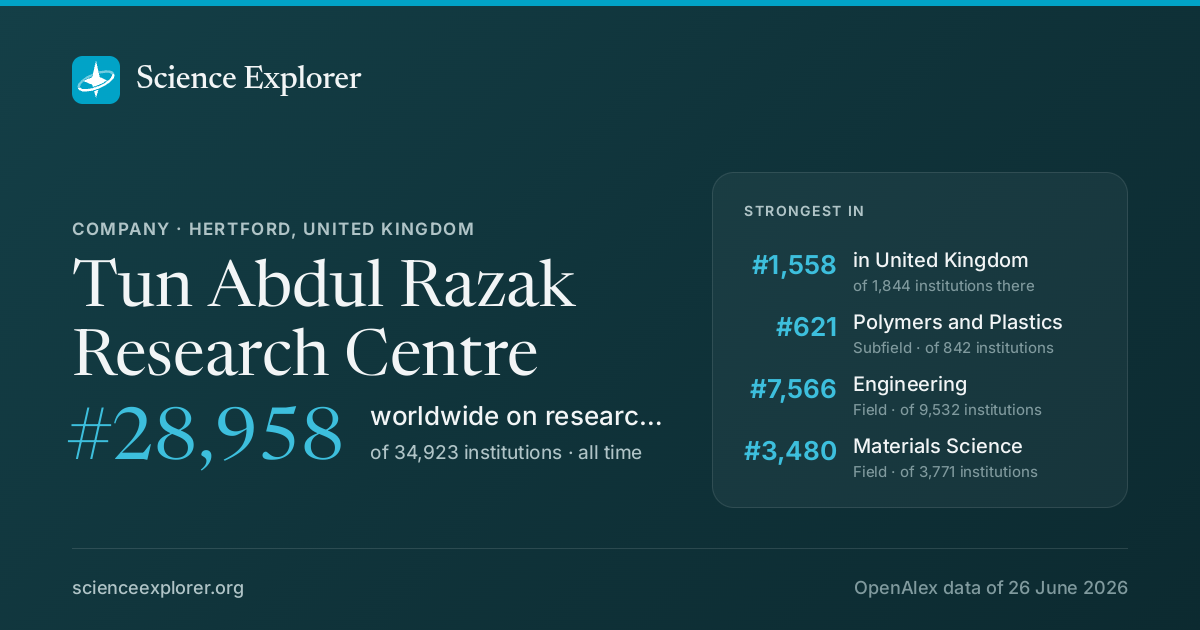
In research, Tun Abdul Razak Research Centre stands highest in Polymers and Plastics (#621 of 842 worldwide), Engineering (#7,566 of 9,532 worldwide) and Materials Science (#3,480 of 3,771 worldwide), over all time.
- World rank, all time
- #28,958 of 34,923
- Rank in United Kingdom
- #1,558 of 1,844
- Research works
- 864 ▼ 9% vs 2018-21
- Citations
- 29k 34.0 per fractional work
- Top-10% rate
- 8.4% all institutions 10.0%
- vs its own fields
- 0.76× 1.00× is exactly expected
- Open access
- 5% world 40%
- International
- 4% world 18%
What is Tun Abdul Razak Research Centre known for in research?
The fields where it stands highest, over all time, ranked among every institution above the floor in each field.
| Field | World rank | Where that sits | Top-10% rate | Works |
|---|---|---|---|---|
| Polymers and PlasticsSubfield | #621 of 842 | 11.6% | 264 | |
| EngineeringField | #7,566 of 9,532 | 20.6% | 252 | |
| Materials ScienceField | #3,480 of 3,771 | 12.0% | 320 | |
| Physical SciencesDomain | #16,158 of 17,446 | 14.2% | 764 |
Each strip is that field's whole ranked pool, with the notch where Tun Abdul Razak Research Centre sits in it, in the colour of the band that rank falls in. The track under the rate is the rate itself: it carries no average mark, because the average differs by field (from about 6% in Dentistry to 21% in Economics).
Which fields of science does Tun Abdul Razak Research Centre work in?
In all years, 88% of research at Tun Abdul Razak Research Centre is in Physical Sciences, 5% in Life Sciences. Its largest fields are Materials Science (37%), Engineering (29%), Chemistry (12%). It does 2.2× the world's share of Physical Sciences.
Each ring splits the one inside it: the four domains of science, their fields, their subfields. Size is fractional works in all years. Every slice is a page; the interactive view zooms down to single topics and colours each by how much more of it this institution does than the world.
Its 4 domains and 25 fields, with their numbers
- Physical Sciences76488.4%
- Materials Science32037.0%
- Engineering25229.1%
- Chemistry10111.7%
- Physics and Astronomy273.2%
- Chemical Engineering242.7%
- Computer Science222.5%
- Environmental Science131.5%
- Earth and Planetary Sciences40.4%
- Energy10.1%
- Mathematics00.1%
- Life Sciences465.3%
- Social Sciences313.6%
- Health Sciences232.7%
- Medicine182.1%
- Health Professions30.4%
- Nursing10.1%
- Dentistry10.1%
Field profile
Location quotient across every field it publishes in: outside the ring is more than an institution of this size would be expected to publish, inside it is less.
Rings at 0.5×, 1× and 2×. Widest outward: Engineering, 4.0×. Every wedge is a field page.
All 9 fields, with their numbers
- Engineering4.00×5 works
- Environmental Science2.65×1 works
- Agricultural and Biological Sciences1.46×1 works
- Business, Management and Accounting1.15×0 works
- Materials Science1.07×0 works
- Earth and Planetary Sciences0.76×0 works
- Social Sciences0.44×0 works
- Medicine0.26×0 works
- Biochemistry, Genetics and Molecular Biology0.10×0 works
Who are the top researchers at Tun Abdul Razak Research Centre?
Ranked on the quality score, W. Moffitt, A. D. Roberts and Geoffrey Gee lead among researchers whose main affiliation is Tun Abdul Razak Research Centre.
- 1
W. Moffitt
 United Kingdom · #290,223 worldwide
5.7k citations · 47 works
- 2
A. D. Roberts
United Kingdom · #907,317 worldwide
13k citations · 94 works
- 3
Geoffrey Gee
United Kingdom · #1,165,236 worldwide
5.3k citations · 118 works
- 4
A. G. Thomas
United Kingdom · #1,337,705 worldwide
11k citations · 208 works
- 5
Leonard Mullins
United Kingdom · #1,380,391 worldwide
4.3k citations · 44 works
- 6
Paul W. Allen
United Kingdom · #1,384,028 worldwide
5.7k citations · 144 works
- 7
Adolf Schallamach
United Kingdom · #1,386,105 worldwide
2.8k citations · 63 works
- 8
P. B. Lindley
United Kingdom · #1,535,748 worldwide
2.5k citations · 33 works
- 9
A. R. Payne
United Kingdom · #1,563,594 worldwide
4k citations · 77 works
- 10
H. W. Greensmith
United Kingdom · #1,778,465 worldwide
1.2k citations · 17 works
Which keywords describe research at Tun Abdul Razak Research Centre?
By fractional works in all years, weighted toward what it does more of than the world: Nanoparticles, Nanocomposites, Polymer, Layered Silicate, Preparation, Mechanical Properties, Rheology and Recycling.
- Biodegradable
- Shape Memory Polymers
- Thermal Properties
- Force Spectroscopy
- Mechanochemistry
- Tribological Performance
- Green Chemistry
- Polyimides
- Catalysis
- Space Applications
- Viscoelasticity
- Friction
- Hyperelastic Modeling
- Biodegradable Polymers
- Polymer Crystallization
- Conducting Polymers
- Recycling
- Mechanical Properties
- Layered Silicate
- Nanocomposites
- Nanoparticles
- Polymer
- Preparation
- Rheology
- Finite Element Analysis
- Polymer Blends
- Polymer Composites
- Arterial Biomechanics
- Renewable Resources
- Thermal Stability
- Elemental Sulfur
- Lithium-Sulfur Batteries
- High Refractive Index
- Polymers
- Biological Applications
- Molecular Modeling
- Atomic Force Microscopy
- Surface Roughness
- Self-Healing
- Drag Reduction
Size is fractional works in all years in the topics tagged with each word; colour is the word's share of this institution's work against its share of the world's. The 40 words are chosen for being large and distinctive. Each links to the topic it comes from most.
All 40 words, with their numbers
- Nanoparticles227▲ 20×13 topics
- Nanocomposites193▲ 29×11 topics
- Polymer141▲ 180×2 topics
- Layered Silicate139▲ 353×1 topic
- Preparation139▲ 353×1 topic
- Mechanical Properties91▲ 11×19 topics
- Rheology82▲ 44×6 topics
- Recycling61▲ 28×4 topics
- Finite Element Analysis60▲ 30×7 topics
- Conducting Polymers58▲ 46×2 topics
- Polymer Blends57▲ 79×1 topic
- Polymer Crystallization57▲ 160×1 topic
- Polymer Composites40▲ 25×5 topics
- Biodegradable Polymers39▲ 34×3 topics
- Arterial Biomechanics37▲ 187×1 topic
- Hyperelastic Modeling37▲ 187×1 topic
- Renewable Resources35▲ 31×3 topics
- Friction35▲ 56×4 topics
- Thermal Stability33▲ 73×2 topics
- Viscoelasticity29▲ 29×3 topics
- Elemental Sulfur28▲ 56×2 topics
- Space Applications27▲ 44×2 topics
- Lithium-Sulfur Batteries27▲ 29×2 topics
- Catalysis26▲ 3.7×11 topics
- High Refractive Index26▲ 75×1 topic
- Polyimides26▲ 75×1 topic
- Polymers25▲ 32×3 topics
- Green Chemistry24▲ 9.3×6 topics
- Biological Applications23▲ 22×4 topics
- Tribological Performance22▲ 41×2 topics
- Molecular Modeling22▲ 40×2 topics
- Mechanochemistry22▲ 23×2 topics
- Atomic Force Microscopy22▲ 46×1 topic
- Force Spectroscopy22▲ 46×1 topic
- Surface Roughness21▲ 19×4 topics
- Thermal Properties20▲ 15×4 topics
- Self-Healing19▲ 84×1 topic
- Shape Memory Polymers19▲ 44×1 topic
- Drag Reduction18▲ 35×2 topics
- Biodegradable18▲ 38×2 topics
Which research topics does Tun Abdul Razak Research Centre publish most on?
By volume in 2022-now: Vehicle Noise and Vibration Control, Seismic Performance and Analysis, Vehicle emissions and performance and Food Waste Reduction and Sustainability.
Area is fractional works; colour is the subfield each topic belongs to.
- 1 Vehicle Noise and Vibration Control Automotive Engineering 1 works
- 2 Seismic Performance and Analysis Civil and Structural Engineering 1 works
- 3 Vehicle emissions and performance Automotive Engineering 0 works
- 4 Food Waste Reduction and Sustainability Food Science 0 works
- 5 Agriculture Sustainability and Environmental Impact Ecology 0 works
- 6 Soil Mechanics and Vehicle Dynamics Civil and Structural Engineering 0 works
- 7 Innovation and Socioeconomic Development Business and International Management 0 works
- 8 Hydraulic and Pneumatic Systems Mechanical Engineering 0 works
- 9 Elasticity and Material Modeling Biomedical Engineering 0 works
- 10 Structural Response to Dynamic Loads Civil and Structural Engineering 0 works
How open and international is its research?
Against the world's own shares: the tick on each track. Both are shares of its output, so they sit on one scale and can be read against each other as well as against the world.
World: 40% of research is openly available.
World: 18% is written across borders.
How has Tun Abdul Razak Research Centre's research output changed?
Output in 2022-2025 was 9% lower than in 2018-2021.
The same series as a ribbon: one cell per year, darker for more. The line above answers how much; this answers when.
Its share of all research
Growing output can still be a shrinking share: all of science grows. This is Tun Abdul Razak Research Centre as a percentage of every work published that year, 0.000063% in 2024.
Fractional works of Tun Abdul Razak Research Centre over all fractional works that year. How the balance of science has shifted.
Other research institutions in Hertford
- Ashwell Museum
- Hertfordshire County Council
- Hertford County Hospital
- Oaklands College
- Institute of Travel & Tourism
- Aspin (United Kingdom)
- OSI Systems (United Kingdom)
- Water-Jel Technologies (United Kingdom)
Share Tun Abdul Razak Research Centre's ranking
Badges for a website1Each links back here and updates with every snapshot

Research measures only: rankings here say nothing about teaching, admissions or student experience. Comparable institutions and collaboration partners have tabs of their own, above.
Discussion
Ask a question or share a note about Tun Abdul Razak Research Centre. Keep it to the research: no personal attacks, advertising or links. Any reader can report a post, which collapses it for everyone until it is opened.