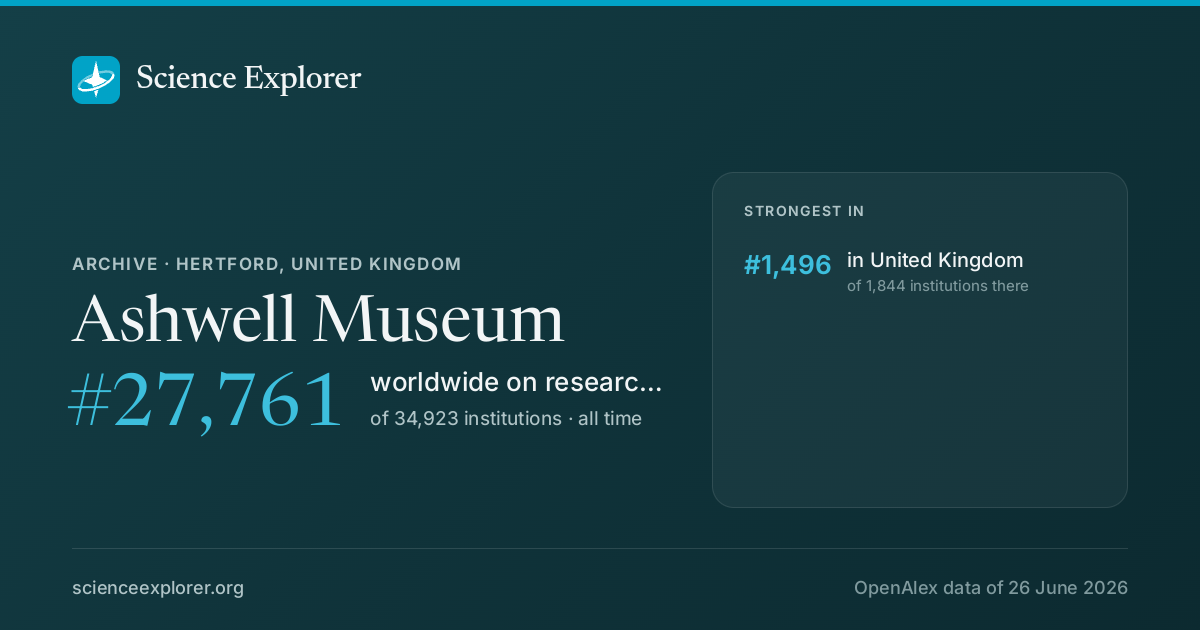
- World rank, all time
- #27,761 of 34,923
- Rank in United Kingdom
- #1,496 of 1,844
- Research works
- 166 ▲ 27% vs 2018-21
- Citations
- 5.3k 31.7 per fractional work
- Top-10% rate
- 10.4% all institutions 10.0%
- vs its own fields
- 0.88× 1.00× is exactly expected
- Open access
- 28% world 40%
- International
- 13% world 18%
Which fields of science does Ashwell Museum work in?
In all years, 36% of research at Ashwell Museum is in Health Sciences, 36% in Social Sciences. Its largest fields are Medicine (26%), Social Sciences (14%), Arts and Humanities (13%). It does 1.6× the world's share of Social Sciences.
Each ring splits the one inside it: the four domains of science, their fields, their subfields. Size is fractional works in all years. Every slice is a page; the interactive view zooms down to single topics and colours each by how much more of it this institution does than the world.
Its 4 domains and 25 fields, with their numbers
- Health Sciences6036.2%
- Medicine4426.2%
- Health Professions127.0%
- Nursing42.3%
- Veterinary10.5%
- Dentistry00.1%
- Social Sciences6035.8%
- Social Sciences2313.7%
- Arts and Humanities2213.4%
- Psychology74.2%
- Business, Management and Accounting42.5%
- Economics, Econometrics and Finance21.1%
- Decision Sciences10.8%
- Physical Sciences2817.1%
- Environmental Science84.7%
- Engineering74.1%
- Chemistry42.4%
- Computer Science42.2%
- Physics and Astronomy21.5%
- Earth and Planetary Sciences21.2%
- Mathematics10.7%
- Chemical Engineering00.2%
- Materials Science00.1%
- Life Sciences1810.9%
Field profile
Location quotient across every field it publishes in: outside the ring is more than an institution of this size would be expected to publish, inside it is less.
Rings at 0.5×, 1× and 2×. Widest outward: Veterinary, 6.4×. Every wedge is a field page.
All 18 fields, with their numbers
- Veterinary6.37×0 works
- Arts and Humanities4.80×3 works
- Pharmacology, Toxicology and Pharmaceutics2.46×0 works
- Earth and Planetary Sciences2.21×1 works
- Health Professions1.97×1 works
- Neuroscience1.60×0 works
- Psychology1.42×1 works
- Social Sciences1.38×3 works
- Medicine1.35×5 works
- Engineering0.89×3 works
- Biochemistry, Genetics and Molecular Biology0.81×1 works
- Business, Management and Accounting0.54×0 works
- Mathematics0.49×0 works
- Environmental Science0.43×0 works
- Agricultural and Biological Sciences0.39×0 works
- Materials Science0.31×0 works
- Nursing0.18×0 works
- Computer Science0.04×0 works
- Veterinary 6.4×
- Arts and Humanities 4.8×
- Pharmacology, Toxicology and Pharmaceutics 2.5×
- Earth and Planetary Sciences 2.2×
- Health Professions 2.0×
- Neuroscience 1.6×
- Psychology 1.4×
- Social Sciences 1.4×
- Medicine 1.4×
- Engineering 0.9×
- Biochemistry, Genetics and Molecular Biology 0.8×
- Business, Management and Accounting 0.5×
- Mathematics 0.5×
- Environmental Science 0.4×
- Agricultural and Biological Sciences 0.4×
- Materials Science 0.3×
- Nursing 0.2×
- Computer Science 0.0×
Who are the top researchers at Ashwell Museum?
Ranked on the quality score, Margaret Ashwell, Sigrid A. Gibson and Anne de la Hunty lead among researchers whose main affiliation is Ashwell Museum.
- 1
Margaret Ashwell
 United Kingdom · #534,207 worldwide
10k citations · 137 works
- 2
Sigrid A. Gibson
United Kingdom · #574,774 worldwide
6.6k citations · 81 works
- 3
Anne de la Hunty
United Kingdom · #1,323,063 worldwide
877 citations · 26 works
- 4
Egon Wellesz
United Kingdom · #2,508,556 worldwide
450 citations · 148 works
- 5
Roderick A. Porter
United Kingdom · #2,647,975 worldwide
1.2k citations · 37 works
- 6
Mervyn Miller
United Kingdom · #2,781,312 worldwide
158 citations · 24 works
- 7
Jeremy Harte
United Kingdom · #3,867,694 worldwide
262 citations · 64 works
- 8
Rosemary Luling Haughton
United Kingdom · #4,412,642 worldwide
79 citations · 38 works
- 9
Margaret Ashwell
United Kingdom · #4,670,273 worldwide
2.4k citations · 96 works
Which keywords describe research at Ashwell Museum?
By fractional works in all years, weighted toward what it does more of than the world: Metabolic Syndrome, Public Health, Cardiovascular Disease, Inflammation, History, Cancer Prevention, Dietary Patterns and Mediterranean Diet.
- Patient Experience
- Ketogenic Diet
- Medieval
- Society
- Colonialism
- Overweight
- Cultural Identity
- Physical Activity
- Religion
- Folklore
- Gender
- Cultural Transmission
- Feminism
- Social History
- Identity
- Obesity
- Dietary Patterns
- Epidemiology
- Cardiovascular Disease
- Inflammation
- Metabolic Syndrome
- Public Health
- History
- Cancer Prevention
- Mediterranean Diet
- Culture
- Nationalism
- Prevalence
- Literature
- Mythology
- Fairy Tales
- Health Effects
- Adolescents
- Primary Care
- Childhood
- Philosophy
- Diabetes
- Weight Loss
- Immigration
- Canada
Size is fractional works in all years in the topics tagged with each word; colour is the word's share of this institution's work against its share of the world's. The 40 words are chosen for being large and distinctive. Each links to the topic it comes from most.
All 40 words, with their numbers
- Metabolic Syndrome15▲ 10×9 topics
- Inflammation14▲ 3.6×11 topics
- Public Health12▲ 5.5×20 topics
- Cardiovascular Disease11▲ 6.1×9 topics
- History10▲ 7.3×13 topics
- Epidemiology9▲ 1.32×20 topics
- Cancer Prevention8▲ 20×2 topics
- Dietary Patterns8▲ 93×1 topic
- Mediterranean Diet8▲ 93×1 topic
- Obesity7▲ 5.9×9 topics
- Culture6▲ 7.8×11 topics
- Identity6▲ 4.8×13 topics
- Nationalism6▲ 6.3×10 topics
- Social History6▲ 33×2 topics
- Prevalence6▲ 8.4×5 topics
- Feminism5▲ 12×4 topics
- Literature5▲ 6.5×8 topics
- Cultural Transmission5▲ 31×2 topics
- Mythology5▲ 83×2 topics
- Gender5▲ 5.1×9 topics
- Fairy Tales5▲ 164×1 topic
- Folklore5▲ 80×1 topic
- Health Effects4▲ 4.4×5 topics
- Religion4▲ 4.6×9 topics
- Adolescents4▲ 7.4×3 topics
- Physical Activity4▲ 6.9×2 topics
- Primary Care4▲ 6.0×6 topics
- Cultural Identity4▲ 5.3×6 topics
- Childhood4▲ 32×1 topic
- Overweight4▲ 33×1 topic
- Philosophy4▲ 4.8×6 topics
- Colonialism4▲ 4.2×8 topics
- Diabetes3▲ 3.8×4 topics
- Society3▲ 7.1×3 topics
- Weight Loss2▲ 8.8×3 topics
- Medieval2▲ 26×2 topics
- Immigration2▲ 11×2 topics
- Ketogenic Diet2▲ 12×2 topics
- Canada2▲ 44×1 topic
- Patient Experience2▲ 18×3 topics
Which research topics does Ashwell Museum publish most on?
By volume in 2022-now: Hormonal and reproductive studies, Reformation and Early Modern Christianity, Canadian Identity and History and Folklore, Mythology, and Literature Studies.
Area is fractional works; colour is the subfield each topic belongs to.
- 1 Hormonal and reproductive studies Endocrinology, Diabetes and Metabolism 1 works
- 2 Reformation and Early Modern Christianity History 1 works
- 3 Canadian Identity and History Sociology and Political Science 1 works
- 4 Folklore, Mythology, and Literature Studies Literature and Literary Theory 0 works
- 5 Gothic Literature and Media Analysis Cultural Studies 0 works
- 6 Oil and Gas Production Techniques Ocean Engineering 0 works
- 7 Drilling and Well Engineering Ocean Engineering 0 works
- 8 Myofascial pain diagnosis and treatment Cell Biology 0 works
- 9 Hormonal Regulation and Hypertension Endocrinology, Diabetes and Metabolism 0 works
- 10 School Health and Nursing Education Speech and Hearing 0 works
How open and international is its research?
Against the world's own shares: the tick on each track. Both are shares of its output, so they sit on one scale and can be read against each other as well as against the world.
World: 40% of research is openly available.
World: 18% is written across borders.
How has Ashwell Museum's research output changed?
Output in 2022-2025 was 27% higher than in 2018-2021.
The same series as a ribbon: one cell per year, darker for more. The line above answers how much; this answers when.
Its share of all research
Growing output can still be a shrinking share: all of science grows. This is Ashwell Museum as a percentage of every work published that year, 0.000058% in 2024.
Fractional works of Ashwell Museum over all fractional works that year. How the balance of science has shifted.
Other research institutions in Hertford
- Tun Abdul Razak Research Centre
- Hertfordshire County Council
- Hertford County Hospital
- Oaklands College
- Institute of Travel & Tourism
- Aspin (United Kingdom)
- OSI Systems (United Kingdom)
- Water-Jel Technologies (United Kingdom)
Share Ashwell Museum's ranking
Badges for a website1Each links back here and updates with every snapshot

Research measures only: rankings here say nothing about teaching, admissions or student experience. Comparable institutions and collaboration partners have tabs of their own, above.
Discussion
Ask a question or share a note about Ashwell Museum. Keep it to the research: no personal attacks, advertising or links. Any reader can report a post, which collapses it for everyone until it is opened.