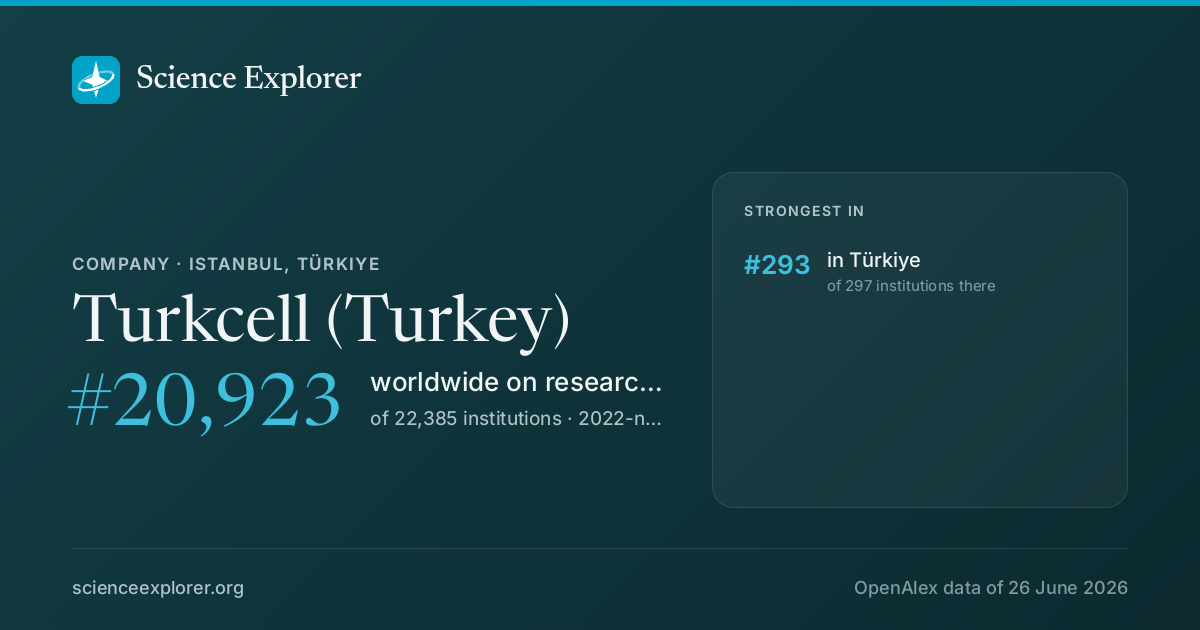
- World rank, 2022-now
- #20,923 of 22,385 · #24,572 all time
- Rank in Türkiye
- #293 of 297
- Research works
- 214 ▲ 109% vs 2018-21
- Citations
- 1.4k 6.7 per fractional work
- Top-10% rate
- 6.7% all institutions 10.0%
- vs its own fields
- 0.95× 1.00× is exactly expected
- Open access
- 38% world 40%
- International
- 13% world 18%
Which fields of science does Turkcell (Turkey) work in?
In 2022-now, 78% of research at Turkcell (Turkey) is in Physical Sciences, 14% in Social Sciences. Its largest fields are Computer Science (40%), Engineering (32%), Social Sciences (6%). It does 1.9× the world's share of Physical Sciences.
Each ring splits the one inside it: the four domains of science, their fields, their subfields. Size is fractional works in 2022-now. Every slice is a page; the interactive view zooms down to single topics and colours each by how much more of it this institution does than the world.
Its 4 domains and 19 fields, with their numbers
- Physical Sciences5777.7%
- Computer Science2940.2%
- Engineering2331.9%
- Physics and Astronomy23.3%
- Environmental Science11.1%
- Materials Science00.6%
- Earth and Planetary Sciences00.3%
- Energy00.2%
- Chemistry00.1%
- Social Sciences1014.1%
- Health Sciences45.6%
- Medicine33.8%
- Health Professions11.7%
- Life Sciences22.6%
What does Turkcell (Turkey) specialise in?
Where its research is concentrated relative to its size: Computer Science takes 5.2× the share of its output that it takes of world research.
- Computer ScienceField · 29.4 works5.2×
Location quotient, a volume reading rather than an impact one. It surfaces small, lopsided specialities.
Field profile
Location quotient across every field it publishes in: outside the ring is more than an institution of this size would be expected to publish, inside it is less.
Rings at 0.5×, 1× and 2×. Widest outward: Computer Science, 5.2×. Every wedge is a field page.
All 19 fields, with their numbers
- Computer Science5.16×29 works
- Engineering2.13×23 works
- Business, Management and Accounting1.56×4 works
- Physics and Astronomy1.47×2 works
- Decision Sciences1.06×1 works
- Health Professions0.66×1 works
- Social Sciences0.51×5 works
- Biochemistry, Genetics and Molecular Biology0.39×2 works
- Arts and Humanities0.32×1 works
- Energy0.25×0 works
- Environmental Science0.23×1 works
- Medicine0.20×3 works
- Psychology0.20×0 works
- Earth and Planetary Sciences0.18×0 works
- Materials Science0.17×0 works
- Neuroscience0.14×0 works
- Economics, Econometrics and Finance0.07×0 works
- Agricultural and Biological Sciences0.06×0 works
- Chemistry0.06×0 works
- Computer Science 5.2×
- Engineering 2.1×
- Business, Management and Accounting 1.6×
- Physics and Astronomy 1.5×
- Decision Sciences 1.1×
- Health Professions 0.7×
- Social Sciences 0.5×
- Biochemistry, Genetics and Molecular Biology 0.4×
- Arts and Humanities 0.3×
- Energy 0.2×
- Environmental Science 0.2×
- Medicine 0.2×
- Psychology 0.2×
- Earth and Planetary Sciences 0.2×
- Materials Science 0.2×
- Neuroscience 0.1×
- Economics, Econometrics and Finance 0.1×
- Agricultural and Biological Sciences 0.1×
- Chemistry 0.1×
Who are the top researchers at Turkcell (Turkey)?
Ranked on the quality score, Gökhan Kalem, Cem Ayyıldız and Selami Bağrıyanık lead among researchers whose main affiliation is Turkcell (Turkey).
- 1
Gökhan Kalem
 Türkiye · #3,714,282 worldwide
187 citations · 23 works
- 2
Cem Ayyıldız
Türkiye · #3,742,457 worldwide
154 citations · 21 works
- 3
Selami Bağrıyanık
Türkiye · #4,354,319 worldwide
153 citations · 27 works
- 4
Ersin Ersoy
Türkiye · #4,662,469 worldwide
57 citations · 18 works
- 5
Mehmet İzzet Sağlam
Türkiye · #5,128,179 worldwide
106 citations · 25 works
Which keywords describe research at Turkcell (Turkey)?
By fractional works in 2022-now, weighted toward what it does more of than the world: Machine Learning, Energy Efficiency, Deep Learning, Wireless Networks, MIMO Systems, Anomaly Detection, Distributed Systems and Wireless Communication.
- Resource Management
- Cooperative Diversity
- Space-Time Coding
- Cybersecurity
- Millimeter Wave
- Performance Prediction
- Interference Alignment
- Beamforming
- Non-Orthogonal Multiple Access
- Intelligent Reflecting Surfaces
- Big Data
- Channel Modeling
- Healthcare
- 5G
- Data Mining
- Massive MIMO
- Distributed Systems
- Neural Networks
- MIMO Systems
- Deep Learning
- Machine Learning
- Energy Efficiency
- Wireless Networks
- Anomaly Detection
- Wireless Communication
- 5G Networks
- IoT Security
- Channel Estimation
- Security
- Internet of Things
- Heterogeneous Networks
- Mobile Edge Computing
- Security and Privacy
- Cellular Networks
- Log Analysis
- Communications
- Smart Cities
- Privacy
- Workflow Management
- Network Coding
Size is fractional works in 2022-now in the topics tagged with each word; colour is the word's share of this institution's work against its share of the world's. The 40 words are chosen for being large and distinctive. Each links to the topic it comes from most.
All 40 words, with their numbers
- Machine Learning11▲ 4.5×21 topics
- Deep Learning9▲ 3.7×27 topics
- Energy Efficiency7▲ 10×7 topics
- MIMO Systems4▲ 74×2 topics
- Wireless Networks4▲ 40×7 topics
- Neural Networks4▲ 3.6×12 topics
- Anomaly Detection4▲ 18×3 topics
- Distributed Systems4▲ 30×4 topics
- Wireless Communication4▲ 34×4 topics
- Massive MIMO3▲ 56×3 topics
- 5G Networks3▲ 21×4 topics
- Data Mining3▲ 5.8×5 topics
- IoT Security3▲ 13×3 topics
- 5G3▲ 67×2 topics
- Channel Estimation3▲ 42×3 topics
- Healthcare3▲ 3.2×4 topics
- Security3▲ 5.3×5 topics
- Channel Modeling2▲ 28×3 topics
- Internet of Things2▲ 3.9×5 topics
- Big Data2▲ 3.5×8 topics
- Heterogeneous Networks2▲ 32×2 topics
- Intelligent Reflecting Surfaces2▲ 82×1 topic
- Mobile Edge Computing2▲ 20×2 topics
- Non-Orthogonal Multiple Access2▲ 82×1 topic
- Security and Privacy2▲ 17×2 topics
- Beamforming2▲ 29×3 topics
- Cellular Networks2▲ 65×1 topic
- Interference Alignment2▲ 65×1 topic
- Log Analysis2▲ 63×1 topic
- Performance Prediction2▲ 39×1 topic
- Communications2▲ 80×1 topic
- Millimeter Wave2▲ 91×1 topic
- Smart Cities2▲ 9.4×2 topics
- Cybersecurity2▲ 9.3×2 topics
- Privacy2▲ 8.3×3 topics
- Space-Time Coding2▲ 68×2 topics
- Workflow Management2▲ 32×2 topics
- Cooperative Diversity2▲ 118×1 topic
- Network Coding2▲ 47×1 topic
- Resource Management2▲ 13×2 topics
Which research topics does Turkcell (Turkey) publish most on?
By volume in 2022-now: Advanced Wireless Communication Technologies, Advanced MIMO Systems Optimization, Software System Performance and Reliability and Millimeter-Wave Propagation and Modeling.
Area is fractional works; colour is the subfield each topic belongs to.
- 1 Advanced Wireless Communication Technologies Electrical and Electronic Engineering 2 works
- 2 Advanced MIMO Systems Optimization Electrical and Electronic Engineering 2 works
- 3 Software System Performance and Reliability Computer Networks and Communications 2 works
- 4 Millimeter-Wave Propagation and Modeling Electrical and Electronic Engineering 2 works
- 5 Cooperative Communication and Network Coding Computer Networks and Communications 2 works
- 6 IoT and Edge/Fog Computing Computer Networks and Communications 2 works
- 7 Software Engineering Research Information Systems 1 works
- 8 Smart Grid Security and Resilience Control and Systems Engineering 1 works
- 9 Distributed and Parallel Computing Systems Computer Networks and Communications 1 works
- 10 Satellite Communication Systems Aerospace Engineering 1 works
How open and international is its research?
Against the world's own shares: the tick on each track. Both are shares of its output, so they sit on one scale and can be read against each other as well as against the world.
World: 40% of research is openly available.
World: 18% is written across borders.
How has Turkcell (Turkey)'s research output changed?
Output in 2022-2025 was 109% higher than in 2018-2021.
The same series as a ribbon: one cell per year, darker for more. The line above answers how much; this answers when.
Its share of all research
Growing output can still be a shrinking share: all of science grows. This is Turkcell (Turkey) as a percentage of every work published that year, 0.00037% in 2024.
Fractional works of Turkcell (Turkey) over all fractional works that year. How the balance of science has shifted.
Other research institutions in Istanbul
- Istanbul University
- Istanbul Technical University
- Marmara University
- Sağlık Bilimleri Üniversitesi
- Yıldız Technical University
- Boğaziçi University
- Istanbul University-Cerrahpaşa
- Koç University
Share Turkcell (Turkey)'s ranking
Badges for a website1Each links back here and updates with every snapshot

Research measures only: rankings here say nothing about teaching, admissions or student experience. Comparable institutions and collaboration partners have tabs of their own, above.
Discussion
Ask a question or share a note about Turkcell (Turkey). Posts are plain text and can be reported.