Science Explorer Back to mapMap
Discussion
University · Gyeongju · South Korea

Uiduk University

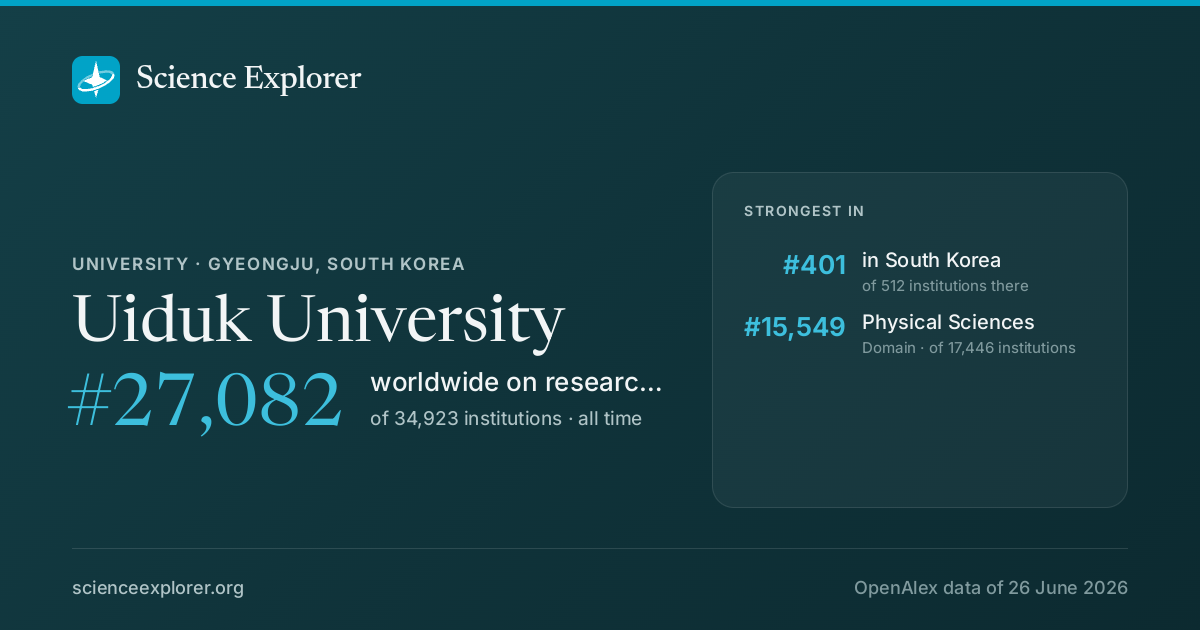
In research, Uiduk University stands highest in Physical Sciences (#15,549 of 17,446 worldwide), over all time.

World rank, all time
#27,082
of 34,923
Rank in South Korea
#401
of 512
Research works
261
▼ 19% vs 2018-21
Citations
2.4k
9.2 per fractional work
Top-10% rate
4.0%
all institutions 10.0%
vs its own fields
0.76×
1.00× is exactly expected
Open access
43%
world 40%
International
16%
world 18%

What is Uiduk University known for in research?

The fields where it stands highest, over all time, ranked among every institution above the floor in each field.

FieldWorld rankWhere that sitsTop-10% rateWorks
Physical SciencesDomain #15,549 of 17,446 3.4%162

Each strip is that field's whole ranked pool, with the notch where Uiduk University sits in it, in the colour of the band that rank falls in. The track under the rate is the rate itself: it carries no average mark, because the average differs by field (from about 6% in Dentistry to 21% in Economics).

Which fields of science does Uiduk University work in?

In 2022-now, 46% of research at Uiduk University is in Physical Sciences, 30% in Health Sciences. Its largest fields are Engineering (22%), Medicine (13%), Health Professions (11%).

Physical Sciences: 17 fractional works · 45.9% of its workEngineering: 8 fractional works · 21.6% of its workElectrical and Electronic Engineering: 2 fractional works · 5.6% of its workBiomedical Engineering: 2 fractional works · 4.8% of its workAerospace Engineering: 1 fractional works · 2.8% of its workControl and Systems Engineering: 1 fractional works · 2.6% of its workSafety, Risk, Reliability and Quality: 1 fractional works · 2.4% of its workAutomotive Engineering: 0 fractional works · 0.9% of its workComputational Mechanics: 0 fractional works · 0.9% of its workMedia Technology: 0 fractional works · 0.9% of its workOcean Engineering: 0 fractional works · 0.7% of its workMaterials Science: 3 fractional works · 9.1% of its workMaterials Chemistry: 2 fractional works · 6.2% of its workElectronic, Optical and Magnetic Materials: 0 fractional works · 1.2% of its workSurfaces, Coatings and Films: 0 fractional works · 0.9% of its workBiomaterials: 0 fractional works · 0.7% of its workComputer Science: 3 fractional works · 7.5% of its workArtificial Intelligence: 1 fractional works · 3.3% of its workInformation Systems: 1 fractional works · 2.7% of its workComputer Vision and Pattern Recognition: 0 fractional works · 0.7% of its workHardware and Architecture: 0 fractional works · 0.4% of its workSignal Processing: 0 fractional works · 0.4% of its workPhysics and Astronomy: 1 fractional works · 2.3% of its workAtomic and Molecular Physics, and Optics: 0 fractional works · 0.9% of its workRadiation: 0 fractional works · 0.9% of its workCondensed Matter Physics: 0 fractional works · 0.5% of its workSmaller subfields together: 0 fractional works · 0.0% of its workMathematics: 1 fractional works · 2.1% of its workStatistics and Probability: 1 fractional works · 2.1% of its workEnvironmental Science: 0 fractional works · 1.3% of its workEcology: 0 fractional works · 0.4% of its workHealth, Toxicology and Mutagenesis: 0 fractional works · 0.4% of its workWater Science and Technology: 0 fractional works · 0.4% of its workEarth and Planetary Sciences: 0 fractional works · 1.2% of its workAtmospheric Science: 0 fractional works · 0.4% of its workGeochemistry and Petrology: 0 fractional works · 0.3% of its workGeophysics: 0 fractional works · 0.3% of its workSmaller subfields together: 0 fractional works · 0.2% of its workChemical Engineering: 0 fractional works · 0.9% of its workFluid Flow and Transfer Processes: 0 fractional works · 0.9% of its workHealth Sciences: 11 fractional works · 29.5% of its workMedicine: 5 fractional works · 13.0% of its workOrthopedics and Sports Medicine: 1 fractional works · 2.7% of its workPharmacology: 1 fractional works · 2.1% of its workRehabilitation: 1 fractional works · 2.0% of its workPublic Health, Environmental and Occupational Health: 1 fractional works · 1.8% of its workPsychiatry and Mental health: 1 fractional works · 1.4% of its workRadiology, Nuclear Medicine and Imaging: 0 fractional works · 0.7% of its workCardiology and Cardiovascular Medicine: 0 fractional works · 0.4% of its workEpidemiology: 0 fractional works · 0.4% of its workFamily Practice: 0 fractional works · 0.4% of its workPulmonary and Respiratory Medicine: 0 fractional works · 0.4% of its workSurgery: 0 fractional works · 0.3% of its workSmaller subfields together: 0 fractional works · 0.3% of its workHealth Professions: 4 fractional works · 11.2% of its workGeneral Health Professions: 2 fractional works · 5.5% of its workPhysical Therapy, Sports Therapy and Rehabilitation: 2 fractional works · 4.7% of its workEmergency Medical Services: 0 fractional works · 0.6% of its workOccupational Therapy: 0 fractional works · 0.4% of its workNursing: 2 fractional works · 5.3% of its workLeadership and Management: 2 fractional works · 4.8% of its workNutrition and Dietetics: 0 fractional works · 0.4% of its workSocial Sciences: 7 fractional works · 19.5% of its workPsychology: 4 fractional works · 9.7% of its workClinical Psychology: 2 fractional works · 5.2% of its workSocial Psychology: 1 fractional works · 3.4% of its workDevelopmental and Educational Psychology: 0 fractional works · 1.2% of its workSocial Sciences: 2 fractional works · 5.3% of its workSociology and Political Science: 1 fractional works · 3.7% of its workEducation: 0 fractional works · 1.2% of its workSmaller subfields together: 0 fractional works · 0.3% of its workDecision Sciences: 1 fractional works · 2.4% of its workStatistics, Probability and Uncertainty: 1 fractional works · 2.2% of its workSmaller subfields together: 0 fractional works · 0.2% of its workBusiness, Management and Accounting: 1 fractional works · 1.7% of its workOrganizational Behavior and Human Resource Management: 0 fractional works · 1.1% of its workMarketing: 0 fractional works · 0.6% of its workArts and Humanities: 0 fractional works · 0.4% of its workVisual Arts and Performing Arts: 0 fractional works · 0.4% of its workLife Sciences: 2 fractional works · 5.0% of its workNeuroscience: 1 fractional works · 2.6% of its workCognitive Neuroscience: 0 fractional works · 1.2% of its workNeurology: 0 fractional works · 0.7% of its workSensory Systems: 0 fractional works · 0.7% of its workAgricultural and Biological Sciences: 1 fractional works · 1.7% of its workInsect Science: 0 fractional works · 0.9% of its workAnimal Science and Zoology: 0 fractional works · 0.4% of its workEcology, Evolution, Behavior and Systematics: 0 fractional works · 0.3% of its workImmunology and Microbiology: 0 fractional works · 0.4% of its workImmunology: 0 fractional works · 0.4% of its workBiochemistry, Genetics and Molecular Biology: 0 fractional works · 0.3% of its workCell Biology: 0 fractional works · 0.3% of its workALL ITS WORKUiduk University38fractional works, 2022-now
Life Sciences5%Physical Sciences46%Health Sciences30%Social Sciences20%

Each ring splits the one inside it: the four domains of science, their fields, their subfields. Size is fractional works in 2022-now. Every slice is a page; the interactive view zooms down to single topics and colours each by how much more of it this institution does than the world.

Its 4 domains and 20 fields, with their numbers
    1. Engineering821.6%
    2. Materials Science39.1%
    3. Computer Science37.5%
    4. Physics and Astronomy12.3%
    5. Mathematics12.1%
    6. Environmental Science01.3%
    7. Earth and Planetary Sciences01.2%
    8. Chemical Engineering00.9%
    1. Medicine513.0%
    2. Health Professions411.2%
    3. Nursing25.3%
    1. Psychology49.7%
    2. Social Sciences25.3%
    3. Decision Sciences12.4%
    4. Business, Management and Accounting11.7%
    5. Arts and Humanities00.4%
    1. Neuroscience12.6%
    2. Agricultural and Biological Sciences11.7%
    3. Immunology and Microbiology00.4%
    4. Biochemistry, Genetics and Molecular Biology00.3%
All of science, and how each field's share has moved since 1950: the Science domain explorer

Field profile

Location quotient across every field it publishes in: outside the ring is more than an institution of this size would be expected to publish, inside it is less.

Agricultural and Biological Sciences: 0.35× its world share, 1 worksAgricultural and Bio…Biochemistry, Genetics and Molecular Biology: 0.05× its world share, 0 worksBiochemistry, Geneti…Immunology and Microbiology: 0.44× its world share, 0 worksImmunology and Micro…Neuroscience: 1.63× its world share, 1 worksNeuroscienceChemical Engineering: 2.52× its world share, 0 worksChemical EngineeringComputer Science: 0.97× its world share, 3 worksComputer ScienceEarth and Planetary Sciences: 0.77× its world share, 0 worksEarth and Planetary …Engineering: 1.44× its world share, 8 worksEngineeringEnvironmental Science: 0.27× its world share, 0 worksEnvironmental ScienceMaterials Science: 2.59× its world share, 3 worksMaterials ScienceMathematics: 1.74× its world share, 1 worksMathematicsPhysics and Astronomy: 1.02× its world share, 1 worksPhysics and AstronomyHealth Professions: 4.24× its world share, 4 worksHealth ProfessionsMedicine: 0.68× its world share, 5 worksMedicineNursing: 10.78× its world share, 2 worksNursingArts and Humanities: 0.15× its world share, 0 worksArts and HumanitiesBusiness, Management and Accounting: 0.52× its world share, 1 worksBusiness, Management…Decision Sciences: 2.46× its world share, 1 worksDecision SciencesPsychology: 3.20× its world share, 4 worksPsychologySocial Sciences: 0.42× its world share, 2 worksSocial Sciences1×world share
more than its size predictsabout as predictedless

Rings at 0.5×, 1× and 2×. Widest outward: Nursing, 10.8×. Every wedge is a field page.

All 20 fields, with their numbers
  1. Nursing10.78×2 works
  2. Health Professions4.24×4 works
  3. Psychology3.20×4 works
  4. Materials Science2.59×3 works
  5. Chemical Engineering2.52×0 works
  6. Decision Sciences2.46×1 works
  7. Mathematics1.74×1 works
  8. Neuroscience1.63×1 works
  9. Engineering1.44×8 works
  10. Physics and Astronomy1.02×1 works
  11. Computer Science0.97×3 works
  12. Earth and Planetary Sciences0.77×0 works
  13. Medicine0.68×5 works
  14. Business, Management and Accounting0.52×1 works
  15. Immunology and Microbiology0.44×0 works
  16. Social Sciences0.42×2 works
  17. Agricultural and Biological Sciences0.35×1 works
  18. Environmental Science0.27×0 works
  19. Arts and Humanities0.15×0 works
  20. Biochemistry, Genetics and Molecular Biology0.05×0 works

Who are the top researchers at Uiduk University?

Ranked on the quality score, Jun Oh Jang, Chang-Keun Yoo and Dong‐Hoon Lee lead among researchers whose main affiliation is Uiduk University.

  1. 1 Jun Oh Jang South Korea · #4,028,007 worldwide 357 citations · 32 works
  2. 2 Chang-Keun Yoo South Korea · #4,065,767 worldwide 125 citations · 21 works
  3. 3 Dong‐Hoon Lee South Korea · #4,457,254 worldwide 727 citations · 60 works
  4. 4 Jung‐Lark Kim South Korea · #4,864,771 worldwide 34 citations · 15 works
  5. 5 Jaechul Byun South Korea · #5,562,733 worldwide 8 citations · 28 works
  6. 6 Byung-Dae Lee South Korea · #5,593,429 worldwide 586 citations · 48 works
  7. 7 Sang-Gug Park South Korea · #5,651,651 worldwide 60 citations · 32 works
  8. 8 Sang-Jin Lee South Korea · #5,903,915 worldwide 262 citations · 55 works
  9. 9 Young-Ho Bae South Korea · #6,496,210 worldwide 2.9k citations · 105 works
  10. 10 Eunju Kim South Korea · #6,848,332 worldwide 125 citations · 70 works
All ranked researchers at Uiduk University

What are the most cited papers from Uiduk University?

The most cited paper from Uiduk University is "Antimicrobial Activities of Tea Catechins and Theaflavins and Tea Extracts against Bacillus cereus" (Mendel Friedman, Philip R. Henika, Carol E. Levin et al., 2006), with 188 citations. Next come "Distribution of phenolic compounds and antioxidative activities in parts of sweet potato (Ipomoea batata L.) plants and in home processed roots" (169) and "Analysis of Phenolic Compounds by High-Performance Liquid Chromatography and Liquid Chromatography/Mass Spectrometry in Potato Plant Flowers, Leaves, Stems, and Tubers and in Home-Processed Potatoes" (139).

Most cited papers
#PaperReleasedCitations
1 Antimicrobial Activities of Tea Catechins and Theaflavins and Tea Extracts against Bacillus cereus Mendel Friedman, Philip R. Henika, Carol E. Levin et al. · Journal of Food Protection Open access Feb 2006 188
2 Distribution of phenolic compounds and antioxidative activities in parts of sweet potato (Ipomoea batata L.) plants and in home processed roots Joong-Keun Jung, Seung-Un Lee, Nobuyuki Kozukue et al. · Journal of Food Composition and Analysis 4 Aug 2010 169
3 Analysis of Phenolic Compounds by High-Performance Liquid Chromatography and Liquid Chromatography/Mass Spectrometry in Potato Plant Flowers, Leaves, Stems, and Tubers and in Home-Processed Potatoes Hyon Woon Im, Bong-Soon Suh, Seung‐Un Lee et al. · Journal of Agricultural and Food Chemistry 4 Apr 2008 139
4 Flavonoid Content in Fresh, Home-Processed, and Light-Exposed Onions and in Dehydrated Commercial Onion Products Seung Un Lee, Jong Ha Lee, Suk Hyun Choi et al. · Journal of Agricultural and Food Chemistry 30 Aug 2008 136
5 Tomatine-Containing Green Tomato Extracts Inhibit Growth of Human Breast, Colon, Liver, and Stomach Cancer Cells Mendel Friedman, Carol E. Levin, Seung‐Un Lee et al. · Journal of Agricultural and Food Chemistry Open access 10 Jun 2009 136
All 61 most cited papers, with filters and sorting

Which keywords describe research at Uiduk University?

By fractional works in 2022-now, weighted toward what it does more of than the world: Self-Efficacy, Job Satisfaction, Social Support, Stress Management, Organizational Commitment, Clinical Competence, Nursing Professionalism and Well-being.

▲ more of its work than of the world's◆ about the world's share▼ less than the world's

Size is fractional works in 2022-now in the topics tagged with each word; colour is the word's share of this institution's work against its share of the world's. The 26 words are chosen for being large and distinctive. Each links to the topic it comes from most.

All 26 words, with their numbers
  1. Self-Efficacy4▲ 40×4 topics
  2. Job Satisfaction2▲ 15×6 topics
  3. Quality of Life2▲ 4.0×5 topics
  4. Social Support2▲ 11×3 topics
  5. Stress Management2▲ 55×2 topics
  6. Epidemiology2▲ 1.40×10 topics
  7. Organizational Commitment2▲ 25×2 topics
  8. Clinical Competence2▲ 340×1 topic
  9. Mental Health2▲ 3.3×8 topics
  10. Nursing Professionalism2▲ 340×1 topic
  11. Well-being2▲ 12×6 topics
  12. Elderly Population2▲ 106×2 topics
  13. Health Locus of Control1▲ 126×1 topic
  14. Health-Promoting Behaviors1▲ 126×1 topic
  15. Machine Learning1◆ 1.08×3 topics
  16. Neural Networks1▲ 2.4×3 topics
  17. Deep Learning1◆ 1.02×4 topics
  18. Depression1▲ 4.0×5 topics
  19. Elderly1▲ 14×2 topics
  20. Muscle Strength1▲ 32×3 topics
  21. Raman Spectroscopy1▲ 17×2 topics
  22. Fall Risk1▲ 64×1 topic
  23. Gait Speed1▲ 64×1 topic
  24. Security1▲ 4.3×2 topics
  25. Neural Plasticity1▲ 15×2 topics
  26. Solar Cells1▲ 13×2 topics

Which research topics does Uiduk University publish most on?

By volume in 2022-now: Healthcare Education and Workforce Issues, Health and Wellbeing Research, Balance, Gait, and Falls Prevention and Graphite, nuclear technology, radiation studies.

  1. 1 Healthcare Education and Workforce Issues Leadership and Management 2 works
  2. 2 Health and Wellbeing Research General Health Professions 1 works
  3. 3 Balance, Gait, and Falls Prevention Physical Therapy, Sports Therapy and Rehabilitation 1 works
  4. 4 Graphite, nuclear technology, radiation studies Materials Chemistry 1 works
  5. 5 Nuclear and radioactivity studies Safety, Risk, Reliability and Quality 1 works
  6. 6 Adversarial Robustness in Machine Learning Artificial Intelligence 1 works
  7. 7 Stroke Rehabilitation and Recovery Rehabilitation 1 works
  8. 8 Semiconductor materials and devices Electrical and Electronic Engineering 1 works
  9. 9 Silicon Nanostructures and Photoluminescence Materials Chemistry 1 works
  10. 10 Thin-Film Transistor Technologies Electrical and Electronic Engineering 1 works

How open and international is its research?

Against the world's own shares: the tick on each track. Both are shares of its output, so they sit on one scale and can be read against each other as well as against the world.

openly available42.7%not open57.3%

World: 40% of research is openly available.

with international co-authors15.6%domestic only84.4%

World: 18% is written across borders.

How has Uiduk University's research output changed?

Output in 2022-2025 was 19% lower than in 2018-2021.

still counting200020052010201520202025
grewheldshrank

The same series as a ribbon: one cell per year, darker for more. The line above answers how much; this answers when.

Its share of all research

Growing output can still be a shrinking share: all of science grows. This is Uiduk University as a percentage of every work published that year, 0.000098% in 2024.

still counting0.00020%0.00040%0.00060%Uiduk University0.00020% in 2025200020102020

Fractional works of Uiduk University over all fractional works that year. How the balance of science has shifted.

Other research institutions in Gyeongju

All research institutions in Gyeongju

Share Uiduk University's ranking
Uiduk University on Science Explorer

A card with Uiduk University's standing and the fields it leads in, for a post or a slide. A link to this page previews as the same card.

Download the card

1200 × 630 PNG, sized for social posts, drawn from the latest snapshot.

Badges for a website1Each links back here and updates with every snapshot

Research measures only: rankings here say nothing about teaching, admissions or student experience. Comparable institutions and collaboration partners have tabs of their own, above.

Discussion

Ask a question or share a note about Uiduk University. Keep it to the research: no personal attacks, advertising or links. Any reader can report a post, which collapses it for everyone until it is opened.