Science Explorer Back to mapMap
Discussion
Institution · Westmount · Canada

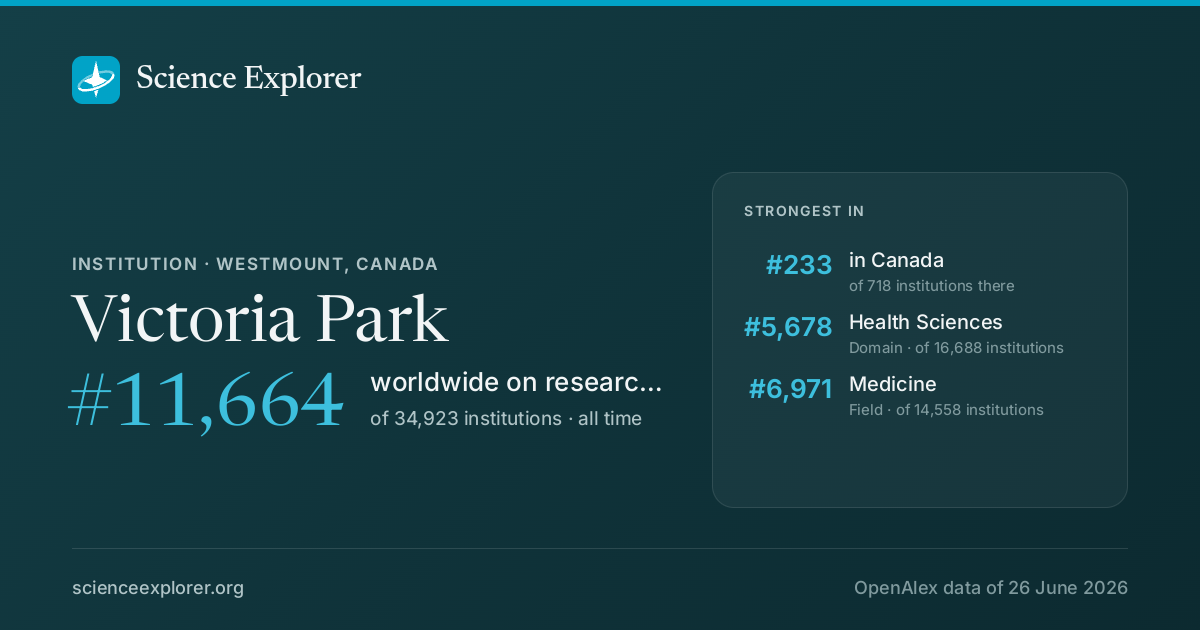
Victoria Park

In research, Victoria Park stands highest in Health Sciences (#5,678 of 16,688 worldwide) and Medicine (#6,971 of 14,558 worldwide), over all time.

World rank, all time
#11,664
of 34,923
Rank in Canada
#233
of 718
Research works
436
▲ 63% vs 2018-21
Citations
9.3k
21.3 per fractional work
Top-10% rate
11.5%
all institutions 10.0%
vs its own fields
1.04×
1.00× is exactly expected
Open access
22%
world 40%
International
37%
world 18%

What is Victoria Park known for in research?

The fields where it stands highest, over all time, ranked among every institution above the floor in each field.

FieldWorld rankWhere that sitsTop-10% rateWorks
Health SciencesDomain #5,678 of 16,688 10.2%212
MedicineField #6,971 of 14,558 10.8%167

Each strip is that field's whole ranked pool, with the notch where Victoria Park sits in it, in the colour of the band that rank falls in. The track under the rate is the rate itself: it carries no average mark, because the average differs by field (from about 6% in Dentistry to 21% in Economics).

Which fields of science does Victoria Park work in?

In all years, 49% of research at Victoria Park is in Health Sciences, 26% in Social Sciences. Its largest fields are Medicine (38%), Social Sciences (9%), Health Professions (8%). It does 2.1× the world's share of Health Sciences.

Health Sciences: 212 fractional works · 48.6% of its workMedicine: 167 fractional works · 38.4% of its workComplementary and alternative medicine: 70 fractional works · 16.0% of its workPharmacology: 11 fractional works · 2.6% of its workPsychiatry and Mental health: 10 fractional works · 2.4% of its workPublic Health, Environmental and Occupational Health: 10 fractional works · 2.3% of its workSurgery: 10 fractional works · 2.2% of its workPediatrics, Perinatology and Child Health: 7 fractional works · 1.7% of its workPhysiology: 6 fractional works · 1.4% of its workDermatology: 6 fractional works · 1.3% of its workPulmonary and Respiratory Medicine: 4 fractional works · 0.9% of its workEpidemiology: 4 fractional works · 0.9% of its workPathology and Forensic Medicine: 4 fractional works · 0.9% of its workRadiology, Nuclear Medicine and Imaging: 3 fractional works · 0.7% of its workNeurology: 3 fractional works · 0.7% of its workRheumatology: 3 fractional works · 0.7% of its workReproductive Medicine: 2 fractional works · 0.5% of its workRehabilitation: 2 fractional works · 0.4% of its workEndocrinology, Diabetes and Metabolism: 1 fractional works · 0.3% of its workEmergency Medicine: 1 fractional works · 0.3% of its workUrology: 1 fractional works · 0.3% of its workOncology: 1 fractional works · 0.3% of its workOphthalmology: 1 fractional works · 0.2% of its workSmaller subfields together: 6 fractional works · 1.4% of its workHealth Professions: 37 fractional works · 8.5% of its workGeneral Health Professions: 18 fractional works · 4.1% of its workComplementary and Manual Therapy: 8 fractional works · 1.8% of its workHealth Information Management: 3 fractional works · 0.7% of its workEmergency Medical Services: 2 fractional works · 0.4% of its workSpeech and Hearing: 2 fractional works · 0.4% of its workPharmacy: 1 fractional works · 0.3% of its workMedical Laboratory Technology: 1 fractional works · 0.2% of its workSmaller subfields together: 2 fractional works · 0.5% of its workDentistry: 5 fractional works · 1.1% of its workOral Surgery: 4 fractional works · 0.9% of its workSmaller subfields together: 1 fractional works · 0.2% of its workNursing: 2 fractional works · 0.4% of its workNutrition and Dietetics: 2 fractional works · 0.4% of its workSmaller subfields together: 0 fractional works · 0.0% of its workVeterinary: 1 fractional works · 0.3% of its workSmall Animals: 1 fractional works · 0.3% of its workSocial Sciences: 115 fractional works · 26.5% of its workSocial Sciences: 39 fractional works · 8.8% of its workSociology and Political Science: 11 fractional works · 2.5% of its workEducation: 8 fractional works · 1.7% of its workAnthropology: 4 fractional works · 0.9% of its workPolitical Science and International Relations: 4 fractional works · 0.9% of its workHealth: 3 fractional works · 0.7% of its workDemography: 2 fractional works · 0.4% of its workGeography, Planning and Development: 2 fractional works · 0.3% of its workSafety Research: 1 fractional works · 0.3% of its workCommunication: 1 fractional works · 0.2% of its workSmaller subfields together: 4 fractional works · 0.8% of its workPsychology: 33 fractional works · 7.5% of its workClinical Psychology: 18 fractional works · 4.2% of its workSocial Psychology: 7 fractional works · 1.5% of its workExperimental and Cognitive Psychology: 3 fractional works · 0.7% of its workDevelopmental and Educational Psychology: 2 fractional works · 0.4% of its workGeneral Psychology: 2 fractional works · 0.4% of its workNeuropsychology and Physiological Psychology: 2 fractional works · 0.4% of its workArts and Humanities: 25 fractional works · 5.6% of its workLanguage and Linguistics: 6 fractional works · 1.3% of its workHistory: 5 fractional works · 1.2% of its workPhilosophy: 4 fractional works · 0.8% of its workLiterature and Literary Theory: 3 fractional works · 0.8% of its workArcheology: 3 fractional works · 0.6% of its workReligious studies: 3 fractional works · 0.6% of its workSmaller subfields together: 1 fractional works · 0.3% of its workEconomics, Econometrics and Finance: 9 fractional works · 2.0% of its workEconomics and Econometrics: 6 fractional works · 1.3% of its workFinance: 2 fractional works · 0.6% of its workSmaller subfields together: 1 fractional works · 0.1% of its workBusiness, Management and Accounting: 7 fractional works · 1.5% of its workOrganizational Behavior and Human Resource Management: 4 fractional works · 0.9% of its workAccounting: 1 fractional works · 0.3% of its workSmaller subfields together: 1 fractional works · 0.3% of its workDecision Sciences: 4 fractional works · 0.9% of its workManagement Science and Operations Research: 2 fractional works · 0.5% of its workStatistics, Probability and Uncertainty: 2 fractional works · 0.4% of its workSmaller subfields together: 0 fractional works · 0.1% of its workPhysical Sciences: 60 fractional works · 13.8% of its workEngineering: 18 fractional works · 4.2% of its workBuilding and Construction: 5 fractional works · 1.1% of its workElectrical and Electronic Engineering: 4 fractional works · 0.8% of its workBiomedical Engineering: 4 fractional works · 0.8% of its workAerospace Engineering: 2 fractional works · 0.4% of its workMechanics of Materials: 1 fractional works · 0.2% of its workSmaller subfields together: 4 fractional works · 0.9% of its workEnvironmental Science: 12 fractional works · 2.7% of its workEcology: 6 fractional works · 1.4% of its workHealth, Toxicology and Mutagenesis: 1 fractional works · 0.3% of its workGlobal and Planetary Change: 1 fractional works · 0.2% of its workNature and Landscape Conservation: 1 fractional works · 0.2% of its workSmaller subfields together: 2 fractional works · 0.6% of its workComputer Science: 11 fractional works · 2.4% of its workComputer Vision and Pattern Recognition: 4 fractional works · 0.9% of its workArtificial Intelligence: 3 fractional works · 0.6% of its workComputational Theory and Mathematics: 2 fractional works · 0.4% of its workSignal Processing: 1 fractional works · 0.3% of its workSmaller subfields together: 1 fractional works · 0.3% of its workMathematics: 5 fractional works · 1.2% of its workAlgebra and Number Theory: 2 fractional works · 0.4% of its workTheoretical Computer Science: 1 fractional works · 0.3% of its workGeometry and Topology: 1 fractional works · 0.2% of its workSmaller subfields together: 2 fractional works · 0.4% of its workEarth and Planetary Sciences: 5 fractional works · 1.1% of its workGeophysics: 1 fractional works · 0.3% of its workPaleontology: 1 fractional works · 0.3% of its workGeology: 1 fractional works · 0.2% of its workSmaller subfields together: 1 fractional works · 0.3% of its workPhysics and Astronomy: 4 fractional works · 0.8% of its workAtomic and Molecular Physics, and Optics: 2 fractional works · 0.5% of its workSmaller subfields together: 1 fractional works · 0.3% of its workMaterials Science: 3 fractional works · 0.6% of its workMaterials Chemistry: 1 fractional works · 0.2% of its workSurfaces, Coatings and Films: 1 fractional works · 0.2% of its workSmaller subfields together: 1 fractional works · 0.2% of its workChemistry: 2 fractional works · 0.4% of its workEnergy: 1 fractional works · 0.2% of its workChemical Engineering: 0 fractional works · 0.1% of its workLife Sciences: 48 fractional works · 11.1% of its workNeuroscience: 16 fractional works · 3.6% of its workCognitive Neuroscience: 11 fractional works · 2.5% of its workNeurology: 3 fractional works · 0.7% of its workSmaller subfields together: 2 fractional works · 0.4% of its workBiochemistry, Genetics and Molecular Biology: 13 fractional works · 3.0% of its workMolecular Biology: 6 fractional works · 1.4% of its workGenetics: 4 fractional works · 0.9% of its workCell Biology: 2 fractional works · 0.4% of its workSmaller subfields together: 1 fractional works · 0.2% of its workAgricultural and Biological Sciences: 12 fractional works · 2.8% of its workPlant Science: 8 fractional works · 1.8% of its workFood Science: 1 fractional works · 0.3% of its workAnimal Science and Zoology: 1 fractional works · 0.3% of its workSmaller subfields together: 2 fractional works · 0.4% of its workPharmacology, Toxicology and Pharmaceutics: 5 fractional works · 1.2% of its workPharmacology: 4 fractional works · 1.0% of its workToxicology: 1 fractional works · 0.2% of its workImmunology and Microbiology: 2 fractional works · 0.5% of its workParasitology: 1 fractional works · 0.3% of its workSmaller subfields together: 1 fractional works · 0.2% of its workALL ITS WORKVictoria Park436fractional works, all years
Life Sciences11%Physical Sciences14%Health Sciences49%Social Sciences26%

Each ring splits the one inside it: the four domains of science, their fields, their subfields. Size is fractional works in all years. Every slice is a page; the interactive view zooms down to single topics and colours each by how much more of it this institution does than the world.

Its 4 domains and 26 fields, with their numbers
    1. Medicine16738.4%
    2. Health Professions378.5%
    3. Dentistry51.1%
    4. Nursing20.4%
    5. Veterinary10.3%
    1. Social Sciences398.8%
    2. Psychology337.5%
    3. Arts and Humanities255.6%
    4. Economics, Econometrics and Finance92.0%
    5. Business, Management and Accounting71.5%
    6. Decision Sciences40.9%
    1. Engineering184.2%
    2. Environmental Science122.7%
    3. Computer Science112.4%
    4. Mathematics51.2%
    5. Earth and Planetary Sciences51.1%
    6. Physics and Astronomy40.8%
    7. Materials Science30.6%
    8. Chemistry20.4%
    9. Energy10.2%
    10. Chemical Engineering00.1%
    1. Neuroscience163.6%
    2. Biochemistry, Genetics and Molecular Biology133.0%
    3. Agricultural and Biological Sciences122.8%
    4. Pharmacology, Toxicology and Pharmaceutics51.2%
    5. Immunology and Microbiology20.5%
All of science, and how each field's share has moved since 1950: the Science domain explorer

Field profile

Location quotient across every field it publishes in: outside the ring is more than an institution of this size would be expected to publish, inside it is less.

Agricultural and Biological Sciences: 0.21× its world share, 0 worksAgricultural and Bio…Biochemistry, Genetics and Molecular Biology: 0.94× its world share, 1 worksBiochemistry, Geneti…Neuroscience: 1.23× its world share, 0 worksNeurosciencePharmacology, Toxicology and Pharmaceutics: 2.35× its world share, 0 worksPharmacology, Toxico…Chemistry: 0.42× its world share, 0 worksChemistryComputer Science: 1.47× its world share, 2 worksComputer ScienceEarth and Planetary Sciences: 0.14× its world share, 0 worksEarth and Planetary …Energy: 0.72× its world share, 0 worksEnergyEngineering: 0.69× its world share, 2 worksEngineeringEnvironmental Science: 0.69× its world share, 1 worksEnvironmental ScienceMaterials Science: 0.29× its world share, 0 worksMaterials ScienceMathematics: 0.85× its world share, 0 worksMathematicsHealth Professions: 2.49× its world share, 1 worksHealth ProfessionsMedicine: 1.34× its world share, 4 worksMedicineVeterinary: 7.32× its world share, 0 worksVeterinaryArts and Humanities: 0.34× its world share, 0 worksArts and HumanitiesBusiness, Management and Accounting: 1.15× its world share, 1 worksBusiness, Management…Decision Sciences: 6.30× its world share, 1 worksDecision SciencesEconomics, Econometrics and Finance: 1.16× its world share, 0 worksEconomics, Econometr…Psychology: 2.12× its world share, 1 worksPsychologySocial Sciences: 0.75× its world share, 2 worksSocial Sciences1×world share
more than its size predictsabout as predictedless

Rings at 0.5×, 1× and 2×. Widest outward: Veterinary, 7.3×. Every wedge is a field page.

All 21 fields, with their numbers
  1. Veterinary7.32×0 works
  2. Decision Sciences6.30×1 works
  3. Health Professions2.49×1 works
  4. Pharmacology, Toxicology and Pharmaceutics2.35×0 works
  5. Psychology2.12×1 works
  6. Computer Science1.47×2 works
  7. Medicine1.34×4 works
  8. Neuroscience1.23×0 works
  9. Economics, Econometrics and Finance1.16×0 works
  10. Business, Management and Accounting1.15×1 works
  11. Biochemistry, Genetics and Molecular Biology0.94×1 works
  12. Mathematics0.85×0 works
  13. Social Sciences0.75×2 works
  14. Energy0.72×0 works
  15. Engineering0.69×2 works
  16. Environmental Science0.69×1 works
  17. Chemistry0.42×0 works
  18. Arts and Humanities0.34×0 works
  19. Materials Science0.29×0 works
  20. Agricultural and Biological Sciences0.21×0 works
  21. Earth and Planetary Sciences0.14×0 works

Who are the top researchers at Victoria Park?

Ranked on the quality score, J. Holden MacMichael, S. Roodhouse Gloyne and Ambrose Heal lead among researchers whose main affiliation is Victoria Park.

  1. 1 J. Holden MacMichael Canada · #1,303,176 worldwide 17 citations · 876 works
  2. 2 S. Roodhouse Gloyne Canada · #1,633,258 worldwide 859 citations · 79 works
  3. 3 Ambrose Heal Canada · #1,888,236 worldwide 90 citations · 252 works
  4. 4 H. V. Morlock Canada · #2,455,625 worldwide 157 citations · 47 works
  5. 5 C. P. Hale Canada · #2,576,494 worldwide 5 citations · 85 works
  6. 6 John A. Randolph Canada · #2,608,053 worldwide 20 citations · 62 works
  7. 7 A.J. Scott Pinchin Canada · #2,696,350 worldwide 108 citations · 29 works
  8. 8 Bennett H. Brough Canada · #2,818,963 worldwide 39 citations · 34 works
  9. 9 Thos. Glover Lyon Canada · #2,949,746 worldwide 2 citations · 18 works
  10. 10 O. K. Williamson Canada · #3,237,580 worldwide 37 citations · 16 works
All ranked researchers at Victoria Park

What are the most cited papers from Victoria Park?

The most cited paper from Victoria Park is "The prevalence of complementary/Alternative medicine in cancer" (Edzard Ernst, 1998), with 895 citations. Next come "The Ascomycota Tree of Life: A Phylum-wide Phylogeny Clarifies the Origin and Evolution of Fundamental Reproductive and Ecological Traits" (679) and "Harmless Herbs? A Review of the Recent Literature" (638).

Most cited papers
#PaperReleasedCitations
1 The prevalence of complementary/Alternative medicine in cancer Edzard Ernst · Cancer 15 Aug 1998 895
2 The Ascomycota Tree of Life: A Phylum-wide Phylogeny Clarifies the Origin and Evolution of Fundamental Reproductive and Ecological Traits Conrad L. Schoch et al. · Systematic Biology Open access Apr 2009 679
3 Harmless Herbs? A Review of the Recent Literature Edzard Ernst · The American Journal of Medicine Feb 1998 638
4 Bringing medicinal plants into cultivation: opportunities and challenges for biotechnology Peter H. Canter, Howard Thomas, Edzard K. Ernst · Trends in biotechnology Review 21 Feb 2005 555
5 N-Acetyl Cysteine as a Glutathione Precursor for Schizophrenia—A Double-Blind, Randomized, Placebo-Controlled Trial Michael Berk, David Copolov, Olivia May Dean et al. · Biological Psychiatry Open access 24 Apr 2008 550
All 60 most cited papers, with filters and sorting

Which keywords describe research at Victoria Park?

By fractional works in all years, weighted toward what it does more of than the world: Herbal Medicine, Adverse Reactions, Regulatory Challenges, Alternative Medicine, Complementary Medicine, Clinical Trials, Osteoarthritis and Depression.

▲ more of its work than of the world's◆ about the world's share▼ less than the world's

Size is fractional works in all years in the topics tagged with each word; colour is the word's share of this institution's work against its share of the world's. The 40 words are chosen for being large and distinctive. Each links to the topic it comes from most.

All 40 words, with their numbers
  1. Herbal Medicine60▲ 60×7 topics
  2. Adverse Reactions52▲ 227×2 topics
  3. Regulatory Challenges51▲ 149×2 topics
  4. Alternative Medicine51▲ 427×1 topic
  5. Complementary Medicine51▲ 427×1 topic
  6. Clinical Trials26▲ 9.7×12 topics
  7. Epidemiology21▲ 1.22×47 topics
  8. Osteoarthritis18▲ 33×4 topics
  9. Depression16▲ 5.0×12 topics
  10. Mental Health12▲ 2.5×21 topics
  11. Adverse Events12▲ 43×2 topics
  12. Quality of Life10▲ 1.67×23 topics
  13. Antioxidant Activity10▲ 4.1×16 topics
  14. Acupuncture10▲ 33×2 topics
  15. Medical Education10▲ 9.4×8 topics
  16. Pain Relief10▲ 46×2 topics
  17. Brain Imaging9▲ 29×2 topics
  18. Neurological Effects9▲ 29×2 topics
  19. Cancer Care9▲ 100×1 topic
  20. Fibroblast Response9▲ 100×1 topic
  21. Neuroscience9▲ 6.6×7 topics
  22. Psychological Factors9▲ 11×5 topics
  23. Primary Care9▲ 4.8×11 topics
  24. Antioxidant8▲ 2.8×21 topics
  25. Balneotherapy8▲ 133×1 topic
  26. Clay Minerals8▲ 133×1 topic
  27. Pharmacology7▲ 4.8×9 topics
  28. Patient Satisfaction6▲ 5.9×6 topics
  29. Gender Differences6▲ 4.7×7 topics
  30. Nocebo6▲ 74×1 topic
  31. Placebo6▲ 74×1 topic
  32. Low Back Pain6▲ 8.7×2 topics
  33. Chronic Pain6▲ 5.7×4 topics
  34. Evidence-Based Practice5▲ 7.3×5 topics
  35. Medical Ethics5▲ 7.0×5 topics
  36. Weight Loss5▲ 7.7×3 topics
  37. Disability5▲ 11×1 topic
  38. Measurement Properties5▲ 16×1 topic
  39. Phenomenology4▲ 8.4×4 topics
  40. Echinacea4▲ 113×1 topic

Which research topics does Victoria Park publish most on?

By volume in 2022-now: Anomaly Detection Techniques and Applications, Data Quality and Management, Aging and Gerontology Research and Facial Rejuvenation and Surgery Techniques.

  1. 1 Anomaly Detection Techniques and Applications Artificial Intelligence 1 works
  2. 2 Data Quality and Management Management Science and Operations Research 1 works
  3. 3 Aging and Gerontology Research Neuropsychology and Physiological Psychology 0 works
  4. 4 Facial Rejuvenation and Surgery Techniques Dermatology 0 works
  5. 5 Body Contouring and Surgery Surgery 0 works
  6. 6 Parkinson's Disease Mechanisms and Treatments Neurology 0 works
  7. 7 Data Mining Algorithms and Applications Information Systems 0 works
  8. 8 demographic modeling and climate adaptation Management Science and Operations Research 0 works
  9. 9 Healthcare Systems and Technology Organizational Behavior and Human Resource Management 0 works
  10. 10 Machine Learning in Healthcare Artificial Intelligence 0 works

How open and international is its research?

Against the world's own shares: the tick on each track. Both are shares of its output, so they sit on one scale and can be read against each other as well as against the world.

openly available21.9%not open78.1%

World: 40% of research is openly available.

with international co-authors37.1%domestic only62.9%

World: 18% is written across borders.

How has Victoria Park's research output changed?

Output in 2022-2025 was 63% higher than in 2018-2021.

still counting1990200020102020
grewheldshrank

The same series as a ribbon: one cell per year, darker for more. The line above answers how much; this answers when.

Its share of all research

Growing output can still be a shrinking share: all of science grows. This is Victoria Park as a percentage of every work published that year, 0.00010% in 2024.

still counting0.0010%0.0020%Victoria Park0.000065% in 202519801990200020102020

Fractional works of Victoria Park over all fractional works that year. How the balance of science has shifted.

Other research institutions in Westmount

All research institutions in Westmount

Share Victoria Park's ranking

Victoria Park on Science Explorer

A card with Victoria Park's standing and the fields it leads in, for a post or a slide. A link to this page previews as the same card.

Download the card

1200 × 630 PNG, sized for social posts, drawn from the latest snapshot.

Badges for a website1Each links back here and updates with every snapshot

Research measures only: rankings here say nothing about teaching, admissions or student experience. Comparable institutions and collaboration partners have tabs of their own, above.

Discussion

Ask a question or share a note about Victoria Park. Posts are plain text and can be reported.