Science Explorer Back to mapMap
Discussion
Government institution · Aarhus · Denmark

Aarhus Municipality

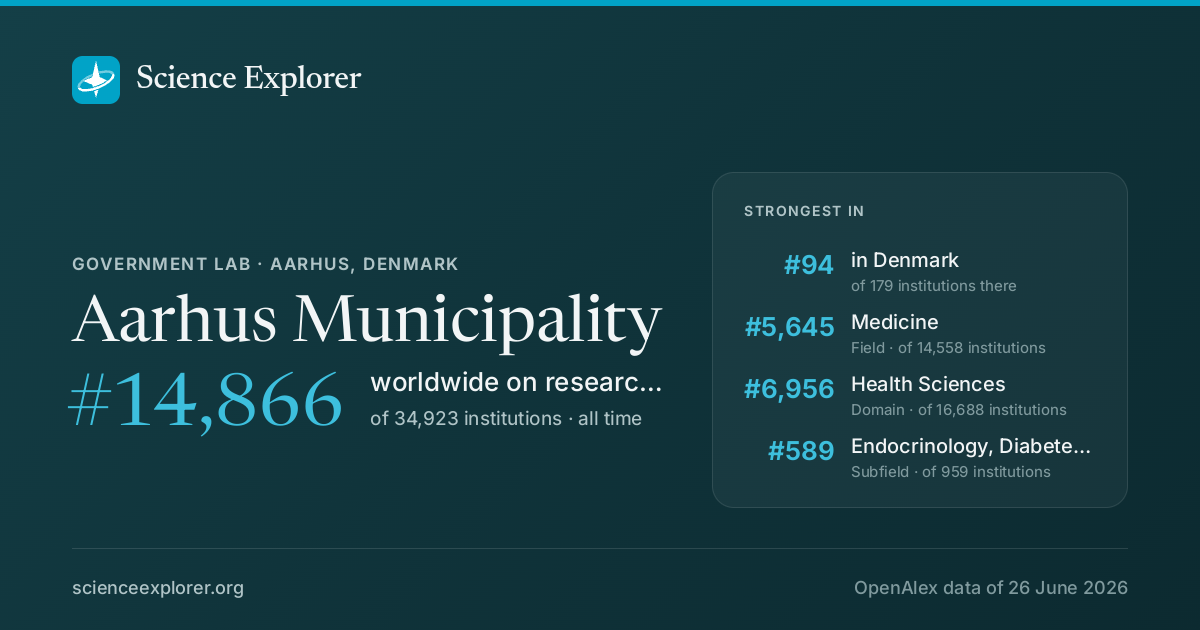
In research, Aarhus Municipality stands highest in Medicine (#5,645 of 14,558 worldwide), Health Sciences (#6,956 of 16,688 worldwide) and Endocrinology, Diabetes and Metabolism (#589 of 959 worldwide), over all time.

World rank, all time
#14,866
of 34,923
Rank in Denmark
#94
of 179
Research works
2.5k
▲ 48% vs 2018-21
Citations
68k
27.3 per fractional work
Top-10% rate
7.5%
all institutions 10.0%
vs its own fields
0.84×
1.00× is exactly expected
Open access
12%
world 40%
International
7%
world 18%

What is Aarhus Municipality known for in research?

The fields where it stands highest, over all time, ranked among every institution above the floor in each field.

FieldWorld rankWhere that sitsTop-10% rateWorks
MedicineField #5,645 of 14,558 9.3%1,822
Health SciencesDomain #6,956 of 16,688 9.2%1,908
Endocrinology, Diabetes and MetabolismSubfield #589 of 959 12.0%240
SurgerySubfield #2,190 of 3,248 7.7%201
Cardiology and Cardiovascular MedicineSubfield #1,110 of 1,509 11.9%132
Biochemistry, Genetics and Molecular BiologyField #4,300 of 5,801 8.6%248
Pulmonary and Respiratory MedicineSubfield #1,656 of 2,077 8.6%122
Life SciencesDomain #9,402 of 11,023 7.8%402

Each strip is that field's whole ranked pool, with the notch where Aarhus Municipality sits in it, in the colour of the band that rank falls in. The track under the rate is the rate itself: it carries no average mark, because the average differs by field (from about 6% in Dentistry to 21% in Economics).

Which fields of science does Aarhus Municipality work in?

In 2022-now, 40% of research at Aarhus Municipality is in Social Sciences, 36% in Health Sciences. Its largest fields are Social Sciences (23%), Medicine (22%), Health Professions (11%). It does 1.5× the world's share of Social Sciences.

Social Sciences: 15 fractional works · 40.2% of its workSocial Sciences: 9 fractional works · 22.7% of its workEducation: 2 fractional works · 6.3% of its workUrban Studies: 2 fractional works · 4.9% of its workPolitical Science and International Relations: 2 fractional works · 4.3% of its workGeography, Planning and Development: 1 fractional works · 2.7% of its workSociology and Political Science: 1 fractional works · 1.5% of its workDemography: 0 fractional works · 1.3% of its workSafety Research: 0 fractional works · 0.9% of its workLaw: 0 fractional works · 0.5% of its workHealth: 0 fractional works · 0.3% of its workSmaller subfields together: 0 fractional works · 0.1% of its workPsychology: 3 fractional works · 8.8% of its workClinical Psychology: 2 fractional works · 4.2% of its workSocial Psychology: 1 fractional works · 2.9% of its workExperimental and Cognitive Psychology: 0 fractional works · 0.6% of its workNeuropsychology and Physiological Psychology: 0 fractional works · 0.5% of its workApplied Psychology: 0 fractional works · 0.3% of its workDevelopmental and Educational Psychology: 0 fractional works · 0.3% of its workBusiness, Management and Accounting: 2 fractional works · 5.0% of its workManagement of Technology and Innovation: 2 fractional works · 4.4% of its workStrategy and Management: 0 fractional works · 0.5% of its workSmaller subfields together: 0 fractional works · 0.1% of its workArts and Humanities: 1 fractional works · 3.1% of its workLanguage and Linguistics: 1 fractional works · 1.5% of its workMusic: 0 fractional works · 0.9% of its workConservation: 0 fractional works · 0.3% of its workHistory: 0 fractional works · 0.3% of its workSmaller subfields together: 0 fractional works · 0.2% of its workDecision Sciences: 0 fractional works · 0.5% of its workInformation Systems and Management: 0 fractional works · 0.5% of its workEconomics, Econometrics and Finance: 0 fractional works · 0.2% of its workEconomics and Econometrics: 0 fractional works · 0.2% of its workHealth Sciences: 14 fractional works · 36.3% of its workMedicine: 8 fractional works · 22.1% of its workPhysiology: 1 fractional works · 2.0% of its workSurgery: 1 fractional works · 2.0% of its workRehabilitation: 1 fractional works · 1.8% of its workEpidemiology: 1 fractional works · 1.5% of its workPediatrics, Perinatology and Child Health: 1 fractional works · 1.5% of its workPublic Health, Environmental and Occupational Health: 1 fractional works · 1.4% of its workPsychiatry and Mental health: 0 fractional works · 1.3% of its workOncology: 0 fractional works · 1.2% of its workNeurology: 0 fractional works · 1.1% of its workEndocrinology, Diabetes and Metabolism: 0 fractional works · 1.0% of its workObstetrics and Gynecology: 0 fractional works · 0.9% of its workRadiology, Nuclear Medicine and Imaging: 0 fractional works · 0.7% of its workRheumatology: 0 fractional works · 0.6% of its workOphthalmology: 0 fractional works · 0.5% of its workGenetics: 0 fractional works · 0.5% of its workOrthopedics and Sports Medicine: 0 fractional works · 0.5% of its workPathology and Forensic Medicine: 0 fractional works · 0.5% of its workPharmacology: 0 fractional works · 0.5% of its workCritical Care and Intensive Care Medicine: 0 fractional works · 0.3% of its workDermatology: 0 fractional works · 0.3% of its workHealth Informatics: 0 fractional works · 0.3% of its workTransplantation: 0 fractional works · 0.3% of its workInfectious Diseases: 0 fractional works · 0.3% of its workGeriatrics and Gerontology: 0 fractional works · 0.2% of its workSmaller subfields together: 0 fractional works · 1.1% of its workHealth Professions: 4 fractional works · 10.6% of its workGeneral Health Professions: 1 fractional works · 2.4% of its workSpeech and Hearing: 1 fractional works · 2.1% of its workPhysical Therapy, Sports Therapy and Rehabilitation: 1 fractional works · 1.7% of its workRadiological and Ultrasound Technology: 1 fractional works · 1.5% of its workOccupational Therapy: 0 fractional works · 1.1% of its workPharmacy: 0 fractional works · 1.1% of its workEmergency Medical Services: 0 fractional works · 0.6% of its workNursing: 1 fractional works · 2.8% of its workIssues, ethics and legal aspects: 1 fractional works · 2.7% of its workSmaller subfields together: 0 fractional works · 0.2% of its workVeterinary: 0 fractional works · 0.5% of its workSmall Animals: 0 fractional works · 0.5% of its workDentistry: 0 fractional works · 0.3% of its workOral Surgery: 0 fractional works · 0.3% of its workPhysical Sciences: 8 fractional works · 20.1% of its workEnvironmental Science: 3 fractional works · 8.9% of its workEcology: 1 fractional works · 2.8% of its workManagement, Monitoring, Policy and Law: 1 fractional works · 1.5% of its workGlobal and Planetary Change: 1 fractional works · 1.5% of its workIndustrial and Manufacturing Engineering: 0 fractional works · 1.3% of its workWater Science and Technology: 0 fractional works · 0.9% of its workEnvironmental Engineering: 0 fractional works · 0.7% of its workSmaller subfields together: 0 fractional works · 0.1% of its workComputer Science: 2 fractional works · 4.2% of its workArtificial Intelligence: 1 fractional works · 1.9% of its workHuman-Computer Interaction: 0 fractional works · 1.2% of its workInformation Systems: 0 fractional works · 0.7% of its workComputer Science Applications: 0 fractional works · 0.3% of its workSmaller subfields together: 0 fractional works · 0.0% of its workEngineering: 2 fractional works · 4.0% of its workIndustrial and Manufacturing Engineering: 1 fractional works · 2.3% of its workBuilding and Construction: 0 fractional works · 0.7% of its workMechanical Engineering: 0 fractional works · 0.5% of its workBiomedical Engineering: 0 fractional works · 0.3% of its workSmaller subfields together: 0 fractional works · 0.2% of its workEarth and Planetary Sciences: 1 fractional works · 1.8% of its workAtmospheric Science: 0 fractional works · 0.9% of its workGeology: 0 fractional works · 0.9% of its workSmaller subfields together: 0 fractional works · 0.0% of its workChemistry: 0 fractional works · 0.6% of its workOrganic Chemistry: 0 fractional works · 0.5% of its workSmaller subfields together: 0 fractional works · 0.2% of its workEnergy: 0 fractional works · 0.5% of its workRenewable Energy, Sustainability and the Environment: 0 fractional works · 0.5% of its workPhysics and Astronomy: 0 fractional works · 0.1% of its workLife Sciences: 1 fractional works · 3.4% of its workBiochemistry, Genetics and Molecular Biology: 0 fractional works · 1.3% of its workMolecular Biology: 0 fractional works · 0.7% of its workGenetics: 0 fractional works · 0.2% of its workMolecular Medicine: 0 fractional works · 0.2% of its workSmaller subfields together: 0 fractional works · 0.2% of its workNeuroscience: 0 fractional works · 0.7% of its workCellular and Molecular Neuroscience: 0 fractional works · 0.5% of its workCognitive Neuroscience: 0 fractional works · 0.3% of its workImmunology and Microbiology: 0 fractional works · 0.7% of its workParasitology: 0 fractional works · 0.5% of its workApplied Microbiology and Biotechnology: 0 fractional works · 0.2% of its workPharmacology, Toxicology and Pharmaceutics: 0 fractional works · 0.5% of its workToxicology: 0 fractional works · 0.5% of its workAgricultural and Biological Sciences: 0 fractional works · 0.2% of its workALL ITS WORKAarhusMunicipality38fractional works, 2022-now
Life Sciences3%Physical Sciences20%Health Sciences36%Social Sciences40%

Each ring splits the one inside it: the four domains of science, their fields, their subfields. Size is fractional works in 2022-now. Every slice is a page; the interactive view zooms down to single topics and colours each by how much more of it this institution does than the world.

Its 4 domains and 23 fields, with their numbers
    1. Social Sciences922.7%
    2. Psychology38.8%
    3. Business, Management and Accounting25.0%
    4. Arts and Humanities13.1%
    5. Decision Sciences00.5%
    6. Economics, Econometrics and Finance00.2%
    1. Medicine822.1%
    2. Health Professions410.6%
    3. Nursing12.8%
    4. Veterinary00.5%
    5. Dentistry00.3%
    1. Environmental Science38.9%
    2. Computer Science24.2%
    3. Engineering24.0%
    4. Earth and Planetary Sciences11.8%
    5. Chemistry00.6%
    6. Energy00.5%
    7. Physics and Astronomy00.1%
    1. Biochemistry, Genetics and Molecular Biology01.3%
    2. Neuroscience00.7%
    3. Immunology and Microbiology00.7%
    4. Pharmacology, Toxicology and Pharmaceutics00.5%
    5. Agricultural and Biological Sciences00.2%
All of science, and how each field's share has moved since 1950: the Science domain explorer

Field profile

Location quotient across every field it publishes in: outside the ring is more than an institution of this size would be expected to publish, inside it is less.

Agricultural and Biological Sciences: 0.05× its world share, 0 worksAgricultural and Bio…Biochemistry, Genetics and Molecular Biology: 0.24× its world share, 0 worksBiochemistry, Geneti…Immunology and Microbiology: 0.66× its world share, 0 worksImmunology and Micro…Neuroscience: 0.46× its world share, 0 worksNeurosciencePharmacology, Toxicology and Pharmaceutics: 1.26× its world share, 0 worksPharmacology, Toxico…Chemistry: 0.40× its world share, 0 worksChemistryComputer Science: 0.54× its world share, 2 worksComputer ScienceEarth and Planetary Sciences: 1.13× its world share, 1 worksEarth and Planetary …Energy: 0.52× its world share, 0 worksEnergyEngineering: 0.27× its world share, 2 worksEngineeringEnvironmental Science: 1.79× its world share, 3 worksEnvironmental SciencePhysics and Astronomy: 0.06× its world share, 0 worksPhysics and AstronomyDentistry: 0.61× its world share, 0 worksDentistryHealth Professions: 4.03× its world share, 4 worksHealth ProfessionsMedicine: 1.15× its world share, 8 worksMedicineNursing: 5.80× its world share, 1 worksNursingVeterinary: 3.27× its world share, 0 worksVeterinaryArts and Humanities: 1.08× its world share, 1 worksArts and HumanitiesBusiness, Management and Accounting: 1.55× its world share, 2 worksBusiness, Management…Decision Sciences: 0.46× its world share, 0 worksDecision SciencesEconomics, Econometrics and Finance: 0.10× its world share, 0 worksEconomics, Econometr…Psychology: 2.88× its world share, 3 worksPsychologySocial Sciences: 1.79× its world share, 8 worksSocial Sciences1×world share
more than its size predictsabout as predictedless

Rings at 0.5×, 1× and 2×. Widest outward: Nursing, 5.8×. Every wedge is a field page.

All 23 fields, with their numbers
  1. Nursing5.80×1 works
  2. Health Professions4.03×4 works
  3. Veterinary3.27×0 works
  4. Psychology2.88×3 works
  5. Environmental Science1.79×3 works
  6. Social Sciences1.79×8 works
  7. Business, Management and Accounting1.55×2 works
  8. Pharmacology, Toxicology and Pharmaceutics1.26×0 works
  9. Medicine1.15×8 works
  10. Earth and Planetary Sciences1.13×1 works
  11. Arts and Humanities1.08×1 works
  12. Immunology and Microbiology0.66×0 works
  13. Dentistry0.61×0 works
  14. Computer Science0.54×2 works
  15. Energy0.52×0 works
  16. Neuroscience0.46×0 works
  17. Decision Sciences0.46×0 works
  18. Chemistry0.40×0 works
  19. Engineering0.27×2 works
  20. Biochemistry, Genetics and Molecular Biology0.24×0 works
  21. Economics, Econometrics and Finance0.10×0 works
  22. Physics and Astronomy0.06×0 works
  23. Agricultural and Biological Sciences0.05×0 works

Who are the top researchers at Aarhus Municipality?

Ranked on the quality score, Cramer Christensen, Carl Erik Mogensen and Ruth Østerby lead among researchers whose main affiliation is Aarhus Municipality.

  1. 1 Cramer Christensen Denmark · #319,660 worldwide 13k citations · 146 works
  2. 2 Carl Erik Mogensen Denmark · #379,440 worldwide 19k citations · 305 works
  3. 3 Ruth Østerby Denmark · #1,490,356 worldwide 5.3k citations · 104 works
  4. 4 Adam Brun Denmark · #1,632,468 worldwide 815 citations · 33 works
  5. 5 Carsten Rindom SchiøTt Denmark · #1,673,750 worldwide 2.7k citations · 31 works
  6. 6 Carl Erik Mogensen Denmark · #1,807,841 worldwide 7.5k citations · 86 works
  7. 7 Thomas Olsen Denmark · #1,923,883 worldwide 7.3k citations · 161 works
  8. 8 Gorm Pallesen Denmark · #2,051,128 worldwide 9.5k citations · 130 works
  9. 9 Steen Olsen Denmark · #2,831,907 worldwide 4.8k citations · 74 works
  10. 10 J. Weeke Denmark · #2,980,596 worldwide 2.7k citations · 68 works
All ranked researchers at Aarhus Municipality

What are the most cited papers from Aarhus Municipality?

The most cited paper from Aarhus Municipality is "Notes on the estimation of the numerical density of arbitrary profiles: the edge effect" (Hans Jørgen G. Gundersen, 1977), with 1,285 citations. Next come "Randomized clinical trial of virtual reality simulation for laparoscopic skills training" (1,241) and "Estimation of surface area from vertical sections" (1,077).

Most cited papers
#PaperReleasedCitations
1 Notes on the estimation of the numerical density of arbitrary profiles: the edge effect Hans Jørgen G. Gundersen · Journal of Microscopy Nov 1977 1,285
2 Randomized clinical trial of virtual reality simulation for laparoscopic skills training Teodor Grantcharov, Viggo Bjerregaard Kristiansen, Jørgen Bendix et al. · British journal of surgery 28 Jan 2004 1,241
3 Estimation of surface area from vertical sections Adrian J. Baddeley, H. J. G. Gundersen, Luis Manuel Cruz-Orive · Journal of Microscopy Jun 1986 1,077
4 The Stages in Diabetic Renal Disease: With Emphasis on the Stage of Incipient Diabetic Nephropathy Carl Erik Mogensen, Cramer Christensen, E. Vittinghus · Diabetes Jun 1983 983
5 Prenatal and Postnatal Prevalence of Klinefelter Syndrome: A National Registry Study Anders Bojesen, Svend Juul, Claus Højbjerg Gravholt · The Journal of Clinical Endocrinology & Metabolism Feb 2003 900
All 60 most cited papers, with filters and sorting

Which keywords describe research at Aarhus Municipality?

By fractional works in 2022-now, weighted toward what it does more of than the world: Pedagogy, Participatory Design, Urban Development, Social Sciences, Discourse Analysis, Qualitative Research, Open Innovation and User-Centric Design.

▲ more of its work than of the world's◆ about the world's share▼ less than the world's

Size is fractional works in 2022-now in the topics tagged with each word; colour is the word's share of this institution's work against its share of the world's. The 31 words are chosen for being large and distinctive. Each links to the topic it comes from most.

All 31 words, with their numbers
  1. Education2▲ 2.9×5 topics
  2. Epidemiology2▲ 1.30×16 topics
  3. Pedagogy2▲ 9.3×4 topics
  4. Public Health2▲ 3.4×12 topics
  5. Participatory Design2▲ 87×2 topics
  6. Qualitative Research2▲ 5.4×3 topics
  7. Urban Development2▲ 13×4 topics
  8. Social Sciences2▲ 29×2 topics
  9. Discourse Analysis2▲ 16×2 topics
  10. Open Innovation2▲ 66×1 topic
  11. User-Centric Design2▲ 158×1 topic
  12. Quality of Life1▲ 2.5×12 topics
  13. Sustainability1▲ 1.38×6 topics
  14. Depression1▲ 3.5×8 topics
  15. Healthcare1▲ 2.8×4 topics
  16. Climate Change1◆ 1.09×8 topics
  17. Diplomacy1▲ 32×1 topic
  18. Early Modern1▲ 259×1 topic
  19. Embodiment1▲ 16×2 topics
  20. Inflammation1▲ 1.39×8 topics
  21. Learning1▲ 9.8×2 topics
  22. Primary Care1▲ 8.1×6 topics
  23. Quality Improvement1▲ 15×3 topics
  24. Geospatial Crowdsourcing1▲ 137×1 topic
  25. Metabolic Syndrome1▲ 3.4×5 topics
  26. Methodology1▲ 55×1 topic
  27. Nursing Diagnoses1▲ 220×1 topic
  28. Nursing Documentation1▲ 220×1 topic
  29. Social Innovation1▲ 17×2 topics
  30. Special Education1▲ 45×1 topic
  31. Volunteered Geographic Information1▲ 137×1 topic

Which research topics does Aarhus Municipality publish most on?

By volume in 2022-now: Innovative Approaches in Technology and Social Development, Historical Influence and Diplomacy, Geographic Information Systems Studies and Social and Educational Sciences.

  1. 1 Innovative Approaches in Technology and Social Development Management of Technology and Innovation 2 works
  2. 2 Historical Influence and Diplomacy Political Science and International Relations 1 works
  3. 3 Geographic Information Systems Studies Geography, Planning and Development 1 works
  4. 4 Social and Educational Sciences Education 1 works
  5. 5 Nursing Diagnosis and Documentation Issues, ethics and legal aspects 1 works
  6. 6 Education, Healthcare and Sociology Research Social Psychology 1 works
  7. 7 Sustainable Industrial Ecology Industrial and Manufacturing Engineering 1 works
  8. 8 Collaborative and Sustainable Housing Initiatives Urban Studies 1 works
  9. 9 Psychedelics and Drug Studies Clinical Psychology 1 works
  10. 10 Environmental Conservation and Management Management, Monitoring, Policy and Law 1 works

How open and international is its research?

Against the world's own shares: the tick on each track. Both are shares of its output, so they sit on one scale and can be read against each other as well as against the world.

openly available11.7%not open88.3%

World: 40% of research is openly available.

with international co-authors7.1%domestic only92.9%

World: 18% is written across borders.

How has Aarhus Municipality's research output changed?

Output in 2022-2025 was 48% higher than in 2018-2021.

still counting1990200020102020
grewheldshrank

The same series as a ribbon: one cell per year, darker for more. The line above answers how much; this answers when.

Its share of all research

Growing output can still be a shrinking share: all of science grows. This is Aarhus Municipality as a percentage of every work published that year, 0.00013% in 2024.

still counting0.010%0.020%0.030%Aarhus Municipality0.00016% in 202519801990200020102020

Fractional works of Aarhus Municipality over all fractional works that year. How the balance of science has shifted.

How much of it reaches the world top 10%

Year by year, against all institutions in the same year.

10%20%all institutions10.0% in 2009Aarhus Municipality9.0% in 20092000

Of each year's output, the share that reached the world's 10% most cited for its field and year. Peak 15.3% in 2004.

Other research institutions in Aarhus

All research institutions in Aarhus

Share Aarhus Municipality's ranking

Aarhus Municipality on Science Explorer

A card with Aarhus Municipality's standing and the fields it leads in, for a post or a slide. A link to this page previews as the same card.

Download the card

1200 × 630 PNG, sized for social posts, drawn from the latest snapshot.

Badges for a website1Each links back here and updates with every snapshot

Research measures only: rankings here say nothing about teaching, admissions or student experience. Comparable institutions and collaboration partners have tabs of their own, above.

Discussion

Ask a question or share a note about Aarhus Municipality. Posts are plain text and can be reported.