Science Explorer Back to mapMap
Discussion
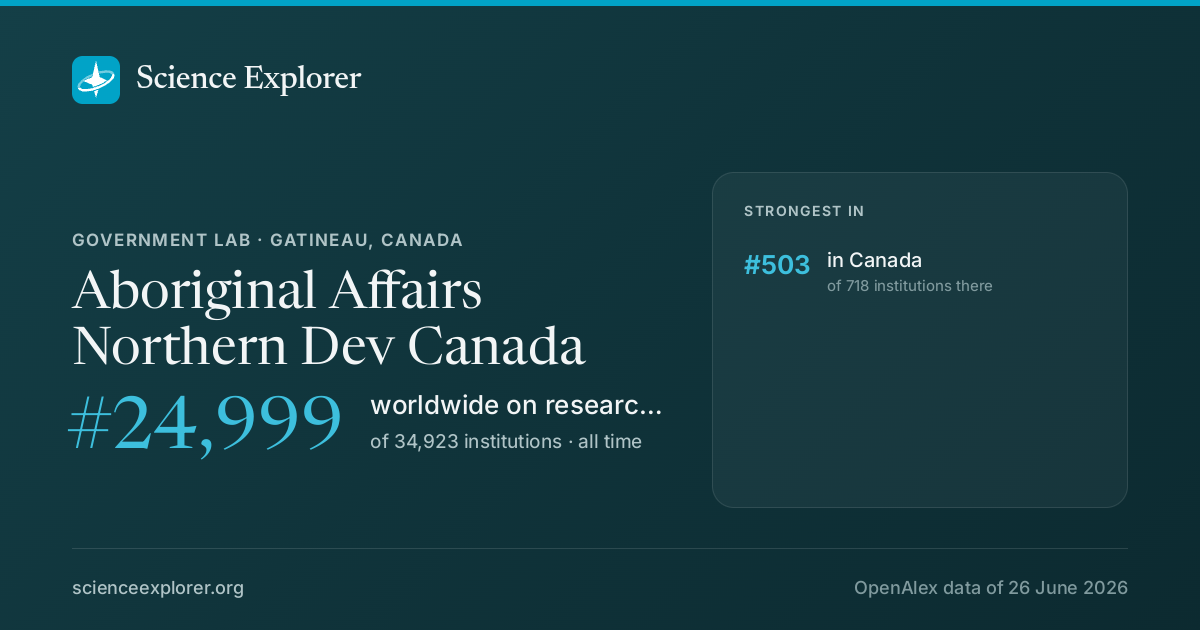
Government institution · Gatineau · Canada

Aboriginal Affairs Northern Dev Canada

World rank, all time
#24,999
of 34,923
Rank in Canada
#503
of 718
Research works
229
▲ 11% vs 2018-21
Citations
4.5k
19.6 per fractional work
Top-10% rate
10.3%
all institutions 10.0%
vs its own fields
1.01×
1.00× is exactly expected
Open access
33%
world 40%
International
11%
world 18%

Which fields of science does Aboriginal Affairs Northern Dev Canada work in?

In all years, 43% of research at Aboriginal Affairs Northern Dev Canada is in Physical Sciences, 38% in Social Sciences. Its largest fields are Social Sciences (26%), Environmental Science (20%), Earth and Planetary Sciences (13%). It does 1.7× the world's share of Social Sciences.

Physical Sciences: 99 fractional works · 43.4% of its workEnvironmental Science: 45 fractional works · 19.6% of its workEcology: 14 fractional works · 5.9% of its workHealth, Toxicology and Mutagenesis: 8 fractional works · 3.4% of its workGlobal and Planetary Change: 6 fractional works · 2.6% of its workManagement, Monitoring, Policy and Law: 4 fractional works · 1.6% of its workEnvironmental Chemistry: 4 fractional works · 1.6% of its workPollution: 3 fractional works · 1.2% of its workNature and Landscape Conservation: 3 fractional works · 1.2% of its workWater Science and Technology: 2 fractional works · 0.7% of its workEnvironmental Engineering: 1 fractional works · 0.6% of its workEcological Modeling: 1 fractional works · 0.5% of its workIndustrial and Manufacturing Engineering: 0 fractional works · 0.2% of its workEarth and Planetary Sciences: 30 fractional works · 13.2% of its workAtmospheric Science: 18 fractional works · 7.8% of its workGeology: 4 fractional works · 1.7% of its workGeophysics: 3 fractional works · 1.3% of its workGeochemistry and Petrology: 2 fractional works · 0.8% of its workOceanography: 2 fractional works · 0.8% of its workEarth-Surface Processes: 1 fractional works · 0.4% of its workPaleontology: 1 fractional works · 0.3% of its workComputer Science: 9 fractional works · 3.9% of its workArtificial Intelligence: 6 fractional works · 2.4% of its workInformation Systems: 1 fractional works · 0.6% of its workComputer Science Applications: 1 fractional works · 0.5% of its workComputer Vision and Pattern Recognition: 0 fractional works · 0.2% of its workSmaller subfields together: 0 fractional works · 0.2% of its workEngineering: 9 fractional works · 3.9% of its workBuilding and Construction: 2 fractional works · 1.0% of its workControl and Systems Engineering: 1 fractional works · 0.5% of its workElectrical and Electronic Engineering: 1 fractional works · 0.4% of its workMechanics of Materials: 1 fractional works · 0.4% of its workCivil and Structural Engineering: 1 fractional works · 0.4% of its workMedia Technology: 1 fractional works · 0.4% of its workOcean Engineering: 1 fractional works · 0.3% of its workMechanical Engineering: 0 fractional works · 0.2% of its workSmaller subfields together: 1 fractional works · 0.2% of its workMathematics: 4 fractional works · 1.5% of its workStatistics and Probability: 4 fractional works · 1.5% of its workPhysics and Astronomy: 2 fractional works · 0.9% of its workAstronomy and Astrophysics: 2 fractional works · 0.7% of its workSmaller subfields together: 0 fractional works · 0.2% of its workEnergy: 0 fractional works · 0.2% of its workFuel Technology: 0 fractional works · 0.2% of its workMaterials Science: 0 fractional works · 0.1% of its workChemistry: 0 fractional works · 0.0% of its workSocial Sciences: 86 fractional works · 37.6% of its workSocial Sciences: 60 fractional works · 26.4% of its workSociology and Political Science: 27 fractional works · 11.6% of its workPolitical Science and International Relations: 9 fractional works · 3.9% of its workHealth: 6 fractional works · 2.7% of its workEducation: 4 fractional works · 1.9% of its workAnthropology: 3 fractional works · 1.3% of its workCultural Studies: 2 fractional works · 1.0% of its workLaw: 2 fractional works · 0.7% of its workGender Studies: 2 fractional works · 0.7% of its workDemography: 1 fractional works · 0.6% of its workDevelopment: 1 fractional works · 0.6% of its workUrban Studies: 1 fractional works · 0.4% of its workPublic Administration: 1 fractional works · 0.4% of its workGeography, Planning and Development: 1 fractional works · 0.3% of its workSmaller subfields together: 1 fractional works · 0.3% of its workArts and Humanities: 11 fractional works · 4.8% of its workArcheology: 3 fractional works · 1.2% of its workHistory and Philosophy of Science: 3 fractional works · 1.1% of its workHistory: 2 fractional works · 0.8% of its workPhilosophy: 2 fractional works · 0.7% of its workLiterature and Literary Theory: 1 fractional works · 0.3% of its workReligious studies: 1 fractional works · 0.3% of its workSmaller subfields together: 1 fractional works · 0.4% of its workEconomics, Econometrics and Finance: 4 fractional works · 1.9% of its workEconomics and Econometrics: 4 fractional works · 1.8% of its workSmaller subfields together: 0 fractional works · 0.1% of its workDecision Sciences: 4 fractional works · 1.7% of its workManagement Science and Operations Research: 3 fractional works · 1.4% of its workSmaller subfields together: 1 fractional works · 0.3% of its workBusiness, Management and Accounting: 3 fractional works · 1.4% of its workOrganizational Behavior and Human Resource Management: 2 fractional works · 0.8% of its workStrategy and Management: 1 fractional works · 0.3% of its workSmaller subfields together: 1 fractional works · 0.3% of its workPsychology: 3 fractional works · 1.4% of its workSocial Psychology: 1 fractional works · 0.5% of its workDevelopmental and Educational Psychology: 1 fractional works · 0.4% of its workClinical Psychology: 1 fractional works · 0.2% of its workApplied Psychology: 0 fractional works · 0.2% of its workSmaller subfields together: 0 fractional works · 0.0% of its workHealth Sciences: 23 fractional works · 10.0% of its workHealth Professions: 16 fractional works · 6.9% of its workGeneral Health Professions: 14 fractional works · 6.0% of its workOccupational Therapy: 1 fractional works · 0.2% of its workMedical Laboratory Technology: 0 fractional works · 0.2% of its workSmaller subfields together: 1 fractional works · 0.4% of its workMedicine: 7 fractional works · 2.9% of its workEmergency Medicine: 1 fractional works · 0.5% of its workPublic Health, Environmental and Occupational Health: 1 fractional works · 0.4% of its workPediatrics, Perinatology and Child Health: 1 fractional works · 0.4% of its workReproductive Medicine: 1 fractional works · 0.4% of its workPathology and Forensic Medicine: 0 fractional works · 0.2% of its workSmaller subfields together: 2 fractional works · 1.1% of its workNursing: 0 fractional works · 0.2% of its workLife Sciences: 21 fractional works · 9.0% of its workAgricultural and Biological Sciences: 16 fractional works · 7.1% of its workPlant Science: 5 fractional works · 2.1% of its workEcology, Evolution, Behavior and Systematics: 4 fractional works · 1.6% of its workAgronomy and Crop Science: 3 fractional works · 1.1% of its workSoil Science: 1 fractional works · 0.6% of its workInsect Science: 1 fractional works · 0.4% of its workAquatic Science: 1 fractional works · 0.4% of its workGeneral Agricultural and Biological Sciences: 1 fractional works · 0.4% of its workFood Science: 1 fractional works · 0.3% of its workSmaller subfields together: 1 fractional works · 0.3% of its workBiochemistry, Genetics and Molecular Biology: 3 fractional works · 1.3% of its workGenetics: 1 fractional works · 0.4% of its workBiochemistry: 1 fractional works · 0.3% of its workMolecular Biology: 1 fractional works · 0.3% of its workSmaller subfields together: 1 fractional works · 0.3% of its workImmunology and Microbiology: 1 fractional works · 0.3% of its workNeuroscience: 1 fractional works · 0.2% of its workCognitive Neuroscience: 0 fractional works · 0.2% of its workSmaller subfields together: 0 fractional works · 0.0% of its workALL ITS WORKAboriginalAffairs Northern…229fractional works, all years
Life Sciences9%Physical Sciences43%Health Sciences10%Social Sciences38%

Each ring splits the one inside it: the four domains of science, their fields, their subfields. Size is fractional works in all years. Every slice is a page; the interactive view zooms down to single topics and colours each by how much more of it this institution does than the world.

Its 4 domains and 23 fields, with their numbers
    1. Environmental Science4519.6%
    2. Earth and Planetary Sciences3013.2%
    3. Computer Science93.9%
    4. Engineering93.9%
    5. Mathematics41.5%
    6. Physics and Astronomy20.9%
    7. Energy00.2%
    8. Materials Science00.1%
    9. Chemistry00.0%
    1. Social Sciences6026.4%
    2. Arts and Humanities114.8%
    3. Economics, Econometrics and Finance41.9%
    4. Decision Sciences41.7%
    5. Business, Management and Accounting31.4%
    6. Psychology31.4%
    1. Health Professions166.9%
    2. Medicine72.9%
    3. Nursing00.2%
    4. Dentistry00.0%
    1. Agricultural and Biological Sciences167.1%
    2. Biochemistry, Genetics and Molecular Biology31.3%
    3. Immunology and Microbiology10.3%
    4. Neuroscience10.2%
All of science, and how each field's share has moved since 1950: the Science domain explorer

Field profile

Location quotient across every field it publishes in: outside the ring is more than an institution of this size would be expected to publish, inside it is less.

Agricultural and Biological Sciences: 1.24× its world share, 1 worksAgricultural and Bio…Biochemistry, Genetics and Molecular Biology: 0.15× its world share, 0 worksBiochemistry, Geneti…Neuroscience: 0.81× its world share, 0 worksNeuroscienceComputer Science: 1.35× its world share, 2 worksComputer ScienceEarth and Planetary Sciences: 1.77× its world share, 0 worksEarth and Planetary …Engineering: 0.07× its world share, 0 worksEngineeringEnvironmental Science: 2.84× its world share, 2 worksEnvironmental SciencePhysics and Astronomy: 0.69× its world share, 0 worksPhysics and AstronomyDentistry: 0.47× its world share, 0 worksDentistryHealth Professions: 4.87× its world share, 2 worksHealth ProfessionsMedicine: 0.16× its world share, 0 worksMedicineNursing: 1.04× its world share, 0 worksNursingArts and Humanities: 1.59× its world share, 1 worksArts and HumanitiesBusiness, Management and Accounting: 0.95× its world share, 0 worksBusiness, Management…Decision Sciences: 0.30× its world share, 0 worksDecision SciencesEconomics, Econometrics and Finance: 3.34× its world share, 1 worksEconomics, Econometr…Psychology: 0.77× its world share, 0 worksPsychologySocial Sciences: 2.21× its world share, 5 worksSocial Sciences1×world share
more than its size predictsabout as predictedless

Rings at 0.5×, 1× and 2×. Widest outward: Health Professions, 4.9×. Every wedge is a field page.

All 18 fields, with their numbers
  1. Health Professions4.87×2 works
  2. Economics, Econometrics and Finance3.34×1 works
  3. Environmental Science2.84×2 works
  4. Social Sciences2.21×5 works
  5. Earth and Planetary Sciences1.77×0 works
  6. Arts and Humanities1.59×1 works
  7. Computer Science1.35×2 works
  8. Agricultural and Biological Sciences1.24×1 works
  9. Nursing1.04×0 works
  10. Business, Management and Accounting0.95×0 works
  11. Neuroscience0.81×0 works
  12. Psychology0.77×0 works
  13. Physics and Astronomy0.69×0 works
  14. Dentistry0.47×0 works
  15. Decision Sciences0.30×0 works
  16. Medicine0.16×0 works
  17. Biochemistry, Genetics and Molecular Biology0.15×0 works
  18. Engineering0.07×0 works

Who are the top researchers at Aboriginal Affairs Northern Dev Canada?

Ranked on the quality score, Éric Guimond, David Milburn and Wilfred Whiteley lead among researchers whose main affiliation is Aboriginal Affairs Northern Dev Canada.

  1. 1 Éric Guimond Canada · #1,313,960 worldwide 1.1k citations · 49 works
  2. 2 David Milburn Canada · #2,365,937 worldwide 607 citations · 16 works
  3. 3 Wilfred Whiteley Canada · #2,543,860 worldwide 379 citations · 42 works
  4. 4 Jason P. Stow Canada · #2,846,724 worldwide 453 citations · 17 works
  5. 5 Sacha Senécal Canada · #3,709,024 worldwide 299 citations · 21 works
  6. 6 Alan R. Winberg Canada · #3,872,807 worldwide 27 citations · 25 works
  7. 7 Mary C. Hyde Canada · #4,069,294 worldwide 47 citations · 25 works
  8. 8 Graham W. Rowley Canada · #4,092,422 worldwide 102 citations · 45 works
  9. 9 L. P. E. Choquette Canada · #5,328,195 worldwide 406 citations · 55 works
All ranked researchers at Aboriginal Affairs Northern Dev Canada

What are the most cited papers from Aboriginal Affairs Northern Dev Canada?

The most cited paper from Aboriginal Affairs Northern Dev Canada is "Seasonal and Annual Fluxes of Nutrients and Organic Matter from Large Rivers to the Arctic Ocean and Surrounding Seas" (R. M. Holmes, James W. McClelland, Bruce J. Peterson et al., 2011), with 739 citations. Next come "Tectonic accretion and the origin of the two major metamorphic and plutonic welts in the Canadian Cordillera" (733) and "Arctic contaminants: sources, occurrence and pathways" (653).

Most cited papers
#PaperReleasedCitations
1 Seasonal and Annual Fluxes of Nutrients and Organic Matter from Large Rivers to the Arctic Ocean and Surrounding Seas R. M. Holmes, James W. McClelland, Bruce J. Peterson et al. · Estuaries and Coasts 2 Mar 2011 739
2 Tectonic accretion and the origin of the two major metamorphic and plutonic welts in the Canadian Cordillera J. W. H. Monger, R A Price, D J Tempelman-Kluit · Geology 1982 733
3 Arctic contaminants: sources, occurrence and pathways Len A. Barrie, Dennis J. Gregor, B. T. Hargrave et al. · The Science of The Total Environment Jul 1992 653
4 Global decomposition experiment shows soil animal impacts on decomposition are climate‐dependent Diana H. Wall et al. · Global Change Biology Open access 19 Jun 2008 550
5 Increasing rates of retrogressive thaw slump activity in the Mackenzie Delta region, N.W.T., Canada Trevor C. Lantz, Steven V. Kokelj · Geophysical Research Letters Mar 2008 358
All 60 most cited papers, with filters and sorting

Which keywords describe research at Aboriginal Affairs Northern Dev Canada?

By fractional works in all years, weighted toward what it does more of than the world: Climate Change, Arctic, Remote Sensing, Nationalism, Hydrology, History, Permafrost and Traditional Knowledge.

▲ more of its work than of the world's◆ about the world's share▼ less than the world's

Size is fractional works in all years in the topics tagged with each word; colour is the word's share of this institution's work against its share of the world's. The 40 words are chosen for being large and distinctive. Each links to the topic it comes from most.

All 40 words, with their numbers
  1. Climate Change54▲ 8.9×44 topics
  2. Arctic18▲ 74×4 topics
  3. Remote Sensing14▲ 5.4×12 topics
  4. History12▲ 6.5×7 topics
  5. Nationalism11▲ 8.6×6 topics
  6. Hydrology11▲ 42×3 topics
  7. Biodiversity11▲ 6.2×13 topics
  8. Permafrost10▲ 105×2 topics
  9. Traditional Knowledge10▲ 105×2 topics
  10. Identity10▲ 5.6×13 topics
  11. Ecological Knowledge10▲ 94×2 topics
  12. Nutrition Transition9▲ 138×2 topics
  13. Vulnerability9▲ 26×4 topics
  14. Food Security9▲ 10×2 topics
  15. Arctic Indigenous Peoples9▲ 204×1 topic
  16. community-based monitoring9▲ 204×1 topic
  17. Sustainable Development8▲ 3.2×12 topics
  18. Colonialism8▲ 7.2×13 topics
  19. Invasive Species8▲ 6.2×13 topics
  20. Water Quality8▲ 8.2×10 topics
  21. Governance8▲ 11×4 topics
  22. Methane Emissions7▲ 61×2 topics
  23. Religion7▲ 5.4×7 topics
  24. Bioaccumulation7▲ 25×3 topics
  25. Carbon Feedback7▲ 93×1 topic
  26. Thawing7▲ 93×1 topic
  27. Cultural Identity6▲ 6.5×4 topics
  28. Decolonization6▲ 35×2 topics
  29. Health Equity6▲ 15×3 topics
  30. Settler Colonialism6▲ 65×2 topics
  31. International Relations6▲ 13×3 topics
  32. Immigration6▲ 22×3 topics
  33. Tectonics6▲ 15×3 topics
  34. Geopolitics6▲ 22×2 topics
  35. Northern Sea Route6▲ 122×1 topic
  36. Shipping6▲ 72×1 topic
  37. Social Policy6▲ 18×2 topics
  38. Language5▲ 10×2 topics
  39. Historical Trauma5▲ 191×1 topic
  40. Indigenous Health5▲ 191×1 topic

Which research topics does Aboriginal Affairs Northern Dev Canada publish most on?

By volume in 2022-now: Health and Medical Studies, Indigenous Health, Education, and Rights, Archaeology and Natural History and Sustainability and Climate Change Governance.

  1. 1 Health and Medical Studies General Health Professions 1 works
  2. 2 Indigenous Health, Education, and Rights Health 1 works
  3. 3 Archaeology and Natural History Anthropology 1 works
  4. 4 Sustainability and Climate Change Governance Global and Planetary Change 1 works
  5. 5 Indigenous Studies and Ecology General Health Professions 1 works
  6. 6 Economic and Financial Impacts of Cancer Economics and Econometrics 0 works
  7. 7 Historical Studies and Socio-cultural Analysis History and Philosophy of Science 0 works
  8. 8 Financial Literacy, Pension, Retirement Analysis Accounting 0 works
  9. 9 Vietnamese History and Culture Studies Sociology and Political Science 0 works
  10. 10 Coastal and Marine Management Management, Monitoring, Policy and Law 0 works

How open and international is its research?

Against the world's own shares: the tick on each track. Both are shares of its output, so they sit on one scale and can be read against each other as well as against the world.

openly available33.3%not open66.7%

World: 40% of research is openly available.

with international co-authors10.9%domestic only89.1%

World: 18% is written across borders.

How has Aboriginal Affairs Northern Dev Canada's research output changed?

Output in 2022-2025 was 11% higher than in 2018-2021.

still counting1990200020102020
grewheldshrank

The same series as a ribbon: one cell per year, darker for more. The line above answers how much; this answers when.

Its share of all research

Growing output can still be a shrinking share: all of science grows. This is Aboriginal Affairs Northern Dev Canada as a percentage of every work published that year, 0.000084% in 2024.

still counting0.0020%0.0040%0.0060%Aboriginal Affairs Northern Dev Canada0.000077% in 202519801990200020102020

Fractional works of Aboriginal Affairs Northern Dev Canada over all fractional works that year. How the balance of science has shifted.

Other research institutions in Gatineau

All research institutions in Gatineau

Share Aboriginal Affairs Northern Dev Canada's ranking

Aboriginal Affairs Northern Dev Canada on Science Explorer

A card with Aboriginal Affairs Northern Dev Canada's standing and the fields it leads in, for a post or a slide. A link to this page previews as the same card.

Download the card

1200 × 630 PNG, sized for social posts, drawn from the latest snapshot.

Badges for a website1Each links back here and updates with every snapshot

Research measures only: rankings here say nothing about teaching, admissions or student experience. Comparable institutions and collaboration partners have tabs of their own, above.

Discussion

Ask a question or share a note about Aboriginal Affairs Northern Dev Canada. Posts are plain text and can be reported.

