Acentech (United States)
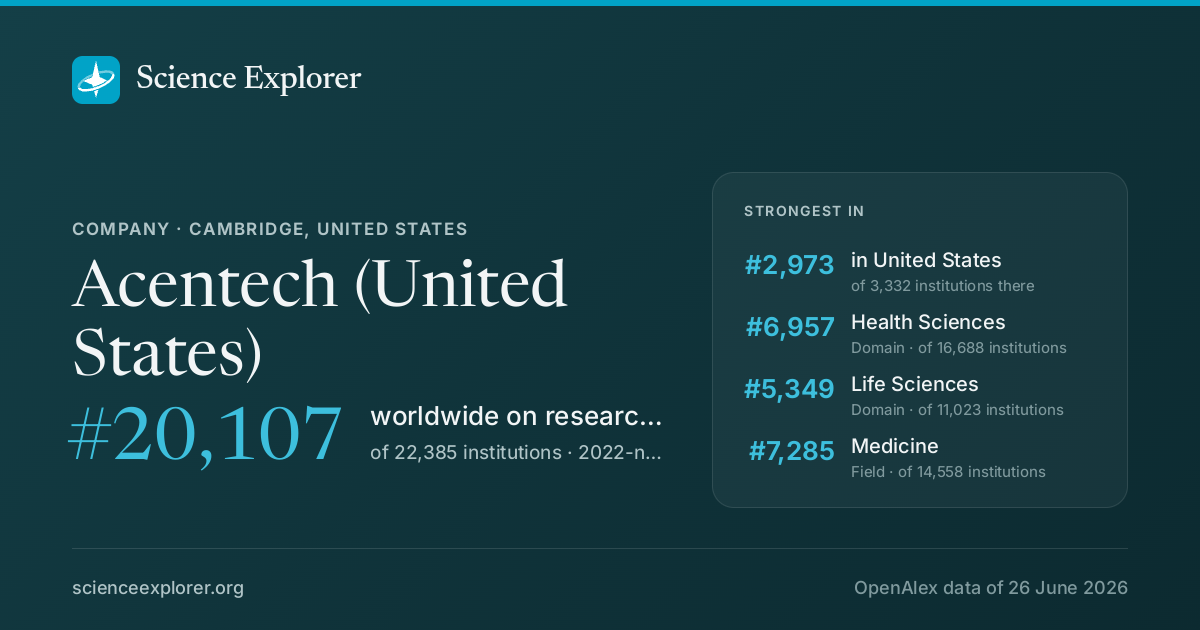
In research, Acentech (United States) stands highest in Health Sciences (#6,957 of 16,688 worldwide), Life Sciences (#5,349 of 11,023 worldwide) and Medicine (#7,285 of 14,558 worldwide), over all time.
- World rank, 2022-now
- #20,107 of 22,385 · #10,901 all time
- Rank in United States
- #2,973 of 3,332
- Research works
- 465 ▲ 50% vs 2018-21
- Citations
- 28k 61.1 per fractional work
- Top-10% rate
- 6.9% all institutions 10.0%
- vs its own fields
- 0.96× 1.00× is exactly expected
- Open access
- 26% world 40%
- International
- 18% world 18%
What is Acentech (United States) known for in research?
The fields where it stands highest, over all time, ranked among every institution above the floor in each field.
| Field | World rank | Where that sits | Top-10% rate | Works |
|---|---|---|---|---|
| Health SciencesDomain | #6,957 of 16,688 | 23.3% | 166 | |
| Life SciencesDomain | #5,349 of 11,023 | 24.2% | 133 | |
| MedicineField | #7,285 of 14,558 | 27.1% | 124 | |
| Physical SciencesDomain | #13,972 of 17,446 | 10.4% | 129 |
Each strip is that field's whole ranked pool, with the notch where Acentech (United States) sits in it, in the colour of the band that rank falls in. The track under the rate is the rate itself: it carries no average mark, because the average differs by field (from about 6% in Dentistry to 21% in Economics).
Which fields of science does Acentech (United States) work in?
In 2022-now, 37% of research at Acentech (United States) is in Physical Sciences, 36% in Health Sciences. Its largest fields are Engineering (26%), Medicine (22%), Health Professions (14%). It does 1.5× the world's share of Health Sciences.
Each ring splits the one inside it: the four domains of science, their fields, their subfields. Size is fractional works in 2022-now. Every slice is a page; the interactive view zooms down to single topics and colours each by how much more of it this institution does than the world.
Its 4 domains and 21 fields, with their numbers
- Physical Sciences2737.3%
- Engineering1925.7%
- Computer Science56.5%
- Earth and Planetary Sciences11.9%
- Environmental Science11.2%
- Mathematics11.1%
- Materials Science00.5%
- Physics and Astronomy00.5%
- Health Sciences2635.6%
- Medicine1621.9%
- Health Professions1013.5%
- Nursing00.2%
- Veterinary00.0%
- Life Sciences1317.3%
- Social Sciences79.7%
- Social Sciences33.5%
- Decision Sciences22.2%
- Psychology11.8%
- Arts and Humanities11.4%
- Economics, Econometrics and Finance10.8%
Field profile
Location quotient across every field it publishes in: outside the ring is more than an institution of this size would be expected to publish, inside it is less.
Rings at 0.5×, 1× and 2×. Widest outward: Health Professions, 5.1×. Every wedge is a field page.
All 21 fields, with their numbers
- Health Professions5.14×10 works
- Immunology and Microbiology2.48×2 works
- Neuroscience2.38×3 works
- Decision Sciences2.31×2 works
- Biochemistry, Genetics and Molecular Biology2.00×8 works
- Engineering1.71×19 works
- Earth and Planetary Sciences1.22×1 works
- Medicine1.14×16 works
- Mathematics0.95×1 works
- Computer Science0.83×5 works
- Psychology0.60×1 works
- Arts and Humanities0.49×1 works
- Pharmacology, Toxicology and Pharmaceutics0.48×0 works
- Economics, Econometrics and Finance0.37×1 works
- Nursing0.31×0 works
- Social Sciences0.27×2 works
- Environmental Science0.24×1 works
- Veterinary0.23×0 works
- Physics and Astronomy0.21×0 works
- Materials Science0.13×0 works
- Agricultural and Biological Sciences0.03×0 works
- Health Professions 5.1×
- Immunology and Microbiology 2.5×
- Neuroscience 2.4×
- Decision Sciences 2.3×
- Biochemistry, Genetics and Molecular Biology 2.0×
- Engineering 1.7×
- Earth and Planetary Sciences 1.2×
- Medicine 1.1×
- Mathematics 0.9×
- Computer Science 0.8×
- Psychology 0.6×
- Arts and Humanities 0.5×
- Pharmacology, Toxicology and Pharmaceutics 0.5×
- Economics, Econometrics and Finance 0.4×
- Nursing 0.3×
- Social Sciences 0.3×
- Environmental Science 0.2×
- Veterinary 0.2×
- Physics and Astronomy 0.2×
- Materials Science 0.1×
- Agricultural and Biological Sciences 0.0×
Who are the top researchers at Acentech (United States)?
Ranked on the quality score, Timothy S. Bringman, James A. Moore and Wyne Lee lead among researchers whose main affiliation is Acentech (United States).
- 1
Timothy S. Bringman
 United States · #512,571 worldwide
7.4k citations · 26 works
- 2
James A. Moore
United States · #1,703,357 worldwide
4.1k citations · 137 works
- 3
Wyne Lee
United States · #1,911,524 worldwide
1.3k citations · 19 works
- 4
Annie K. Ogasawara
United States · #1,924,570 worldwide
1.9k citations · 43 works
- 5
Eric E. Ungar
United States · #2,993,763 worldwide
1.6k citations · 113 works
- 6
Jonah Sacks
United States · #3,030,129 worldwide
148 citations · 21 works
- 7
James D. Barnes
United States · #3,082,478 worldwide
259 citations · 16 works
- 8
Yasuhisa Toyota
United States · #3,350,834 worldwide
25 citations · 75 works
- 9
Benjamin E. Markham
United States · #3,390,135 worldwide
31 citations · 49 works
- 10
Jeffrey A. Zapfe
United States · #3,776,492 worldwide
391 citations · 38 works
Which keywords describe research at Acentech (United States)?
By fractional works in 2022-now, weighted toward what it does more of than the world: Health Effects, Noise Pollution, Public Health, Dynamic Interaction, Footbridges, Vibration Serviceability, Cognitive Decline and Interactive Evolutionary Computation.
- Phosphorylation
- PET Imaging
- Rituximab
- Tumor Regression
- CAR T Cells
- Vibration-based Damage Identification
- Neurological Disorders
- Facilities Management
- Risk Management
- Cell Cycle Control
- Phononic Crystals
- Immunotherapy
- Hearing Loss
- Wave Propagation
- Quality of Life
- Interactive Evolutionary Computation
- Vibration Serviceability
- Artificial Intelligence
- Machine Learning
- Noise Pollution
- Health Effects
- Public Health
- Dynamic Interaction
- Footbridges
- Cognitive Decline
- Music Generation
- Vibration Control
- Cochlear Implants
- Lymphoma
- Acoustic Metamaterials
- Cancer Immunotherapy
- Nonlinear Dynamics
- Breast Cancer
- High-Speed Trains
- Prognostic Factors
- Wireless Sensors
- Chimeric Antigen Receptor
- Dynamic Response
- Gene Therapy
- Aerodynamics
Size is fractional works in 2022-now in the topics tagged with each word; colour is the word's share of this institution's work against its share of the world's. The 40 words are chosen for being large and distinctive. Each links to the topic it comes from most.
All 40 words, with their numbers
- Health Effects8▲ 18×1 topic
- Noise Pollution8▲ 259×1 topic
- Public Health8▲ 7.6×3 topics
- Machine Learning5▲ 2.2×7 topics
- Dynamic Interaction4▲ 78×2 topics
- Artificial Intelligence3▲ 3.2×2 topics
- Footbridges3▲ 129×1 topic
- Vibration Serviceability3▲ 129×1 topic
- Cognitive Decline3▲ 36×2 topics
- Interactive Evolutionary Computation3▲ 201×1 topic
- Music Generation3▲ 201×1 topic
- Quality of Life3▲ 2.7×5 topics
- Vibration Control2▲ 51×2 topics
- Wave Propagation2▲ 30×2 topics
- Cochlear Implants2▲ 88×1 topic
- Hearing Loss2▲ 27×1 topic
- Lymphoma2▲ 20×2 topics
- Immunotherapy2▲ 4.2×9 topics
- Acoustic Metamaterials2▲ 79×1 topic
- Phononic Crystals2▲ 79×1 topic
- Cancer Immunotherapy2▲ 17×3 topics
- Cell Cycle Control2▲ 71×2 topics
- Nonlinear Dynamics2▲ 11×2 topics
- Risk Management2▲ 5.3×2 topics
- Breast Cancer2▲ 8.4×5 topics
- Facilities Management2▲ 27×2 topics
- High-Speed Trains2▲ 31×3 topics
- Neurological Disorders2▲ 3.7×7 topics
- Prognostic Factors2▲ 4.7×8 topics
- Vibration-based Damage Identification2▲ 32×1 topic
- Wireless Sensors2▲ 32×1 topic
- CAR T Cells1▲ 26×1 topic
- Chimeric Antigen Receptor1▲ 26×1 topic
- Tumor Regression1▲ 18×2 topics
- Dynamic Response1▲ 38×2 topics
- Rituximab1▲ 13×3 topics
- Gene Therapy1▲ 8.9×5 topics
- PET Imaging1▲ 9.7×3 topics
- Aerodynamics1▲ 21×1 topic
- Phosphorylation1▲ 61×2 topics
Which research topics does Acentech (United States) publish most on?
By volume in 2022-now: Noise Effects and Management, Structural Engineering and Vibration Analysis, Music Technology and Sound Studies and Hearing Loss and Rehabilitation.
Area is fractional works; colour is the subfield each topic belongs to.
- 1 Noise Effects and Management Speech and Hearing 8 works
- 2 Structural Engineering and Vibration Analysis Civil and Structural Engineering 3 works
- 3 Music Technology and Sound Studies Computer Vision and Pattern Recognition 3 works
- 4 Hearing Loss and Rehabilitation Cognitive Neuroscience 2 works
- 5 Acoustic Wave Phenomena Research Biomedical Engineering 2 works
- 6 Structural Health Monitoring Techniques Civil and Structural Engineering 2 works
- 7 CAR-T cell therapy research Oncology 1 works
- 8 Aerodynamics and Fluid Dynamics Research Aerospace Engineering 1 works
- 9 Cultural Industries and Urban Development Urban Studies 1 works
- 10 European Union Policy and Governance Political Science and International Relations 1 works
How open and international is its research?
Against the world's own shares: the tick on each track. Both are shares of its output, so they sit on one scale and can be read against each other as well as against the world.
World: 40% of research is openly available.
World: 18% is written across borders.
How has Acentech (United States)'s research output changed?
Output in 2022-2025 was 50% higher than in 2018-2021.
The same series as a ribbon: one cell per year, darker for more. The line above answers how much; this answers when.
Its share of all research
Growing output can still be a shrinking share: all of science grows. This is Acentech (United States) as a percentage of every work published that year, 0.00024% in 2024.
Fractional works of Acentech (United States) over all fractional works that year. How the balance of science has shifted.
Other research institutions in Cambridge
- Harvard University
- Massachusetts Institute of Technology
- National Bureau of Economic Research
- World Wide Web Consortium
- Biogen (United States)
- Draper Laboratory
- Cambridge Health Alliance
- Harvard Global Health Institute




Share Acentech (United States)'s ranking
Badges for a website1Each links back here and updates with every snapshot

Research measures only: rankings here say nothing about teaching, admissions or student experience. Comparable institutions and collaboration partners have tabs of their own, above.
Discussion
Ask a question or share a note about Acentech (United States). Posts are plain text and can be reported.